
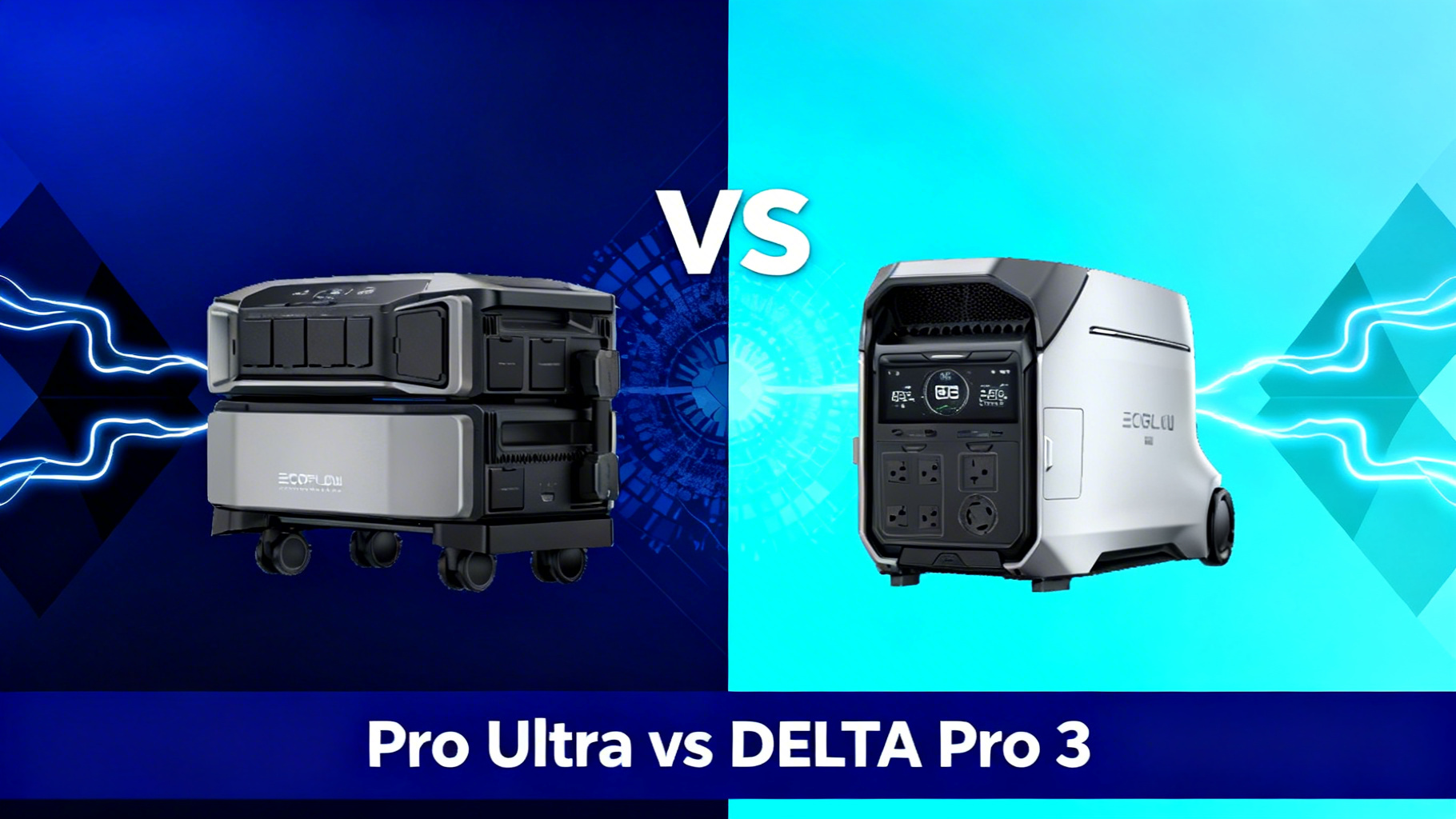
Two Systems, One Decision
EcoFlow now offers two credible paths to whole-home backup power: the DELTA Pro 3 at $1,999 and the DELTA Pro Ultra at $4,099. Both deliver 120V and 240V output. Both use LFP chemistry. Both are UL9540 certified. So which one belongs in your home?
The answer depends on your home size, your outage scenarios, and how much output headroom you actually need. This guide focuses specifically on EcoFlow’s lineup. For a broader look at whole home battery backup systems across all brands, that resource covers more ground.
By the end of this guide, you’ll have a clear answer based on your specific situation, not a generic recommendation.


Best Value
EcoFlow DELTA Pro 3
4kWh base, expandable to 48kWh
$1,999 $3,699
Whole-Home System
EcoFlow DELTA Pro Ultra
6kWh base, expandable to 90kWh
$4,099 $6,098
How EcoFlow Whole-Home Backup Works
EcoFlow’s whole-home backup approach differs from a traditional standby generator. Instead of a permanent installation with a transfer switch, you’re working with a high-capacity power station connected to your home’s electrical panel via the Smart Home Panel 2 (SHP2).
When grid power fails, the SHP2 detects the outage and switches your protected circuits to battery power in under 20 milliseconds. That’s fast enough that most electronics, including computers and CPAP machines, never notice the transition. Without the SHP2, you’d connect appliances directly to the power station’s output ports during an outage.
Both the DELTA Pro 3 and DELTA Pro Ultra carry UL9540 certification, which qualifies them for residential installation. The DELTA Pro Ultra adds UL1973, the higher standard typically required by insurance underwriters for permanent home energy storage systems. For most homeowners, UL9540 is sufficient. If your insurer or local code requires UL1973, the choice is made for you.
Get the 1-page outage plan
What to plug in first, how long a fridge really runs on a battery, and the 3 safety rules for connecting a power station to your home. Printable, sent by email.
About one email a week. Unsubscribe in one click. We may earn a commission when you buy through our links, at no extra cost to you. Privacy Policy
Head-to-Head: Specs That Matter
Before getting into use cases, the raw specs tell a clear story. These two systems are not simply “big” and “bigger” versions of the same product. They target different power requirements.
The DELTA Pro 3 is a single portable unit delivering 4,000W continuous output with a 6,000W surge via X-Boost technology. The DELTA Pro Ultra is a modular inverter-plus-battery system starting at 7,200W from one inverter, scalable to 21,600W with three inverters. That output gap matters when you’re trying to run a central HVAC system simultaneously with a water heater and kitchen appliances.


One spec worth highlighting: the DELTA Pro 3’s 50-minute charge time (0–80%) is exceptional for a 4kWh unit. The DELTA Pro Ultra, with its larger 6kWh base, takes approximately 2.5 hours for the same charge level. If your outages are short and recharging quickly matters, the DP3 has a meaningful edge here.
Check EcoFlow’s official DELTA Pro Ultra page and EcoFlow’s official DELTA Pro 3 page for the complete specification sheets.
The Role of Smart Home Panel 2
Neither system delivers true whole-home backup out of the box. The missing component is the EcoFlow Smart Home Panel 2, priced at $1,599 (original $1,899). It replaces your existing breaker panel and connects directly to both systems.
With the SHP2 installed, your selected circuits switch automatically to battery power within 20ms of a grid failure. That’s transparent to your devices. Without it, you’re manually running extension cords to the power station’s outlets during an outage, which limits how many circuits you can protect and requires you to be home when the power goes out.
For a full breakdown of installation and compatibility, the ecoflow smart home panel 2 setup guide covers every step in detail. Both the DELTA Pro 3 and DELTA Pro Ultra are SHP2-compatible, so this add-on cost applies equally to either choice.
💡 Pro Tip: Budget the SHP2 into your total system cost from the start. The complete DELTA Pro 3 setup (unit + SHP2) comes to approximately $3,598. The complete DELTA Pro Ultra setup comes to approximately $5,698. That’s the true apples-to-apples comparison.
Who Should Choose the DELTA Pro 3
The DELTA Pro 3 makes sense for homes where 4,000W continuous output covers your critical loads. For most households under 2,000 sq ft, that’s enough to run a refrigerator, lighting, phone charging, a router, and most window AC units simultaneously.
The 240V output from a single unit is a genuine advantage here. Spec analysis confirms the DP3 can handle most central AC compressors in the 2–3 ton range (2,000–3,500W) via X-Boost surge capacity. Budget-conscious buyers also benefit from the $1,999 starting price and the option to add capacity incrementally rather than all at once.

Portability is a real secondary benefit. The DELTA Pro 3 moves on wheels, which means it can serve as a camping or RV unit when it’s not needed for home backup. The DELTA Pro Ultra is a fixed system by design. For smaller homes or apartments, ecoflow home backup options start at a much lower price point with the DELTA 2.
Who Should Choose the DELTA Pro Ultra
The DELTA Pro Ultra is built for scenarios where 4,000W isn’t enough. The entry configuration delivers 7,200W continuous from one inverter. A two-inverter setup hits 14,400W. That’s sufficient to run central AC, an electric water heater, a washer/dryer, and EV charging simultaneously, which is genuinely whole-home operation.
Analysis of published output figures confirms the DELTA Pro Ultra is the only portable system that can sustain loads typically served by a whole-house generator (7–15kW range) without a permanent installation. For homes above 2,500 sq ft with central HVAC, this output headroom isn’t theoretical: it’s necessary. Owners of 2,000+ sq ft homes will find more context in the roundup of best power stations for large homes that compares EcoFlow against other brands.

The dual UL certification (UL1973 + UL9540) also matters if your insurance carrier requires documentation for a home energy storage system. The DELTA Pro Ultra is the only portable power station carrying both certifications, which can influence homeowner policy terms in some states.
Planning long-term home resilience?
The DELTA Pro Ultra’s 90kWh ceiling and UL1973 status make it the system to evaluate for multi-day outage planning.
Expandability: How Far Can Each System Grow?
Both systems support significant battery expansion, but they operate on different architectures. The DELTA Pro 3 adds external batteries to reach up to 48kWh. The DELTA Pro Ultra supports up to 15kWh per inverter, and with three inverters daisy-chained, that ceiling reaches 90kWh.
In practical terms: a DELTA Pro 3 expanded to 48kWh could cover average US home consumption (roughly 30 kWh/day) for about 36–40 hours of essentials-only operation. A DELTA Pro Ultra at 90kWh extends that to 2–3 days of full-home operation, or significantly longer in essentials-only mode.

Capacity Expansion: What Each System Can Reach
DELTA Pro 3
Base unit
4 kWh
+ 1 Extra Battery
8 kWh
+ Multiple batteries
Up to 48 kWh
Approx. 7–20 days backup (avg home)
DELTA Pro Ultra
Base (1 inv + 1 bat)
6 kWh
+ Extra batteries
Up to 15 kWh per inv
2 × Inverters max
Up to 90 kWh
Approx. 10–30+ days backup (avg home)

One important cost consideration: expanding capacity on either system requires purchasing additional battery units at several hundred to over a thousand dollars each. If you anticipate needing 20+ kWh eventually, the DELTA Pro Ultra’s architecture may be more cost-effective than buying the DELTA Pro 3 and maxing it out with batteries.
Which System Is Right for Your Home?
The decision comes down to four factors: home size, peak load requirements, outage duration goals, and budget. Here’s how to apply each one.
Home size: Under 2,000 sq ft with a 2-ton central AC or smaller, the DELTA Pro 3’s 4,000W continuous output typically covers your critical circuit loads. Above 2,500 sq ft with a 3-ton or larger HVAC, verified output data points to the DELTA Pro Ultra as the appropriate choice.
Peak loads: Running a central AC, electric dryer, and EV charger simultaneously requires sustained output above 6,000W. The DELTA Pro 3 can’t sustain that. The DELTA Pro Ultra starts at 7,200W and scales from there.
Outage planning: For short, unpredictable outages (2–24 hours), the DELTA Pro 3 covers essential loads with its base 4kWh. For multi-day outages (hurricane season,, winter storm scenarios), the DELTA Pro Ultra’s expandability to 90kWh gives you meaningful runway. Run your specific appliances through the portable power station runtime calculator to get a precise estimate before committing.
Budget: The DELTA Pro 3 + SHP2 combo is approximately $3,598. The DELTA Pro Ultra + SHP2 is approximately $5,698. That’s a $2,100 difference, which is significant. If the DP3’s output specs genuinely cover your loads, paying the premium for the Ultra doesn’t improve your outcome.
Which EcoFlow Whole-Home System Fits You?
Choose DELTA Pro 3 if…
- Your home is under 2,000 sq ft
- Budget is $1,999–$3,500
- You need 240V but want portability
- Fast recharge (50 min) is a priority
- You may expand capacity later with extra batteries
Choose DELTA Pro Ultra if…
- You run a central AC (3-ton or larger)
- Home is 2,500+ sq ft
- Multi-day outages are your scenario
- You need UL-certified insurance-grade reliability
- Whole-home circuit integration via SHP2 is the goal
How does EcoFlow stack up against other brands?
See how the DELTA Pro 3 compares to Bluetti, Jackery, and Anker SOLIX for large-home backup.
Frequently Asked Questions
Can the EcoFlow DELTA Pro 3 power a central air conditioner?
Yes. The DELTA Pro 3 delivers 4,000W continuous output with a 6,000W surge ceiling via X-Boost technology. Analysis of central AC wattage data confirms most residential units in the 2–3 ton range (2,000–3,500W typical draw) fall within the DP3’s surge capacity. Spec analysis shows the system can sustain these loads during normal operation. However, units above 3.5 tons (36,000 BTU) may require the DELTA Pro Ultra’s higher continuous output for sustained operation without throttling. If you’re unsure of your AC’s draw, check the nameplate wattage on the outdoor compressor unit.
Do I need the Smart Home Panel 2 for whole-home backup?
The Smart Home Panel 2 is optional but strongly recommended for a full whole-home backup setup. Without it, you connect appliances directly to the power station’s output ports during an outage. That limits you to the number of outlets available and requires manual reconnection each time the grid goes down. With the SHP2 installed, your protected circuits switch automatically within 20 milliseconds of a grid failure, with no action required on your part. The SHP2 adds $1,599 to the total system cost but substantially changes the practical experience of using either system as a whole-home backup solution.
How many days of backup does the DELTA Pro Ultra provide?
At the base 6kWh configuration, runtime calculations based on average US home consumption (approximately 30 kWh per day) show roughly 5–6 hours of full-home operation. For essentials-only mode covering a refrigerator, lighting, and device charging, efficiency data suggests 24–36 hours of coverage from the base unit. With additional batteries expanded to 90kWh, full-home operation extends to 2–3 days, and essentials-only coverage extends significantly beyond that. The DELTA Pro Ultra’s battery self-heating system also keeps it charging below freezing, within EcoFlow’s rated range of -4°F to 113°F (-20°C to 45°C), which matters for winter outage scenarios where other systems may throttle performance below freezing.
Is the DELTA Pro 3 UL9540 certified for home use?
Yes. The DELTA Pro 3 carries UL9540 certification, which qualifies it for residential installation requirements and satisfies most insurance carriers that require certification documentation for home backup systems. The DELTA Pro Ultra holds both UL9540 and the higher UL1973 certification (battery energy storage systems standard), making it the more appropriate choice in jurisdictions or insurance policies that specify UL1973 compliance. If you’re uncertain which standard your insurer requires, contact them directly before purchasing either system.
What is the difference between the DELTA Pro 3 and DELTA Pro Ultra in terms of output?
The output gap is significant. The DELTA Pro 3 delivers 4,000W continuous output from a single unit, with a 6,000W X-Boost surge ceiling. The DELTA Pro Ultra starts at 7,200W continuous from one inverter and scales to 14,400W with two inverters, and up to 21,600W with three inverters. That range covers whole-home loads that the DP3 cannot sustain, including large central HVAC systems, EV charging, electric water heaters, and full kitchen appliance stacks running simultaneously. Spec-for-spec, the Ultra is the only option in EcoFlow’s lineup capable of replacing a whole-house generator’s output profile in a portable form factor.
EcoFlow DELTA Pro Ultra
$4,099
Best whole-home backup for large homes and central AC
Price verified March 2026. Free shipping available
Related Reads
Originally published: March 31, 2026