
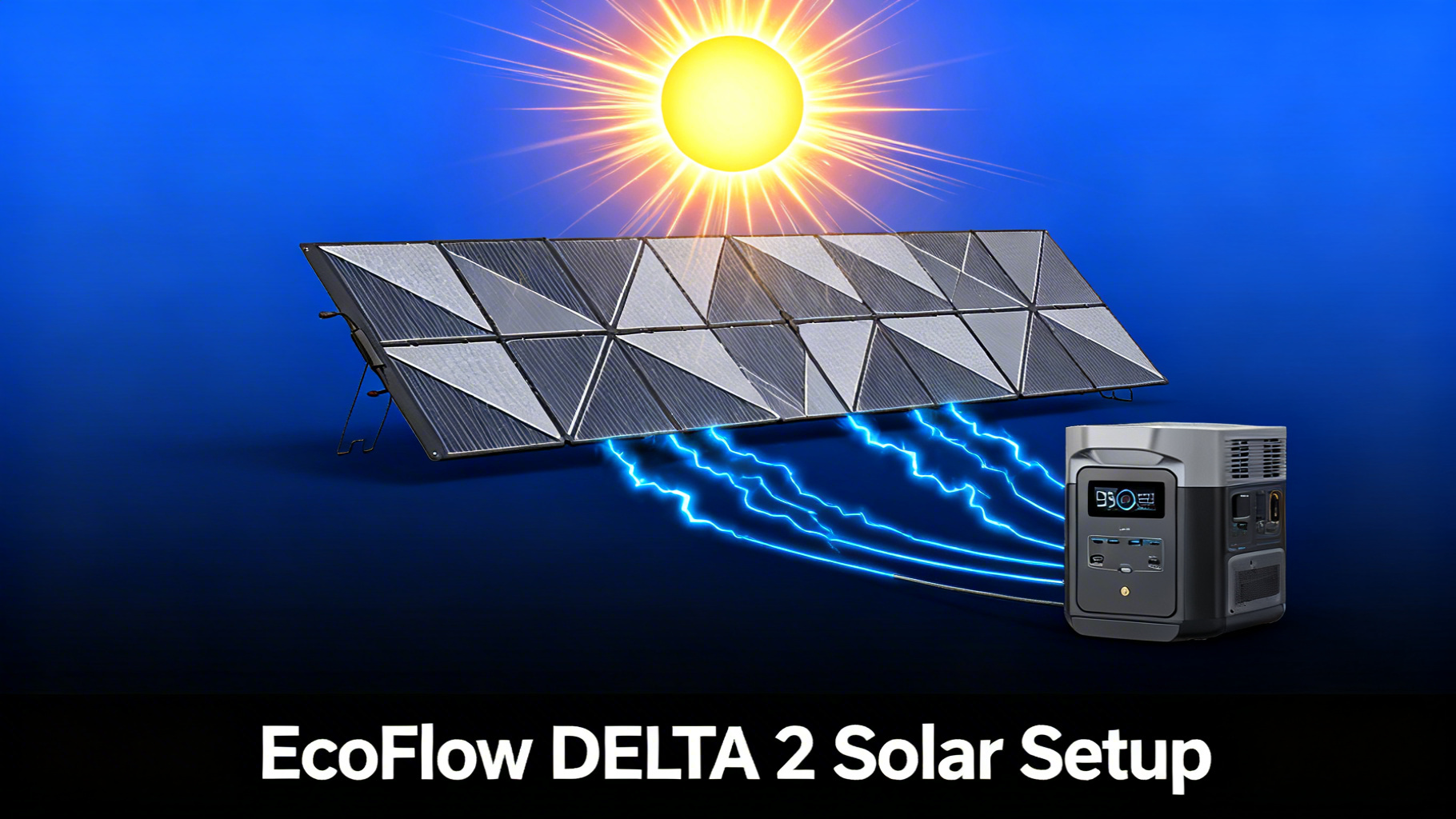

The EcoFlow RIVER 2 Pro packs a 768Wh LFP battery into a compact, carry-friendly unit that charges in 70 minutes from AC. But solar charging is where this station truly earns its place in a camping, van life, or off-grid kit. With a 220W solar input ceiling and a built-in MPPT controller, the RIVER 2 Pro can top up entirely from the sun in around 3.5 hours under good conditions.
The question most buyers face: which panel actually makes sense? EcoFlow offers three compatible options at very different price points and weights. Choosing the wrong one means leaving charging speed on the table, or carrying more weight than you need. This guide covers the solar input specs, a side-by-side panel comparison, and a step-by-step connection walkthrough. If you’re also evaluating complete solar generator systems, the roundup of best solar generators of 2026 covers full bundles from every major brand.
EcoFlow RIVER 2 Pro
$339.00 $599.00
- 768Wh LFP battery, 10-year lifespan
- 800W AC output with X-Boost to 1,600W
- Max 220W solar input, full charge in ~3.5 hrs
Own a EcoFlow? Get the owner's checklist.
Storage, cold weather, solar limits and battery health for your EcoFlow power station, in one email. After that, about one email a week with setup guides, plus a heads-up when compatible batteries or panels go on sale.
Unsubscribe in one click. We may earn a commission when you buy through our links, at no extra cost to you. Privacy Policy
Understanding the RIVER 2 Pro’s Solar Input
Before selecting a panel, the RIVER 2 Pro’s solar specs set the boundaries. According to the official RIVER 2 Pro specifications, the station accepts solar input between 11V and 60V DC at a maximum of 220W. The input port is XT60. Any panel that stays inside these limits will charge the RIVER 2 Pro without issue.

EcoFlow RIVER 2 Pro: Solar Input at a Glance
Max Solar Input
220W
Input Voltage
11-60V
Capacity
768Wh
Charge Time (220W)
~3.5h
Based on published EcoFlow specifications. Real-world times vary by panel angle, sunlight intensity, and ambient temperature.
Max Solar Wattage: 220W Ceiling
The 220W ceiling means a single 220W panel is the most efficient match possible for this station. Connecting a panel that exceeds 220W won’t damage the unit, but any wattage above the limit goes unused. In practice, this means there’s no benefit to oversizing beyond 220W on a single-panel setup.
Two smaller panels in parallel can also reach 220W combined, provided their total voltage stays below 60V. This is covered in the dual-panel section below.
Voltage Window: 11V to 60V
This voltage range is wide enough to accommodate almost any portable solar panel on the market. EcoFlow’s own panels output between 17V and 48V depending on model, all well within the window. If you’re considering a third-party panel, verify its open-circuit voltage (Voc) stays under 60V to avoid triggering the over-voltage protection cutoff.
MPPT vs PWM: Why MPPT Matters Here
The RIVER 2 Pro uses an MPPT (Maximum Power Point Tracking) charge controller rather than the older PWM (Pulse Width Modulation) type. The practical difference: MPPT continuously adjusts the electrical load to extract maximum available wattage from the panel, even when the sun angle is suboptimal or cloud cover reduces output. On partly cloudy days, this can mean 15-30% more harvested energy compared to a PWM system at the same input. For the EcoFlow DELTA 2 solar setup, the same MPPT logic applies at higher wattage limits.
Which Panel Is Best for the RIVER 2 Pro?
EcoFlow offers three portable solar panels that are directly compatible with the RIVER 2 Pro: the 220W Bifacial, the 160W, and the 110W. Each represents a different tradeoff between charging speed, portability, and budget. The 220W Bifacial panel technical specs show the clearest performance advantage for anyone prioritizing charge time.


EcoFlow 220W Bifacial: The Fastest Match
Spec-for-spec, the EcoFlow RIVER 2 Pro paired with the 220W Bifacial is the fastest complete solar kit available for this station. The bifacial design adds a rear glass panel rated at 155W, which captures diffuse and reflected light. On partly cloudy days or in environments with a light-colored ground surface, this translates into measurably higher actual output versus a mono-faced panel at the same rated wattage. Charge time calculations based on published specs show a 0-100% cycle in approximately 3.5 hours under optimal conditions.
The panel is 10% smaller than comparable 220W panels and folds into a carry case that doubles as a kickstand. IP68 waterproof and dustproof. At $279 (down from $649), the current pricing makes this the strongest value argument in the lineup for buyers who want maximum daily charging output.
EcoFlow 160W Portable: Best Balance of Speed and Portability
The 160W panel weighs 15.4 lbs and delivers a charge time of roughly 4.8 hours for the 768Wh RIVER 2 Pro. That’s about 1.3 hours slower than the 220W Bifacial, but the weight savings matter on multi-day hikes or van builds where cargo space is limited. Conversion efficiency sits at 21-22%, and the EcoFlow MPPT algorithm is specifically tuned for cold and cloudy conditions. At $209, it’s the panel most backpackers and weekend campers will find hits the sweet spot between performance and pack weight.
EcoFlow 110W Portable: Entry-Level Budget Option
The 110W panel at $169 is the lightest and most portable option, with a 23% conversion rate that’s actually the highest in the lineup on paper. In practice, the lower wattage ceiling limits it to approximately 7-hour charge times for the 768Wh battery. This makes sense for occasional use: supplemental charging during a weekend trip, or topping up between sessions rather than relying on solar as the primary power source. The panel is self-supporting via a built-in kickstand and carries an IP68 rating.
Own a EcoFlow? Get the owner's checklist.
Storage, cold weather, solar limits and battery health for your EcoFlow power station, in one email. After that, about one email a week with setup guides, plus a heads-up when compatible batteries or panels go on sale.
Unsubscribe in one click. We may earn a commission when you buy through our links, at no extra cost to you. Privacy Policy
Step-by-Step: How to Connect Solar Panels to the RIVER 2 Pro
Connecting a solar panel to the RIVER 2 Pro takes under five minutes. The process requires no tools, no technical background, and no configuration. If you can plug in a cable, you can run this setup. Each EcoFlow portable panel ships with a pre-attached XT60 solar cable, so there’s no adapter hunting required for first-party panels.
Step 1: Gather Your Equipment
You’ll need three things: the RIVER 2 Pro power station, a compatible solar panel with XT60 output cable, and a clear outdoor location with direct sunlight. If you’re using a third-party panel with MC4 connectors, add an MC4-to-XT60 adapter to the list. That’s it. No extension cords, inverters, or charge controllers required since the MPPT controller is built into the RIVER 2 Pro.
💡 Pro Tip: Charge the RIVER 2 Pro to 0% before starting a solar-only session if you want to accurately measure actual charge time. A partial state of charge at the start will show a shorter apparent charge time.
Step 2: Position the Panel for Maximum Output
Position the panel facing directly toward the sun at an angle between 30 and 45 degrees. In the Northern Hemisphere, face the panel south. Use the built-in kickstand on EcoFlow panels to hold the angle. Panel output drops significantly when it’s flat on the ground compared to a properly angled position: data from panel manufacturers consistently shows 20-30% output loss at flat versus a 35-degree optimal angle.

Step 3: Connect the XT60 Cable to the Solar Port
Locate the DC solar input port on the RIVER 2 Pro (labeled “Solar” on the input panel). Plug the XT60 connector from the solar panel cable into this port. The connector is keyed and only inserts in one direction. Apply firm, even pressure until you hear a click. Do not force it at an angle.

Portable Power Station Runtime Calculator
Estimate exactly how long the RIVER 2 Pro will run your specific appliances.
Step 4: Verify Charging on the LCD Display
Power on the RIVER 2 Pro if it isn’t already on. The LCD screen should display an input wattage reading within 30 seconds of connection. You’ll see the battery percentage and a solar input figure (in watts). A reading of 0W in direct sunlight indicates either a connection issue, the panel is shaded, or the cable is not fully seated. You’ll know charging is active when the wattage reading is above 0 and the battery percentage begins incrementing.
⚠️ Common mistake: Connecting the panel in shade then moving to sunlight without checking the display. Always verify the input reading after positioning to confirm the system is actually charging.
Step 5: Optimize Angle Throughout the Day
Solar output isn’t static throughout the day. As the sun moves across the sky, a fixed panel angle increasingly loses efficiency. Performance data from portable solar users consistently shows that adjusting panel angle every 2-3 hours, tracking the sun’s arc, can increase total daily energy harvest by 15-25% compared to a set-and-forget approach. Use the portable power station runtime calculator to estimate runtimes for your specific appliances once charging is complete.
Running Two Panels: Parallel Setup for Faster Charging
If you already own two 110W panels, or if you’re buying a dual-panel kit, a parallel connection lets you reach the RIVER 2 Pro’s 220W ceiling with budget panels. Understanding connecting panels in series vs parallel determines whether you stay within voltage limits and extract the most from your setup.
What the Spec Sheet Permits: 220W Max, 60V Limit
Two 110W EcoFlow panels in parallel combine their amperage while keeping voltage at the single-panel level. Since each 110W panel outputs around 18V, the parallel pair stays well within the 60V maximum. Combined wattage reaches 220W, matching the ceiling of the RIVER 2 Pro’s solar input. This is the spec-supported dual-panel configuration for this station.
Parallel vs Series: Which Wiring to Use
In a parallel configuration, positive connects to positive and negative to negative, using a Y-adapter. This doubles amperage without increasing voltage. In a series configuration, positive connects to negative in a daisy chain, doubling voltage instead. For the RIVER 2 Pro, series wiring on two 110W panels would push combined voltage toward 36V, still within the 60V window but with no practical advantage over parallel for this specific station. Parallel remains the recommended approach. The cost of two 110W panels at $338 total actually exceeds the 220W Bifacial at $279, so the dual-110W route only makes sense if you already own the panels.
Expected Charge Times: What the Data Shows
Charge time calculations for the RIVER 2 Pro are straightforward: divide the 768Wh capacity by the panel’s actual wattage output, then add roughly 10-15% overhead for MPPT charging inefficiency and system losses. The table below uses ideal conditions as a baseline; real-world conditions typically add 30-60 minutes due to suboptimal sun angle, partial shading, and ambient temperature effects on panel efficiency.
When Does Solar Charging Make Sense for the RIVER 2 Pro?
Solar charging makes the most sense for scenarios where AC power is unavailable for extended periods. Campers, van lifers, and anyone keeping a power station charged in a remote location will see the biggest benefit. For purely indoor home backup use, AC wall charging at 70 minutes (0-100%) is faster and more reliable than any solar configuration. The RIVER 2 Pro’s solar input shines in off-grid situations, not as a replacement for the wall outlet. Campers frequently pair this station with one of the best power stations for camping setups for a complete weekend-ready kit.
This setup makes sense if…
- You camp 2+ nights and need reliable daytime charging
- You want a lightweight solar kit under 35 lbs total
- You’re topping up the RIVER 2 Pro between uses on a van or RV
- You need a quiet alternative to a gas generator
Skip solar charging if…
- Your primary use is indoor home backup (AC wall charge is faster)
- You need multiple full daily charges (768Wh may not be enough capacity)
- You live in a low-sunlight region with frequent overcast days
- You expect same-day turnaround: solar takes 3-7 hrs depending on panel

Best Solar Generators of 2026
Full bundles from EcoFlow, Jackery, Bluetti, and Anker SOLIX, ranked and compared.
Troubleshooting: Why Is My RIVER 2 Pro Not Charging from Solar?
A handful of issues account for the vast majority of solar charging problems reported by RIVER 2 Pro users. Most are simple fixes that don’t require any tools or technical knowledge.
Problem 1: Display Shows 0W Input
Check three things in order: first, confirm the XT60 connector is fully seated (it should click in). Second, verify the panel is in direct sunlight and not shaded by a tree, awning, or cloud. Third, check that the RIVER 2 Pro is powered on. A recurring pattern in owner feedback points to the XT60 connection as the most common fix: the connector can appear seated without actually making contact.
Problem 2: Wattage Is Lower Than Expected
Spec ratings reflect peak performance under Standard Test Conditions (25°C, 1000 W/m² irradiance, optimal angle). Real-world input will typically fall 15-30% below rated wattage. If you’re seeing 140W from a 220W panel on a clear day, that’s within normal range. Partial shading of even one cell disproportionately reduces output due to the series cell arrangement inside most panels. Move the panel to eliminate any shadow, even from a small object.
Problem 3: Charging Stops Mid-Session
The RIVER 2 Pro’s battery management system pauses charging when the battery reaches 100% and resumes if charge drops. If the station is also powering devices, it may cycle between charging and not charging as the load draw fluctuates. This is normal behavior. The station also throttles solar input when battery temperature is outside the optimal range (typically below 0°C or above 45°C).
Problem 4: Cable Gets Hot
Mild warmth on the XT60 cable is normal during high-wattage input. Significant heat, especially near the connector, indicates a loose connection creating resistance. Disconnect, inspect the connector pins for damage or debris, reseat firmly, and recheck. If the heat persists, discontinue use and contact EcoFlow support before the next session.
Pro Tips: Getting the Most from Your Solar Setup
A few habits consistently separate high-output solar setups from mediocre ones. None of these require additional equipment.

💡 Pro Tip: Start charging at first light. Even low-angle morning sun can generate 60-80W on a 220W panel. Beginning a session at 7am instead of 9am can add 90-120Wh to your daily harvest before most campers have breakfast.
Keep the panel surface clean. Dust, pollen, and bird droppings reduce output proportionally to coverage area. A quick wipe with a damp cloth before deploying can recover 5-10% of output on a visibly dirty panel. For the bifacial 220W panel specifically, clearing the rear glass matters just as much as the front when using reflected light.
Avoid running heavy loads simultaneously with solar charging when the goal is fast top-up. If you’re drawing 200W from the station while charging at 150W, the net charge rate is only 50W. Charging without a load during the peak solar window (10am-2pm) maximizes harvest. Use the battery’s stored power during morning and evening, and recharge during peak sun hours.
Series vs Parallel Solar Panels: Complete Guide
Understand the voltage and amperage implications before wiring a dual-panel setup.
Frequently Asked Questions
What is the maximum solar input for the EcoFlow RIVER 2 Pro?
The RIVER 2 Pro accepts up to 220W of solar input, with a voltage window of 11V to 60V. Exceeding 220W does not damage the unit, but any wattage above the limit is not used. The built-in MPPT controller handles the regulation automatically.
Can I use non-EcoFlow solar panels with the RIVER 2 Pro?
Yes. Any panel outputting 11-60V DC with an XT60 output connector is compatible. Third-party panels work, but the EcoFlow MPPT charging algorithm is optimized for EcoFlow’s own panels. MC4 panels require an MC4-to-XT60 adapter, available from EcoFlow and third-party accessory brands.
How long does it take to charge the RIVER 2 Pro with the 220W panel?
Under ideal conditions (direct sunlight, optimal panel angle), the 220W Bifacial panel charges the 768Wh station from 0 to 100% in approximately 3.5 hours. Real-world conditions typically add 30-60 minutes due to panel angle, cloud cover, and temperature effects.
Can I connect two solar panels to the RIVER 2 Pro?
Yes, in parallel, provided the combined wattage does not exceed 220W and the voltage stays within the 11-60V window. Two 110W panels in parallel is the most common dual-panel configuration for this unit. A Y-adapter is required to connect two panels to the single XT60 input.
Does the RIVER 2 Pro charge from solar while powering devices simultaneously?
Yes. The pass-through charging function allows the station to charge from solar while simultaneously powering connected devices. The net charge rate equals solar input minus load draw. If solar input is 150W and load draw is 100W, the battery charges at a net rate of approximately 50W.
What connector does the EcoFlow RIVER 2 Pro use for solar input?
The RIVER 2 Pro uses an XT60 input connector. All EcoFlow portable solar panels include an XT60 cable in the box. Third-party panels with MC4 connectors require an MC4-to-XT60 adapter to connect to this station.
Is the EcoFlow 220W Bifacial panel worth the extra cost over the 160W?
Analysis of charge time data shows the 220W Bifacial cuts charge time by roughly 1.3 hours compared to the 160W. At a $70 premium, that efficiency gain is justified for frequent users and in cloudy conditions where the rear panel captures diffuse light. For occasional weekend campers prioritizing portability, the 160W at $209 is the stronger value.
Does solar charging void the RIVER 2 Pro warranty?
No. Solar charging via compatible panels is a supported charging method under EcoFlow’s published warranty terms. Using only non-EcoFlow equipment for solar input may affect warranty claims related to solar input damage, per EcoFlow’s warranty documentation.
Conclusion
The RIVER 2 Pro’s 220W solar input ceiling and built-in MPPT controller make it one of the more capable solar-ready stations in the sub-$400 segment. The 220W Bifacial panel is the natural match for anyone who wants the fastest possible solar recharge: the spec alignment is exact, and the bifacial design provides a meaningful performance edge in imperfect conditions. For backpackers and weight-conscious campers, the 160W at $209 delivers solid charging performance in a lighter, more packable form factor. The 110W makes sense only as a budget starting point or for supplemental top-up use.
The setup process itself is straightforward regardless of which panel you choose. Connection takes under five minutes, the display confirms charging status immediately, and optimizing panel angle throughout the day is the single highest-impact step for maximizing your daily energy harvest. For a broader look at complete station options, the guides on the best power stations for camping cover the full field.

EcoFlow RIVER 2 Pro
$339.00
Best 768Wh solar-ready station under $400
Price verified April 2026. Free shipping available.
Originally published: March 31, 2026