
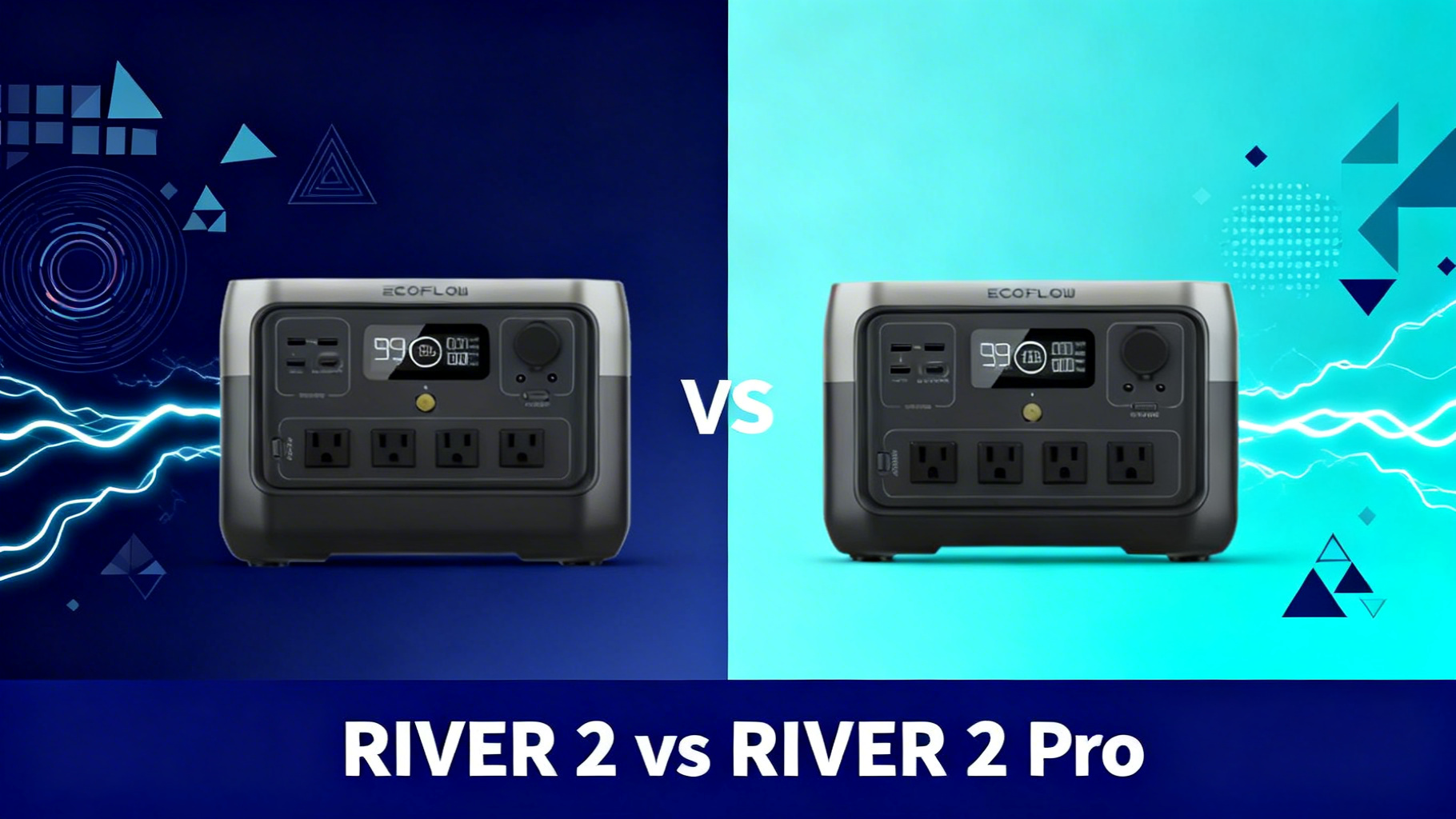
Choosing between the RIVER 2 Max and RIVER 2 Pro feels straightforward on paper, yet the two models overlap enough to create genuine uncertainty. Both use LFP (LiFePO4) chemistry, both recharge in under 75 minutes, and both carry EcoFlow’s X-Boost technology. The real question is whether the 50% capacity gap and $90 price difference add up to a meaningful upgrade, or whether the Max already covers most use cases at a lower cost.
This comparison breaks down the numbers across capacity, charging speed, output, weight, and value so you can make the right call for your specific situation. For a complete look at every option in the lineup, the EcoFlow RIVER series buyer’s guide breaks down the full range from entry to advanced.
The short answer: the RIVER 2 Max at $249 wins on value and portability; the RIVER 2 Pro at $339 wins on capacity, solar throughput, and safety certification. There’s no universally better model, only the better match for your workload.
Get our Black Friday alerts for EcoFlow
We track live prices on 40+ models from Jackery, EcoFlow, BLUETTI and Anker SOLIX. When a deal beats the lowest price we've recorded, you'll hear from us. During Black Friday week, one short recap a day at most.
Unsubscribe in one click. We may earn a commission when you buy through our links, at no extra cost to you. Privacy Policy
Quick Verdict: Which One Should You Buy?
If your primary concern is budget or you need a lightweight unit for day trips and weekend camping, the RIVER 2 Max at $249 is the clear call. If you’re planning multi-day off-grid use, regular solar cycling, or you want safety certification included at the hardware level, the Pro earns its $90 premium.
Full Specifications Head-to-Head
Spec-for-spec, these two models are closer than their price gap suggests. Both use LFP (LiFePO4) batteries rated for 3,000+ cycles, both support EPS with a 30ms switchover, and both offer three AC outlets with 100W USB-C PD. The differences that matter are concentrated in four areas: capacity, solar input, AC output ceiling, and weight.
Full Spec Comparison
Source: official RIVER 2 Max specs page and official RIVER 2 Pro specs page. Prices verified March 2026.
Get our Black Friday alerts for EcoFlow
We track live prices on 40+ models from Jackery, EcoFlow, BLUETTI and Anker SOLIX. When a deal beats the lowest price we've recorded, you'll hear from us. During Black Friday week, one short recap a day at most.
Unsubscribe in one click. We may earn a commission when you buy through our links, at no extra cost to you. Privacy Policy
Battery and Capacity: The Core Difference
The 256Wh capacity gap between these two models is the single biggest factor in this comparison. Think of watt-hours (Wh) as the size of your fuel tank: the Max holds 512Wh, the Pro holds 768Wh. That 50% difference compounds across every runtime estimate and every multi-device scenario.

For weekend camping trips or single overnight power needs, the 512Wh Max is typically sufficient. Running essential devices like a laptop (65W), a CPAP (45W), and phone charging simultaneously for 6 to 8 hours falls within the Max’s practical range. The problem surfaces when those single-night trips extend to two or three days without a reliable AC source for recharging.

The Pro’s 768Wh changes that equation meaningfully. A mini-fridge running continuously draws roughly 60W average; capacity data shows the Pro sustains that load for approximately 11 hours versus 7.5 hours on the Max. For anyone running a refrigeration appliance as part of a camping or van setup, that 3.5-hour gap matters across a full day.
💡 Pro Tip: Both models run 80% of essential home appliances via X-Boost. The real capacity question is runtime duration, not appliance compatibility.
Real-World Runtime Estimates
Runtime calculations based on published capacity and typical appliance draws show consistent patterns across both models. These figures assume approximately 90% efficiency, which aligns with real-world data from LFP chemistry at moderate loads. For device-specific estimates, the portable power station runtime calculator lets you input your exact wattage draw against either model’s capacity.
Estimated Runtime Comparison
RIVER 2 Max (512Wh)
💡
LED Lamp (10W)
~46 hrs
💻
Laptop (65W)
~7 hrs
❄️
Mini Fridge (60W)
~7.5 hrs
📱
Smartphone (18W)
~28x
RIVER 2 Pro (768Wh)
💡
LED Lamp (10W)
~69 hrs
💻
Laptop (65W)
~10.5 hrs
❄️
Mini Fridge (60W)
~11.3 hrs
📱
Smartphone (18W)
~42x
Estimates based on published Wh capacity at ~90% efficiency. Actual results vary by load and temperature.

One detail worth noting: these estimates assume single-appliance loads. Running a laptop and a phone simultaneously from the Max reduces total runtime proportionally. Mixed-device scenarios generally fall between the individual device estimates shown above.
Charging Performance
Both models use EcoFlow’s EV-grade fast charging technology, and the AC recharge times are genuinely fast for their respective capacities. The Max charges 0 to 100% in 60 minutes; the Pro takes 70 minutes for a larger 768Wh pack. Neither figure has a meaningful practical disadvantage for most users.
Solar performance is where the gap becomes more relevant for off-grid buyers. The Max accepts up to 160W of solar input. Owners looking to maximize renewable charging should reference the RIVER 2 Max solar charging setup article for compatible panel recommendations. The Pro accepts up to 220W, and EcoFlow reports it can deliver up to 1.8kWh per day through solar cycling under favorable conditions. The RIVER 2 Pro solar setup guide covers compatible panel configurations for the 768Wh unit specifically.

For car charging, both units accept 12V DC input. Both also support USB-C charging input, giving you four total input methods (AC, car, solar, USB-C) on the Pro and the same on the Max. The additional solar headroom on the Pro is the deciding factor if you’re building a solar-first charging setup.
EcoFlow RIVER 2 Pro
768Wh · 800W AC · TUV Certified · X-Boost 1,600W
$339 $599
Output and Port Comparison
Port count is identical between these two models: three AC outlets, two USB-A ports, one USB-C (100W PD), and one DC output. The difference is in AC output wattage. The Max delivers 1,000W continuous with a 2,000W surge; the Pro delivers 800W continuous, with X-Boost extending effective output to 1,600W for compatible appliances.


In practice, the Max’s 2,000W surge rating is the more useful spec for appliances with high startup draw, like compressor-based coolers or power tools. The Pro’s 800W continuous ceiling is lower, but X-Boost compensates by intelligently managing power delivery to appliances rated up to 1,600W. Most household devices fall within that range anyway.
X-Boost Technology: How Each Model Uses It
X-Boost is EcoFlow’s power management technology that allows the unit to run appliances rated above the nominal AC output. It works by limiting the actual draw the appliance can pull, extending runtime while enabling compatibility with a wider range of devices.
RIVER 2 Max X-Boost
The Max runs X-Boost up to 2,000W. This is the higher ceiling of the two models, making it the better choice if you need to run a single high-draw appliance like a space heater or an electric skillet. The trade-off is the smaller 512Wh tank: higher wattage loads drain it faster.
The RIVER 2 Max is particularly well-suited to scenarios where you run one device at a time at high wattage, then let it recharge quickly from AC before the next use cycle.
RIVER 2 Pro X-Boost
The Pro’s X-Boost ceiling sits at 1,600W, slightly lower than the Max. What the Pro provides instead is more stored capacity to run those appliances longer. Analysis of published specs reveals the Pro can power 80% of common home appliances, including hair dryers (at limited draw), electric blankets, and standard kitchen appliances.
💡 Pro Tip: X-Boost appliance compatibility data indicates both models can run a standard CPAP machine. Specific runtime calculations for CPAP use appear in the FAQ section below.
Weight, Portability, and Design
The 5-pound weight difference between the Max (13.2 lbs) and the Pro (18.2 lbs) is noticeable in real-world handling. At 13.2 lbs, the Max approaches one-handed carry territory. At 18.2 lbs, the Pro is still very portable by power station standards, but the difference compounds across trips involving significant walking or backpacking.
Both models share the same general RIVER 2 design language: compact rectangular form factor, a built-in handle, and a similar footprint. The Pro is physically larger to accommodate the additional battery capacity. Neither requires a dedicated case or rack, and both fit under a car seat or in an overhead storage compartment on most vehicles.
⚠️ Important: Neither model supports expansion battery packs. If you anticipate needing capacity beyond 768Wh, the DELTA 2 series is the appropriate next step, not a second RIVER unit.
Which One Is Right for You?
The answer depends on how you’ll actually use the unit. Both models are excellent in their segment. Neither carries a significant design flaw that would disqualify it for a given use case. The variables that drive the decision are measurable: budget ceiling, target runtime, acceptable weight, and whether solar charging is part of the regular workflow.
Which One Fits Your Use Case?
Choose RIVER 2 Max if…
- Budget is the primary driver (saves $90)
- You need higher surge wattage (2,000W peak)
- Lighter weight matters for travel (13.2 lbs)
- Weekend camping or day trips are the main use
- Charging speed from AC is the priority (60 min)
Choose RIVER 2 Pro if…
- You need 50% more capacity for multi-day use
- Higher solar input (220W) matters for off-grid
- TUV Rheinland certification is a safety priority
- X-Boost compatibility with 1,600W appliances needed
- Daily solar cycling (up to 1.8kWh/day) is the goal


If your needs eventually grow beyond either RIVER model’s capacity ceiling, the next logical step is the DELTA series. Buyers needing more than either RIVER offers should review the EcoFlow DELTA 2 home backup breakdown before committing to a purchase in this range.
Portable Power Station Runtime Calculator
Enter your devices and get precise runtime estimates for both the Max and Pro.
Pricing and Value Analysis
At $249, the RIVER 2 Max delivers 512Wh at $0.49 per watt-hour. The RIVER 2 Pro at $339 offers 768Wh at $0.44 per watt-hour. On a cost-per-stored-watt basis, the Pro is the better value, despite the higher purchase price. That math only applies, however, if you actually use the extra 256Wh.
For buyers who cap out at 512Wh in their daily use pattern, paying $90 more for capacity that goes unused doesn’t improve the value equation. The Max’s 60-minute AC recharge also partially compensates for its smaller tank: if you have AC access, you can top it off mid-day and effectively double your available capacity within an hour.
EcoFlow RIVER Series Buyer’s Guide
Full lineup breakdown: RIVER 2 vs RIVER 3, entry through advanced, all models compared.
The Pro’s TUV Rheinland certification is the one non-quantitative differentiator worth mentioning. It’s the first power station in this category to carry that certification, which validates the battery management system’s safety architecture through third-party testing. For buyers where safety certification matters (medical device users, families with young children, indoor use scenarios), that distinction carries weight beyond the spec sheet.
The RIVER 2 Pro also offers Bluetooth and Wi-Fi app control via the EcoFlow app, enabling remote monitoring of charge status, charge mode settings, and power scheduling. The Max includes app connectivity as well, though the feature set is comparable between models at this price tier.
Final Verdict
Spec-for-spec analysis of the RIVER 2 Max vs RIVER 2 Pro points to a straightforward decision framework: buy the Max if your budget is tight or your use is occasional; buy the Pro if capacity and solar throughput are the priority. Both are solid, reliable units with LFP longevity and fast recharge. Neither carries a disqualifying weakness.
The Max wins for most weekend campers and casual emergency prep buyers. The Pro earns its premium for multi-day off-grid users, solar-primary setups, and anyone who wants the added assurance of TUV Rheinland certification. At $249, the Max represents the stronger value proposition for the average buyer. At $339, the Pro delivers measurably more capability for those who can use it.
EcoFlow RIVER 2 Max
$249
Best mid-range value under $300
Price verified March 2026. Free shipping available.
Frequently Asked Questions
What is the main difference between the EcoFlow RIVER 2 Max and RIVER 2 Pro?
The primary distinction is capacity: the RIVER 2 Max holds 512Wh against the RIVER 2 Pro’s 768Wh, a 50% gap that directly affects runtime. The Pro also accepts 220W of solar input versus 160W on the Max, and carries a TUV Rheinland safety certification. The Max counters with a lower starting price ($249 vs $339), slightly faster AC recharge time (60 vs 70 minutes), and a higher AC surge rating (2,000W vs 1,600W via X-Boost).
Can both the RIVER 2 Max and RIVER 2 Pro run a CPAP machine?
Yes. Both models include EcoFlow’s X-Boost technology, which allows them to power appliances rated above their nominal AC output. A standard CPAP machine draws between 30W and 60W, well within range of either unit. Runtime calculations based on capacity indicate the Pro can sustain a 60W CPAP for approximately 11 hours, while the Max provides roughly 7.5 hours on the same load.
Is the EcoFlow RIVER 2 Pro worth the extra $90 over the RIVER 2 Max?
The value case depends on use pattern. For buyers doing single overnight trips where 512Wh is sufficient, the $90 premium does not yield proportional benefit. For buyers with regular solar charging needs or multi-day off-grid use, the 50% capacity gain and 220W solar input make the Pro the stronger long-term investment. Analysis of the cost-per-Wh shows the Pro at $0.44/Wh against the Max at $0.49/Wh, so the Pro also wins on raw value per stored watt.
Which model charges faster from solar panels?
The RIVER 2 Pro accepts up to 220W of solar input, compared to 160W on the RIVER 2 Max. EcoFlow reports the Pro can provide up to 1.8kWh per day through solar cycling, making it the more capable option for solar-primary setups. However, given the Max’s smaller capacity, it can reach full charge at 160W in a shorter elapsed time under ideal conditions.
Are both models compatible with EcoFlow expansion batteries?
Neither the RIVER 2 Max nor the RIVER 2 Pro supports external expansion batteries. Expandable capacity is a feature reserved for the DELTA series (DELTA 2, DELTA 2 Max, DELTA Pro 3, and DELTA 3 Max). Buyers who anticipate needing to scale capacity beyond the base unit should evaluate stepping up to the DELTA 2 line.
Related Reads
Originally published: March 31, 2026