
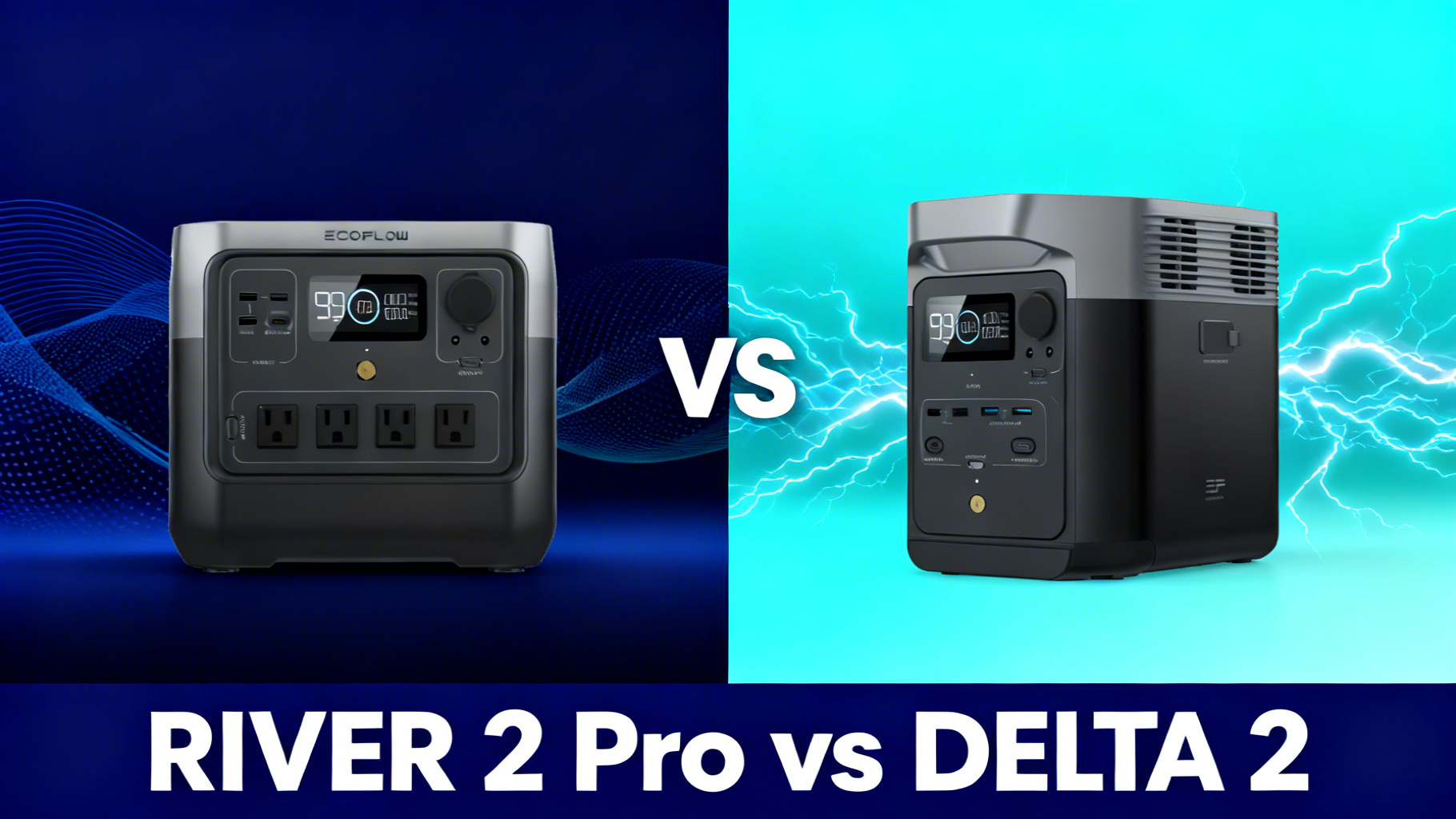
Choosing between the EcoFlow RIVER 2 and RIVER 2 Pro feels straightforward at first glance: pay $150 more and get a bigger unit. But the real picture is more nuanced than that. The Pro doesn’t just offer more capacity. It uses a different battery chemistry, doubles the solar input, nearly triples the AC output, and targets a fundamentally different type of user.
The RIVER 2 sits at $189 (down from $239) with a compact 256Wh capacity and a 60-minute AC recharge. The RIVER 2 Pro runs $339 (down from $599) with 768Wh, an LFP battery rated for 3,000+ cycles, and X-Boost technology that pushes effective output to 1,600W. For a broader look at the full RIVER lineup including the newer RIVER 3, our EcoFlow RIVER series buying guide covers every model and capacity tier.
This comparison breaks down every meaningful difference between the two so you can make a clear, informed decision based on how you actually plan to use the unit.
Update (July 2026): The EcoFlow RIVER 2 has been discontinued and is no longer sold by EcoFlow. Links for the RIVER 2 in this article now lead to its successor, the EcoFlow RIVER 3 (245Wh capacity, 300W rated output with X-Boost up to 600W, $199). We’re keeping this comparison live to help existing RIVER 2 owners and anyone weighing remaining or secondhand RIVER 2 stock against the RIVER 2 Pro.

EcoFlow RIVER 2
$189 $239
- 256Wh capacity, lightest RIVER 2 model
- Full recharge in 60 minutes via AC
- 30ms EPS switchover for sensitive devices
Get our Black Friday alerts for EcoFlow
We track live prices on 40+ models from Jackery, EcoFlow, BLUETTI and Anker SOLIX. When a deal beats the lowest price we've recorded, you'll hear from us. During Black Friday week, one short recap a day at most.
Unsubscribe in one click. We may earn a commission when you buy through our links, at no extra cost to you. Privacy Policy
At a Glance: Key Differences
Before diving into the details, here’s a quick spec-by-spec breakdown. A few numbers stand out immediately: the Pro carries 3x the capacity, more than double the AC output, and a battery chemistry rated for 6x more charge cycles. These aren’t incremental improvements. They represent a genuinely different product tier.

The four takeaways that matter most: the Pro offers 3x the capacity at 768Wh vs 256Wh; it uses an LFP battery rated for 3,000+ cycles vs roughly 500; its X-Boost output reaches 1,600W vs 300W continuous on the base model; and it weighs 18.2 lbs vs 7.7 lbs, making portability a genuine trade-off. Neither unit is better in every category. The right one depends entirely on your use case.
EcoFlow RIVER 2: The Lightweight Budget Option
The RIVER 2 is EcoFlow’s entry-level portable station, priced at $189 with a 256Wh lithium-ion battery and 300W continuous AC output. At just 7.7 lbs, it’s genuinely grab-and-go. You can toss it in a hiking pack or slide it under a car seat without thinking twice.
Its headline feature is the 60-minute full recharge via AC, which is faster than the Pro. The 30ms EPS auto-switch means it can protect sensitive electronics like routers and medical devices during a power outage. App control is included, and it can run off solar up to 110W input. The RIVER 2 is designed for occasional users who need reliable power for phones, laptops, fans, and lights, without the bulk or cost of a larger unit.
One limitation the specs make clear: at 300W continuous output, the RIVER 2 won’t run high-draw appliances. Coffee makers, hair dryers, and most kitchen appliances are off the table. For light-duty, portable-first use cases, the EcoFlow RIVER 2 hits a strong price-to-utility ratio.
EcoFlow RIVER Series Buyer’s Guide: RIVER 2 vs RIVER 3 Lineup Explained
Compare every RIVER model side by side, including the newer RIVER 3 lineup and capacity tiers.
Get our Black Friday alerts for EcoFlow
We track live prices on 40+ models from Jackery, EcoFlow, BLUETTI and Anker SOLIX. When a deal beats the lowest price we've recorded, you'll hear from us. During Black Friday week, one short recap a day at most.
Unsubscribe in one click. We may earn a commission when you buy through our links, at no extra cost to you. Privacy Policy
EcoFlow RIVER 2 Pro: The Capable Daily Driver

The RIVER 2 Pro is a fundamentally different product. Its 768Wh LFP (lithium iron phosphate) battery stores three times more energy and is rated for 3,000+ charge cycles: roughly 10 years of daily use before hitting 80% capacity. That’s not a marketing claim. LFP chemistry is inherently more stable than standard lithium-ion, as detailed in the LFP battery chemistry explained breakdown from Battery University.
The Pro also carries 800W continuous AC output with X-Boost technology that intelligently manages delivery to run appliances drawing up to 1,600W perceived load. That means a coffee maker, a portable electric cooktop on low, or a hair dryer on cool setting, all of which are simply beyond the RIVER 2’s reach. Solar input doubles to 220W, enabling up to 1.8kWh of solar generation per day. The RIVER 2 Pro also holds a TUV Rheinland safety certification, the first portable power station to do so.
The trade-off is weight: at 18.2 lbs, it’s portable but not pocket-friendly. It suits users who want a station they can move around, not necessarily carry everywhere.
Head-to-Head: Battery and Capacity
The capacity gap is the single most important difference between these two units. Watt-hours (Wh) measure how much total energy the battery stores, like the size of a fuel tank. The RIVER 2 holds 256Wh; the RIVER 2 Pro holds 768Wh. That’s not a modest step up. It’s three times the reservoir.
For most light-duty users, 256Wh covers a full day of device charging: phones, a laptop session, a small fan running overnight. But the moment you want to run a cooler, extend a camping trip past 24 hours, or use the station as home backup for anything beyond a router and a few lights, 256Wh runs short quickly.
RIVER 2 (256Wh): Estimated Runtime
💡
LED Bulb (10W)
~22 hrs
💻
Laptop (45W)
~5 hrs
📱
Phone (18W)
~12 charges
❄️
Mini Fridge (60W)
~3.5 hrs
RIVER 2 Pro (768Wh): Estimated Runtime
💡
LED Bulb (10W)
~65 hrs
💻
Laptop (45W)
~14 hrs
📱
Phone (18W)
~36 charges
❄️
Mini Fridge (60W)
~10.5 hrs
Runtime estimates at 85% efficiency. Actual results vary by load and temperature.
Beyond capacity, the battery chemistry difference matters significantly for frequent users. The RIVER 2 uses standard lithium-ion, rated for approximately 500 cycles before dropping to 80% capacity. The Pro uses LFP cells rated for 3,000+ cycles. Use the Pro daily, and cycle data suggests a 10-year useful lifespan. Use the RIVER 2 daily, and you’re looking at roughly 18 months before meaningful degradation begins. To estimate exactly how long either model will power your specific devices, use our runtime calculator, which handles any appliance wattage.
Portable Power Station Runtime Calculator
Enter your appliances and get an instant runtime estimate for any power station capacity.
Head-to-Head: Charging Speed
Recharge speed is one area where the RIVER 2 actually edges ahead. Its AC charging time of 60 minutes for a full charge is slightly faster than the Pro’s 70 minutes, though in practice that 10-minute difference rarely matters. Both units recharge from flat to full in under 90 minutes, which is class-leading for this price range.
The solar charging picture is more differentiated. The RIVER 2 accepts up to 110W of solar input, which on a clear day can replenish its 256Wh bank in roughly 2.5 to 3.5 hours. The Pro accepts up to 220W, enabling full replenishment of its 768Wh bank in approximately 3.5 to 4.5 hours under ideal conditions. That’s a meaningful advantage for anyone planning multi-day outdoor use without grid access.

Both units support car DC charging and USB-C input as additional options. The Pro adds Wi-Fi connectivity alongside Bluetooth for app control, useful when monitoring charging remotely. If you’re planning to pair either model with panels, our dedicated RIVER 2 Pro solar charging setup guide breaks down the best panel configurations.
Head-to-Head: Power Output and X-Boost
Output capacity is where the gap becomes most consequential for real-world use. The RIVER 2 delivers 300W continuous AC output with a 600W surge. That covers phones, laptops, tablets, small fans, LED lighting, and most consumer electronics. It won’t run a microwave, a coffee maker, a portable induction cooktop, or a hair dryer.
The RIVER 2 Pro delivers 800W continuous AC output. More importantly, X-Boost technology allows it to intelligently power appliances drawing up to 1,600W perceived load. EcoFlow’s spec data confirms this enables the Pro to run approximately 80% of common home appliances, including devices that would trip a standard 800W limit. This is a genuine capability gap, not a marginal spec difference.
Head-to-Head: Portability and Design
Weight is the clearest physical trade-off between these two units. The RIVER 2 at 7.7 lbs is compact enough to fit in a large backpack and carry comfortably for extended distances. It’s the kind of unit you genuinely toss in the car without planning around it.
The RIVER 2 Pro at 18.2 lbs requires more intentional transport. It’s manageable, roughly the weight of a small carry-on bag, but you’ll notice it. The handle design makes it practical for cabin-to-campsite distances, but hiking with it is not realistic.
Both units have similar compact form factors relative to their capacity class. Neither requires permanent installation or significant setup. Campers prioritizing minimal weight and budget will find the RIVER 2 among the best portable power stations for camping for short outings.

What Can Each Model Power? (Use Case Breakdown)
Runtime calculations based on the respective capacities show a practical performance divide. The RIVER 2’s 256Wh bank at 85% efficiency delivers approximately 218Wh of usable energy. The RIVER 2 Pro’s 768Wh bank yields around 653Wh of usable output under the same conditions.
Not sure which appliances each model can handle? Our compatibility checker instantly tells you whether your devices will run on 256Wh or 768Wh.
Winner by Use Case
✅ Choose the RIVER 2 if…
- Budget is your primary concern ($189 vs $339)
- You use it occasionally (weekends, day trips)
- Portability matters most (7.7 lbs)
- You only need to power small devices (phones, laptops, lights)
- You want the fastest recharge (60 min AC)
✅ Choose the RIVER 2 Pro if…
- You use it regularly (weekly or more)
- You need to power appliances over 300W
- Long-term durability matters (LFP: 3,000+ cycles)
- Solar charging is part of your setup (220W input)
- Home backup for essential devices is a priority
Weekend Camping and Day Trips: RIVER 2
For single-night or day trip camping, 256Wh covers the essentials without issue. Charging phones, running a headlamp or small fan overnight, and powering a laptop for a few hours fits comfortably within the RIVER 2’s bank. The 7.7 lb weight is genuinely backpack-friendly. If you’re car camping occasionally and don’t need to run a cooler for long stretches, the base model is the smarter buy.
Van Life and Extended Outdoor Stays: RIVER 2 Pro
Multi-day outdoor use is where the capacity gap becomes critical. Runtime data for a 60W 12V cooler shows the RIVER 2 depleted in roughly 3.5 hours. The Pro handles the same load for over 10 hours. Add solar recharging at 220W, and the Pro can sustain an off-grid setup across multiple days. Van lifers and extended campers with solar panels in their setup will find the base RIVER 2 too constrained.
Home Backup for Essential Devices: RIVER 2 Pro
Home backup use requires both adequate capacity and reliable long-term cycling. The RIVER 2’s 500-cycle limitation means daily or near-daily use will degrade it within 18 months. The Pro’s LFP cells and 3,000+ cycle rating make it genuinely practical as a recurring home backup unit. Its 30ms EPS auto-switch, shared with the base model, protects routers, medical equipment, and sensitive electronics during outages.
Tight Budget, Occasional Use: RIVER 2
If you’re buying your first portable power station and expect to use it a handful of times per year, the $189 price point of the RIVER 2 is difficult to argue against. The LFP advantage on the Pro only pays off under regular cycling. For occasional users, the Li-ion battery in the RIVER 2 will last years without hitting the 500-cycle limit.
Powering Appliances like Coffee Makers and CPAPs: RIVER 2 Pro
Published specifications for the RIVER 2 confirm a hard 300W output ceiling. Coffee makers, CPAP machines on higher settings, portable induction cooktops, and hair dryers all exceed that limit. The RIVER 2 Pro, with its X-Boost output to 1,600W effective load, handles these appliances. For anyone whose use case includes a CPAP for sleep apnea or any kitchen appliance, the Pro is the only viable option between these two.
Best Portable Power Stations for Camping
Our ranked list of the top camping power stations tested across capacity, weight, and outdoor durability.
Price and Long-Term Value Analysis
The upfront gap is $150: $189 for the RIVER 2 vs $339 for the Pro (both at current pricing, down from $239 and $599 respectively). For budget-conscious buyers, that’s a meaningful difference. But the long-term math shifts the equation.
At roughly 500 cycles, the RIVER 2’s cost per cycle works out to approximately $0.38 per cycle. The Pro at 3,000+ cycles delivers approximately $0.11 per cycle: a 70% reduction in cost per use. For a user cycling the station twice weekly, the Pro’s total lifespan stretches to nearly 30 years of theoretical use, while the RIVER 2 would need replacement after roughly 5 years of the same frequency.
The conclusion from the cycle data: for frequent users, the Pro pays for itself within the first year or two relative to the cost of replacing a RIVER 2. For occasional users, the RIVER 2’s lower upfront cost and sufficient performance make the premium unjustifiable.
Verdict: Our Recommendation
There’s no universal winner here. The right unit depends entirely on how often you use it and what you need to run. Spec analysis across both models points to a clear decision framework:
Buy the RIVER 2 if you’re an occasional user (monthly or less), your device list tops out at phones, laptops, and small fans, portability is a priority, and $189 fits your budget. It’s a capable, reliable unit for light-duty use, and the 60-minute recharge speed is genuinely impressive at this price point. Note that the RIVER 2 has been discontinued as of July 2026, so buying one now means sourcing remaining or secondhand stock; EcoFlow’s current entry-level model is the RIVER 3.
Buy the RIVER 2 Pro if you use portable power weekly or more, need to run appliances over 300W, plan to integrate solar panels, or want a station built for long-term reliability. The LFP battery, 768Wh capacity, and X-Boost output make it a substantially more capable unit that justifies the $150 premium for the right user profile.
Ready to Choose?
Prices verified March 2026. Free shipping available on EcoFlow.com
FAQ
Is the EcoFlow RIVER 2 Pro worth the extra $150 over the RIVER 2?
For occasional users (monthly or less), the RIVER 2 at $189 covers most light-duty needs. For anyone using portable power weekly or powering appliances above 300W, the Pro’s 3x capacity, LFP battery lifespan, and X-Boost output justify the $150 premium within the first year of regular use. The key question is usage frequency, not budget alone.
What is X-Boost on the EcoFlow RIVER 2 Pro?
X-Boost is EcoFlow’s proprietary technology that allows the RIVER 2 Pro to power appliances requiring up to 1,600W, even though its AC output is rated at 800W. The station intelligently manages power delivery to run devices like coffee makers, hair dryers (on low settings), and portable electric heaters that would otherwise exceed its rated output. The base RIVER 2 does not include X-Boost.
Can the EcoFlow RIVER 2 power a refrigerator?
The RIVER 2’s 300W AC output and 256Wh capacity limit its refrigerator use. A compact 12V cooler drawing 40-60W will run for approximately 3-4 hours. A standard household mini-fridge (60-80W) may work for about 3 hours. For sustained refrigerator backup, the RIVER 2 Pro (768Wh, 800W output with X-Boost) provides a far more practical solution at around 8-10 hours with a 60W draw.
What is the battery life difference between the RIVER 2 and RIVER 2 Pro?
The RIVER 2 uses a lithium-ion battery rated for approximately 500 charge cycles before reaching 80% capacity. The RIVER 2 Pro uses LFP (LiFePO4) chemistry, which EcoFlow rates at 3,000+ cycles, equivalent to roughly 10 years of daily use. For frequent users, this cycle difference represents a significant long-term cost advantage for the Pro model.
Can the EcoFlow RIVER 2 Pro charge via solar?
Yes. The RIVER 2 Pro accepts up to 220W of solar input, which can fully charge the 768Wh bank in approximately 3.5 to 4.5 hours under ideal conditions. The base RIVER 2 accepts up to 110W of solar input and charges its 256Wh bank in roughly 2.5 to 3.5 hours. Both support EcoFlow’s own portable solar panels as well as third-party panels meeting the voltage and current specifications.
Is the EcoFlow RIVER 2 expandable?
No, neither the RIVER 2 nor the RIVER 2 Pro supports external battery expansion. Both are fixed-capacity units. For expandable EcoFlow portable stations, the DELTA 2 and DELTA 2 Max support optional add-on batteries. If future expandability is a priority, the DELTA series is a better starting point than the RIVER 2 lineup.
Related Reads
Originally published: March 31, 2026