
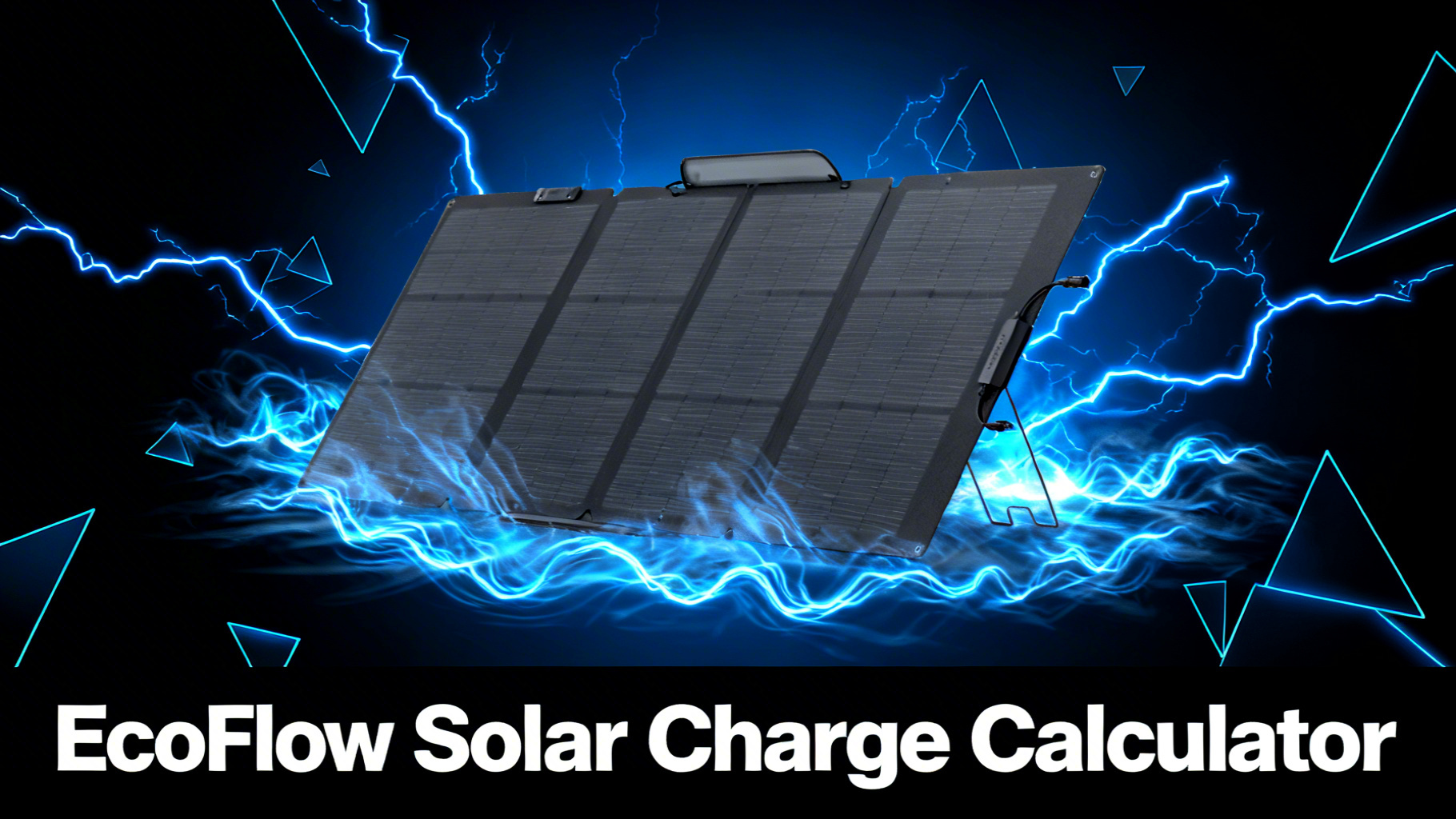
EcoFlow’s solar input specs look straightforward on paper. Then real life intervenes: cloud cover, suboptimal panel angles, MPPT conversion overhead. The number on the spec sheet and the number on your EcoFlow display rarely match.
This page cuts through the confusion. You’ll find a complete charge time reference for every current RIVER and DELTA model paired with every EcoFlow portable solar panel, plus the formula behind the numbers so you can calculate your own scenarios. No guesswork, no marketing copy, just data-driven estimates grounded in verified specifications.

EcoFlow 400W Portable Solar Panel
$599.00
- Up to 23% conversion rate — fastest charging available
- IP68 waterproof rating, self-supporting adjustable stand
- One-piece folding design, XT60 cable included
How This Calculator Works
The Charge Time Formula (Simple Version)
Every charge time estimate on this page uses the same three-variable formula. Once you understand it, you can run your own calculations for any panel and station combination.
The core math: take the station’s capacity in watt-hours, divide by your panel’s rated wattage, then multiply by an efficiency factor that accounts for real-world losses. The result is your realistic charge time in hours.
The Solar Charge Time Formula
Step 1
Capacity (Wh)
e.g. DELTA Pro = 3,600Wh
Step 2
Solar Input (W)
e.g. 400W panel = 400W
Step 3
Efficiency Factor
Typically 1.15-1.25×
Result
Charge Time (hrs)
e.g. ~11.5 hours
Why the efficiency factor? Solar panels rarely deliver rated wattage in real conditions. Temperature, angle, wiring losses, and MPPT conversion overhead mean you should expect 80-88% of panel-rated output on a good day. The 1.15-1.25 multiplier accounts for this, delivering realistic charge time estimates.
For a full breakdown of which station and panel bundle suits your lifestyle, our EcoFlow solar generator guide covers every combo in detail.
What “Efficiency Factor” Actually Means
Rated panel wattage assumes Standard Test Conditions (STC): 25°C cell temperature, 1,000 W/m² irradiance, optimal angle. Outdoor conditions rarely align with all three simultaneously.
The main culprits for lost watts: panel temperature above 25°C (output drops roughly 0.3-0.5% per additional degree), suboptimal tilt angle, partial shading from trees or clouds, cable resistance, and the MPPT controller’s own conversion overhead, which typically runs at 93-97% efficiency. Stack these together and a realistic expectation sits at 80-88% of rated output on a clear, warm day.
⚠️ Important: All charge time estimates in this guide apply a 15-20% efficiency buffer. Your actual results will vary based on location, season, panel placement, and ambient temperature. Think of these numbers as informed targets, not guarantees.
Complete EcoFlow Solar Input Specs: Every Station
Before running charge time calculations, you need to know your station’s maximum solar input. That cap determines everything. Connecting more panel wattage than the station accepts doesn’t reduce charge time further — the excess is simply unused.
EcoFlow Solar Input at a Glance
RIVER 3
110W
Max solar input
245Wh
RIVER 3 Plus
220W
Max solar input
286Wh
DELTA 3
500W
Max solar input
1,024Wh
DELTA 3 Plus
800W
Max solar input
1,024Wh
DELTA 3 Max
1,000W
Max solar input
2,048Wh
DELTA 2 Max
1,000W
Max solar input
2,048Wh
DELTA Pro
1,600W
Max solar input
3,600Wh
DELTA Pro 3
2,600W
Max solar input
4,096Wh
Source: EcoFlow official specifications
EcoFlow Solar Panel Lineup: Which One Do You Have?
EcoFlow sells four portable panels at the time of writing: the entry-level 110W, the NextGen 160W, the NextGen 220W Bifacial, and the flagship 400W. Panel choice matters as much as station selection when calculating real charge times.
EcoFlow Portable Solar Panels — Side by Side
110W
$169
Entry-level
Efficiency: 23%
Weight: 4.6 lbs
IP68 waterproof
Best for: RIVER 3, DELTA 3
NextGen 160W
$209
Mid-range
Efficiency: 25%
30-60° adj. bracket
IP68 waterproof
Best for: DELTA 3, DELTA 3 Plus
Editor’s Pick
NextGen 220W Bifacial
$279
Best value
Efficiency: 25% (bifacial)
Dual-side capture
IP68 waterproof
Best for: DELTA 3 Max, DELTA 2 Max
400W
$599
Premium / High power
Efficiency: 23%
Self-supporting stand
IP68 waterproof
Best for: DELTA Pro, DELTA 2 Max
Before estimating charge times, check the solar input specifications for your specific DELTA or RIVER model — maximum voltage, amperage, and wattage limits vary significantly across the lineup.

The bifacial design on the 220W is worth understanding. Standard panels only capture light on the front face. The bifacial cell structure also captures reflected light from the rear, which adds meaningful output when the panel is positioned over reflective surfaces like concrete, sand, snow, or white gravel. In practice, this means the 220W Bifacial often outperforms panels with higher nominal wattage in real-world setups.

The NextGen 160W sits in a practical middle ground: lighter and more packable than the 220W Bifacial, yet meaningfully more capable than the 110W for mid-size stations like the DELTA 3 and DELTA 3 Plus. Its 25% conversion efficiency matches the Bifacial, making it a strong pick when portability takes priority over maximum output.
EcoFlow Solar Charge Time Tables: All Models
RIVER 3 and RIVER 3 Plus Solar Charge Times

The RIVER 3 accepts up to 110W of solar input, which pairs perfectly with EcoFlow’s own 110W portable panel. Its 245Wh capacity is modest by design, targeting lightweight camping and day-trip backup rather than extended off-grid use. Charge time calculations show that a single 110W panel reaches full charge in roughly 2.8 hours under favorable conditions.
The RIVER 3 Plus bumps capacity to 286Wh and solar acceptance to 220W, opening up the NextGen 220W Bifacial as a single-panel solution. That combination cuts charge time to approximately 1.7 hours — practical enough to top up during a midday break.
💡 Pro Tip: “(capped)” entries in these tables mean the panel’s rated wattage exceeds the station’s maximum solar input. The station accepts exactly its rated maximum — connecting a larger panel than needed doesn’t cause damage, it simply means you’re leaving some capacity unused.
DELTA 3 and DELTA 3 Plus Solar Charge Times
The DELTA 3 and DELTA 3 Plus share the same 1,024Wh capacity but differ significantly on solar input: 500W vs 800W respectively. That gap matters when you’re planning a multi-panel setup. A DELTA 3 with two 220W Bifacial panels (440W) lands inside its 500W cap for full efficiency. The DELTA 3 Plus can push up to 800W, making two 400W panels a viable combination.


DELTA 3 Max Solar Charge Times

The DELTA 3 Max doubles the capacity of the DELTA 3 to 2,048Wh while accepting up to 1,000W of solar input. That ceiling makes it the most versatile station in the DELTA 3 family for serious solar setups. Two 400W panels bring charge time to approximately 2.9 hours — fully viable for daily recharge within a single solar window.
For weekend versus week-long sizing, see our weekend vs week-long camping power guide. For van lifers and RV users, the DELTA 3 Max with two 220W Bifacial panels (440W combined) represents a balanced setup: under 5.3 hours to full on a clear day, manageable weight and panel count, and pricing that stays well below the DELTA Pro tier.
EcoFlow NextGen 220W Bifacial Solar Panel
Best value for DELTA 3 and DELTA 3 Plus owners — bifacial design captures rear-reflected light for up to 25% more energy.
$279.00
DELTA 2 Max Solar Charge Times
The DELTA 2 Max shares the same 2,048Wh capacity and 1,000W solar input as the DELTA 3 Max, but comes from an earlier product generation. Charge time calculations are therefore identical panel-for-panel. Two 400W panels bring it to full in approximately 2.9 hours. Two 220W Bifacial panels take roughly 5.3 hours. Single-panel users with the EcoFlow 400W panel should expect approximately 5.9 hours under favorable conditions.
The DELTA 2 Max’s 1,000W solar cap means running three or four 400W panels provides no advantage over two. Budget for panel quality and positioning rather than adding a third panel beyond what the station can accept.
DELTA Pro Solar Charge Times

The DELTA Pro stands apart from every other station in this guide on one key metric: a 1,600W solar input ceiling that accommodates four 400W panels simultaneously. Its 3,600Wh capacity is substantial, which means charge time calculations show longer absolute times at lower panel counts. A single 400W panel takes approximately 10.4 hours. Two panels cut that to roughly 5.2 hours. Four panels push to the full 1,600W ceiling, delivering a full charge in approximately 2.6 hours.
Owners looking to maximize all four 400W panels in series should read the full DELTA Pro solar setup guide for wiring instructions and angle optimization.
DELTA Pro 3 Solar Charge Times
The DELTA Pro 3 is EcoFlow’s flagship portable station, carrying 4,096Wh of capacity and an extraordinary 2,600W solar input ceiling. Six 400W panels can be connected simultaneously, though the practical limit for most users is two to three. Charge time data for the DELTA Pro 3 reflects its scale: even four 400W panels (1,600W combined) take approximately 2.9 hours to reach full. At six panels pushing the full 2,600W, the calculation drops to approximately 1.8 hours, which is remarkable for a station this size.
For 14-day off-grid trips, see our 2-week camping power planning guide. Keep in mind that the DELTA Pro 3 targets serious off-grid and home backup scenarios. For most camping or van life applications, the DELTA 3 Max or DELTA Pro represents a more proportionate choice for both budget and solar capacity.
Factors That Affect Real-World EcoFlow Solar Charge Times
Weather and Cloud Cover
Cloud cover is the single largest variable outside your control. Thin cirrus clouds reduce panel output by 10-20%. Heavy overcast can cut output to 20-30% of rated capacity. Charge time calculations based on full sun simply don’t apply on cloudy days, which is why the efficiency factor in this guide uses a range rather than a fixed number.
Regional location matters too. A setup in Phoenix, Arizona receives significantly more peak sun hours per day than the same setup in Seattle during winter. For real-world numbers in cold and overcast conditions, the winter solar charging performance guide breaks down panel output across seasons.
Home Backup with EcoFlow
Seasonal solar variation significantly impacts home backup readiness. Our guide covers what to expect across all four seasons.
Panel Angle and Sun Tracking
A flat panel on the ground captures substantially less energy than one tilted toward the sun. The optimal angle changes based on your latitude and the time of year. At mid-latitudes during summer, a tilt of 15-25° typically captures peak output. During winter, steeper angles of 50-60° are more effective.
The EcoFlow NextGen panels include an integrated angle guide and adjustable bracket (30-60°), which helps field users hit closer to optimal without a protractor. Panel tilt has a measurable impact on output, and our solar panel angle optimization guide shows exactly how many watts you lose at sub-optimal angles.
Temperature and Panel Efficiency
Solar panels lose efficiency as they heat up. Most panels have a temperature coefficient of approximately -0.3% to -0.5% per degree Celsius above 25°C. On a hot summer day with the panel surface reaching 50-60°C, you might lose 8-12% of rated output from temperature alone. In cold weather, the opposite occurs: panels often slightly exceed their rated wattage, which partially offsets the typically lower winter irradiance.
Series vs Parallel Wiring for Multi-Panel Setups
When connecting multiple EcoFlow panels to a single station, wiring configuration affects how the MPPT controller handles input. The accepted wiring method depends on the station model and the panel voltage specifications. In general, series wiring increases voltage while keeping amperage constant, while parallel wiring increases amperage while keeping voltage constant. Check your station’s voltage range before deciding on configuration, as some stations have strict voltage windows that affect which wiring option works.
💡 Pro Tip: The EcoFlow OASIS app displays live solar input wattage in real time. Monitoring this during setup lets you immediately verify whether your panel angle and wiring configuration is delivering the expected wattage to the station.
Which EcoFlow Panel Is Right for Your Station?
The data points toward consistent matches between station model and panel choice. Here’s the short version by station:
RIVER 3: The 110W portable panel is the only option that stays within this station’s 110W cap. It’s the correct choice by design.
RIVER 3 Plus: The NextGen 220W Bifacial hits the 220W ceiling exactly and cuts charge time nearly in half compared to the 110W. Worth the upgrade for regular users.
DELTA 3: Two NextGen 220W Bifacial panels (440W combined) represent the practical ceiling for this station’s 500W cap. A single 400W panel also works and falls within range.
DELTA 3 Plus and DELTA 3 Max: Both accept up to four 220W Bifacial panels. Two 400W panels also work efficiently within both stations’ limits.
DELTA 2 Max: Same solar ceiling as the DELTA 3 Max (1,000W). Two 400W panels deliver the fastest practical charge time at approximately 2.9 hours.
DELTA Pro: Four 400W panels max out this station’s 1,600W input for the fastest possible charge. Two panels represents the best balance of cost and performance for most users.
DELTA Pro 3: Designed for large solar arrays up to 2,600W. Most users won’t need more than three to four 400W panels to achieve acceptable charge times.
EcoFlow Solar Generator Guide
For a full breakdown of which station and panel bundle suits your lifestyle, our EcoFlow solar generator guide covers every combo in detail.
Once you know your charge time, use our power station runtime calculator to estimate how long each station lasts on a full charge. The two tools work together: charge time tells you how fast you can replenish, runtime tells you how long you can run.
For regional solar yield estimates by location, NREL solar irradiance data provides detailed figures that help translate the charge time tables above into practical daily expectations for your specific area.
Frequently Asked Questions
How long does it take to charge an EcoFlow DELTA Pro with solar panels?
Charge time data for the DELTA Pro (3,600Wh) shows approximately 2.6 hours with four 400W panels at its maximum 1,600W input. A single 400W panel requires approximately 10.4 hours. Two 400W panels, the most common setup, take approximately 5.2 hours under good sun conditions. These estimates apply a realistic efficiency factor accounting for MPPT conversion and wiring losses.
Can I charge my EcoFlow faster by connecting more solar panels?
Yes, up to the station’s maximum solar input limit. Adding panels beyond that limit does not reduce charge time further. The DELTA Pro accepts up to 1,600W, so a fifth 400W panel adds no benefit. Each station’s cap is listed in the specs table above.
Why is my actual charge time longer than the numbers in this table?
Several factors reduce real-world solar output below panel-rated watts: suboptimal panel angle, partial shading, high ambient temperatures (panels lose efficiency above 25°C), and the MPPT conversion process itself. The estimates in this guide already apply a 15-20% efficiency buffer. Actual results depend on location, season, and installation.
Can I use non-EcoFlow solar panels to charge my EcoFlow station?
Yes, provided the panel’s output falls within the station’s accepted voltage range and the connector is compatible (or adapted). EcoFlow stations use XT60 connectors for solar input. Third-party panels with matching voltage specs and an XT60 adapter are compatible. Voltage is the critical spec to check, not just wattage.
Does the EcoFlow app show real-time solar charge time estimates?
Yes. The EcoFlow OASIS app displays live solar input wattage and a remaining charge time estimate based on current conditions. This real-time figure is more accurate than any pre-calculated estimate since it reflects actual output at that moment.
Is the NextGen 220W Bifacial panel worth the premium over the 110W for my DELTA 3?
Spec-for-spec analysis shows the 220W Bifacial roughly halves charge time compared to the 110W on a DELTA 3 (5.3 hours vs 10.7 hours) and adds bifacial capture that delivers measurable gains in environments with ground reflection (concrete, sand, snow). For frequent solar users who want to charge fully in a single day, the data supports the upgrade. Occasional campers charging smaller stations may find the 110W sufficient.

EcoFlow 400W Portable Solar Panel
$599.00
Fastest solar charging for DELTA 2 Max and DELTA Pro — the benchmark for serious solar setups.
Price verified March 2026 — Free shipping available
Related Reads
Originally published: March 25, 2026