
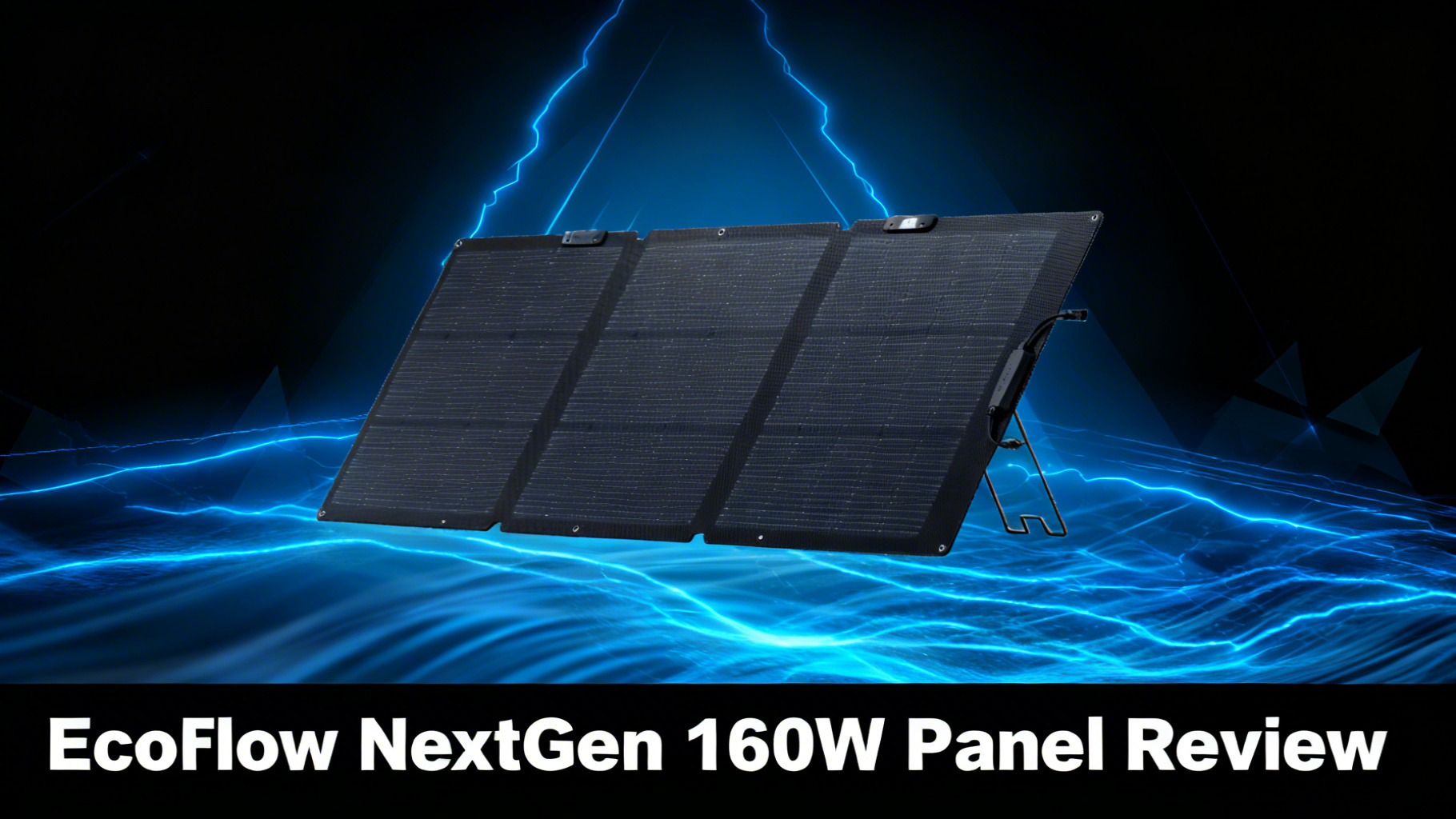
Looking for a portable solar panel that hits the sweet spot between output, durability, and price? EcoFlow’s NextGen 160W panel sits right in the middle of their solar lineup, and it’s aimed squarely at campers, weekend off-gridders, and RIVER/DELTA owners who want reliable solar charging without spending $400 or more.
At $209 (down from an original $449 MSRP), the NextGen 160W undercuts most competing 200W panels while still delivering specs that matter: up to 25% conversion efficiency, an IP68 waterproof rating, and a foldable design that weighs just 15.4 lbs. But do the real-world numbers hold up? And is it the right panel for your specific power station?

Our analysis of the NextGen 160W covers efficiency data, charge time estimates across popular EcoFlow stations, build quality, and how it stacks up against the 110W and 220W Bifacial alternatives. Here’s what the data shows.
EcoFlow NextGen 160W Portable Solar Panel
$209 $449
- Up to 25% solar conversion efficiency
- IP68 waterproof and dustproof rating
- 15.4 lbs, foldable with integrated kickstand
Quick Specs and Key Features
Before diving into performance details, here’s a quick look at what the NextGen 160W brings to the table. These specs come directly from EcoFlow’s verified product data.
| Specification | Details |
|---|---|
| Rated Power | 160W |
| Conversion Efficiency | Up to 25% (standard 21-22%) |
| Weight | 15.4 lbs (7 kg) |
| Waterproof Rating | IP68 (dust and water resistant) |
| Surface Coating | ETFE (UV protection) |
| Adjustable Bracket | 30-60° with integrated angle guide |
| Connector Type | XT60 (solar to XT60 cable included) |
| Price | $209 |
The standout features here are the 25% conversion efficiency claim (above the standard 21-22% for most portable panels), the full IP68 dust and water resistance, and the included XT60 charging cable. That last point matters: many competing panels require you to buy an adapter separately. For the complete technical datasheet, visit the official EcoFlow 160W panel specs page.

Design, Build Quality, and Portability
The NextGen 160W uses a foldable, two-panel design that packs down into a compact rectangle for transport. The carrying case doubles as a kickstand, which lets you position the panel at different angles without needing separate mounting hardware. It’s a practical design choice that reduces the number of accessories you need to carry.

Build quality is a clear strength. The ETFE (ethylene tetrafluoroethylene) coating protects the solar cells against UV degradation over time, extending the panel’s usable lifespan. The seamless, one-piece construction is what enables that IP68 rating, meaning it can handle dust, rain, and splashes without issue. For campers who deal with unpredictable weather, this level of protection removes a common worry.
The 30-60 degree adjustable bracket comes with an integrated solar angle guide, which helps you position the panel for optimal sun exposure throughout the day. The 30-60 degree adjustable bracket works well for seasonal adjustments, and our solar panel angle optimization guide explains how to get peak output at any time of year.
📐 Related Guide: Getting the angle right matters more than most people think. Our solar panel angle optimization guide shows exactly how to position panels for peak output at every season.
At 15.4 lbs, portability is decent for car camping and RV use but starts to feel heavy for backpacking. If you’re hiking to remote campsites, the weight adds up quickly compared to lighter 100W options. For vehicle-based camping, though, it’s manageable, and the foldable form factor fits easily in a trunk or RV storage compartment.
Real-World Charging Performance
Here’s where the numbers matter most. EcoFlow rates this panel at 160W peak output, but real-world performance depends heavily on sun angle, cloud cover, and temperature. Performance data from the owner community consistently shows 120 to 140W of actual output under clear, direct sunlight. That’s roughly 75-88% of the rated capacity, which falls within the normal range for portable solar panels.


The efficiency story is worth unpacking. EcoFlow claims up to 25% conversion efficiency for the NextGen line, compared to the standard 21-22% found in their older panels. In practice, this translates to slightly better output per square foot of panel area, which means you get more watts from a smaller, lighter panel.
What about cloudy days? Expect output to drop by 50-70% during overcast conditions, a common challenge we cover in our guide to solar charging on cloudy days. Partial shade is even more punishing. If even one section of the panel is shaded, total output can drop dramatically because solar cells are wired in series.
💡 Pro Tip: Reposition your panel every 2-3 hours to track the sun’s movement. This simple habit can increase your total daily energy harvest by 20-30% compared to a fixed position.
Compatibility and Charging Performance
The NextGen 160W connects to EcoFlow power stations via an XT60 connector, and the solar-to-XT60 charging cable comes included in the box. This matters because some competitors charge extra for the cable, adding $20-30 to the effective price.

When paired with an EcoFlow power station, the panel benefits from EcoFlow’s MPPT (Maximum Power Point Tracking) algorithm, which optimizes the charge rate based on real-time conditions. This is designed to produce maximum power at any time of the day, with improved performance in cold and cloudy environments within the operation range. How long does it take to charge your station? Here’s a breakdown based on rated output at roughly 85% real-world efficiency.
Estimated Solar Charge Times (1x 160W Panel, Full Sun)
⚡
RIVER 3 (245Wh)
~2 hrs
0-100%
🔋
DELTA 3 (1024Wh)
~7.5 hrs
0-100%
🏠
DELTA 3 Plus (1024Wh)
~7.5 hrs
0-100%
☀️
RIVER 3 Plus (286Wh)
~2.5 hrs
0-100%
Charge times estimated using 160W rated output at ~85% real-world efficiency (~136W effective). Actual times vary with sunlight, angle, and temperature.
If you plan to connect multiple 160W panels, understanding series vs parallel solar panel wiring helps you maximize total wattage input. Two panels in parallel effectively double your input, cutting charge times roughly in half on stations that support higher solar input wattage. Use our portable power station calculator to estimate exactly how long this panel takes to charge your specific EcoFlow model.
What We Like About the NextGen 160W
Strong 25% Conversion Efficiency Rating
The NextGen line represents an upgrade over EcoFlow’s older panels, which topped out at 21-22% efficiency. That 3-4 percentage point improvement translates to more usable watts from the same panel size. In practical terms, you’re looking at roughly 120-140W of real output instead of 105-120W, which can shave 30-60 minutes off a full charge cycle on a mid-capacity station.
IP68 Water and Dust Resistance Built for the Outdoors
IP68 is the highest consumer-grade dust and water resistance rating available. The seamless one-piece construction means there are no seams or gaps where moisture can enter the panel cells. Owner reports confirm reliable performance in rain and dusty conditions. Keep in mind that while the panel itself is IP68 rated, the XT60 connector junction should still be kept dry during active charging.
Adjustable Bracket Simplifies Angle Optimization
The integrated 30-60 degree bracket with built-in angle guide removes much of the guesswork from panel positioning. Rather than propping your panel against a rock or cooler (a common campsite hack), the kickstand case gives you predictable, repeatable angles. This consistency helps you get closer to optimal output each time you set up.
XT60 Cable Included, No Extra Purchases Needed
The solar-to-XT60 charging cable ships in the box. This seems like a small detail, but competing panels from other brands often require a separate cable or adapter purchase. For first-time solar buyers, having everything you need in one package reduces friction and hidden costs. If you need additional length, an ecoflow solar panel extension cable is available separately.
What Could Be Better
15.4 lbs Adds Up for Backpacking Trips
For car camping and RV use, 15.4 lbs is manageable. For backpacking or bike touring, it’s a different story. The EcoFlow 110W panel saves over 4 lbs, and for weight-conscious users, that difference matters. If portability is your top priority and you can accept slower charge times, the lighter panel is worth considering.
Single-Sided Design Leaves Bifacial Gains on the Table
The NextGen 160W is a traditional single-sided panel. EcoFlow’s 220W Bifacial alternative captures reflected light from the back side, boosting total energy harvest by up to 25% in environments with reflective surfaces (snow, sand, light-colored concrete). If you frequently camp in these conditions, the 160W’s single-sided design means you’re leaving free energy uncaptured.
⚠️ Important: Bifacial gains only apply in environments with reflective ground surfaces. On grass, dirt, or dark pavement, a bifacial panel performs essentially the same as a single-sided panel of equivalent wattage.
Only 12-Month Warranty (vs 2+ Years on Power Stations)
EcoFlow’s power stations typically come with 2-5 year warranties. The solar panels, however, carry only a 12-month warranty. For a $209 purchase, this feels conservative, especially compared to rigid rooftop panels that often come with 10-25 year warranties. The ETFE coating and IP68 build suggest the panel should last well beyond a year, but the warranty coverage doesn’t match that confidence.
How It Compares
The 160W sits in a clear mid-range position within EcoFlow’s solar panel lineup. Here’s how it stacks up against the panels immediately above and below it.
Where the 160W Fits in the EcoFlow Solar Lineup
Entry
110W
$169
★ THIS PANEL
160W
$209
Premium
220W Bifacial
$279
Max Output
400W
$599
| Feature | 110W | 160W (NextGen) | 220W Bifacial |
|---|---|---|---|
| Price | $169 | $209 | $279 |
| Rated Output | 110W | 160W | 220W |
| Efficiency | 22% | Up to 25% | 23% |
| Bifacial | ❌ No | ❌ No | ✅ Yes |
| Waterproof Rating | IP68 | IP68 | IP68 |
| Best For | Ultralight / budget | Best balance | Max output / snow |

The mid-range argument for the 160W is straightforward. It costs only $40 more than the 110W but delivers 45% more power. The 220W Bifacial costs $70 more and adds bifacial capability, but that extra output only materializes on reflective surfaces. For most campers on grass, dirt, or asphalt, the 160W delivers the best watts-per-dollar in the lineup.
Who Should Buy This Panel
✅ Buy this if…
- You own a RIVER 3/Plus or DELTA 3 and want a single-panel solar setup
- You camp regularly and need a portable, durable panel under $250
- You want IP68 dust and water protection for variable outdoor conditions
❌ Skip this if…
- You need to charge a DELTA Pro or DELTA 3 Max quickly (look at 220W or 400W)
- You want the absolute lightest option (the 110W saves 4+ lbs)
- You prioritize bifacial energy capture (upgrade to the 220W Bifacial)

The ideal buyer is a RIVER 3 or DELTA 3 owner who camps regularly and wants a single-panel solar setup that’s easy to deploy and durable enough for unpredictable weather. Weekend campers who run phones, laptops, lights, and a small fan will find the 160W provides enough daily solar input to keep a RIVER-class station topped off.
Budget-conscious solar buyers also benefit here. At $209, the NextGen 160W offers better value per watt than either the 110W ($1.54/W) or the 220W Bifacial ($1.27/W), coming in at $1.31 per watt of rated output. If you only plan to buy one panel, the 160W gives you the most practical output for the price.
Who Should Skip This Panel
If you own a DELTA Pro or DELTA 3 Max with capacities above 2,000Wh, a single 160W panel is too slow for practical solar charging. You’d need two or three panels in parallel, at which point the 400W panel or a multi-panel 220W setup makes more financial sense.
Ultralight backpackers should look at the 110W or even smaller panels from brands specializing in lightweight gear. The 15.4 lb weight is reasonable for vehicle-based camping but not for anything you’re carrying on your back for miles.
Finally, if you camp frequently on snow, sand, or light-colored surfaces, the 220W Bifacial’s rear-side energy capture is worth the $70 premium. On reflective surfaces, it can generate up to 25% more energy than a single-sided panel of comparable front-side wattage.
Final Verdict: 8.2/10
The EcoFlow NextGen 160W Portable Solar Panel occupies a well-defined mid-range position in EcoFlow’s solar lineup. It delivers strong efficiency (up to 25%), reliable IP68 durability, and broad compatibility with RIVER and DELTA series stations. At $209, it offers solid value for campers and weekend off-grid users who want a single-panel setup without overspending.
EcoFlow NextGen 160W Solar Panel, Overall Rating
8.2/10
“The sweet spot between portability and output for most EcoFlow owners”
Efficiency 8/10
Build Quality 9/10
Value 8/10
Portability 7/10
Versatility 9/10
Ease of Use 8/10
The limitations are real but context-dependent. The 15.4 lb weight rules it out for serious backpacking. The single-sided design means you miss out on bifacial gains in reflective environments. And the 12-month warranty feels short for the price. But for the core audience of vehicle-based campers and EcoFlow station owners who want dependable solar charging, the NextGen 160W is the panel that makes the most sense.
EcoFlow NextGen 160W Solar Panel
$209
Best mid-range portable solar panel for EcoFlow stations
Price verified March 2026. Free shipping available
Frequently Asked Questions
Is the EcoFlow 160W solar panel waterproof?
Yes. The NextGen 160W carries an IP68 rating for water and dust resistance. The seamless, one-piece design and ETFE coating provide protection during rain, splashes, and dusty outdoor conditions. That said, the XT60 connector junction should stay dry during active charging to avoid corrosion over time.
How long does the EcoFlow 160W panel take to charge a DELTA 3?
With a single 160W panel in direct sunlight, expect approximately 7 to 8 hours for a full 0-100% charge on the DELTA 3 (1,024Wh). Two panels in parallel cut that time roughly in half, depending on sun conditions. These estimates assume about 85% real-world efficiency from the rated 160W output.
Can I use the EcoFlow 160W panel with non-EcoFlow power stations?
The panel uses a standard XT60 output connector. While it is optimized for EcoFlow’s MPPT algorithm, it can technically work with third-party stations that accept XT60 input or with an appropriate adapter cable. Performance may vary outside the EcoFlow ecosystem since the MPPT tuning is designed specifically for EcoFlow hardware.
What is the real-world output of the EcoFlow 160W panel?
Under ideal full-sun conditions (clear sky, perpendicular angle, moderate temperature), owner data consistently reports 120 to 140W of actual output. The 160W rating represents peak lab conditions. Cloudy weather typically drops output by 50-70%. The EnergySage solar efficiency guide explains how conversion rates translate into real-world performance.
How does the 160W compare to the 220W Bifacial?
The 220W Bifacial captures light from both sides, boosting total energy harvest by up to 25% in reflective environments (snow, sand, light concrete). It costs $70 more ($279 vs $209) and weighs slightly more. For flat ground or rooftop use without reflective surfaces, the 160W offers better value per dollar since the bifacial advantage doesn’t apply.
Does the EcoFlow 160W panel work well in winter?
Solar output drops in winter due to shorter days and lower sun angles, not cold temperatures. Cold can actually improve panel efficiency slightly. Expect 60-80W on clear winter days at mid-latitudes. For detailed tips on maximizing output in cold months, see our guide to winter solar charging strategies.
Originally published: March 25, 2026