
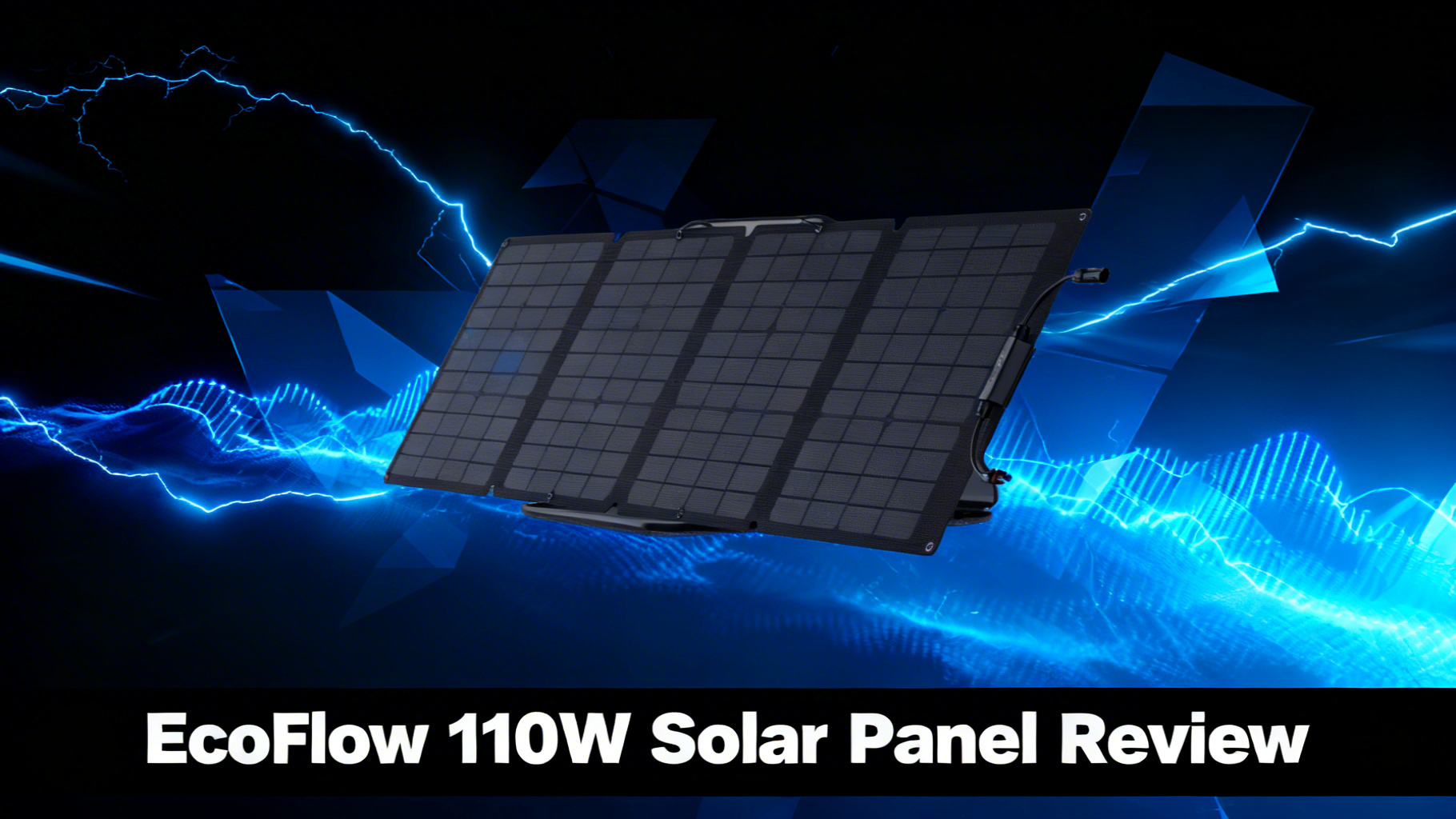
Looking for an affordable solar panel that pairs seamlessly with your EcoFlow power station? The EcoFlow 110W Portable Solar Panel has been one of the brand’s most accessible entry points into solar charging, priced at just $169 (down from $399 MSRP). But with EcoFlow’s newer NextGen lineup now available, is this panel still worth your money in 2026?
The 110W sits at the bottom of EcoFlow’s solar panel range, targeting weekend campers, RIVER series owners, and budget-conscious buyers who want to dip into solar without a major investment. It uses monocrystalline silicon cells rated at up to 23% conversion efficiency, comes with an IP68 waterproof rating, and folds into a compact one-piece design with a built-in kickstand.

Our analysis covers the full spec sheet, real-world charge time calculations for popular EcoFlow units, build quality, and how the 110W stacks up against the NextGen 160W and 220W Bifacial panels. Here’s what the data reveals.
The Bottom Line: The EcoFlow 110W is a solid, no-frills entry-level solar panel for RIVER series owners and occasional campers. At $169, it delivers reliable performance and IP68 durability. However, DELTA owners and heavy solar users get better value per watt from the NextGen 160W ($1.31/W vs $1.54/W).
⚡ EcoFlow 110W Portable Solar Panel
$169 $399
-58% OFF
- ✅ 23% conversion efficiency, monocrystalline cells
- ✅ IP68 waterproof, built-in kickstand (0-180°)
- ✅ Compatible with all EcoFlow RIVER and DELTA units
Check Current Price on EcoFlow →
💡 Price checked March 2026 | Free shipping available
Quick Specs & Key Features

The EcoFlow 110W is built around monocrystalline silicon cells, the same cell technology used across most premium portable solar panels. At 23% efficiency, it sits right at the industry standard for this class of panel, meaning it converts roughly a quarter of available sunlight into usable electricity. For reference, monocrystalline solar panel efficiency data shows that most portable panels in this price range fall between 21% and 24%.
The XT60 connector is EcoFlow’s proprietary standard, included in the box along with the Solar to XT60 charging cable. This means plug-and-play compatibility with every RIVER and DELTA unit in EcoFlow’s lineup, no adapters needed. The panel is also chainable: you can link up to 2 panels in parallel for RIVER series or 4 panels in parallel for DELTA series using EcoFlow’s parallel cable accessory.
At ~13.2 lbs, the 110W is light enough for car camping and tailgating, though it’s not a panel you’d want to carry on a long hike. The one-piece folding design keeps things simple: unfold, prop up the kickstand, connect, and you’re charging. You can check the full details on the official EcoFlow 110W product page.
What We Love About the EcoFlow 110W
23% Monocrystalline Efficiency at $169
At $169, the 110W panel delivers monocrystalline efficiency that matches panels costing two or three times as much. The 23% conversion rate is not groundbreaking, but it’s solidly competitive. What makes this panel stand out is the price-to-performance ratio: you get a reliable, name-brand panel with full EcoFlow ecosystem compatibility for less than many generic alternatives.
Performance data indicates that in ideal conditions (direct sunlight, clear skies, optimal panel angle), the 110W can reach its rated output. Real-world figures typically land between 70-90W, which is normal for any portable solar panel once you factor in angle, time of day, and atmospheric conditions.
IP68 Waterproof Rating for All-Weather Use
The IP68 rating is one of the highest waterproof certifications available for portable solar panels. It means the panel is completely dust-tight and can handle submersion in water. In practical terms, you don’t need to scramble to pack it away during a sudden rainstorm. Rain, dust, splashes, and morning dew won’t damage the cells or the wiring.
For campers and outdoor users, this durability rating removes a lot of worry. Owner feedback consistently reports the panel holding up well across seasons, even in rough conditions. Keep in mind that while the panel itself is IP68, the cable connections should still be protected from prolonged water exposure.
Self-Supporting Kickstand with 0-180° Adjustment
The built-in kickstand is one of the 110W’s most practical features. It adjusts from 0 to 180 degrees, allowing you to angle the panel precisely toward the sun without needing rocks, sticks, or third-party stands. This matters more than most people realize: even a 15-degree angle adjustment can increase output by 10-15% during morning and afternoon hours.

💡 Pro Tip: The 110W panel’s adjustable kickstand works best when aimed directly at the sun. Our solar panel angle optimization guide walks you through the best angle for each season.
One-Piece Folding Design for Easy Transport
The 110W uses a simple one-piece folding design with a rubber handle. Fold it in half, latch it shut, and it’s ready to go. There are no loose flaps, separate bags, or complicated assembly steps. At 13.2 lbs folded, it fits easily in a car trunk, RV storage bay, or behind a van seat.

This simplicity is a genuine advantage over multi-panel designs that require unfolding three or four sections. For weekend campers who want a grab-and-go solar solution, the 110W nails the convenience factor.
What Could Be Better
110W Output Limits Charging Speed for Larger Units
Here’s where the 110W shows its limitations. If you’re pairing it with a DELTA 3 (1,024Wh) or DELTA Pro, charge times stretch into the 10-12 hour range with a single panel. That’s essentially a full day of sunlight just to top off one unit. For RIVER series owners with smaller batteries (245-286Wh), this isn’t an issue. But DELTA owners will feel the bottleneck quickly.
The math is straightforward: 110W of solar input into a 1,024Wh battery, factoring in real-world efficiency losses, means slow going. If you own a DELTA unit and want reasonable solar charge times, the NextGen 160W or 220W panels are the smarter pick.
No USB-C or USB-A Direct Output Ports
Unlike some competing panels from Jackery and Bluetti, the EcoFlow 110W has no built-in USB ports. You can’t charge a phone or tablet directly from the panel. Everything has to route through a power station first, which means you always need your RIVER or DELTA unit in the chain. For some users, this is a non-issue. For others, especially hikers or day-trippers who want to charge a phone without carrying a power station, it’s a notable gap.
Older Generation Design Compared to NextGen Lineup
The 110W is part of EcoFlow’s original panel lineup, not the newer NextGen series. The NextGen panels feature updated cell technology, improved cable management, and (in the case of the 220W Bifacial) dual-sided energy collection. The 110W still works perfectly well, but it lacks the refinements that the NextGen models bring. If you’re buying into the EcoFlow ecosystem for the first time, it’s worth comparing the 110W against the NextGen 160W before committing.
Charge Times with EcoFlow Power Stations
Charge time is where the rubber meets the road for any solar panel. Here’s what the calculations show when pairing a single EcoFlow 110W panel with popular EcoFlow power stations, assuming full sun conditions and accounting for typical efficiency losses.
Estimated Charge Times with 1x EcoFlow 110W Panel
⚡
RIVER 3 (245Wh)
~2.5 hrs
Full sun conditions
🔋
RIVER 3 Plus (286Wh)
~3 hrs
Full sun conditions
🏠
DELTA 3 (1024Wh)
~10-12 hrs
Full sun, single panel
⚙️
DELTA 3 Plus (1024Wh)
~10-12 hrs
Full sun, single panel
The pattern is clear. The 110W panel is a natural match for RIVER series units with their smaller batteries. A RIVER 3 goes from empty to full in roughly 2.5 hours of good sunlight, which is practical for a day at camp. DELTA units, with their much larger capacities, need multiple panels chained together (or an AC wall charge overnight) to keep up.
If you plan to chain two or more 110W panels, understanding series vs parallel solar panel wiring helps you maximize input. Two 110W panels in parallel cut RIVER charge times roughly in half, and four panels make DELTA charge times much more manageable.


🔧 Tool: Not sure if 110W is enough for your setup? Use our portable power station calculator to match your daily usage with the right panel size.
How It Compares: 110W vs 160W vs 220W
Is the 110W the right call, or should you spend a bit more? Here’s a spec-for-spec comparison of EcoFlow’s three main portable solar panel options.
The numbers tell an interesting story. The 110W has the lowest sticker price at $169, but the highest cost per watt at $1.54/W. The NextGen 160W, at $209, drops that ratio to $1.31/W, and the 220W Bifacial brings it down to $1.27/W. In pure value-per-watt terms, the 110W is actually the least efficient use of your money.
So why would you choose the 110W? Two scenarios make it the right pick. First, if you own a RIVER 3 or RIVER 3 Plus, you don’t need more than 110W of solar input. The battery capacity is small enough that one panel handles the job in about 2.5-3 hours. Second, if the $40 difference between $169 and $209 is a real budget factor, the 110W gets you into solar without stretching your finances.
For DELTA series owners, the analysis points clearly toward the NextGen 160W or 220W. The extra wattage translates directly into faster charge times, and the lower cost per watt means you’re getting more solar production for your dollar.
Who Should Buy the EcoFlow 110W
✅ Buy this if…
- You own an EcoFlow RIVER 3, RIVER 3 Plus, or similar compact unit
- You need a portable panel for weekend camping and day trips
- You want IP68 waterproof protection for unpredictable weather
- Budget is a priority and you need the lowest entry point into EcoFlow solar
❌ Skip this if…
- You own a DELTA Pro or DELTA 3 Max and need fast solar recharging
- You plan to run an off-grid setup that demands 200W+ solar input
- You want bifacial technology for maximum efficiency in varied conditions
Weekend campers who already own one of the best power stations for camping will find the 110W panel a natural companion. It’s light enough to throw in the car, durable enough for unpredictable weather, and powerful enough to keep a RIVER unit topped off during a two-day trip.
RIVER series owners are the sweet spot for this panel. The battery capacities of the RIVER 3 (245Wh) and RIVER 3 Plus (286Wh) match well with 110W of solar input, delivering full charges in 2.5-3 hours of good sunlight. You get a complete solar charging loop without overspending on panel wattage you don’t need.
Use our portable power station calculator to figure out how much solar capacity matches your daily power needs.
Who Should Skip This Panel
If you own a DELTA Pro, DELTA 3 Max, or any EcoFlow unit with 1,500Wh+ capacity, the 110W panel will feel underpowered. You’ll be waiting all day for a partial charge, which defeats the purpose of portable solar. The NextGen 160W ($209) or 220W Bifacial ($279) are better investments for larger units.
Off-grid users and full-time van lifers who rely on solar as a primary charging source should also look elsewhere. A 110W panel simply doesn’t produce enough daily energy to sustain continuous use. You need at least 200-400W of total solar input for a reliable off-grid setup.
Finally, if you’re drawn to EcoFlow’s latest technology (bifacial cells, improved cable management, updated aesthetics), the NextGen lineup is the better entry point. The 110W is a proven, reliable design, but it lacks the refinements of the newer generation.
FAQ
Is the EcoFlow 110W compatible with non-EcoFlow power stations?
The EcoFlow 110W uses an XT60 connector, which is EcoFlow’s proprietary connection standard. It plugs directly into all EcoFlow RIVER and DELTA series units without adapters. For non-EcoFlow power stations that use MC4 connectors (the more common industry standard), you would need a third-party XT60-to-MC4 adapter cable. Keep in mind that EcoFlow does not officially support this configuration, so compatibility and performance may vary.
Can I chain two EcoFlow 110W panels together?
Yes. EcoFlow supports chaining up to 2x 110W panels in parallel for RIVER series units and up to 4x 110W panels in parallel for DELTA series units. You’ll need EcoFlow’s parallel cable accessory (sold separately) to connect them. Chaining panels doubles or quadruples the solar input, cutting charge times proportionally. If you plan to chain panels, our guide on series vs parallel solar panel wiring explains the best configuration.
What does the 23% conversion rate mean in practice?
The 23% conversion rate describes how efficiently the monocrystalline silicon cells turn sunlight into electricity. In ideal conditions (direct sunlight, optimal angle, clear skies), the panel can reach its full 110W rated output. In real-world use, output typically ranges from 70-90W depending on panel angle, time of day, cloud cover, and temperature. According to monocrystalline solar panel efficiency data, 23% is competitive with most portable panels in this price range.
How does the 110W perform on cloudy days?
Solar output drops significantly in overcast conditions. On partly cloudy days, expect roughly 20-40% of rated output (22-44W). Heavy overcast can push production down to 10-15% of the rated wattage. The panel still generates power in diffused light, but charge times increase substantially. Our guide on solar charging on cloudy days explains how to maximize production when the sun is not cooperating. For users in consistently cloudy climates, a higher-wattage panel like the NextGen 160W or 220W Bifacial may be more practical.
Is the EcoFlow 110W worth it over the NextGen 160W?
It depends on your power station. The 110W costs $169 ($1.54/W) while the NextGen 160W costs $209 ($1.31/W). The 160W delivers better value per watt and faster charging speeds. The 110W makes sense if you primarily charge RIVER series units (which have lower max solar input) or if the $40 price difference is a real factor. For DELTA series owners, the 160W or 220W is generally the smarter investment because it significantly reduces charge times.
Does the EcoFlow 110W include a carrying case?
No, the EcoFlow 110W does not come with a separate carrying case. However, the one-piece folding design with a built-in rubber handle makes it self-contained for transport. The panel folds in half and latches securely, protecting the solar cells during storage and travel. The Solar to XT60 charging cable is included in the box, so you have everything you need to start charging right away.
Final Verdict: 7.5/10
The EcoFlow 110W Portable Solar Panel does exactly what it promises: it provides affordable, reliable solar charging for EcoFlow power station owners. It’s not the most powerful panel, it’s not the best value per watt, and it lacks the updated features of the NextGen lineup. But at $169, with IP68 waterproofing, a practical kickstand, and full ecosystem compatibility, it earns its place as a solid entry-level option.
EcoFlow 110W Portable Solar Panel, Overall Rating
7.5/10
“Affordable, reliable entry-level solar for EcoFlow owners”
⚡ Efficiency 7/10
💰 Value 8/10
🎨 Build Quality 8/10
📦 Portability 8/10
🔌 Compatibility 7/10
🌧️ Durability 8/10
The best candidates for this panel are RIVER 3 and RIVER 3 Plus owners who want to add solar charging for weekend trips and occasional outdoor use. If you’re in that camp, the 110W is a practical, well-built choice that won’t disappoint.
If you own a DELTA series unit or plan to scale your solar setup beyond 200W, skip the 110W and invest the extra $40-$110 in the NextGen 160W or 220W Bifacial. The faster charge times and better cost per watt pay for themselves quickly.
EcoFlow 110W Portable Solar Panel
$169
Best entry-level EcoFlow panel for RIVER and DELTA owners
Price verified March 2026 | Free shipping available
Originally published: March 25, 2026