
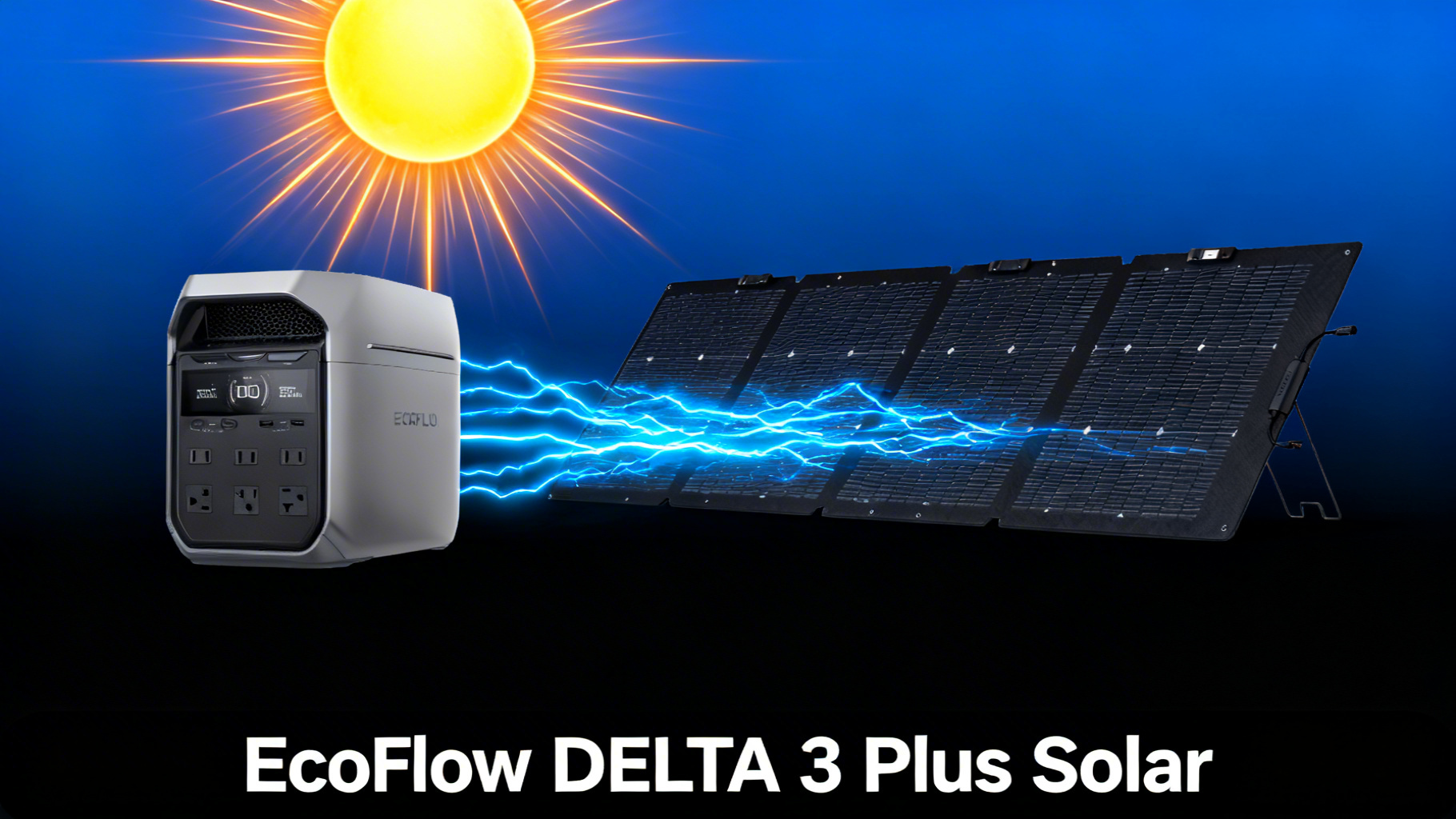
Want to charge your EcoFlow DELTA 3 Plus entirely from the sun? With 1024Wh of LiFePO4 capacity and a generous 500W max solar input, this power station is built for fast, efficient solar recharging. The question isn’t whether solar works with the DELTA 3 Plus. It’s which panels give you the best charge time for your budget.
In this guide, we’ll walk you through the complete solar setup process: which EcoFlow panels pair best with the DELTA 3 Plus, how to connect everything, and how to squeeze maximum wattage out of your panels. Whether you’re setting up for a weekend camping trip or building a reliable off-grid charging system, the steps are simpler than you might expect.

The DELTA 3 Plus is priced at $599 (down from $799), and it supports expandable capacity from 1 to 5kWh with extra batteries. It delivers 1800W AC output (2200W surge, 3600W with X-Boost) and offers five recharging methods including solar, AC, 800W alternator charger, Smart Generator 3000 (Dual Fuel), and multicharging. Add a 5-year warranty, and you have a mid-range power station that’s clearly designed for serious solar users.
✅ This setup is ideal if…
- You want a full solar recharge during a single day of camping
- You need 1024Wh for small appliances, laptops, and phone charging
- You want expandability up to 5kWh with extra batteries
- You prefer EcoFlow’s XT60 plug-and-play solar connectivity
❌ Consider alternatives if…
- You need to power high-draw appliances like an AC unit or full-size fridge
- You require more than 500W of solar input for rapid off-grid recharging
- You need whole-home backup capacity (look at DELTA Pro or DELTA 3 Max)
⚡ EcoFlow DELTA 3 Plus – Current Best Price
$599
$799
-25% OFF
- ✅ 1024Wh LiFePO4 battery, expandable to 5kWh
- ✅ 1800W AC output (3600W surge with X-Boost)
- ✅ 500W max solar input, charges in ~2 hours
Check Current Price on EcoFlow →
💡 Price checked March 2026 | Free shipping available
What You’ll Need
Required Equipment
Before you start, gather these essentials. The good news: if you’re using EcoFlow’s own solar panels, you won’t need any adapters or extra cables.
- EcoFlow DELTA 3 Plus portable power station (1024Wh, 500W max solar input)
- EcoFlow NextGen solar panel: either the 160W ($209) or the 220W Bifacial ($279), or two panels for faster charging
- XT60 solar charging cable (included with all EcoFlow NextGen panels)
Not sure if the 1024Wh capacity is right for your needs? Use our power station sizing calculator to estimate your daily power draw.
Optional But Helpful
- EcoFlow App (iOS/Android): monitors real-time solar input wattage, battery percentage, and estimated charge time
- Parallel Y-splitter cable (XT60): required only if connecting two solar panels simultaneously
- MC4-to-XT60 adapter: needed only if using third-party (non-EcoFlow) solar panels
Estimated Time and Difficulty
Setup time: 10 to 15 minutes for a single panel, 15 to 20 minutes for a dual-panel configuration. Difficulty: Beginner-friendly. No tools required. If you can plug in a laptop charger, you can set this up.

DELTA 3 Plus Solar Input Specs
Before connecting anything, it helps to know exactly what the DELTA 3 Plus can handle on the solar side. You can verify these numbers on the official DELTA 3 Plus specs page.
⚡ EcoFlow DELTA 3 Plus Solar Charging Specs
Max Solar Input
500W
Battery Capacity
1024Wh
Voltage Range
11-60V
Solar Connector
XT60
💡 Note: The DELTA 3 Plus uses an MPPT charge controller for maximum solar efficiency. Full solar charge takes approximately 2 to 2.5 hours with 500W input.

The key numbers: 500W maximum solar input and a voltage range of 11 to 60V. The MPPT (Maximum Power Point Tracking) charge controller dynamically adjusts to find the optimal voltage and current from your panels, delivering more usable power than a basic PWM controller.
The solar connector is an XT60 port. All EcoFlow NextGen panels include the matching cable in the box. For third-party panels with MC4 connectors, you’ll need an MC4-to-XT60 adapter cable.
Solar Charge Times by Panel
How fast can you charge the DELTA 3 Plus with solar? That depends on which panel or combination you choose. The table below shows estimated charge times based on rated wattage and the 1024Wh capacity.
Keep in mind that these figures assume ideal conditions: direct sunlight, proper panel angle, and minimal cloud cover. For strategies on solar charging on cloudy days, expect 40 to 60% of rated output.
The standout takeaway: a single 220W Bifacial panel gets you a full charge in about 5 to 6 hours, which is enough for a solid day of sun exposure. If you need the DELTA 3 Plus topped off by early afternoon, two 220W Bifacial panels push you close to the 500W solar input ceiling, cutting charge time to roughly 2.5 to 3 hours.
Recommended Solar Combos for the DELTA 3 Plus
Which solar panel setup makes the most sense for you? It comes down to how fast you need the charge and how much you’re willing to spend. Here’s how the three main configurations compare.
Best Value: 1x NextGen 220W Bifacial ($279)
For most users, a single EcoFlow NextGen 220W Bifacial panel hits the sweet spot. At $279, it delivers up to 25% conversion efficiency and captures extra energy from reflected light on the rear glass side. Charge time data confirms a full 0 to 100% charge in approximately 5 to 6 hours of direct sun.
Place it on a light-colored surface (concrete, sand, or a reflective tarp), and the rear glass picks up ambient light, pushing effective output closer to 275W. For full specs, see the EcoFlow NextGen 220W Bifacial panel details.
Fastest Charge: 2x NextGen 220W Bifacial ($558)
If speed is the priority, two 220W Bifacial panels connected in parallel deliver approximately 440W of combined input, approaching the 500W maximum with bifacial gain. The result: a full charge in roughly 2.5 to 3 hours. The trade-off is cost ($558) and more setup area, but for users who rely on solar as their primary charging method, the time savings are worth it.
Budget Pick: 1x NextGen 160W ($209)
The NextGen 160W panel is the most affordable option at $209 with up to 25% conversion efficiency, IP68 waterproofing, and a compact folding design. The limitation: charge time stretches to 8 to 9 hours. This panel works well for weekend campers who can leave it charging all day, and you can always add a second 160W panel later for 320W combined input (roughly 4 to 5 hours).
The DELTA 3 Plus ranks among the best power stations for camping thanks to its balance of capacity, portability, and solar charging speed.


🏆 Recommended Solar Combos for DELTA 3 Plus (1024Wh)
Editor’s Pick
2x NextGen 220W Bifacial
~2.5 to 3 hr charge | Near-max solar input
$558
Step 1: Connect Your Solar Panel to the DELTA 3 Plus
Single Panel Connection
Unfold your EcoFlow NextGen solar panel and locate the XT60 cable attached to the junction box. Plug the XT60 connector directly into the solar input port on the back of the DELTA 3 Plus. The connector is keyed, so it only fits one way.
You’ll know it’s correct when the display shows a solar input reading in watts. If it stays at 0W, confirm the panel is unfolded, facing the sun, and the cable is fully seated.
⚠️ Common mistake: Connecting the solar cable while the panel is face-down or still folded. Always unfold the panel and point it toward the sun before checking the wattage reading.

Two-Panel Connection (Parallel)
If you plan to connect two panels, understanding series vs parallel solar connections will help you maximize efficiency with the DELTA 3 Plus MPPT controller.
For a parallel connection (recommended for the DELTA 3 Plus), use a Y-splitter cable with XT60 connectors. Plug each panel’s cable into the Y-splitter, then connect the single output to the DELTA 3 Plus. Parallel wiring keeps voltage the same while combining current, which is the safest approach within the 11 to 60V range.
You’ll know it’s working when the display shows wattage close to the combined output. Two 220W panels should show between 300W and 440W depending on conditions.
Step 2: Position Your Panels for Maximum Output
Finding the Right Angle
Panel angle matters more than most people realize. The ideal tilt is between 30 and 60 degrees, facing directly toward the sun. Both EcoFlow NextGen panels include an integrated adjustable angle bracket that lets you dial in the exact tilt without any extra equipment.
For detailed tilt calculations based on your latitude and season, check our solar panel angle optimization guide.
A general rule: in summer months, flatten the angle closer to 30 degrees. In winter or at higher latitudes, steepen it toward 60 degrees. The built-in solar angle guide on the NextGen panels takes the guesswork out of this step.

Tracking the Sun Throughout the Day
Solar panels produce the most power when they face the sun head-on. Repositioning your panel every 2 to 3 hours can increase total daily energy capture by up to 30%.
If you’re using the bifacial 220W panel, placement surface matters too. Light-colored ground (concrete, sand, snow, or a reflective tarp) bounces sunlight onto the rear glass, boosting output by up to 25%. Dark surfaces like grass absorb light instead of reflecting it, reducing the bifacial advantage.
💡 Pro Tip: Set a phone timer for every 2 hours as a reminder to adjust your panel angle. This small habit can shave 1 to 2 hours off your total charge time over a full day.
Step 3: Monitor and Verify Charging
Reading the EcoFlow App Display
Once your panel is connected and positioned, the DELTA 3 Plus display (or the EcoFlow App) shows three key numbers: solar input wattage, estimated time to full charge, and current battery percentage. The app adds historical input graphs and completion notifications, and connects via Bluetooth or Wi-Fi.
What Normal Charging Looks Like
In real-world conditions, expect your panel to deliver roughly 60 to 80% of its rated wattage. A 220W panel will typically show 130W to 180W, while a 160W panel shows approximately 95W to 130W. Don’t worry if the wattage fluctuates: passing clouds, angle changes, and temperature shifts all cause normal variation. The MPPT controller continuously adjusts to maximize output.
You’ll know everything is working correctly when:
- The display shows a positive solar input wattage (any number above 0W)
- The battery percentage is gradually increasing
- The estimated time to full is decreasing over the course of the day
Pro Tips for Faster Solar Charging

Start early. Peak solar output runs from roughly 10 AM to 2 PM. Setting up by 9 AM gives you the longest charging window.
Keep panels cool. Solar efficiency drops as temperature rises. Allow airflow underneath the panel rather than laying it flat on hot ground, and you’ll gain 10 to 15% more output.
Use multicharging when available. The DELTA 3 Plus supports simultaneous solar and AC charging. If you have access to a wall outlet, solar input stacks on top of AC charging for significantly faster total charge time.
Avoid partial shade. Even a small shadow across one section of a solar panel can dramatically cut output. Position your panel clear of trees, vehicles, and other obstructions.
Troubleshooting Common Solar Charging Issues
Panel Not Charging at All
If the DELTA 3 Plus shows 0W solar input, check three things in order. First, confirm the XT60 cable is fully seated in the solar port. Second, make sure the panel is unfolded and facing the sun. Third, verify that the panel isn’t damaged or that the cable isn’t kinked. If you’re using a third-party panel, confirm it operates within the 11 to 60V range.
Low Wattage Input
Seeing significantly less wattage than expected? The most common causes are suboptimal panel angle, partial shade, or cloud cover. Adjust the panel to face the sun directly and clear any obstructions. Also check that the panel surface is clean. On very hot days (above 95°F / 35°C), panel efficiency drops naturally by 10 to 15%.
Charging Stops Intermittently
Intermittent charging usually indicates a loose cable connection or rapidly changing cloud conditions. Reseat the XT60 connector firmly. If the issue persists in clear weather, inspect the cable for damage near the connector end.
Slow Charge Despite Full Sun
Real-world solar output is typically 60 to 80% of the panel’s rating. Temperature, humidity, and air quality all play a role. If you consistently see less than 50% of rated output in clear sun, the panel or cable may need inspection.
Frequently Asked Questions
What is the maximum solar input for the EcoFlow DELTA 3 Plus?
The DELTA 3 Plus accepts up to 500W of solar input through its XT60 solar charging port. The voltage range is 11 to 60V, and the unit uses an MPPT charge controller for optimal efficiency. With 500W of solar panels connected, a full charge takes approximately 2 to 2.5 hours in ideal conditions.
Can I use non-EcoFlow solar panels with the DELTA 3 Plus?
Yes, the DELTA 3 Plus works with any solar panel that uses an MC4 or XT60 connector and operates within the 11 to 60V range. You will need an MC4-to-XT60 adapter cable for third-party panels. However, EcoFlow panels are optimized for the MPPT controller and include the correct XT60 cable in the box, which makes setup simpler.
How long does it take to solar charge the DELTA 3 Plus with a 220W panel?
With a single EcoFlow NextGen 220W Bifacial panel, expect a full charge in approximately 5 to 6 hours of direct sunlight. The bifacial design can capture up to 25% more energy from reflected light, which can reduce charge time to approximately 4.5 to 5 hours in optimal conditions with a reflective surface underneath.
Can I charge the DELTA 3 Plus with solar and AC power simultaneously?
Yes, the DELTA 3 Plus supports multicharging, meaning you can combine solar and AC wall charging at the same time. This significantly reduces total charge time. Solar input adds on top of the AC charging rate, so both sources contribute simultaneously for faster combined charging.
How many solar panels can I connect to the DELTA 3 Plus?
You can connect as many panels as needed, as long as the total wattage does not exceed 500W and the voltage stays within the 11 to 60V range. For most setups, two EcoFlow NextGen 220W Bifacial panels (440W combined, up to approximately 500W with bifacial gain) represent the optimal configuration that nearly maxes out solar input.
Does the EcoFlow DELTA 3 Plus work with the 400W solar panel?
Yes, the EcoFlow 400W Portable Solar Panel is compatible. Since the DELTA 3 Plus maxes out at 500W solar input, a single 400W panel already gets you close to that limit. Using the 400W panel alone provides approximately 3 to 3.5 hours of charge time, making it a solid single-panel solution for users who want simplicity and speed without managing multiple panels.
Final Verdict: Best Solar Setup for the DELTA 3 Plus
The EcoFlow DELTA 3 Plus is one of the most solar-friendly power stations in its class. With 500W of solar input, an efficient MPPT controller, and plug-and-play XT60 connectivity, getting a reliable solar setup running takes under 15 minutes.
For most users, the single NextGen 220W Bifacial panel ($279) is the best starting point: it balances charge speed, cost, and portability. If you need faster turnaround, two 220W Bifacial panels ($558) cut charge time to under 3 hours. Budget-conscious buyers can start with the NextGen 160W ($209) and add a second panel later.
⚡ Ready to Build Your Solar Setup?
EcoFlow DELTA 3 Plus
$599
Best mid-range solar generator for camping and home backup
Price verified March 2026. Free shipping available.
Related Reads
Originally published: March 25, 2026