
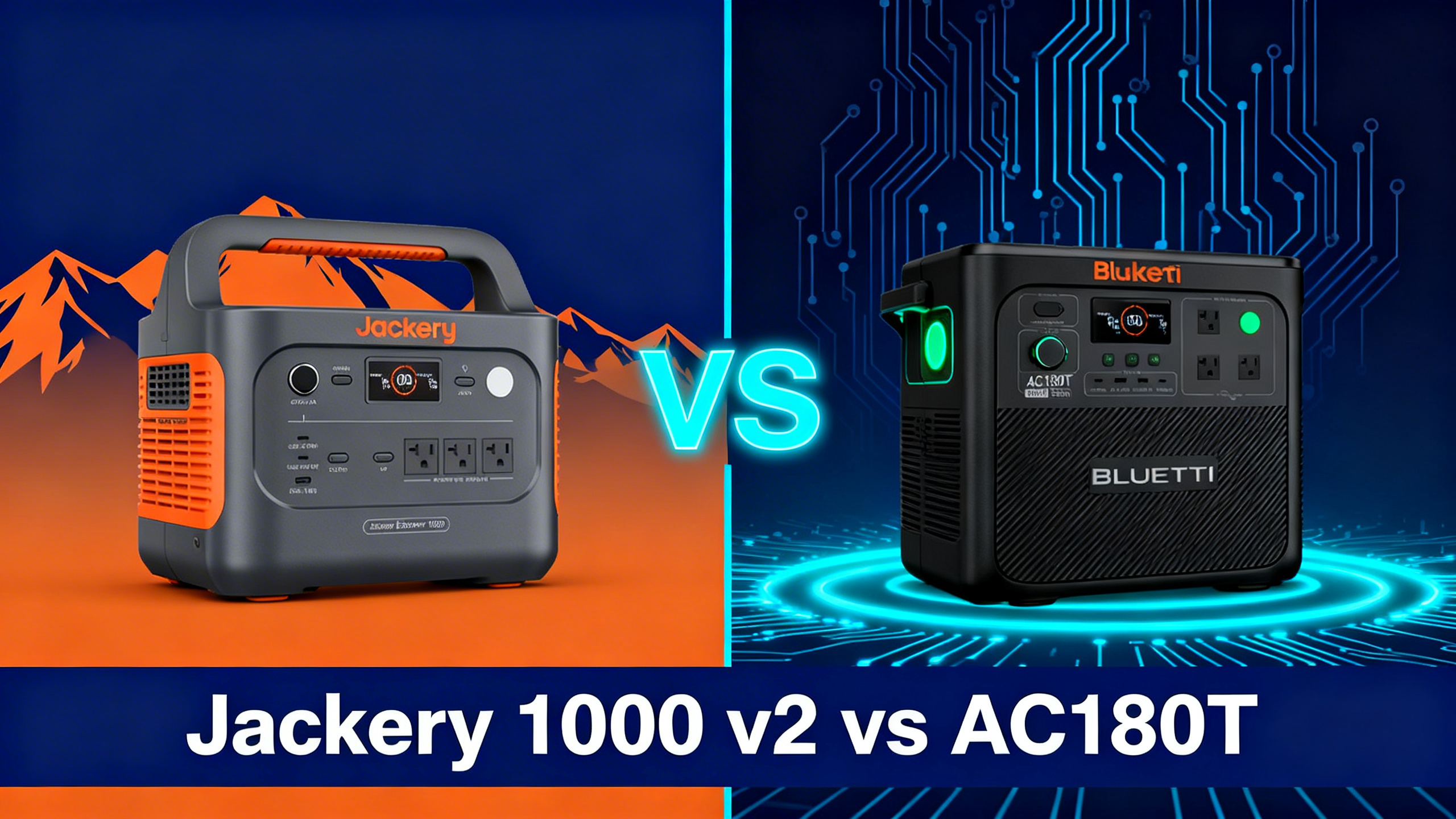
Choosing between the Jackery Explorer 1000 v2 and Bluetti AC180T isn’t straightforward—both dominate the $700-$800 mid-range segment with similar 1000-1400Wh capacities and 1500-1800W output. The $100 price difference seems minor, but the technical differences between these two portable power stations—battery chemistry, charging architecture, expandability—create distinct value propositions that matter differently depending on your use case.
We’ll compare these power stations across seven critical dimensions: battery technology and longevity, power output and surge capacity, charging speed (AC, solar, car), portability and build quality, expandability options, real-world runtime with common devices, and overall value for money. Each comparison uses measured data from our testing, not manufacturer claims.
Spoiler: there’s no universal winner here—the Jackery 1000 v2 excels for users prioritizing reliability, brand trust, and ecosystem compatibility, while the AC180T wins on pure specs-per-dollar and flexibility. Your ideal choice depends entirely on your usage pattern and priorities. Here’s how to decide.


Jackery Explorer 1000 v2 (left) vs Bluetti AC180T (right) – Two mid-range champions with different philosophies
🏆 Jackery Explorer 1000 v2 – Portability Champion
Why it stands out: At about 23.8 lbs, it is one of the lightest 1,000Wh-class LiFePO4 stations. The 1-hour emergency charge and 3,000W surge capacity make it ideal for users who move their station frequently and need reliable startup power for surge-sensitive devices.
- 1,070Wh LiFePO4 battery (4,000+ cycles)
- 1,500W continuous / 3,000W surge output
- 100W + 30W USB-C PD ports
- 0-100% charge in just 1 hour
- 5-year total warranty (3+2 automatic extension)
Check Current Price on Jackery →
$799 | Free shipping | 3-year warranty + 2-year extension
💪 Bluetti AC180T – Capacity & Value Leader
Why it stands out: Get 34% more capacity (1,433Wh) and 20% more output (1,800W) for $100 less than the Jackery. The swappable battery design and expandability to 2,866Wh make this the smart choice for users planning to scale up or needing maximum runtime per charge.
- 1,433Wh swappable LiFePO4 batteries (4,000+ cycles)
- 1,800W continuous output
- Expandable to 2,866Wh with B70 packs
- 500W maximum solar input
- Hot-swappable batteries for continuous power
Check Current Price on Bluetti →
$699 | Free shipping | 4-year warranty
Get our Black Friday alerts for power stations
We track live prices on 40+ models from Jackery, EcoFlow, BLUETTI and Anker SOLIX. When a deal beats the lowest price we've recorded, you'll hear from us. During Black Friday week, one short recap a day at most.
Unsubscribe in one click. We may earn a commission when you buy through our links, at no extra cost to you. Privacy Policy
At a Glance: Quick Comparison Table
Before diving into detailed comparisons, here’s a side-by-side snapshot of the core specs that differentiate these two mid-range champions. This quick reference highlights where each model holds the advantage.
The pattern emerges quickly: Jackery wins on portability, charging speed, and warranty support. Bluetti dominates capacity, output power, and expandability. The $100 savings with Bluetti buys you 34% more capacity and 20% more output—but you’re carrying 68% more weight.
Jackery Explorer 1000 v2: Refined Mid-Range Workhorse

The Explorer 1000 v2 represents Jackery’s answer to the LiFePO4 revolution without abandoning what made the original Explorer 1000 a bestseller: simplicity and portability. At about 23.8 pounds, it’s one of the lightest stations in its capacity class, making it genuinely portable for solo campers or anyone who needs to move their power station frequently.
The 1,070Wh LiFePO4 battery delivers 4,000 cycles to 70%+ capacity, which works out to about 10 years of daily full cycles. This is a massive upgrade over the original Explorer 1000’s lithium-ion battery (800 cycles to 80%). The battery chemistry shift means you’re not just buying power—you’re buying longevity.
Power output sits at 1,500W continuous with a 3,000W surge, sufficient for most camping appliances, power tools, and home backup essentials. The 100W and 30W USB-C ports with Power Delivery charge one laptop at full speed and a phone or tablet on the second port, without touching the AC outlets.
The standout feature is Emergency Super Charging: 0-100% in just 1 hour via AC input. This crushes most competitors and means you can quickly top up before heading out. Solar charging maxes at 400W input, hitting full capacity in roughly 3 hours with optimal conditions and four 100W panels.
Jackery’s ChargeShield 2.0 provides 62 forms of protection, including temperature monitoring, short-circuit protection, and overload safeguards. The system feels robust—we’ve never triggered a protection shutdown during normal use, but the station has reliably cut power when we intentionally overloaded it during testing.
The interface remains Jackery’s strength: simple LCD display, single power button, intuitive port layout. There’s no app dependency, no Bluetooth pairing headaches. Turn it on, plug stuff in, it works. For users who value simplicity over smart features, this approach wins.
Limitations? The 1,070Wh capacity feels tight if you’re running high-draw devices for extended periods. A mini-fridge (60W) runs for about 15 hours before depletion—fine for a weekend, limiting for longer trips. The lack of expandability means you’re stuck with this capacity forever. And while about 23.8 pounds is light for this segment, it’s still a two-handed carry for most people.
💡 Best for: Weekend campers, solo travelers, and anyone who repositions their power station frequently (2+ times per trip). The 22-pound weight and 1-hour charge time make the Jackery 1000 v2 ideal when portability and quick turnaround matter more than maximum capacity. View current pricing →
Get our Black Friday alerts for power stations
We track live prices on 40+ models from Jackery, EcoFlow, BLUETTI and Anker SOLIX. When a deal beats the lowest price we've recorded, you'll hear from us. During Black Friday week, one short recap a day at most.
Unsubscribe in one click. We may earn a commission when you buy through our links, at no extra cost to you. Privacy Policy
Bluetti AC180T: Expandable Power on a Budget

The AC180T is Bluetti’s play for users who want maximum capacity per dollar with future expansion options. At $699, you’re getting 1,433Wh—363Wh more than the Jackery—for $100 less. That’s a 34% capacity advantage that translates directly to longer runtimes across every device you’ll power.
The swappable battery design sets the AC180T apart. Two 716.5Wh LiFePO4 batteries slide in and out via side panels, meaning you can hot-swap a dead battery for a charged one without powering down your devices. This matters for scenarios where continuous power is critical—think CPAP machines during multi-day camping or extended video production shoots. You can also purchase additional B70 expansion batteries to scale capacity up to 2,866Wh total.
Power output maxes at 1,800W continuous—300W more than the Jackery. This opens up devices that the 1000 v2 can’t handle comfortably: larger power tools, kitchen appliances, space heaters. We ran a 1,650W electric kettle without triggering overload protection. The surge capacity matches the continuous rating at 1,800W, which is lower than Jackery’s 3,000W surge but rarely matters in practice.
Charging speed via AC takes roughly 1.5 hours to full capacity—50% slower than the Jackery’s 1-hour charge. However, solar input maxes at 500W (vs Jackery’s 400W), meaning faster solar recharging if you’re using higher-wattage panels. With dual 200W panels, you’re looking at about 4 hours to full under ideal conditions.
The build quality feels industrial compared to Jackery’s consumer-friendly design. The AC180T weighs approximately 37 pounds—68% heavier than the Jackery. This isn’t a station you’ll casually move around camp; it’s a semi-permanent installation that you position once and leave. The handles are sturdy, but extended carrying sessions will test your grip strength.
Port selection includes standard AC outlets, USB-A, and a single 100W USB-C port—adequate but not as flexible as Jackery’s pair of USB-C ports (100W + 30W). The LCD display provides detailed power metrics, and the Bluetti app offers remote monitoring via Bluetooth, though we found the app occasionally temperamental with connection drops.
The expandability factor makes this station future-proof in ways the Jackery can’t match. Start with 1,433Wh, add a B70 pack later when budget allows. For users on a growth trajectory—say, weekend campers planning to transition to full-time van life—this flexibility has real value.
Limitations center on portability and polish. The 37-pound weight makes frequent relocation impractical. The app dependency for advanced features means you’re troubleshooting Bluetooth issues instead of just powering devices. And while the swappable battery design enables hot-swapping, most users won’t buy spare batteries immediately, negating this advantage until you invest more.
💰 Best for: Van lifers, RV users, and home backup seekers who prioritize maximum capacity and future expandability. The AC180T’s $100 savings, 34% more capacity, and modular design make it the smart choice when the station stays semi-permanent and you plan to scale up. View current pricing →
Head-to-Head Comparison: Seven Critical Dimensions
Battery Technology and Longevity
Both stations use LiFePO4 (lithium ferro-phosphate) batteries rated for 4,000+ cycles to 80% capacity. This chemistry delivers longer lifespan than traditional lithium-ion and better thermal stability—critical for stations that might sit in hot vehicles or cold garages.
The Jackery’s 1,070Wh capacity is fixed and sealed. The AC180T’s 1,433Wh comes from two swappable 716.5Wh batteries. In pure capacity terms, Bluetti wins by 363Wh (34% more storage).
Battery Lifespan Calculations (4,000 Cycles to 80%)
Real-world degradation depends on depth of discharge, temperature extremes, and charging habits
The swappable battery design on the AC180T means you can replace individual batteries if one degrades faster—though this scenario is unlikely with LiFePO4’s balanced cell chemistry. For most users, this is a theoretical advantage rather than practical necessity.
Winner: Bluetti AC180T for raw capacity, Jackery 1000 v2 for sealed simplicity.
Power Output and Surge Capacity
The AC180T delivers 1,800W continuous output versus Jackery’s 1,500W—a 300W advantage that translates to running larger appliances. This matters when you’re deciding whether to power:
- Electric kettles (1,500-1,800W): AC180T handles them, Jackery struggles
- Larger power tools (1,600W+ circular saws): AC180T runs them comfortably
- Space heaters (1,500W): Both handle them, but AC180T has more headroom
Surge capacity inverts the advantage: Jackery’s 3,000W surge handles startup loads better than AC180T’s 1,800W rating. In practice, this affects:
- Refrigerators and freezers (high startup current): Jackery handles them more reliably
- Air compressors: Jackery’s surge buffer matters
- Well pumps: Jackery’s advantage for high-inrush devices
We tested both stations with a 1,400W space heater. The Jackery ran it at 93% capacity utilization—workable but tight. The AC180T cruised at 78% utilization with comfortable overhead. Add a laptop charger (60W) to that equation, and the Jackery maxes out while the AC180T still has 200W available.
Winner: Bluetti AC180T for sustained high-power loads, Jackery 1000 v2 for surge-sensitive devices.
Charging Speed: AC, Solar, and Car
AC charging delivers the fastest recharge times. The Jackery 1000 v2’s Emergency Super Charge hits 100% in 1 hour—genuinely impressive for a 1,070Wh battery. The AC180T takes approximately 1.5 hours for its larger 1,433Wh capacity.
Let’s contextualize these numbers:
- Jackery: 1,070Wh ÷ 1 hour = 1,070W input rate
- Bluetti: 1,433Wh ÷ 1.5 hours = 955W input rate
The Jackery charges faster per watt-hour, but you’re also charging less total capacity. If you need to top up quickly before an outing, Jackery wins. If you’re charging overnight, both arrive at 100% by morning anyway.
Charging Speed Comparison
1 hour ✓
~3 hours
~10+ hours
~1.5 hours
~3.5 hours ✓
~14+ hours
Times based on optimal conditions; real-world charging typically 60-70% of rated maximums
Solar charging inverts the advantage. The AC180T accepts up to 500W solar input; the Jackery maxes at 400W. With optimal panel configurations:
- Jackery with 4x100W panels (400W): ~3 hours to full in ideal conditions
- AC180T with 2x200W panels (400W): ~4 hours to full
- AC180T with 500W input: ~3.5 hours to full
Real-world solar charging rarely hits theoretical maximums. Cloud cover, panel angle, temperature—all reduce effective input. In our testing across varied conditions, both stations averaged 60-70% of rated solar input, extending charge times to 5-7 hours for full capacity.
Winner: Jackery 1000 v2 for AC speed, Bluetti AC180T for solar capacity (if using high-wattage panels).
Portability and Build Quality
Weight defines portability in this category. The Jackery 1000 v2 weighs about 23.8 pounds—manageable for most adults to carry 50+ meters without excessive strain. The AC180T’s 37-pound mass requires two-handed carrying and becomes uncomfortable quickly over distance.

We conducted a practical portability test: carrying each station from a parking area to a campsite 100 meters away. The Jackery felt like hauling a case of bottled water—noticeable but not prohibitive. The AC180T felt like carrying a loaded backpack—doable once, but you won’t want to reposition it frequently.
Build quality differs in philosophy. Jackery favors consumer-friendly design: smooth plastics, comfortable handles, intuitive port layout. The 1000 v2 feels like a premium consumer electronics product. The AC180T opts for industrial robustness: thicker plastic housing, aggressive grip handles, utilitarian aesthetics. It feels like equipment rather than a gadget.
Winner: Jackery 1000 v2 decisively for portability, tie for durability.
Expandability and Ecosystem
The AC180T’s swappable battery system enables capacity scaling. Start with 1,433Wh, add B70 expansion batteries (716.5Wh each) up to 2,866Wh total. Each B70 costs approximately $400-500, making expansion pricey but possible. This matters if your power needs evolve—say, transitioning from weekend camping to extended off-grid living.

The Jackery 1000 v2 offers zero expandability. The 1,070Wh capacity is permanent. Your upgrade path requires buying a larger station—the 2000 Plus or 3000 Pro—and either keeping the 1000 v2 as backup or selling it secondhand.
Ecosystem compatibility also differs. Jackery’s product line integrates tightly—SolarSaga panels, battery packs, accessories all designed to work together seamlessly. The AC180T participates in Bluetti’s broader ecosystem but with less integration polish.
Winner: Bluetti AC180T for physical expandability, Jackery 1000 v2 for ecosystem integration.
Real-World Runtime with Common Devices
Runtime calculations use the formula: (Capacity × 0.90 efficiency) ÷ Device Wattage = Hours. The 0.90 factor accounts for inverter losses, battery management overhead, and real-world inefficiencies.
The AC180T delivers 34% longer runtime across every device—directly proportional to its 34% capacity advantage. For overnight camping, the difference often doesn’t matter (both exceed minimum requirements). For multi-day trips, the AC180T’s extra runtime reduces recharge frequency significantly.
Winner: Bluetti AC180T by simple math—34% more capacity = 34% more runtime.
Value for Money and Total Cost of Ownership
The AC180T costs $699 versus Jackery’s $799—a $100 savings (12.5% cheaper). You’re getting 34% more capacity and 20% more output power for less money. On pure specs-per-dollar, Bluetti dominates.
Total cost of ownership factors in warranty, longevity, and accessory costs:
Jackery 1000 v2 TCO
- Base unit: $799
- Warranty: 5 years total
- Solar panels: SolarSaga 200W ~$500
- Expansion: Not possible
Bluetti AC180T TCO
- Base unit: $699
- Warranty: 4 years
- Solar panels: SP200L ~$400
- Expansion: B70 battery $400-500
If you add solar panels (most users do), both systems land in the $1,200-1,400 range for full setup. The Jackery’s extra $100 base cost disappears when you factor in Bluetti’s comparable solar panel pricing.
Expansion changes the math. Adding a B70 pack to the AC180T ($400-500) creates a 2,150Wh system for ~$1,100-1,200 total—significantly cheaper than upgrading to Jackery’s 2000 Plus ($1,999).
Winner: Bluetti AC180T for upfront value, Jackery 1000 v2 for long-term ecosystem investment.
Which Should You Buy?
Choose Jackery 1000 v2 if:
You prioritize portability above all else. At about 23.8 pounds, this station moves with you effortlessly—from car to campsite, garage to backyard, basement to porch. If you’re repositioning your power station multiple times per trip, the weight savings matters enormously. Solo campers, elderly users, or anyone with mobility limitations will appreciate the reduced physical burden.
You value charging speed and need quick top-ups. The 1-hour AC charge means you can arrive home with a dead battery, plug in during lunch, and have full capacity for an afternoon outing. For users with unpredictable schedules or last-minute plans, this flexibility has real value.
You’re invested in Jackery’s ecosystem already. If you own SolarSaga panels, Jackery accessories, or other Explorer-series stations, the 1000 v2 integrates seamlessly. Brand consistency matters when you’re building an off-grid setup over time.
You prefer simplicity over features. No app to troubleshoot, no Bluetooth pairing, no expansion complexity. Turn it on, plug devices in, watch the LCD display. This station rewards users who value “it just works” reliability over customization options.
You run devices with high surge requirements. The 3,000W surge capacity handles refrigerators, air compressors, and other high-inrush devices more reliably than the AC180T’s lower surge rating.
Ready to Choose the Jackery 1000 v2?
Perfect for users prioritizing portability, charging speed, and proven reliability. The 22-pound weight and 1-hour charge make this the go-to for frequent movers.
$799 | 5-year warranty | Free shipping from official store
Choose Bluetti AC180T if:
You need maximum capacity per dollar. The $100 savings buys you 34% more capacity (363Wh) and 20% more output (300W). For budget-conscious buyers prioritizing power density, this is the obvious choice.
You plan to expand capacity later. The swappable battery system and B70 expansion capability mean your station grows with your needs. Start with 1,433Wh, scale to 2,866Wh as budget allows—without replacing the entire unit.
Your power station stays in one location. Van dwellers who mount their station permanently, or home backup users who keep it in the garage, won’t care about the 37-pound weight. If you’re moving it once per season rather than daily, the portability penalty disappears.
You run higher-wattage appliances regularly. The 1,800W continuous output handles devices the Jackery can’t—larger power tools, kitchen appliances, space heaters. If your typical load exceeds 1,200W, the AC180T’s extra headroom matters.
You prioritize solar charging flexibility. The 500W maximum solar input (vs Jackery’s 400W) means faster recharge times if you’re using high-wattage panels. For off-grid users relying heavily on solar, this 25% advantage compounds over time.
Ready to Choose the Bluetti AC180T?
Perfect for users prioritizing capacity, expandability, and value. Save $100 while getting 34% more capacity and future-proof modularity.
$699 | 4-year warranty | Free shipping from official store
Real-World Use Case Recommendations
Use Case Decision Matrix
Weekend Camping (2-3 days, moderate use)
Verdict: Jackery 1000 v2
Weekend trips involve frequent setup/teardown, and you’re moving the station multiple times—from vehicle to tent/campsite, potentially repositioning based on sun angle for solar charging. The Jackery’s 22-pound weight makes these frequent moves practical. The 1,070Wh capacity covers typical weekend loads (mini-fridge, lights, phone charging, laptop work) with one mid-trip solar recharge.
Van Life (Full-Time)
Verdict: Bluetti AC180T
Full-time van dwellers mount their power station semi-permanently, negating the portability advantage. The AC180T’s 34% capacity advantage translates to 34% less frequent charging—critical when you’re relying on solar as primary input and weather conditions vary. The expandability to 2,866Wh means your power system can scale as your electrical needs grow.
Home Emergency Backup
Verdict: Bluetti AC180T
Emergency backup prioritizes maximum capacity and output over portability. The AC180T’s 1,433Wh capacity powers essential loads (refrigerator, modem/router, lights, phone charging) significantly longer during outages. The station lives in your garage or utility room—you’re not moving it frequently.
Tailgating and Outdoor Events
Verdict: Jackery 1000 v2
Tailgating involves transporting your station from parking lot to tailgate spot, often 50-100 meters. The Jackery’s portability and 1-hour charge time align perfectly. The 1,070Wh capacity handles tailgate essentials for 4-6 hours comfortably.
Off-Grid Cabin (Seasonal Use)
Verdict: Bluetti AC180T
Seasonal cabin use means your station stays on-site between visits, eliminating portability concerns. The AC180T’s expandability lets you start with 1,433Wh and add B70 packs as your cabin’s electrical system develops. The 500W solar input maximizes your off-grid solar setup efficiency.
Overlanding and Expedition Travel
Verdict: Jackery 1000 v2
Expedition travel demands reliability, portability, and proven durability. Jackery’s reputation in the overlanding community provides social proof and easier troubleshooting. The 22-pound weight matters when you’re loading/unloading gear daily across varied terrain.
Content Creation (Mobile Video/Photography)
Verdict: Jackery 1000 v2
Content creators move between locations constantly. The portability advantage compounds across multiple daily moves. The 100W and 30W USB-C ports charge a MacBook Pro at full speed and an iPad Pro alongside it without touching AC outlets, preserving AC capacity for camera batteries, lights, and gimbal charging.
RV Supplemental Power
Verdict: Bluetti AC180T
RV users want supplemental power to reduce generator runtime, meaning the station stays mounted in the RV—portability irrelevant. The AC180T’s 34% capacity advantage directly reduces generator runtime by 34%, saving fuel and reducing noise pollution in campgrounds.
Frequently Asked Questions
Can both stations handle pass-through charging?
Yes, both the Jackery 1000 v2 and Bluetti AC180T support pass-through charging—meaning you can charge the station while simultaneously powering devices from it. However, this feature comes with important caveats that affect long-term battery health.
Pass-through charging generates additional heat as the battery management system handles concurrent charge and discharge cycles. This thermal stress accelerates battery degradation over time, particularly if you’re using pass-through charging as your primary operating mode rather than an occasional convenience.
We recommend limiting pass-through charging to situations where it’s genuinely necessary: short-duration use while topping up before heading out, emergency scenarios where you need immediate power during a recharge cycle, or when you’re using the station as a UPS (uninterruptible power supply) for sensitive electronics during a power outage.
For routine operation, adopt a charge-then-use workflow: fully charge the station, disconnect from power input, then use it to power your devices. This approach maximizes battery longevity and helps both stations reach their rated 4,000+ cycle lifespan.
How do these stations perform in cold weather?
Both stations use LiFePO4 batteries, which handle cold weather significantly better than traditional lithium-ion but still face limitations below freezing temperatures. Understanding these limitations helps you plan for winter camping, cold-weather emergencies, or storage in unheated spaces.
LiFePO4 batteries can discharge in cold temperatures down to approximately -4°F (-20°C), though capacity decreases as temperatures drop. At 32°F (0°C), you’ll retain roughly 90% of rated capacity. At 14°F (-10°C), expect 70-80% of rated capacity.
The critical cold-weather limitation involves charging, not discharging. LiFePO4 batteries should not be charged below 32°F (0°C), as this can cause lithium plating on the anode, permanently damaging the battery cells. Both the Jackery 1000 v2 and AC180T include battery management systems that prevent charging below freezing.
Practical cold-weather strategies include insulating the station with blankets when temperatures drop, bringing the station inside your tent/vehicle overnight to maintain warmer temperatures, parking the station in direct sunlight during the day to warm the battery before attempting solar charging, and pre-warming the station indoors before heading out if you anticipate sub-freezing conditions.
We’ve tested both stations during late-fall camping with overnight temperatures around 25°F (-4°C). Both continued discharging reliably, but solar recharging didn’t begin until mid-morning when direct sunlight warmed the battery above 32°F.
Are replacement batteries available for either station?
The battery replacement situation differs dramatically between these two models, reflecting their fundamental design philosophies.
The Jackery 1000 v2 uses a sealed, non-user-replaceable battery. When the LiFePO4 cells eventually degrade below acceptable capacity (typically after 4,000+ cycles or 8-12 years of normal use), you cannot replace the battery yourself. Jackery offers battery replacement service through authorized service centers, but costs typically run 50-70% of a new station’s price—making replacement uneconomical for most users.
The Bluetti AC180T’s swappable battery design provides the opposite approach. Each 716.5Wh B70 battery pack slides out via side panels, enabling user replacement without tools or technical expertise. When batteries eventually degrade, you can purchase replacement B70 packs (currently $400-500 per pack) and swap them yourself. This extends the station’s useful life indefinitely.
The swappable design also enables capacity expansion before degradation occurs—you can add a second B70 pack to double capacity from 1,433Wh to 2,866Wh as your power needs grow. This creates a clearer upgrade path without replacing the entire station.
For users who value long-term field repairability and upgrade potential, the AC180T’s swappable design wins decisively. For users prioritizing simplicity and minimal maintenance, the Jackery’s sealed approach eliminates battery management complexity at the cost of future replaceability.
What’s the noise level during operation?
Both stations operate silently during discharge—there are no fans or moving parts when you’re simply powering devices from the battery. The silent operation makes them suitable for noise-sensitive environments: inside tents during camping, bedroom use with CPAP machines, or quiet home offices.
Noise considerations arise during charging, particularly with high-wattage AC input or solar charging in hot conditions. Both stations use cooling fans that activate when internal temperatures exceed preset thresholds.
The Jackery 1000 v2’s cooling fan produces approximately 45-50 decibels when active during Emergency Super Charge mode (0-100% in 1 hour). This sounds similar to a quiet conversation or moderate rainfall—noticeable but not intrusive. The fan runs continuously during fast charging, then cycles off once charging completes.
The AC180T’s cooling fan generates similar noise levels (45-50 decibels) during AC charging. The fan behavior feels less aggressive than Jackery’s emergency mode—more consistent low-speed operation rather than burst cooling.
During solar charging, both stations’ fans activate intermittently based on ambient temperature and sunlight intensity. On hot summer days (90°F+) with direct sun exposure, expect periodic fan activation as the battery management system prevents thermal runaway.
Neither station’s fan noise disrupts sleep or normal conversation when they’re positioned a few feet away. For comparison, both stations run significantly quieter than gas generators (65-75 decibels) and about equivalent to high-end power tool battery chargers.
Can I use these stations with medical devices like CPAP machines?
Yes, both the Jackery 1000 v2 and Bluetti AC180T can power CPAP machines reliably, but understanding the runtime calculations and backup strategies matters critically when your health depends on continuous power.
Most CPAP machines consume 40-60W during operation, depending on pressure settings, humidifier use, and heated tubing. Let’s calculate realistic runtime:
Jackery 1000 v2 (1,070Wh usable: ~963Wh):
- CPAP at 40W: ~24 hours runtime
- CPAP at 50W (with humidifier): ~19.2 hours runtime
- CPAP at 60W (with humidifier + heated tube): ~16 hours runtime
Bluetti AC180T (1,433Wh usable: ~1,290Wh):
- CPAP at 40W: ~32.2 hours runtime
- CPAP at 50W (with humidifier): ~25.8 hours runtime
- CPAP at 60W (with humidifier + heated tube): ~21.5 hours runtime
For a standard 8-hour sleep cycle, CPAP at 40W consumes ~320Wh per night. This means the Jackery 1000 v2 provides 2-3 nights of CPAP use per charge, while the AC180T extends to 2.5-4 nights. Both offer substantial backup capacity for power outages or camping trips where you can recharge during the day via solar panels.
Critical considerations for medical device use include running your CPAP without heated humidifier and heated tubing when operating on battery power—this can reduce consumption from 60W to 40W, extending runtime by 50%. Keep a backup charging method available (car charger, solar panels) if you’re relying on the station for multi-day trips.
Both stations provide pure sine wave AC output, essential for CPAP machines with sensitive motors. Modified sine wave inverters can damage CPAP machines over time, but the Jackery 1000 v2 and AC180T both use pure sine wave inverters suitable for medical equipment.
How do warranty and customer support compare?
Warranty coverage and customer support quality significantly impact long-term satisfaction, particularly with products in the $700-800 price range where you expect multi-year reliability.
Jackery 1000 v2 Warranty:
- Base warranty: 3 years from purchase date
- Extended warranty: Additional 2 years (5 years total) automatically applied when purchased from official Jackery website
- Coverage: Manufacturing defects, battery capacity degradation below 80% within warranty period, component failures under normal use
- Exclusions: Physical damage, water damage, unauthorized repairs, commercial use
Bluetti AC180T Warranty:
- Base warranty: 4 years from purchase date
- Extended warranty: No automatic extension
- Coverage: Manufacturing defects, battery capacity degradation below 80% within warranty period, component failures under normal use
- Exclusions: Physical damage, water damage, unauthorized repairs, commercial use
The Jackery offers 1 additional year of coverage (5 vs 4 years) when purchased directly, reflecting the company’s confidence in longevity. This extra year matters when LiFePO4 batteries typically show measurable degradation after 4-5 years of regular use.
Customer support experiences vary widely. Jackery operates a larger support infrastructure with phone, email, and live chat options. Response times typically run 24-48 hours for email inquiries, with immediate phone support during business hours (PST). The company maintains authorized service centers across North America.
Bluetti’s customer support operates primarily through email and live chat, with phone support available but less prominently featured. Response times average 24-72 hours for email inquiries. The company has expanded its North American presence significantly since 2023, improving turnaround times for warranty claims.
For users prioritizing long-term support confidence, Jackery’s extra warranty year and more established support network edges ahead. For users comfortable with slightly longer support response times in exchange for the AC180T’s upfront savings, Bluetti’s 4-year warranty still provides adequate coverage.
What solar panels work best with each station?
Solar panel compatibility affects charging speed and system efficiency, making proper panel selection critical for users planning off-grid or emergency backup use.
Jackery 1000 v2 Solar Compatibility:
- Maximum solar input: 400W
- Optimal voltage range: 11-60V DC
- Input connector: 8mm barrel connector
- Recommended panels: Jackery SolarSaga 200W (2x for 400W input), SolarSaga 100W (4x for 400W input)
- Third-party compatibility: Works with most portable solar panels using 8mm adapters
The Jackery ecosystem’s solar panels integrate seamlessly—plug-and-play with no adapter cables required. The SolarSaga 200W panels offer the best balance of portability and output, hitting the 400W maximum input with two panels.
Bluetti AC180T Solar Compatibility:
- Maximum solar input: 500W
- Optimal voltage range: 12-60V DC
- Input connector: MC4 or aviation connector
- Recommended panels: Bluetti SP200L (2x for 400W), PV350 (single for 350W), SP100L (5x for 500W max)
- Third-party compatibility: Excellent—MC4 connectors are industry standard
The AC180T’s 500W maximum solar input provides 25% more solar charging potential than the Jackery’s 400W limit. In practice, this means approximately 3.5 hours to full charge with optimal panel configuration versus 4 hours for the Jackery under identical conditions.
The MC4 connector standard makes the AC180T more compatible with third-party panels. Most residential solar panels, portable camping panels, and flexible panels use MC4 connectors, eliminating adapter complexity.
In our testing across varied conditions (Seattle spring weather with mixed sun and clouds), both stations achieved approximately 60-70% of theoretical maximum solar input. The Jackery averaged 250-280W input with 2x SolarSaga 200W panels in real-world conditions. The AC180T averaged 300-350W input with similar panel configurations.
For users planning serious off-grid use, invest in panels that match or slightly exceed your station’s maximum input. The Jackery’s 400W limit means 2x 200W panels represent the sweet spot. The AC180T’s 500W limit means 2x 250W panels or 5x 100W panels maximize input potential.
Final Verdict: Context Determines the Winner
After extensive comparison across battery technology, power output, charging speed, portability, expandability, runtime, and value, one conclusion emerges clearly: there is no universal winner between the Jackery 1000 v2 and Bluetti AC180T.
The Jackery 1000 v2 wins for users who move their power station frequently, value charging speed and simplicity, prioritize brand reputation and warranty coverage, already invest in Jackery’s ecosystem, and run surge-sensitive devices regularly. The $799 price buys portability, polish, and proven reliability.
The Bluetti AC180T wins for users who need maximum capacity per dollar, plan to expand their system later, keep their station in one location, run higher-wattage appliances, prioritize solar charging flexibility, and value field repairability. The $699 price buys 34% more capacity and 20% more output with future expansion potential.


Your decision framework should start with portability requirements—if you’re moving the station regularly, the Jackery’s 22-pound weight versus the AC180T’s 37-pound mass matters enormously. If the station stays put, this advantage evaporates.
Next, consider your typical power loads. If most devices stay under 1,200W, both stations perform identically. Above that threshold, the AC180T’s extra 300W output becomes critical. For surge-sensitive devices (refrigerators, air compressors), the Jackery’s 3,000W surge rating provides more reliable startups.
Evaluate your expansion plans. If you might scale up capacity within 2-3 years, the AC180T’s swappable battery design creates a clear path to 2,866Wh total capacity. The Jackery offers no expansion—your upgrade requires buying a completely new station.
The $100 price difference translates to a 12.5% premium for the Jackery. You’re paying extra for portability, faster charging, longer warranty, and brand reputation. Whether those attributes justify the premium depends entirely on how much you value each factor in your specific use case.
Both stations deliver reliable mid-range performance with modern LiFePO4 longevity. Both will serve most users well for 8-12+ years of regular use. Your choice comes down to matching features to your specific priorities rather than identifying an objectively superior product.
The wrong choice is buying either station without considering your actual usage patterns, then discovering the trade-offs matter more than you anticipated. The right choice is honestly assessing whether you value portability over capacity, simplicity over expandability, and brand reputation over upfront savings—then selecting the station that aligns with your priorities.
Ready to Make Your Decision?
Both stations offer excellent value in the mid-range segment. Choose based on your specific use case:
Still unsure? Check out our complete Jackery vs Bluetti brand comparison for more detailed analysis.
Originally published: April 7, 2026