
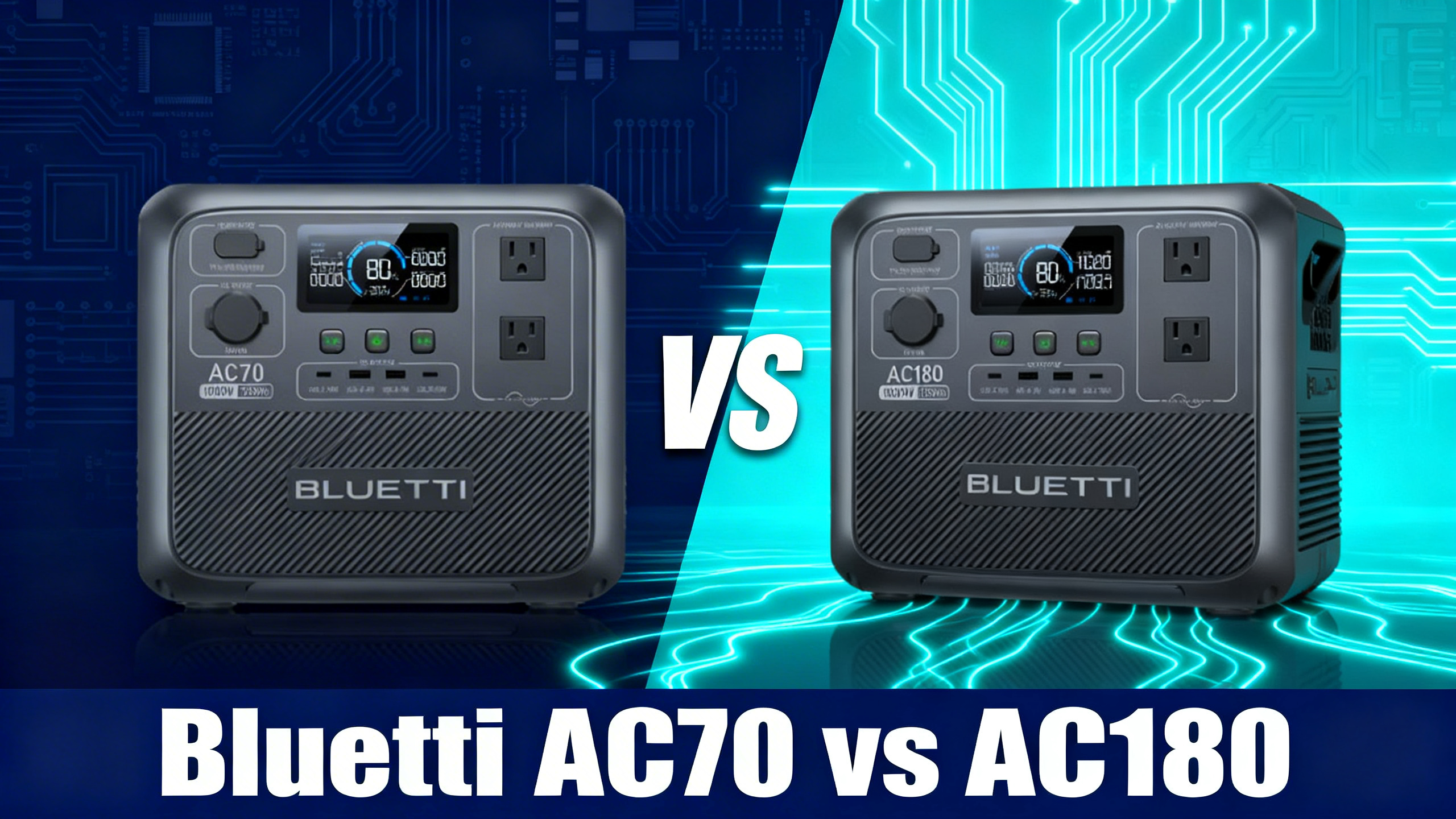

Quick Verdict: The AC180 ($499) delivers 50% more capacity than the AC70 ($349) for just $150 more—while being $100 cheaper than the AC70’s regular price. For 90% of users, the AC180 offers better value. The AC70 wins only when ultra-portability (18 lbs vs 27 lbs) is your absolute priority.
Choosing between the Bluetti AC70 and AC180 isn’t straightforward—both pack impressive power into compact frames, yet the AC180 costs $150 less while offering 50% more capacity. Does the AC70’s portability advantage (9 pounds lighter) justify its smaller 768Wh battery, or should you grab the AC180’s 1,152Wh at the better value?
For weekend warriors, van life beginners, and home backup seekers under $700, this decision matters. The wrong choice means either overpaying for unused capacity or running out of power when you need it most. On a tighter budget, the AC70 also competes against the EB3A and Elite 30 V2 in Bluetti’s entry-level range.
Bluetti AC70
✓ 768Wh capacity
✓ 1000W output
✓ 18 lbs ultra-portable
✓ $349 (was $599)
Bluetti AC180
✓ 1,152Wh capacity (+50%)
✓ 1800W output (+80%)
✓ 27 lbs portable
✓ $499 (was $699)
The AC70 ($349 currently, down from $599) targets the ultra-portable segment with its 18-pound frame and LiFePO4 reliability. Think weekend camping trips, tailgating, or lightweight backup power. The AC180 ($499, down from $699) sits in the sweet-spot mid-range: 50% more capacity and nearly double the output wattage, all while undercutting the AC70’s typical price. It’s one of Bluetti’s most popular portable stations for good reason.
Both feature LiFePO4 batteries rated for 3,000+ cycles, fast AC charging, and Power Lifting modes—but their capacity and output differences create distinct use cases.
We’ll compare these models head-to-head across 7 critical factors: capacity and runtime, output wattage, portability, charging speed, expandability, port selection, and long-term value. By the end, you’ll know exactly which model matches your power needs, budget, and usage frequency.
Spoiler: the AC180 wins on pure value, but the AC70 dominates for ultra-portability. Your usage frequency determines the right pick.
🏆 Our Top Pick: Bluetti AC180
Why we recommend it: 50% more capacity + 80% more power output for just $150 more than the AC70. Best value in Bluetti’s mid-range lineup with 1,152Wh capacity and 1800W inverter—enough to run coffee makers, microwaves, and power tools. Currently $200 off at $499.
$499 (was $699) | Free shipping | 1,152Wh capacity | 1800W output
Get our Black Friday alerts for BLUETTI
We track live prices on 40+ models from Jackery, EcoFlow, BLUETTI and Anker SOLIX. When a deal beats the lowest price we've recorded, you'll hear from us. During Black Friday week, one short recap a day at most.
Unsubscribe in one click. We may earn a commission when you buy through our links, at no extra cost to you. Privacy Policy
At a Glance: Key Differences
Before diving into detailed analysis, here’s what separates these two Bluetti powerhouses. If you’re in a hurry, this table captures the critical specs—though we recommend reading the full comparison for nuanced use case recommendations.
The data tells a clear story: the AC180 delivers more capacity, more output power, and better value per watt-hour—all while costing less upfront than the AC70. But the AC70’s 9-pound weight advantage matters for specific scenarios we’ll explore below. If the AC180 is your frontrunner, see how it stacks against the AC240 in the mid-range battle.
Bluetti AC70 (768Wh, 18 lbs)

Bluetti AC180 (1,152Wh, 27 lbs)
Head-to-Head Comparison
Capacity & Runtime: More Power, Longer Runtimes
The capacity difference between these models is substantial and affects every aspect of real-world use.
The AC70’s 768Wh battery delivers solid performance for light-to-moderate needs. Here’s what you can expect on a full charge:
AC70 Runtime Estimates (768Wh)
The AC180’s 1,152Wh extends those runtimes significantly—that extra 384Wh is the difference between comfort and running out of power:
AC180 Runtime Estimates (1,152Wh)
The math is straightforward: the AC180 provides 50% more runtime for every device you plug in. For weekend campers, that’s the difference between a Friday-Sunday trip versus a full week. For CPAP users, it’s the difference between 2 nights and 4 nights of therapy.
Keep in mind these are estimates based on rated capacity and assume 85% inverter efficiency. Your actual runtime will vary based on ambient temperature, battery age, and load consistency.
Winner: AC180 for capacity-dependent use cases. The AC70 works for minimalist campers who pack light, but most users will appreciate the AC180’s extra headroom.

AC70 Ports: 2× AC, 2× USB-C, 2× USB-A

AC180 Ports: 4× AC, 1× USB-C, 4× USB-A
Output Power: Can You Run What You Need?
This is where the gap widens considerably. The AC70’s 1000W inverter handles small appliances fine—think laptops, fans, phones, tablets, LED lights, and most camping gear. But it struggles with high-draw devices.
| Appliance | Wattage | AC70 (1000W) | AC180 (1800W) |
|---|---|---|---|
| Laptop | 65W | ✓ | ✓ |
| Mini-fridge | 60-80W | ✓ | ✓ |
| CPAP machine | 30-60W | ✓ | ✓ |
| Coffee maker | 800-1,200W | ~ (borderline) | ✓ |
| Microwave | 700-1,200W | ✗ | ✓ |
| Hair dryer | 1,200-1,800W | ✗ | ✓ |
| Power tools | 1,000-1,500W | ~ (hit/miss) | ✓ |
The AC180’s 1800W inverter opens up a whole new category of appliances. The 2,700W surge capacity means even devices with high startup draw (like refrigerators with compressors) won’t trip the breaker.
If your use case involves only phones, laptops, and LED camping lights, the AC70’s 1000W is plenty. But the moment you want a hot cup of coffee in the morning or need to run actual household appliances during a power outage, the AC180 becomes non-negotiable.
Winner: AC180 for versatility. The AC70 works for electronics-only users, but the AC180’s extra wattage future-proofs your purchase.
💡 Need to Run High-Draw Appliances?
The AC180’s 1800W inverter handles coffee makers, microwaves, and power tools with ease. Currently $200 off—best value in Bluetti’s lineup for users who need real power output.
1800W continuous | 2,700W surge | $499 (save $200)
Portability: Every Pound Counts
Here’s where the AC70 finally scores a meaningful win.
At 18 pounds, the AC70 is light enough to carry with one hand for extended periods. The compact dimensions (12.4 × 8.7 × 9.1 inches) mean it fits in tight spaces—backpack compartments, motorcycle saddlebags, under RV seats, or in a car’s footwell.
The AC180’s 27-pound weight isn’t backbreaking, but it’s definitely a two-handed carry. At 13.6 × 9.8 × 11.8 inches, it’s noticeably bulkier. You’ll feel that extra 9 pounds when hiking from the parking lot to your campsite or lifting it in and out of your car multiple times a day.
⚠️ Who benefits from the AC70’s portability advantage? Backpackers and hikers where every pound matters, motorcycle/bike campers with limited cargo space, elderly users who need easier maneuverability, apartment dwellers wanting smaller storage footprint, and frequent movers.
The portability advantage is real and shouldn’t be dismissed. If you’re constantly on the move or have physical limitations, those 9 pounds matter more than the spec sheet suggests.
Winner: AC70 for ultra-portable scenarios. The AC180 is still portable (it has a handle), but the AC70 wins when weight is the primary concern.
🎒 Ultra-Portability Priority?
The AC70’s 18-pound weight makes it ideal for backpacking, motorcycle camping, or elderly users. Compact enough to fit in tight spaces while still delivering 768Wh of reliable LiFePO4 power.
18 lbs | 768Wh capacity | $349 (was $599)

AC70 in action: Perfect for weekend camping and lightweight adventures
Charging Speed, Ports & Expandability
Both models charge quickly, but the AC180 edges ahead thanks to higher AC input wattage. The AC70 charges in ~2 hours (850W input) while the AC180 completes a full charge in ~1.7 hours (1,440W input). Solar charging performance is nearly identical since both max out at 500W input.
Port selection favors different use cases. The AC70 offers 2× USB-C ports (100W PD each)—great for fast-charging multiple devices like a MacBook and iPad simultaneously. The AC180 doubles your AC outlet count with 4× AC outlets, which matters when running a mini-fridge, fan, and laptop charger at the same time.
Both models support Bluetti’s B80 expansion battery (806Wh), effectively doubling capacity. However, the value proposition favors the AC180: buying the AC180 alone ($499) gives you 1,152Wh, while the AC70+B80 combo ($748) delivers 1,574Wh—that’s 27% more capacity for 50% more money.
Winner: AC180 for most buyers (more AC outlets, better expansion value). AC70 for solo USB-C power users.
Long-Term Value Analysis
Bluetti AC70
(768Wh × 3,000 cycles)
Bluetti AC180 ⭐
(1,152Wh × 3,000 cycles)
Bottom Line: The AC180 costs just $150 more but delivers 50% extra capacity and 80% more power output. That’s exceptional value that’s hard to beat.
Get our Black Friday alerts for BLUETTI
We track live prices on 40+ models from Jackery, EcoFlow, BLUETTI and Anker SOLIX. When a deal beats the lowest price we've recorded, you'll hear from us. During Black Friday week, one short recap a day at most.
Unsubscribe in one click. We may earn a commission when you buy through our links, at no extra cost to you. Privacy Policy
Winner by Use Case
There’s no universal winner between these two models—your specific needs determine the right choice. Here’s how they stack up across common scenarios:
🏕️ Weekend Camping (1-3 days)
Winner: AC70
For short trips powering phones, a portable fridge, and LED lights, the AC70’s 768Wh is plenty. The 9-pound weight savings makes packing easier.
⛺ Extended Camping (4+ days)
Winner: AC180
Once you’re out for more than a long weekend, capacity becomes critical. The AC180’s 1,152Wh gives you more buffer for cloudy days when solar charging underperforms.
🚐 Van Life (Full-Time)
Winner: AC180
Daily users need maximum capacity to minimize solar recharge dependency. The AC180’s 1800W inverter also handles cooking appliances and power tools. The extra weight doesn’t matter when permanently installed.
🏠 Home Emergency Backup
Winner: AC180
During power outages, you’re running refrigerators, medical devices, and communication equipment simultaneously. The AC180’s four AC outlets and 1800W capacity keep essentials running longer.
🏈 Tailgating & Outdoor Events
Winner: AC70
For day-use scenarios powering a portable TV, speakers, and a cooler, the AC70’s lighter weight makes sense. You’re not concerned about multi-day runtime.
😴 CPAP Users (Travel)
Winner: AC180
CPAP machines draw 30-60W. The AC70 provides ~2.5 nights while the AC180 gives you ~4 nights. For anything beyond a weekend trip, the AC180 prevents running out mid-sleep.
🎒 Backpacking & Motorcycle Camping
Winner: AC70
When cargo space and weight are severely constrained, the AC70’s compact size and 18-pound weight make it the only viable option. The AC180 simply doesn’t fit in most motorcycle saddlebags or hiking packs.
🏆 Ready to Choose the AC180?
Best for 90% of buyers: The AC180 delivers exceptional value at $499 with 1,152Wh capacity and 1800W output. Perfect for van life, extended camping, home backup, and CPAP users. Currently $200 off regular price.
$499 | Free shipping | In stock | 3,000+ cycle LiFePO4 battery
Final Recommendations
After analyzing capacity, output power, portability, charging, ports, expandability, and value, here’s our bottom-line guidance:
Choose the AC180 if you:
- Want the best value per dollar (50% more capacity for 43% more money)
- Need to run high-draw appliances (coffee makers, microwaves, power tools)
- Plan extended trips beyond weekend camping
- Use your station frequently (van life, daily off-grid use)
- Prioritize capacity and versatility over ultra-portability
- Want four AC outlets for simultaneous device charging
- Need extended CPAP runtime (4+ nights per charge)
The AC180 is the smarter choice for 90% of buyers. It delivers more power, more capacity, and better value—all while costing less upfront than the AC70’s regular price.
Choose the AC70 if you:
- Need ultra-lightweight portability (18 lbs vs 27 lbs matters to you)
- Have limited cargo space (motorcycle, bike, hiking)
- Only power low-draw electronics (phones, laptops, LED lights)
- Want dual USB-C ports for fast-charging multiple devices
- Are elderly or have physical limitations
- Use it only for short weekend trips (1-3 days)
- Prefer a smaller footprint for apartment storage
The AC70 makes sense for a narrow set of use cases where portability trumps capacity. If you’re constantly on the move or weight is a genuine concern, the 9-pound savings justifies the capacity sacrifice.
Our Verdict
For most buyers, the AC180 is the clear winner. It’s rare to find a comparison where the less expensive model actually offers better value and more capability—but that’s exactly what’s happening here at current pricing.
The AC180’s 1,152Wh capacity, 1800W inverter, and $0.43/Wh value make it Bluetti’s best mid-range option. You’re getting 50% more capacity for just $150 more than the AC70’s promotional price. That’s exceptional value.
The AC70 remains a solid choice for ultra-portable applications, but it’s a niche product designed for specific scenarios. Unless weight and size are your absolute priorities, the AC180 delivers more capability for less money—a rare combination that makes it easy to recommend.
Bottom line: Buy the AC180 unless you have a specific reason to prioritize portability over capacity. Your future self will thank you when you’re not rationing power on day three of a camping trip.
🏆 Our Top Pick: AC180
Best value for 90% of users. 1,152Wh capacity + 1800W output for just $499.
$499 (was $699) | Save $200
🎒 Ultra-Portable: AC70
Best for weight-conscious users. Only 18 lbs with 768Wh capacity.
$349 (was $599) | Save $250
Frequently Asked Questions
Is the AC180 really worth less money than the AC70 despite having 50% more capacity?
Yes, and it’s one of the more unusual pricing scenarios we’ve seen. The AC180 currently sells for $499 (down from $699) while the AC70’s promotional price is $349 (regularly $599). That’s just $150 more for 50% additional capacity and 80% more output power. The AC180 delivers better value on every metric—capacity, power output, and cost per watt-hour. The only trade-off is the extra 9 pounds of weight.
Can the AC70 run a coffee maker?
It depends on your coffee maker’s wattage. Most drip coffee makers draw 800-1,200W. The AC70’s 1000W inverter can technically handle some models, and the Power Lifting Mode might boost it to 1,400W for resistive loads. However, we don’t recommend pushing it to the limit regularly—you’ll stress the inverter and potentially trigger overload protection. If morning coffee is non-negotiable, the AC180’s 1800W inverter is the safer choice.
Which model is better for CPAP users?
The AC180 wins for CPAP users traveling more than 2-3 nights. A typical CPAP machine draws 30-60W depending on pressure settings and humidifier use. The AC70’s 768Wh provides roughly 2.5 nights of therapy, while the AC180’s 1,152Wh extends that to 4 nights. For weekend trips, the AC70 works fine. For week-long vacations or RV camping, the AC180’s extra capacity prevents mid-sleep shutdowns. That peace of mind is worth the extra weight.
Can I charge both stations while using them (passthrough charging)?
Yes, both the AC70 and AC180 support passthrough charging. You can plug in the AC wall charger (or connect solar panels) while simultaneously powering devices. This feature is crucial for extended outages or off-grid living, allowing 24/7 operation as long as you have a charging source available. The battery management system intelligently routes power to connected devices first, then charges the battery with any excess input.
Which station is quieter?
Both stations operate nearly silent when powering DC devices (USB ports, 12V outlet). The fans kick in when using AC outlets under moderate-to-heavy loads. The AC70 runs slightly quieter at low loads due to its smaller inverter, but the difference is marginal—both measure around 45-50dB at full load, roughly equivalent to a quiet conversation. Neither will disturb sleep in a tent or RV. If noise is a primary concern, both models are quiet enough for overnight use.
How long do these stations last in storage without use?
Both models use LiFePO4 batteries that maintain charge significantly better than older lithium-ion chemistries. Expect around 3-5% self-discharge per month when stored powered off in moderate temperatures (60-75°F). That means if you fully charge either station and store it for six months, you’ll still have 70-85% capacity remaining. Bluetti recommends charging to 60-80% for long-term storage and topping up every 3-6 months to maintain battery health. Avoid storing in extreme temperatures—heat degrades batteries faster than cold.
Can I use the B80 expansion battery on both models?
Yes, both the AC70 and AC180 are compatible with Bluetti’s B80 expansion battery (806Wh). You’ll need an aviation-to-XT60 cable to connect the B80 to either station. With the B80 attached, the AC70 expands to 1,574Wh total capacity, and the AC180 reaches 1,958Wh. However, the value proposition favors the AC180: buying the AC180 alone ($499) gives you 1,152Wh, while the AC70+B80 combo ($748) delivers 1,574Wh—27% more capacity for 50% more money. Unless you specifically need the AC70’s portability, the AC180 offers better base value.
Ready to Power Your Adventures?
Whether you choose the ultra-portable AC70 or the value-packed AC180, you’re getting Bluetti’s proven LiFePO4 reliability with 3,000+ cycle lifespan. Both models are currently on sale with free shipping.
This comparison is based on current pricing and specifications as of October 2025. Prices and availability subject to change. See retailer sites for latest details.
Originally published: April 7, 2026