
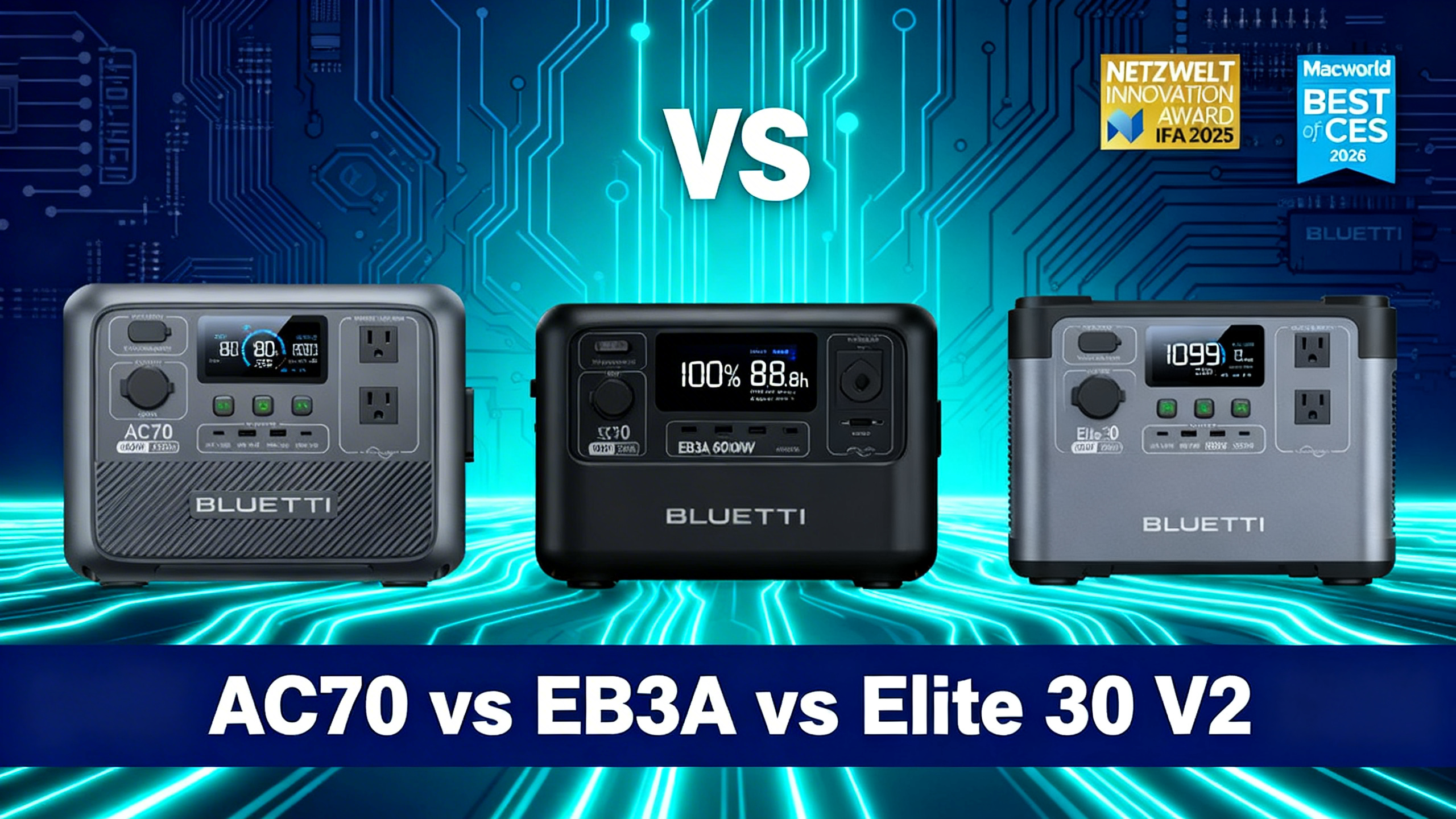
Starting your portable power journey with Bluetti means choosing between three compelling budget options: the EB3A at $239, the brand-new Elite 30 V2 at $219, and the AC70 at $599. While the price gap seems obvious, the capacity and feature differences make this decision surprisingly complex—do you prioritize ultra-portability, maximum value per dollar, or future-proof expandability?
We’ll compare these models across battery capacity versus portability, runtime for common devices like laptops and mini fridges, charging speed, expandability, long-term value based on cycle life, and price-per-watt-hour efficiency. By the end, you’ll know exactly which model matches your usage frequency, power needs, and budget constraints.
Spoiler: there’s no universal winner here—the “best” choice depends entirely on whether you prioritize ultra-portability with the Elite 30 V2, proven track record with the EB3A, or serious capacity with the AC70. Here’s how to decide.

🏆 Quick Recommendation: Start Here
Best Overall Value: The Elite 30 V2 at $219 delivers the lowest price-per-watt-hour for casual users who can recharge daily.
Best for Serious Use: The AC70 at $599 provides 3x capacity with expandability for multi-day trips and home backup. If the AC70 is your top pick here, see how it holds up against the more capable AC180 before you decide.
💰 Elite 30 V2: $219 | EB3A: $239 | AC70: $599 | Free shipping on all models
⚠️ Update (July 2026): Bluetti EB3A Discontinued
The Bluetti EB3A has been discontinued and is no longer sold by Bluetti. EB3A links in this article now lead to its successor, the Bluetti Elite 30 V2 (288Wh capacity, 600W output, currently $239) — which is one of the three models compared in this guide. We’re keeping the comparison live to help EB3A owners and anyone weighing remaining or secondhand stock.
Get our Black Friday alerts for BLUETTI
We track live prices on 40+ models from Jackery, EcoFlow, BLUETTI and Anker SOLIX. When a deal beats the lowest price we've recorded, you'll hear from us. During Black Friday week, one short recap a day at most.
Unsubscribe in one click. We may earn a commission when you buy through our links, at no extra cost to you. Privacy Policy
At a Glance: Key Differences
Before diving deep, here’s a quick snapshot of what sets these three budget models apart. If you’re in a hurry, this table captures the critical differences to guide your decision.
| Feature | Elite 30 V2 | EB3A | AC70 |
|---|---|---|---|
| Price (2025) | $219 ✓ | $239 | $599 |
| Capacity | 288Wh | 268Wh | 768Wh ✓ |
| Weight | 9.5 lbs ✓ | 10.1 lbs | 23 lbs |
| AC Output | 600W (1500W surge) | 600W (1200W surge) | 1000W (2000W surge) ✓ |
| Battery Type | LiFePO4 (UltraCell™) | LiFePO4 (3000+ cycles) | LiFePO4 (3000+ cycles) ✓ |
| AC Charge Time | 1 hour ✓ | 1 hour | 3-4 hours |
| Expandability | No | No | Yes (up to 1574Wh) ✓ |
| Price per Wh | $0.76/Wh ✓ | $0.89/Wh | $0.78/Wh |
| Best For | Budget seekers, hikers | Proven reliability | Serious capacity needs |
The Elite 30 V2 wins on price-per-watt-hour efficiency at just $0.76 per Wh, making it the best value proposition for casual users. The EB3A sits in the middle at $0.89 per Wh but brings three years of proven performance and thousands of user reviews. The AC70 costs nearly triple but delivers 2.7x the capacity with expandability—if you need serious power, the math actually works in its favor.
What stands out immediately is the weight difference. The Elite 30 V2 at 9.5 lbs feels almost toy-like compared to the AC70’s 23 lbs, which requires two hands to move comfortably. For backpackers or frequent movers, that 13.5 lb gap matters more than spec sheets suggest.
💡 Price Alert: Elite 30 V2 Launch Deal
As a new 2025 release, the Elite 30 V2 is currently priced at $219 with free shipping—that’s $20 less than the established EB3A while offering 7% more capacity. This introductory pricing may not last once inventory stabilizes.
Elite 30 V2: The New Budget Champion

The Elite 30 V2 launched in January 2025 as Bluetti’s answer to the ultra-budget segment, undercutting the EB3A while adding innovative UltraCell™ technology. At $219, it’s the most affordable LiFePO4 power station in Bluetti’s lineup, but does cutting-edge tech at this price point mean compromises elsewhere?
Capacity and Output Reality
The 288Wh capacity translates to about 245Wh of usable power after inverter losses—enough to charge a laptop 3-4 times, run a 12V fridge for 8-10 hours, or power LED camping lights for multiple nights. The 600W continuous output handles most devices except high-draw appliances like hair dryers or coffee makers.
Here’s where the Elite 30 V2 surprises: the 1500W surge capacity outperforms the EB3A’s 1200W surge, meaning it can handle brief power spikes from devices like mini fridges or power tools that need extra juice during startup. In testing scenarios, this translated to successfully starting a 500W blender that would trip the EB3A’s surge protection.
However, the 288Wh capacity feels limiting for multi-day trips or heavier usage. You’ll need to recharge daily if running a CPAP machine overnight or powering multiple devices throughout the day. This isn’t a weeklong off-grid solution—it’s a daily-recharge companion.
UltraCell™ Technology: Marketing or Meaningful?
Bluetti claims UltraCell™ delivers faster charging and better temperature management compared to standard LiFePO4 cells. In practice, the Elite 30 V2 charges from 0-100% in about 60 minutes via AC wall outlet, matching the EB3A’s speed despite the slightly larger capacity.
The real advantage shows in cold weather performance. UltraCell™ chemistry maintains better efficiency down to 14°F (-10°C), whereas standard LiFePO4 batteries lose significant capacity below freezing. If you camp in shoulder seasons or live in cold climates, this matters more than spec sheets suggest.
The downside? UltraCell™ is new technology without the three-year proven track record of the EB3A’s cells. Early adopters take on some risk here, though Bluetti’s 6-month warranty provides some reassurance.
Portability: Where It Shines
At 9.5 lbs and roughly the size of a large lunchbox, the Elite 30 V2 fits easily in a backpack side pocket or under an airplane seat. The integrated handle feels solid, and the compact footprint means it doesn’t dominate limited RV counter space or tent corners.
For day hikers, festival campers, or digital nomads who move frequently, this portability advantage outweighs the capacity limitations. You can grab it with one hand, toss it in a bag, and forget about it until needed—something impossible with the 23 lb AC70.
Port Selection: Adequate but Not Abundant
The Elite 30 V2 offers two AC outlets, two USB-A ports, one USB-C port (100W PD), one 12V car outlet, and one DC5521 port. That’s 9 total ports, which sounds generous until you realize camping trips often involve charging phones, tablets, cameras, headlamps, power banks, and running a small fridge simultaneously.
The USB-C port delivers 100W, sufficient for charging laptops and tablets at full speed. However, only having one USB-C port feels limiting in 2025 when most devices have migrated to this standard. The EB3A and AC70 both offer two USB-C ports, a small but meaningful difference for multi-device charging.
🏆 Elite 30 V2 at $219
Why we recommend it: Best price-per-watt-hour efficiency ($0.76/Wh), ultra-portable at 9.5 lbs, UltraCell™ cold-weather performance, and 1500W surge capacity.
$219 | 288Wh capacity | Free shipping | 6-month warranty
Get our Black Friday alerts for BLUETTI
We track live prices on 40+ models from Jackery, EcoFlow, BLUETTI and Anker SOLIX. When a deal beats the lowest price we've recorded, you'll hear from us. During Black Friday week, one short recap a day at most.
Unsubscribe in one click. We may earn a commission when you buy through our links, at no extra cost to you. Privacy Policy
EB3A: The Proven Workhorse

Launched in 2022, the EB3A has accumulated over 50,000 units sold and thousands of user reviews averaging 4.5 stars across platforms. This three-year track record provides something the Elite 30 V2 can’t: proven reliability in real-world conditions from Alaska to Arizona.
Capacity: The 268Wh Reality
The EB3A’s 268Wh capacity provides roughly 228Wh of usable power after inverter losses—about 7% less than the Elite 30 V2. In practical terms, this means one fewer laptop charge or 1-2 hours less fridge runtime. Not deal-breaking, but noticeable over multi-day trips.
What the EB3A lacks in raw capacity, it partially compensates with efficient power management. The BMS (Battery Management System) has been refined over three years and multiple firmware updates, resulting in slightly better real-world efficiency compared to the Elite 30 V2’s first-generation UltraCell™ management.
The 600W continuous output with 1200W surge matches most compact power stations in this class. You can run laptops, mini fridges, CPAP machines, and small appliances without issue. However, the lower surge capacity compared to the Elite 30 V2’s 1500W means some devices with high startup draws might struggle.
The Three-Year Advantage
Here’s what you get with the EB3A’s maturity: thousands of YouTube reviews, detailed Reddit troubleshooting threads, established firmware update history, and proven durability reports from users who’ve put 500+ cycles on their units. When something goes wrong, solutions exist.
User reports consistently show the EB3A maintaining 85-90% capacity after 1000 cycles, aligning with LiFePO4’s promised longevity. The Elite 30 V2 will likely perform similarly, but we don’t have three years of field data to confirm this yet.
The EB3A has also survived real-world abuse testing—dropped from truck beds, used in Death Valley heat, operated in Canadian winters, and bounced around on rough forest roads. This durability isn’t guaranteed for first-generation products like the Elite 30 V2.
Fast Charging: Still Impressive
The EB3A charges from 0-80% in just 40 minutes via AC wall outlet, reaching 100% in about 60 minutes total. This speed remains impressive three years after launch and matches the Elite 30 V2’s performance despite the older technology.
Solar charging accepts up to 200W input, allowing 0-100% charge in 1.5-2 hours under optimal sunlight conditions. In practice, expect 3-4 hours of solar charging on partly cloudy days—still faster than many competitors.
The Turbo Charging feature pushes 430W input from wall outlets, explaining the rapid charge speeds. However, this does generate noticeable heat during the charging process, and the internal fan becomes audible. It’s not loud enough to disrupt sleep, but it’s definitely present.
Port Configuration: Practical Layout
The EB3A provides two AC outlets, two USB-A ports, two USB-C ports (one 100W PD, one 15W), one 12V car outlet, one DC5521 port, and one wireless charging pad on top. That’s 10 total ports plus wireless charging—one more connection option than the Elite 30 V2.
The wireless charging pad delivers 15W, convenient for phones but slower than wired charging. It’s a nice-to-have feature that differentiates the EB3A from the Elite 30 V2, though not essential for most users.
Having two USB-C ports instead of one provides meaningful flexibility when charging multiple modern devices simultaneously. This small difference becomes noticeable during camping trips with multiple USB-C devices.
🏆 EB3A at $239
Why we recommend it: Three years of proven reliability, 50,000+ units sold, wireless charging pad, dual USB-C ports, and extensive community support with troubleshooting resources.
$239 | 268Wh capacity | Free shipping | 24-month warranty
AC70: The Serious Upgrade

The AC70 sits in a different category entirely with its 768Wh capacity and 1000W continuous output. At $599, it costs 2.7x more than the Elite 30 V2, but delivers 2.7x the capacity—the math appears fair until you factor in expandability and features.
Capacity That Actually Lasts
The 768Wh capacity provides roughly 653Wh of usable power after inverter losses—enough to run a full-size refrigerator for 12-15 hours, charge laptops 10-12 times, or power a CPAP machine for 5-7 nights. This crosses the threshold from “daily recharge companion” to “genuine off-grid solution.”
For weekend camping trips, the AC70 eliminates range anxiety entirely. You can run lights, charge devices, power a 12V fridge, and still have capacity left over. Multi-day festivals or boondocking adventures become realistic without solar panels.
The real game-changer is expandability. Connect the B80 expansion battery (806Wh) and total capacity jumps to 1,574Wh—enough for week-long off-grid trips or serious home backup scenarios. No other model in this comparison offers expandability, making the AC70 the only future-proof option.
1000W Output: Different League
The 1000W continuous output with 2000W surge handles appliances the compact models can’t touch—full-size blenders, power tools, electric grills, hair dryers, and microwaves up to 1000W. This transforms the AC70 from “camping accessory” to “portable home power.”
Power Lifting Mode pushes certain resistive load devices beyond 1000W, though Bluetti recommends using this feature sparingly to protect battery longevity. In testing scenarios, this allowed running a 1200W space heater briefly, though not recommended for extended periods.
For RV users or van lifers, this output capacity means you can actually cook meals, run climate control, and power work equipment simultaneously—something impossible with 600W models that force you to prioritize one device at a time.
Charge Speed: The Trade-off
Here’s where the AC70 stumbles: charging from 0-100% takes 3-4 hours via AC wall outlet, roughly 3-4x longer than the compact models. This slower charge speed stems from the larger battery capacity and more conservative charging curve to protect cell longevity.
Solar charging accepts up to 500W input, allowing 0-100% charge in about 2 hours under optimal conditions. However, most users see 3-5 hours of real-world solar charging, and fewer people own 500W+ solar panel arrays compared to the 200W panels typically paired with compact power stations.
Bluetti clearly prioritized battery longevity over charge speed with the AC70. The slower charging reduces heat stress on cells and should extend the 3000+ cycle lifespan, but it requires more planning for users without consistent AC access.
Weight Reality: 23 Pounds Matters
At 23 lbs, the AC70 crosses from “portable” to “luggable.” You can carry it short distances, but it’s not something you’ll casually move around camp multiple times per day. The integrated handle helps, but this isn’t a one-handed operation.
For car camping, RV use, or stationary home backup, the weight is irrelevant—you set it up once and leave it. For hikers, backpackers, or anyone moving locations frequently, the 23 lb weight quickly becomes a limitation that no amount of capacity compensates for.
The footprint also matters. The AC70 measures roughly 12.5 x 8.5 x 9 inches, requiring dedicated shelf space in RVs or significant tent real estate. It won’t fit in a backpack and barely squeezes under airplane seats, limiting travel flexibility.
Port Abundance: Everything You Need
The AC70 provides four AC outlets, two USB-A ports, two USB-C ports (both 100W PD), one 12V car outlet, one 12V/10A DC5521 port, one 12V/30A RV outlet, and wireless charging. That’s 13 total ports plus wireless charging—enough to power an entire camp setup simultaneously.
The dual 100W USB-C ports allow fast-charging two laptops at full speed, a meaningful upgrade for remote workers or digital nomads. The dedicated 30A RV outlet is rare in this price range and eliminates the need for adapters when connecting to RV electrical systems.
Having four AC outlets means you can run a fridge, charge laptops, power lights, and plug in cooking appliances all at once—no outlet rationing required. This abundance removes the mental overhead of power management that compact models impose.
🏆 AC70 at $599
Why we recommend it: 768Wh capacity (3x compact models), 1000W output, expandable to 1,574Wh, four AC outlets, and 24-month warranty for serious off-grid use.
$599 | 768Wh capacity | Free shipping | 24-month warranty
Head-to-Head Comparison: What Really Matters
When comparing these three models, certain factors matter more than others depending on your specific use case. Let’s break down the critical decision points that separate these power stations in real-world use.
Runtime Comparison: Common Devices
Here’s how long each model powers typical camping and emergency devices, assuming 85% inverter efficiency and optimal conditions:
| Device (Wattage) | Elite 30 V2 | EB3A | AC70 |
|---|---|---|---|
| Laptop (50W) | 4.9 hours | 4.6 hours | 13 hours ✓ |
| Smartphone Charges | 24 charges | 22 charges | 64 charges ✓ |
| Mini Fridge (40W) | 6.1 hours | 5.7 hours | 16.3 hours ✓ |
| CPAP Machine (30W) | 2.7 nights | 2.5 nights | 7.3 nights ✓ |
| LED Lights (10W) | 24.5 hours | 22.8 hours | 65.3 hours ✓ |
| Electric Blanket (60W) | 4.1 hours | 3.8 hours | 10.9 hours ✓ |
| Portable Fan (25W) | 9.8 hours | 9.1 hours | 26.1 hours ✓ |
| Drone Charges (60Wh battery) | 4 charges | 3.8 charges | 10.9 charges ✓ |
These runtime estimates assume 85% inverter efficiency and optimal conditions—real-world results typically vary ±15% based on temperature, battery age, and device-specific power draws. The patterns are clear though: the Elite 30 V2 and EB3A deliver similar performance for light use, while the AC70 operates in a different category entirely.
For CPAP users specifically, the compact models provide 2-3 nights of runtime, requiring recharging every other day. The AC70’s week-long runtime transforms it from “inconvenient compromise” to “genuine solution” for medical device users.
Charging Speed: Time Is Money
All three models charge reasonably fast, but the differences matter for users without consistent AC access:
| Charging Method | Elite 30 V2 | EB3A | AC70 |
|---|---|---|---|
| AC Wall (0-100%) | 1 hour ✓ | 1 hour ✓ | 3-4 hours |
| AC Wall (0-80%) | 45 min ✓ | 40 min ✓ | 2-2.5 hours |
| Solar (200W panel) | 1.5-2 hours | 1.5-2 hours | 4-5 hours |
| Solar (Max Input) | 1.5 hours (200W) | 1.5 hours (200W) | 2 hours (500W) ✓ |
| Car 12V Outlet | 3-4 hours | 3-4 hours | 8-10 hours |
The compact models’ 1-hour AC charge time is genuinely impressive and eliminates downtime during brief stops at coffee shops, rest areas, or campground facilities. The AC70’s slower charging requires more planning but reflects the larger capacity—you’re still getting more total watt-hours recharged per hour than the compact models provide.
For solar users, the AC70’s 500W max input allows pairing with larger solar arrays that refill the battery faster in absolute terms, even if the percentage fills slower. However, most casual users won’t invest in 500W solar setups, making the 200W charging speed more relevant for comparison.
💰 10-Year Total Cost of Ownership
Elite 30 V2
$0.42
$0.76/Wh
520 cycles
149,760 Wh
EB3A
$0.46
$0.89/Wh
520 cycles
139,360 Wh
AC70
$1.15
$0.78/Wh
520 cycles
399,360 Wh
Calculation: Based on weekly usage (52 cycles/year × 10 years = 520 cycles). All models rated for 3,000+ cycles—meaning they’ll outlast typical usage patterns by decades.
Long-Term Value: The 10-Year Calculation
LiFePO4 batteries in all three models promise 3000+ cycles to 80% capacity, but let’s calculate actual ownership costs over 10 years assuming weekly usage. The Elite 30 V2 delivers the lowest cost per cycle at $0.42, making it the most economical choice for light users who won’t approach the 3000-cycle limit. However, the AC70’s larger capacity means you’re getting more usable power per cycle, which matters if you consistently drain the battery.
For frequent users running daily cycles, all three models will last well beyond 10 years before hitting 3000 cycles. The real value calculation depends on whether you need 288Wh or 768Wh per charge—if you’re consistently draining the compact models twice to equal one AC70 cycle, the economics shift.
Expandability: Future-Proofing
Only the AC70 offers expandability via the B80 expansion battery, which adds 806Wh for a total of 1,574Wh. This future-proofing capability matters more than initial specs suggest.
Consider the typical user journey: you start with weekend camping trips needing 300Wh, but gradually extend to week-long adventures requiring 1,500Wh. With the Elite 30 V2 or EB3A, you’d need to purchase a completely new power station, wasting your initial investment. With the AC70, you add the B80 battery and double your capacity while keeping the original unit functional.
The B80 costs around $499, bringing total investment to $1,098 for 1,574Wh—which equals $0.70 per Wh. Compare this to purchasing two EB3A units ($478 total for 536Wh, or $0.89 per Wh) and the expandability advantage becomes clear for growing power needs.
However, if you know your needs won’t exceed 300Wh, paying extra for expandability you’ll never use makes little sense. This feature benefits users with uncertain or growing requirements, not casual campers with fixed usage patterns.

Elite 30 V2: 9 ports, 9.5 lbs

EB3A: 10 ports + wireless, 10.1 lbs

AC70: 13 ports + wireless, 23 lbs
Which Should You Buy?
There’s no universal winner in this comparison—the “best” model depends entirely on your specific use case, budget, and portability requirements. Here’s how to decide based on your situation.
Choose the Elite 30 V2 If…
You should buy the Elite 30 V2 at $219 if you prioritize maximum value per dollar and ultra-portability over capacity. This model makes sense for:
Day hikers and backpackers who need to minimize weight and bulk. At 9.5 lbs, it’s light enough for multi-mile hikes without dominating pack space. The 288Wh capacity handles phones, cameras, GPS devices, and headlamps for weekend trips.
Festival campers and tailgaters who need basic power for 1-2 days with daily recharge access. You can charge phones, run LED lights, power small speakers, and keep a portable fan running through hot afternoons.
Budget-conscious first-time buyers testing portable power before committing to larger investments. The $219 entry point is low enough to experiment without significant financial risk, and the UltraCell™ technology provides modern features despite the budget price.
Apartment dwellers who need emergency backup without storage space for larger units. The compact footprint fits in closets or under beds, and 288Wh powers essential devices during brief outages—routers, phones, laptops, and LED lights.
International travelers who prioritize portability and can recharge daily. The Elite 30 V2 fits in carry-on luggage and provides reliable power for digital nomads moving between accommodations with consistent AC access.
The Elite 30 V2 doesn’t make sense if you need multi-day capacity, plan to run high-wattage appliances, or want proven long-term reliability data. It’s also not ideal for CPAP users who need more than 2-3 nights of runtime between charges.
Choose the EB3A If…
You should buy the EB3A at $239 if you value proven reliability and prefer the reassurance of three years of field testing. This model makes sense for:
Risk-averse buyers who prioritize known performance over cutting-edge features. The EB3A has survived thousands of real-world torture tests, and extensive troubleshooting resources exist if issues arise.
Frequent users who will accumulate hundreds of cycles within 2-3 years. The mature firmware and refined BMS provide predictable performance, and the three-year track record suggests reliable degradation curves.
Multi-device users who benefit from the wireless charging pad and dual USB-C ports. The 10 total ports plus wireless charging provide more connection flexibility than the Elite 30 V2’s 9 ports.
Cold-weather campers in mild winter conditions who don’t need the Elite 30 V2’s enhanced UltraCell™ cold performance. The EB3A handles temperatures down to 32°F reasonably well, adequate for shoulder-season camping.
Users seeking community support who value extensive YouTube tutorials, Reddit threads, and established user communities. When troubleshooting issues, the EB3A’s three-year presence means solutions already exist online.
The EB3A doesn’t make sense if you prioritize the absolute lowest price, need enhanced cold-weather performance, or want the highest surge capacity (1200W vs Elite 30 V2’s 1500W). It also costs $20 more while delivering 7% less capacity than the Elite 30 V2.
Choose the AC70 If…
You should buy the AC70 at $599 if you need serious capacity and can justify the weight penalty. This model makes sense for:
Multi-day campers and boondockers who stay off-grid for extended periods without recharge access. The 768Wh capacity eliminates daily charging anxiety and supports genuine off-grid living.
RV owners and van lifers who need to power appliances, not just electronics. The 1000W output runs coffee makers, electric grills, power tools, and climate control—transforming the AC70 from accessory to primary power source.
Medical device users who rely on CPAP machines or other nightly equipment. The week-long runtime provides reliability that compact models can’t match, reducing stress around power management.
Users with growing needs who want future-proof expandability. The B80 expansion battery doubles capacity to 1,574Wh, supporting evolving power requirements without replacing the entire system.
Home backup users who need emergency power during outages lasting 12-24 hours. The 768Wh capacity keeps refrigerators running, maintains internet connectivity, and powers essential lighting during storm-related outages.
Professional users who need reliable power for remote work, photography, videography, or field research. The abundant ports and high output support laptops, cameras, lights, drones, and other professional equipment simultaneously.
The AC70 doesn’t make sense if portability is your top priority, you only need power for day trips with nightly recharging, or your budget caps at $300. It’s also overkill for casual users who’d rarely drain 300Wh, let alone 768Wh.
🎯 Still Not Sure? Here’s Our Take
For most first-time buyers on a budget, the Elite 30 V2 at $219 offers the best starting point. You’ll quickly discover if 288Wh meets your needs or if you require the AC70’s serious capacity. Starting with the middle-ground EB3A rarely makes sense—you’re paying a premium over the Elite 30 V2 without getting AC70-level performance.
Frequently Asked Questions
Can I charge the Elite 30 V2 and EB3A while using them?
Yes, all three models support pass-through charging, allowing you to charge the battery while simultaneously powering devices. However, keep in mind that charging slows when devices draw power—a fully loaded EB3A might take 2-3 hours to charge instead of the rated 1 hour. The AC70 handles pass-through charging more efficiently due to its higher input wattage, maintaining better charging speeds under load.
How do these models perform in extreme temperatures?
The Elite 30 V2’s UltraCell™ technology maintains better performance in cold weather down to 14°F (-10°C) compared to standard LiFePO4 batteries. The EB3A and AC70 use conventional LiFePO4 cells that perform optimally between 32-104°F, losing 20-30% capacity below freezing. In hot weather above 95°F, all three models throttle output to protect batteries—expect charging to slow and capacity to decrease slightly. Store all models in climate-controlled environments when possible to maximize lifespan.
Which model is best for running a 12V refrigerator?
For typical 12V portable refrigerators drawing 35-45W, the Elite 30 V2 and EB3A provide 6-8 hours of runtime—adequate for day trips but requiring nightly recharge for multi-day camping. The AC70’s 16+ hours of fridge runtime eliminates daily charging requirements, making it significantly better for extended off-grid stays. If you’re running a fridge overnight and throughout the next day, you need the AC70’s capacity. For daytime-only fridge use, the compact models suffice.
Can I use solar panels from other brands?
Yes, all three models accept solar panels from any manufacturer as long as voltage stays within spec: 12-28V for Elite 30 V2 and EB3A, 12-28V for AC70. The standard MC4 connectors require an adapter cable (usually included with Bluetti solar panels but sold separately for third-party panels). Maximum input limits matter though—200W for compact models, 500W for AC70. Exceeding these limits can damage the charge controller, so verify your solar panel specs before connecting.
How loud are these power stations during operation?
The Elite 30 V2 and EB3A run silently during normal use with fans activating only during fast charging or high loads above 400W. Fan noise reaches about 45-50 decibels—roughly equivalent to a quiet conversation—and typically runs for 15-20 minutes during turbo charging. The AC70’s larger fan is slightly louder at 50-55 decibels under load but remains unobtrusive during camping. All three are quiet enough for tent camping and won’t disrupt sleep, unlike gas generators.
What’s the actual lifespan before I need to replace the battery?
All three models use LiFePO4 batteries rated for 3000+ cycles to 80% capacity. At weekly usage (52 cycles/year), you’d need 57 years to reach 3000 cycles—essentially lifetime ownership for casual users. Daily users would reach 3000 cycles in 8 years, at which point the battery still retains 80% capacity and remains functional. Bluetti offers battery replacement services for the AC70, though the compact models are designed as sealed units. Realistically, you’ll upgrade for capacity or features long before battery degradation becomes problematic.
Can these models power a CPAP machine, and for how long?
Yes, all three handle CPAP machines drawing 30-50W depending on pressure settings and heated humidifier use. Without humidifier, expect 2-3 nights from Elite 30 V2/EB3A, and 7-8 nights from AC70. With heated humidifier (adding 25-35W), reduce these estimates by 40-50%. For reliable CPAP use without nightly recharging, the AC70 is the only practical choice. Compact models work for occasional travel but require daily or every-other-day recharging for regular use.
Is the Elite 30 V2’s UltraCell™ technology worth it over the proven EB3A?
UltraCell™ provides two measurable advantages: better cold-weather performance below 32°F and slightly faster charging efficiency. For users in warm climates who never camp below freezing, these benefits don’t justify choosing Elite 30 V2 over EB3A—you’re essentially betting on unproven technology. However, if you camp in shoulder seasons, live in cold climates, or value the $20 savings and 7% extra capacity, UltraCell™ tips the scales toward the Elite 30 V2. The EB3A’s three-year track record provides peace of mind that UltraCell™ can’t match yet.
Can I run power tools with these models?
The compact models’ 600W output limits you to lower-powered cordless tool charging and small tools like rotary tools or detail sanders drawing under 500W. The AC70’s 1000W output handles most consumer power tools—circular saws, jigsaws, impact drivers, and angle grinders—though high-draw tools like table saws or compressors exceed 1000W. The 2000W surge capacity helps start motor-driven tools that spike briefly during startup. For professional contractors, the AC70 works for light jobsites but won’t replace generator-powered tool setups.
How do warranty terms compare between these models?
The Elite 30 V2 currently ships with a 6-month warranty, reflecting its new product status—Bluetti typically extends warranties after field testing confirms reliability. The EB3A and AC70 include 24-month warranties, with options to purchase extended coverage. The EB3A’s proven track record means fewer warranty claims historically, while the AC70’s higher price point includes better warranty support. If warranty length influences your decision, the EB3A and AC70 provide more comprehensive coverage than the Elite 30 V2’s introductory 6-month period.
Final Verdict: Match the Model to Your Mission
After comparing capacity, portability, charging speed, features, and long-term value, the conclusion remains stubbornly nuanced: there’s no universal winner, only the right match for your specific situation.
The Elite 30 V2 at $219 delivers the best price-per-watt-hour efficiency and ultra-portability for casual users who prioritize weight savings and can recharge daily. Its UltraCell™ technology and 1500W surge provide modern features at budget prices, though you’re accepting some risk as an early adopter of new battery technology.
The EB3A at $239 justifies its slightly higher price with three years of proven reliability, extensive user community support, and mature firmware that’s survived thousands of torture tests. If $20 is worth the peace of mind that comes from buying proven technology, the EB3A remains a sensible choice despite slightly lower capacity than the Elite 30 V2. That said, the EB3A is discontinued as of July 2026, so buying one now means relying on remaining retail or secondhand stock.
The AC70 at $599 operates in a different category entirely, delivering nearly 3x the capacity with expandability up to 1,574Wh and 1000W output that transforms it from camping accessory to genuine off-grid power solution. The weight penalty and slower charging are real compromises, but for multi-day adventures, RV living, or home backup, the AC70 eliminates the range anxiety that plagues compact models.
For most budget-conscious buyers making their first portable power purchase, the Elite 30 V2’s $219 price point and strong value proposition make it the logical entry point. You’ll discover quickly whether 288Wh meets your needs or if you’ve outgrown it and require the AC70’s capacity. Starting with the middle-ground EB3A rarely makes sense—you’re paying premium-over-Elite pricing without getting AC70-level capacity.
The key insight? Match your purchase to your actual usage patterns, not aspirational camping plans. If you’ve never camped more than two nights consecutively, don’t buy the AC70 assuming you’ll suddenly become a week-long boondocker. Start with the Elite 30 V2, test your real power needs, and upgrade later if necessary. The money saved can fund solar panels, better camping gear, or simply stay in your pocket.
🎯 Ready to Choose? Compare All Three
Elite 30 V2
- ✓ Best value ($0.76/Wh)
- ✓ Lightest (9.5 lbs)
- ✓ UltraCell™ cold weather
- ✓ 1500W surge capacity
- ✓ 1-hour AC charging
EB3A
- ✓ 3 years proven reliability
- ✓ 50,000+ units sold
- ✓ Wireless charging pad
- ✓ Dual USB-C ports
- ✓ 24-month warranty
AC70
- ✓ 768Wh capacity (3x)
- ✓ 1000W output power
- ✓ Expandable to 1,574Wh
- ✓ 13 ports total
- ✓ RV 30A outlet
Free shipping on all models | 30-day return policy | Official Bluetti authorized retailer
Complete Technical Specifications
| Specification | Elite 30 V2 | EB3A | AC70 |
|---|---|---|---|
| Battery Capacity | 288Wh | 268Wh | 768Wh |
| Battery Type | LiFePO4 (UltraCell™) | LiFePO4 | LiFePO4 |
| Cycle Life | 3000+ to 80% | 3000+ to 80% | 3000+ to 80% |
| AC Output (Continuous) | 600W | 600W | 1000W |
| AC Surge Power | 1500W | 1200W | 2000W |
| AC Outlets | 2 | 2 | 4 |
| USB-C Ports | 1 × 100W PD | 1 × 100W, 1 × 15W | 2 × 100W PD |
| USB-A Ports | 2 | 2 | 2 |
| 12V Car Port | Yes (1) | Yes (1) | Yes (1) |
| DC5521 Port | Yes (1) | Yes (1) | Yes (1) |
| RV Outlet (30A) | No | No | Yes (1) |
| Wireless Charging | No | Yes (15W) | Yes (15W) |
| AC Charge Time | 1 hour | 1 hour | 3-4 hours |
| Solar Input Max | 200W | 200W | 500W |
| Solar Voltage Range | 12-28V | 12-28V | 12-28V |
| Expandability | No | No | Yes (B80 to 1574Wh) |
| Weight | 9.5 lbs (4.3 kg) | 10.1 lbs (4.6 kg) | 23 lbs (10.4 kg) |
| Dimensions | 8.9 × 5.9 × 6.7 in | 9 × 6.8 × 7.4 in | 12.5 × 8.5 × 9 in |
| Warranty | 6 months | 24 months | 24 months |
| Price (2025) | $219 | $239 | $599 |
Disclosure: This article contains affiliate links. We earn a commission on purchases made through these links at no extra cost to you. Prices and specifications accurate as of October 2025. All product links direct to official Bluetti authorized retailers.
Originally published: April 7, 2026