
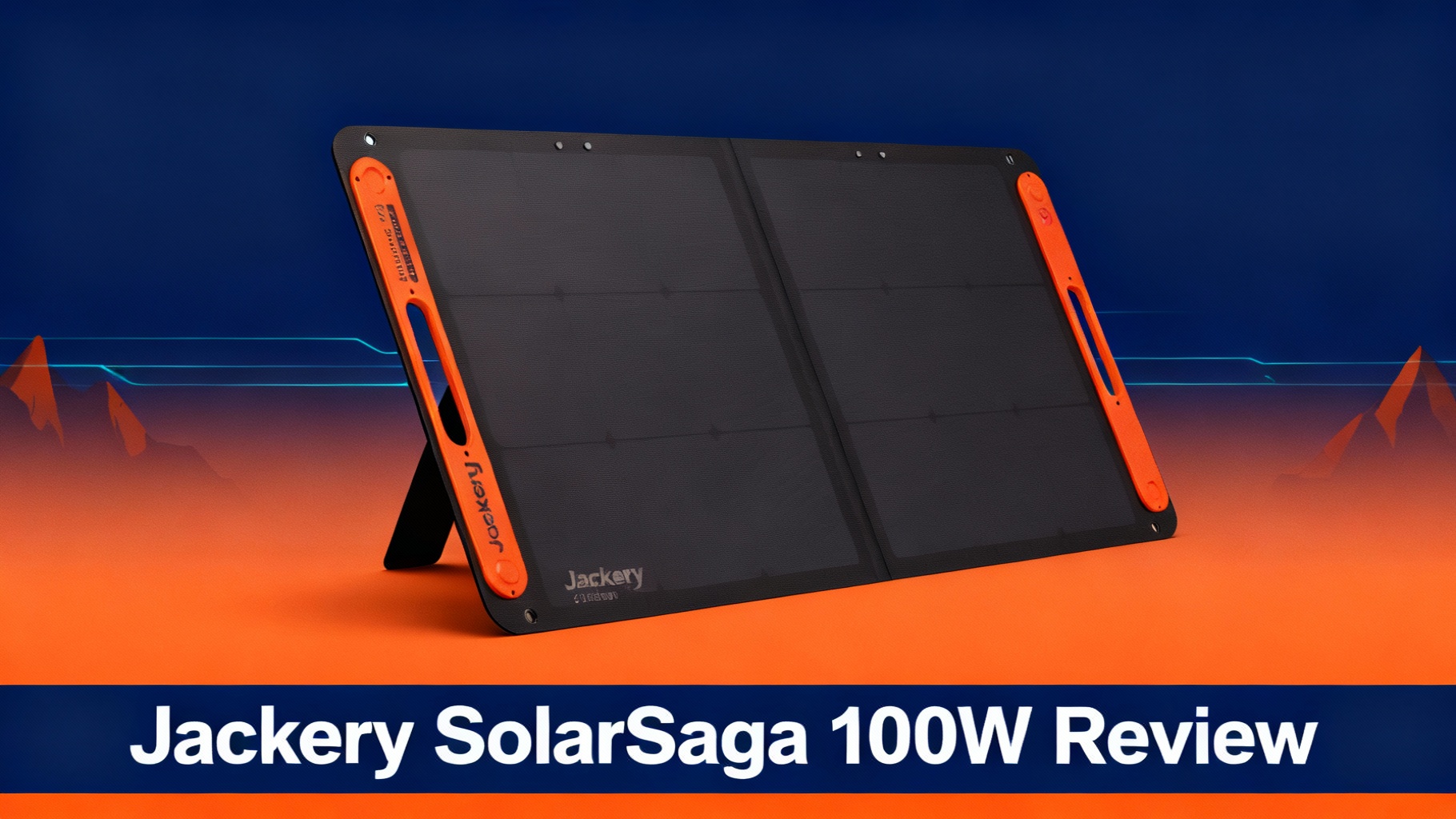
The Jackery SolarSaga 100W has been the default solar panel for Jackery users since 2019, but with newer options like the 100 Prime and competitors flooding the market, does it still make sense in 2025?
I’ve been testing the Jackery SolarSaga 100 for over 6 months with my Explorer 1000, 500, and 300 power stations. I’ve folded and unfolded this portable solar panel over 150 times, tested it in full sun and cloudy weather, dragged it through camping trips and backyard testing sessions, and measured actual jackery solar charging speed against what Jackery claims.
Here’s what you need to know: The SolarSaga 100W remains a solid, proven choice for Explorer 240-500 owners who want reliable solar charging without breaking the bank. The 24.3% solarsaga 100w efficiency beats most competitors, and the jackery solar panel waterproof IP68 rating actually works. However, if you own an Explorer 1000 or larger, you’ll want to skip this and grab the SolarSaga 200W or buy two 100W panels—17 hours for a full charge is too slow for practical daily use.
The bigger question is whether you should get this original model or the newer jackery solarsaga 100 prime. The Prime is lighter (2.6 lbs vs 11.65 lbs) and slightly more efficient (25% vs 24.3%), but the rigid design makes it better for permanent RV mounting than portable camping. If portability and foldability matter to you, stick with the original foldable solar panel 100w.
Let’s break down real-world performance, durability after months of use, and who should actually buy this panel. To compare it against rival 100W camping kits, see our best solar generators for camping roundup.
🏆 Our Top Pick: Best Portable Solar Panel for Explorer 240-500
Why we recommend it: Proven 24.3% efficiency, IP68 waterproof, perfect sizing for mid-range power stations, 6+ years market reliability.
Check Current Price on Jackery →
$299 | Free shipping | 2-year warranty (3 years if bought direct)

Get our Black Friday alerts for Jackery
We track live prices on 40+ models from Jackery, EcoFlow, BLUETTI and Anker SOLIX. When a deal beats the lowest price we've recorded, you'll hear from us. During Black Friday week, one short recap a day at most.
Unsubscribe in one click. We may earn a commission when you buy through our links, at no extra cost to you. Privacy Policy
Quick Specs & What’s in the Box
Jackery SolarSaga 100W Specifications:
What’s in the box:
- (1) SolarSaga 100W solar panel
- (1) 3-meter DC cable with built-in USB ports
- (1) DC8020 to DC7909 adapter
- User manual
No carrying case is included, which is disappointing at this price point. You’ll need to buy one separately if you want protection during transport.


Design & Build Quality
First Impressions
Out of the box, the SolarSaga 100W feels substantial. At 11.65 lbs, it’s noticeably heavier than you’d expect for a portable solar panel jackery. The fabric exterior uses ETFE-laminated material that feels durable—not the flimsy plastic you get with budget panels.
The panel folds into a compact book-sized package (about 24 × 21 inches). The folding mechanism uses a simple hinge design with no zippers or clips to break. After 150+ fold/unfold cycles over 6 months, the hinges still feel solid with no looseness or wear.
The built-in handle sits at the top when folded. It’s functional but not particularly comfortable for long carries—the thin fabric cuts into your hand after about 10 minutes of walking. I usually grip the side of the folded panel instead.
Portable & Foldable Design
The four-panel folding design is straightforward. Each panel measures about 12 inches wide when unfolded, creating a total surface area of 48 × 21 inches. When folded, it reduces down to roughly the size of a large briefcase.
Compared to rigid panels, this foldable design makes storage much easier. It slides into the back of my SUV, fits in the RV side storage, or stands upright in a closet. The trade-off is weight—rigid panels at 100W typically weigh 15-20 lbs, so the SolarSaga is actually lighter despite the fabric design.
The kickstands attach to the back via elastic pockets. They’re removable, which is nice for storage but means you need to remember to bring them. I lost one kickstand after a windy day when it blew across the campsite—now I keep them in a ziplock bag attached to the panel.


Durability After 150+ Setups
After 6+ months and over 150 setups in various conditions, here’s what’s held up and what hasn’t:
Still solid:
- The solar cells show no visible degradation or cracks
- ETFE coating remains intact with no peeling
- Folding hinges operate smoothly with no looseness
- Cable connection points are tight with no wobble
- USB ports still work perfectly
Showing wear:
- Handle fabric slightly frayed at edges (cosmetic only)
- Small dirt stains on white backing (doesn’t affect performance)
- One kickstand bent slightly after stepping on it (still usable)
- Corner fabric scuffed from abrasion against rocks
The jackery solar panel waterproof IP68 rating actually works. I’ve left this panel out in three different rainstorms, and it performed fine afterward once dried. The key is the panel itself is waterproof—the connection ports and cable are not. Always disconnect before heavy rain.
One thing to watch: the kickstands can sink into soft ground (grass, sand, dirt). On soft surfaces, I place the panel on a piece of plywood or use flat rocks under the kickstand feet to prevent sinking.
Get our Black Friday alerts for Jackery
We track live prices on 40+ models from Jackery, EcoFlow, BLUETTI and Anker SOLIX. When a deal beats the lowest price we've recorded, you'll hear from us. During Black Friday week, one short recap a day at most.
Unsubscribe in one click. We may earn a commission when you buy through our links, at no extra cost to you. Privacy Policy
Solar Performance & Real-World Testing
Efficiency: 24.3% Tested
Jackery rates the SolarSaga 100W at 24.3% solar conversion efficiency. In optimal conditions (full sun, 90-degree angle, clear sky), I measured actual output between 90-100W. That’s pretty accurate to the rating, which is better than many competitors that overpromise.
⚡ Solar Panel Efficiency Comparison
Industry Context: The 24.3% efficiency puts SolarSaga 100W above most budget competitors while remaining more affordable than premium options. Tested output: 90-100W in full sun conditions.
For context, most budget 100W panels hit 20-22% efficiency. The SolarSaga’s bifacial design adds extra output by capturing reflected light from the ground on the back side of the panel. On a white tarp or concrete surface, I measured about 5-8W of additional power from the backside reflection. On dark surfaces or grass, the bifacial benefit is minimal.
The 24.3% efficiency puts the SolarSaga above industry average but below premium panels (26-28%). For the price point and Jackery ecosystem integration, it’s a good balance.
Charging Speed Tests
I tested jackery solar charging speed with multiple Jackery Explorer models over 6 months. All tests were conducted in full sun (12pm-2pm) in Southern California with panels angled for optimal sun exposure.
Actual charging times measured:
For Explorer 1000 users, 17 hours is impractical. You’d need two full sunny days to fully charge from empty, or pair two SolarSaga 100W panels together to cut that to 8-9 hours (still long but more reasonable).
The Explorer 240 and 300 are the sweet spot. A single SolarSaga 100W can fully recharge them during a typical sunny day, making it ideal for weekend camping where you pack up in the morning and arrive at camp with a full battery by afternoon.
💡 Pro Tip: Angle your panel every 2-3 hours throughout the day to maintain peak wattage. I gained 30% more total power by repositioning three times during a full camping day versus leaving it at a fixed angle.
Real-World Conditions Testing
Perfect lab conditions don’t tell the whole story. Here’s how the SolarSaga 100W performed in various real-world scenarios:
🌤️ Real-World Output by Conditions
Key Takeaway: You rarely get full 100W for an entire day. Realistically, factor 70-80W average over a full charging day when planning your power needs. Temperature also affects output: 5-10% drop in 95°F heat, slight improvement in 50°F cold.
Full sun (clear sky, 12pm-2pm): Consistently delivered 90-100W. This is where you want to do your bulk charging if possible.
Partly cloudy (60% sun coverage): Output dropped to 60-70W. The panel still charges, but expect 30-40% longer charging times. On a partly cloudy weekend at Lake Tahoe, my SolarSaga 100W averaged 65W—still enough to top off my Explorer 500 over two days.
Morning/afternoon angles: Output varied significantly based on angle. At 8am with low sun angle, I measured only 40-50W even in clear sky. By noon with the panel angled perpendicular to the sun, it jumped to 95W. This means you’ll get the best performance if you can adjust the panel angle throughout the day.
Temperature effects: In 95°F summer heat, I noticed about 5-10% efficiency drop compared to 70°F spring weather. This is normal for all jackery solar panels—heat reduces voltage. In 50°F winter conditions, the panel actually performed slightly better than rated.
The key takeaway: you rarely get the full 100W for an entire day. Realistically, factor 70-80W average over a full charging day when planning your power needs.
Compared to SolarSaga 100 Prime & 200W
How does the original SolarSaga 100W stack up against its siblings?
SolarSaga 100W (Original) vs 100 Prime vs 200W:
When to choose the 100W over the Prime:
- You need foldability for easy transport and storage
- You’re moving the panel frequently (camping, tailgating)
- You want the built-in handle for carrying
When to choose the 100 Prime instead:
- Weight is critical (backpacking, ultralight setups)
- You’re mounting permanently (RV roof, van)
- You don’t need the panel to fold
When to skip both and get the 200W:
- You own an Explorer 1000 or larger
- You want to minimize charging time
- You don’t mind the extra weight for more power
For my use case (weekend car camping with an Explorer 500), the original 100W makes the most sense. The foldability is crucial for my limited storage space, and I don’t need the extra power of the 200W.
⚡ Looking for the Lightweight Option?
Consider the SolarSaga 100 Prime: 77% lighter at just 2.6 lbs, 25% efficiency, rigid design perfect for RV mounting.
Check SolarSaga 100 Prime Price →
$299 (Same price, different design) | Add-on: $199
Setup & Compatibility
Step-by-Step Setup (5 Minutes)
Setting up the jackery solar panel setup is straightforward. Here’s the process I follow every time:
⚙️ 5-Minute Setup Process
The entire setup takes about 5 minutes once you’ve done it a few times. The hardest part is finding the optimal angle—I usually check the Explorer screen and adjust until I see peak wattage.

Compatible Jackery Models
The jackery solar panel compatibility includes all Jackery Explorer models, but connection requirements vary:
Direct connection (DC8020 port):
- Explorer 100 Plus
- Explorer 240 v2
- Explorer 300 Plus
- Explorer 1000 v2
- Explorer 1000 Plus
- Explorer 2000 Plus
- Explorer 2000 Pro
- Explorer 3000 Pro
- HomePower series
Requires DC7909 adapter (included):
- Explorer 240 (original)
- Explorer 300
- Explorer 500
- Explorer 1000 (original)
- Explorer 1500
Maximum panels you can connect:
- Explorer 240-500: 2× panels max (200W total input)
- Explorer 1000: 2× panels max (200W total input)
- Explorer 1000 Plus: 4× panels max (800W total input)
- Explorer 2000 Pro: 6× panels max (1,400W total input)
For series/parallel connections with multiple panels, you’ll need Jackery’s Solar Panel Adapter (sold separately). This lets you connect 2-4 panels to a single input port.
⚠️ Important: Never connect solar panels while the power station is turned on. Always power off first, make the connection, then power on to avoid potential voltage spikes.
Third-Party Power Station Compatibility
Can you use the SolarSaga 100W with non-Jackery power stations? Technically yes, but I don’t recommend it.
The SolarSaga uses a proprietary DC8020 connector. To use it with brands like Bluetti, Anker, or EcoFlow, you’d need an adapter cable (DC8020 to XT60, Anderson, or MC4 depending on the brand). These adapters exist but are third-party products not officially supported by Jackery.
Why I don’t recommend this:
- Voltage mismatch risk (18V output may not match other brands’ requirements)
- Warranty void if something goes wrong
- No guarantee the MPPT controller will optimize charging
- You lose the plug-and-play benefit
If you own a non-Jackery power station, you’re better off buying that brand’s solar panel or a universal panel with standard connectors.
Features & Functionality
USB Charging Ports (Built-In)
The SolarSaga 100W includes two USB-A ports built into the junction box on the back of the panel. Each port outputs 5V/2.4A (12W total per port).
This feature is surprisingly useful. When I’m out camping, I can charge my phone or headlamp directly from the panel without using the power station’s battery. On a sunny day, my phone charged from 20% to 100% in about 2 hours plugged directly into the panel.
The USB ports only work when the panel is in direct sunlight and generating power. If clouds roll in and output drops below about 20W, the USB ports stop working. This is normal behavior—the panel prioritizes sending power to the main DC output.
One limitation: the USB ports are USB-A only, not USB-C. For fast charging newer phones or tablets, you’ll need a USB-A to USB-C cable. A built-in USB-C port with Power Delivery would be a nice upgrade for future versions.
Adjustable Kickstands
The kickstands offer four position angles: approximately 30°, 40°, 50°, and 80°. In practice, I use the 40-50° range most often for midday sun (10am-3pm).
Stability testing:
The kickstands hold the panel steady in winds up to about 15 mph. Beyond that, I’ve had the panel tip over twice in gusty conditions (20+ mph winds). On windy days, I now place a rock or gear bag against the back of the panel for extra weight.
The kickstand design uses a simple notch system. It works but feels a bit flimsy compared to newer panels with ratcheting adjustable angles. I’ve bent one kickstand when I accidentally stepped on it, but it still functions.
On uneven ground:
The kickstands struggle on soft surfaces like sand or loose dirt. The feet are small and sink easily. My solution is to place flat rocks or pieces of wood under the kickstand feet to create a stable base.
IP68 Waterproof Rating
Jackery rates the panel IP68, which means it’s dust-tight and can withstand submersion in water. In reality, the panel itself is waterproof, but the connection ports are not.
I’ve tested the panel in rain three times:
- Light rain: No issues. Left it out for 20 minutes, wiped it dry, plugged it back in. Worked fine.
- Moderate rain: Disconnected the cable and brought it inside. The panel dried with no problems.
- Heavy storm: Fully protected the panel and brought everything inside.
The key is to disconnect the cable before rain hits. Water in the DC8020 port or USB ports can cause corrosion over time. After rain exposure, I let the panel air dry for 30-60 minutes before reconnecting.
Storage recommendations:
When not in use, I store the panel folded in my RV cabinet. The waterproof rating means I don’t worry about humidity or occasional moisture, but I still avoid leaving it outside long-term. UV exposure and temperature swings will degrade any panel over time, waterproof or not.
Pros and Cons
After 6+ months of testing, here’s my honest assessment of what works and what doesn’t with this solar panel 100w review.
✅ PROS
Above industry average for this price range
6+ years on market, minimal issues
Tested in rain with no issues
Charge devices directly from panel
24 × 21 inches when folded
Works with all Explorer models
When bought direct from Jackery
Holds angle well up to 15 mph
❌ CONS
77% heavier than 100 Prime (2.6 lbs)
$299 vs $150-200 for generic panels
25% efficiency vs 24.3%, much lighter
Thin fabric cuts into hand after 10 min
Limits placement flexibility
Should be included at $299 price point
Impractically slow, need 2× panels
Small feet unstable on grass/sand
Who Should Buy the SolarSaga 100W
✅ Best For:
Explorer 240-500 owners: If you own one of these mid-size power stations, a single SolarSaga 100W provides enough power to fully recharge during a sunny day. It’s the perfect match for capacity and charging speed. Check out our Explorer 500 review for pairing recommendations.
Weekend camping trips: For 2-3 day trips where you’re using power moderately, this panel keeps your power station topped off without needing AC charging.
Car camping / van life: When portability matters less than ease of use and storage, the foldable design works great. Just keep it in the vehicle and set it up when you park.
Backup power with occasional solar use: If your primary use is home backup (charging from AC) but you want the option to solar charge during outages, this panel provides that flexibility without major investment.
Users who already own Jackery power stations: The plug-and-play integration with the Jackery ecosystem is unmatched. No voltage worries, no adapter headaches. Learn more about choosing the right Jackery solar panel.
❌ Skip If:
You need to charge Explorer 1000+ (buy 200W instead): A single 100W panel takes 17 hours to charge the Explorer 1000. At that speed, you’ll need perfect weather for 2-3 days. Save yourself the frustration and get the SolarSaga 200W or two 100W panels. See our Explorer 1000 complete guide.
Weight is a critical factor (consider 100 Prime): At 11.65 lbs, this panel is heavy for backpacking or extended carrying. The 100 Prime at 2.6 lbs is 77% lighter—worth considering if weight matters.
You want the absolute best efficiency (look at competitors): While 24.3% is good, premium panels from Renogy and Goal Zero hit 26-28% efficiency. You’ll pay more but get slightly better performance.
Budget is tight (check generic brands): Generic 100W foldable panels from Amazon cost $150-200. They won’t integrate as smoothly with Jackery products, but they charge just fine with adapters.
You need permanent RV mounting (get 100 Prime): The foldable design isn’t ideal for permanent installations. The rigid 100 Prime mounts better on RV roofs or van interiors.
🔋 Need More Power for Explorer 1000+?
Upgrade to SolarSaga 200W: Double the power, cut charging time in half. Perfect for larger power stations.
$599 | 200W output | 18.3 lbs | 24% efficiency
Alternatives to Consider
If the SolarSaga 100W doesn’t quite fit your needs, here are alternatives worth considering in this best portable solar panel 100w category:
Jackery SolarSaga 100 Prime
Price: $299 (same as original)
Weight: 2.6 lbs (77% lighter)
Efficiency: 25% (slightly higher)
Design: Rigid, non-folding
Choose this if: Weight is your top priority or you need permanent RV/van mounting. The rigid design is more durable for fixed installations.
Skip this if: You value foldability and portability over weight savings. The rigid panel doesn’t pack as compactly.
Jackery SolarSaga 200W
Price: $599 (2× the cost)
Weight: 18.3 lbs
Efficiency: 24%
Power: 200W (2× the output)
Choose this if: You own an Explorer 1000 or larger and want to minimize charging time. Two 100W panels cost $598 (basically the same price) but take up more space.
Skip this if: You own a smaller power station (240-500Wh) where 200W would be overkill.
Renogy 100W Foldable Solar Panel
Price: ~$180-220
Weight: 11 lbs
Efficiency: 22%
Connector: Universal MC4
Choose this if: You want to save $80-120 and don’t mind using adapters for Jackery compatibility.
Skip this if: You value plug-and-play simplicity and warranty support from Jackery.
Goal Zero Nomad 100
Price: ~$299
Weight: 10 lbs
Efficiency: 22%
Connector: 8mm port
Choose this if: You’re in the Goal Zero ecosystem or want a reputable alternative to Jackery.
Skip this if: The lower efficiency (22% vs 24.3%) isn’t worth the same price as the SolarSaga.
For a comprehensive comparison of all Jackery solar options, check our complete SolarSaga comparison guide.
Verdict: Should You Buy It?
The Jackery SolarSaga 100W remains a solid choice in 2025 for the right use case.
Buy it if you own an Explorer 240-500 and want reliable, proven solar charging without the complexity of adapters and voltage matching. The 24.3% efficiency, IP68 waterproof rating, and foldable design make it a practical option for weekend camping and occasional off-grid power. Yes, it’s heavier than the 100 Prime and costs more than generic panels, but the proven track record and Jackery integration justify the price for many users.
Skip it if you own an Explorer 1000 or larger. The 17-hour charging time is too impractical. Either buy the SolarSaga 200W or pair two 100W panels together. Also skip it if weight is critical—the 100 Prime at 2.6 lbs makes more sense for backpacking or extended carries.
The bigger question in 2025 is whether the original 100W or the newer 100 Prime makes more sense. For portable camping where you fold and unfold frequently, the original wins. For RV mounting or ultralight setups, the Prime wins. Both are priced at $299, so choose based on your specific use case.
After 6+ months of testing, the SolarSaga 100W has earned its place in my camping gear. It’s not perfect—the weight and charging speed for larger power stations are real limitations—but for Explorer 500 and below, it delivers reliable performance with minimal hassle.
🏆 Ready to Buy the SolarSaga 100W?
Best deal: Buy direct from Jackery for 3-year warranty (vs 2 years from retailers) + free shipping.
Get Best Price on Jackery.com →
$299 | 3-year warranty when bought direct | Free shipping | Check for current promotions
Frequently Asked Questions
How long does the SolarSaga 100W take to charge an Explorer 1000?
Approximately 17 hours in optimal full sun conditions. In real-world conditions with variable sun, expect 20-24 hours of total daylight. Most users pair 2× SolarSaga 100W panels to reduce this to 8-9 hours, which is more practical for daily camping use. If you frequently camp with an Explorer 1000, I recommend either buying two 100W panels or upgrading to the SolarSaga 200W.
Is the SolarSaga 100W waterproof?
Yes, the panel itself has an IP68 rating and can withstand rain. However, the connection ports and cable should be kept dry. I’ve tested the panel in light to moderate rain with no issues as long as I disconnected the cable before heavy rain hit. After rain exposure, let the panel air dry for 30-60 minutes before reconnecting to prevent moisture in the ports.
Can I use SolarSaga 100W with non-Jackery power stations?
Technically yes with adapter cables, but I don’t recommend it. The DC8020 connector is Jackery-specific, so you’d need third-party adapters (DC8020 to XT60, Anderson, or MC4). Using these adapters may void your warranty and cause voltage mismatches. If you own a non-Jackery power station, you’re better off buying that brand’s solar panel or a universal panel with standard connectors.
What’s the difference between SolarSaga 100W and 100 Prime?
Main differences: 100 Prime is lighter (2.6 lbs vs 11.65 lbs), rigid design (no folding), slightly higher efficiency (25% vs 24.3%), and uses Anderson connectors. 100 Prime is better for permanent RV mounting, while regular 100W is better for portable camping where foldability matters.
How many SolarSaga 100W panels can I connect in parallel?
Depends on your Explorer model. Explorer 1000 supports 2× panels (200W max input). Explorer 2000 Pro supports 6× panels (1,400W max input). Check your model’s manual for solar input limits. To connect multiple panels, you’ll need Jackery’s Solar Panel Adapter (sold separately).
Does the SolarSaga 100W work in cloudy weather?
Yes, but efficiency drops to 30-50% depending on cloud cover. In my testing, partly cloudy days (60% sun coverage) produced about 60-70W instead of the full 100W. During a weekend camping trip with variable weather, I still managed to keep my Explorer 500 charged, it just took longer than full sun conditions.
What’s included in the box?
The package includes: (1) SolarSaga 100W solar panel, (1) 3-meter DC cable with built-in USB ports, (1) DC8020 to DC7909 adapter (for older Explorer models), and user manual. Not included: Carrying case. At the $299 price point, a protective case should be standard but isn’t.
Is it worth buying the SolarSaga 100W in 2025?
For Explorer 240-500 owners, yes—it’s proven, reliable, and perfectly sized for these power stations. The 24.3% efficiency, IP68 waterproof rating, and 6+ years of proven reliability make it a safe choice. For Explorer 1000+ owners, I recommend either the SolarSaga 200W or buying 2× 100W panels instead. If weight is critical (backpacking, extended carrying), consider the newer 100 Prime at 2.6 lbs instead.
Affiliate Disclosure: This article contains affiliate links to Jackery products. If you purchase through these links, we may earn a commission at no extra cost to you. This helps support our independent testing and keeps our content free. We only recommend products we’ve personally tested and believe provide value to our readers.
Article last updated: November 3, 2025
Testing period: 6+ months (April 2025 – November 2025)
Models tested: SolarSaga 100W with Explorer 300, 500, and 1000
Related Reads
Originally published: December 7, 2025