
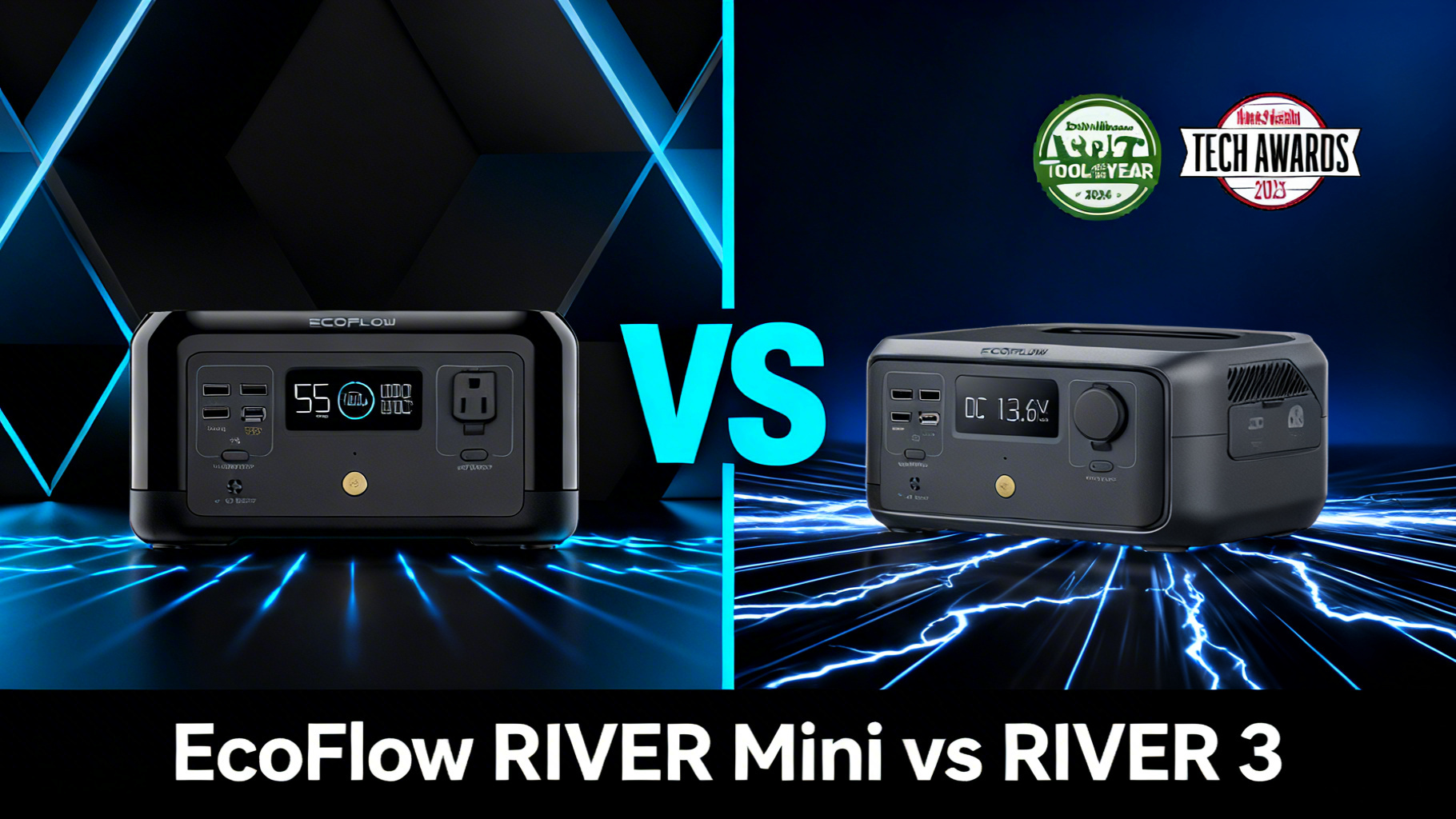
Choosing between the EcoFlow RIVER Mini and the EcoFlow RIVER 3 seems straightforward at first. Both are compact portable power stations, both charge fast with X-Stream technology, and both fit easily into a daypack or car trunk. But here’s the thing: the older, smaller RIVER Mini costs twice as much as the newer, more capable RIVER 3.
That pricing gap raises an obvious question. Is the RIVER Mini’s ultra-light design and built-in wireless charging pad really worth the $200 premium? Or does the RIVER 3 deliver so much more value that the choice becomes a no-brainer? Both models rank among our best compact portable power stations, but they serve different priorities.

Let’s break down every spec, feature, and use case so you can decide which compact power station actually fits your needs.

At a Glance: Key Differences
Before diving into the details, here’s a side-by-side look at the numbers that matter most. The differences between these two compact stations are larger than you might expect from products in the same EcoFlow lineup.
The RIVER 3 leads in almost every measurable category: capacity, battery chemistry, charge speed, waterproofing, noise level, and UPS functionality. The RIVER Mini’s advantages are narrower but specific: lower weight and a built-in wireless charging pad.
RIVER Mini Overview: The Ultra-Portable Pioneer
The EcoFlow RIVER Mini launched in 2021 as one of the lightest portable power stations in EcoFlow’s lineup. At just 6.3 lbs and 210Wh of capacity, it was designed for users who prioritize portability above everything else. Full specifications are available on the EcoFlow RIVER Mini product page.
The Wireless variant (the one currently sold at $399) adds a built-in Qi charging pad on top of the unit. Drop your phone on it, and it starts charging without cables. That’s a genuinely convenient feature for travel.
Output specs include 300W continuous AC power, enough to handle laptops, cameras, drones, and small kitchen appliances. X-Stream fast charging fills the battery from a wall outlet in roughly 1.5 hours, and solar input maxes out at 100W for an approximately 2-hour solar recharge.
However, the RIVER Mini uses standard Li-ion battery chemistry with an estimated lifespan around 500 charge cycles. That’s the older generation technology, and it shows in the long-term value calculation.
RIVER 3 Overview: The Modern Compact Powerhouse
The EcoFlow RIVER 3 represents EcoFlow’s 2024 generation of compact power stations. It packs 245Wh of capacity into a unit that’s 30% smaller than the industry average for this category, according to EcoFlow’s own specs.
The spec sheet reads like an upgrade in every direction. LiFePO4 battery chemistry rated for 3,000+ cycles to 80% capacity. IP54 waterproofing for outdoor use. UPS mode with less than 20ms switchover for keeping electronics alive during power blips. And noise levels under 30dB, which is quieter than a whisper.
AC output matches the RIVER Mini at 300W continuous, but the RIVER 3 adds X-Boost technology that can handle devices up to 600W. That’s a significant advantage for powering higher-draw appliances that the Mini simply can’t touch.
AC recharge time drops to approximately 1 hour with no battery damage, according to EcoFlow. At $199 (down from $239), the EcoFlow RIVER 3 price makes the feature set hard to argue with. For full technical details, refer to the official EcoFlow RIVER 3 specs page.
⚡ EcoFlow RIVER 3 – Current Best Price
$199
$239
-17% OFF
- 245Wh LiFePO4, 300W output (X-Boost 600W)
- 1-hour fast charging, IP54 waterproof
- Under 30dB whisper quiet operation
💡 Price checked March 2026 | Free shipping available
Battery Technology and Lifespan

This is where the generational gap between these two stations becomes impossible to ignore. The RIVER Mini runs on standard Li-ion cells. The RIVER 3 uses LiFePO4 (lithium ferro-phosphate), a fundamentally different and more durable chemistry.
What does that mean in practice? The RIVER Mini’s Li-ion battery is rated for approximately 500 cycles before it degrades to 80% of its original capacity. The RIVER 3’s LiFePO4 cells are rated for 3,000+ cycles at the same threshold. That’s roughly 6x the functional lifespan.
LiFePO4 also offers better thermal stability and a lower risk of thermal runaway. For a device you might leave in a hot car or use in direct sunlight, that’s a meaningful safety advantage.
If you charge either unit once per day, the RIVER Mini would start losing noticeable capacity after about 1.5 years. The RIVER 3 would maintain strong performance for over 8 years at the same usage rate. That difference transforms the value equation entirely.
Battery Capacity and Runtime
The capacity gap is narrower than the technology gap: 210Wh (Mini) vs 245Wh (RIVER 3). That’s a 17% increase in favor of the RIVER 3. Not dramatic, but noticeable when you’re counting charge cycles for your devices.
What Can Each Model Power?
📱
Smartphone Charges
Mini: ~14x
RIVER 3: ~16x
~15Wh per charge
💻
Laptop Charges
Mini: ~3x
RIVER 3: ~3.5x
~65Wh per charge
💡
LED Light (10W)
Mini: ~18 hrs
RIVER 3: ~21 hrs
10W draw
📷
CPAP Machine (50W)
Mini: ~3.6 hrs
RIVER 3: ~4.2 hrs
50W draw
Runtime calculations based on the RIVER 3’s 245Wh capacity show it pulling ahead consistently across common devices. The RIVER 3 also features a 2x runtime mode for light-wattage appliances, effectively doubling usable runtime for low-draw devices like LED lights and phone chargers. The Mini doesn’t have an equivalent feature.
Use our portable power station calculator to estimate exactly how long each model will power your gear.
Charging Speed
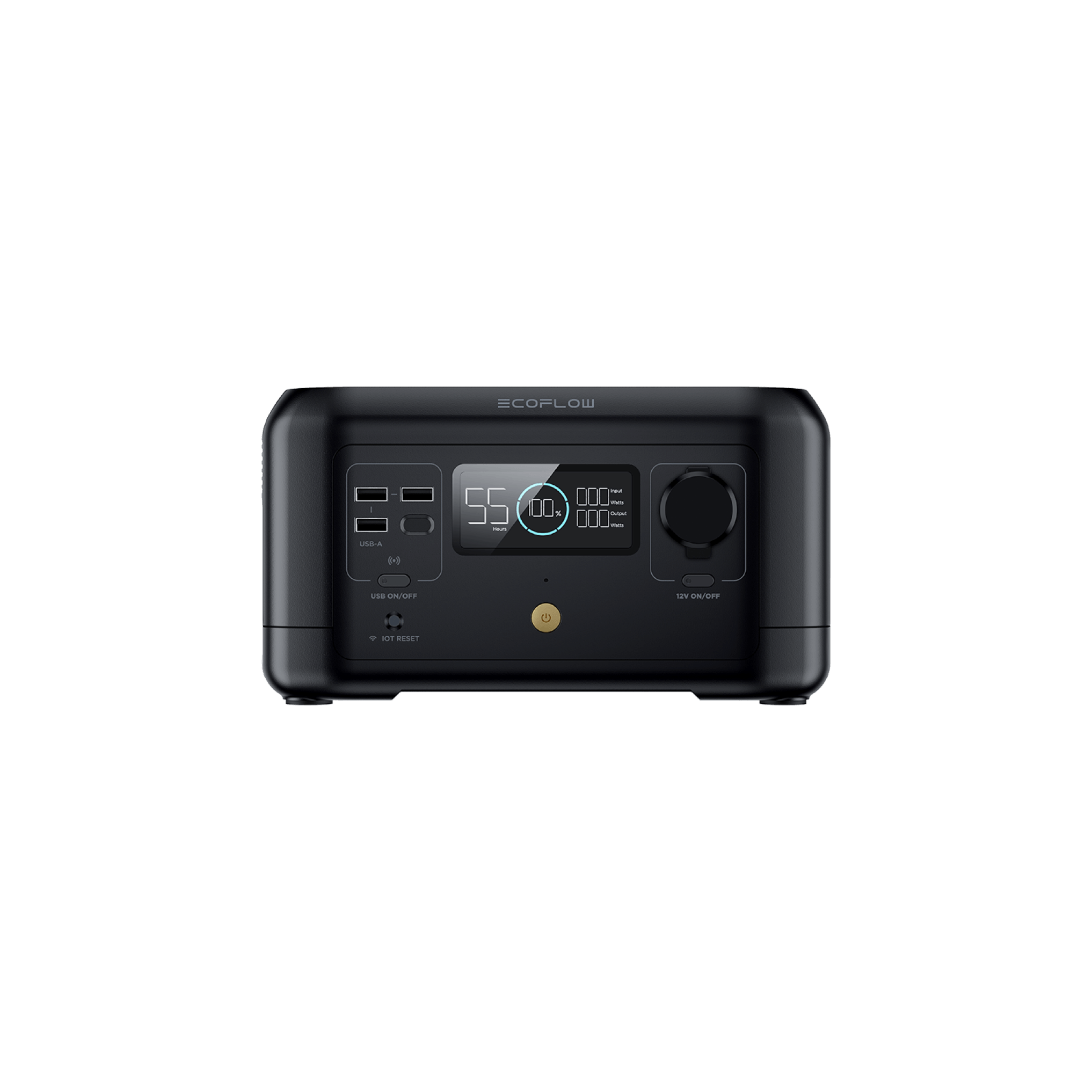
Both stations use EcoFlow’s proprietary X-Stream charging technology, but the RIVER 3 is notably faster. From a wall outlet, the RIVER 3 reaches full charge in approximately 1 hour. The RIVER Mini takes about 1.5 hours.
That 30-minute difference matters most when you’re packing for a trip and realize your station is dead. The RIVER 3 gets you out the door faster.
Solar charging on the RIVER Mini supports up to 100W input for an approximate 2-hour solar recharge. The RIVER 3’s solar input capabilities are comparable, making both stations reasonable companions for a portable solar panel.
Keep in mind that real-world solar charging depends heavily on panel quality, angle, cloud cover, and temperature. Rated solar charge times are best-case numbers.
Ports and Connectivity

Here’s one category where the RIVER Mini actually holds an advantage on paper. It supports up to 8 devices simultaneously, compared to the RIVER 3’s 6 device limit. If you’re charging multiple phones, tablets, cameras, and accessories at once, those extra ports could matter.
The RIVER Mini Wireless also includes its built-in Qi wireless charging pad. Just set your phone on top of the unit. No cable needed. It’s a small convenience, but one that the RIVER 3 simply doesn’t offer.
Both stations support EcoFlow App control via WiFi and Bluetooth. You can monitor battery status, adjust settings, and update firmware from your phone. App functionality is comparable between the two models.
Portability and Design

If absolute minimum weight is your priority, the EcoFlow RIVER Mini wins clearly. At 6.3 lbs, it’s approximately 1.5 lbs lighter than the RIVER 3 (which comes in around 7.8 lbs). For hikers, cyclists, or anyone counting ounces in their pack, that’s a real difference.
However, the RIVER 3 compensates with IP54 waterproof rating. That means it can handle dust and water splashes, making it a more confident choice for beach trips, rainy campsites, and outdoor use in general. The RIVER Mini has no waterproof rating.
Design-wise, the RIVER 3 reflects EcoFlow’s current generation aesthetic: cleaner lines, more compact footprint (30% smaller than industry average per EcoFlow’s data), and an overall more refined build. The RIVER Mini looks and feels like the 2021 product it is.
💰 EcoFlow RIVER Mini (Wireless):
Currently $399 on EcoFlow
Value and Long-Term Cost
This is where the EcoFlow RIVER Mini vs RIVER 3 comparison gets uncomfortable for the Mini. Let’s look at the numbers.
The RIVER Mini Wireless costs $399. The RIVER 3 costs $199. That means the Mini is exactly 2x the price while delivering less capacity, older battery technology, and fewer modern features.
Price per watt-hour tells the story clearly: the RIVER Mini comes in at approximately $1.90/Wh, while the RIVER 3 sits at roughly $0.81/Wh. The RIVER 3 delivers more than twice the value per unit of stored energy.
Factor in battery longevity, and the gap widens further. At 500 cycles, the RIVER Mini’s effective cost per cycle is about $0.80. At 3,000+ cycles, the RIVER 3’s cost per cycle drops to roughly $0.07. Over a 5-year period with regular use, the RIVER 3 is dramatically cheaper to own.
Both the RIVER Mini and RIVER 3 appear in our list of best budget power stations under $500, though the RIVER 3 offers significantly better long-term value.
So why does the RIVER Mini cost more? It’s a legacy product with a premium Wireless variant. The RIVER 3 benefits from newer, more cost-efficient LiFePO4 manufacturing. The pricing reflects product generations, not product quality.
Who Should Buy Which?
EcoFlow RIVER 3: Who Is It For?
✅ Buy the RIVER 3 if…
- You want the best value per Wh in the compact category
- Battery longevity matters (LiFePO4, 3,000+ cycles)
- You need IP54 waterproofing for outdoor use
- UPS backup for electronics is a priority
- You prefer whisper-quiet operation under 30dB
❌ Skip the RIVER 3 if…
- Absolute minimum weight is your top priority
- You need built-in wireless phone charging
- You already own a RIVER Mini and your needs haven’t changed
EcoFlow RIVER Mini (Wireless): Who Is It For?
✅ Buy the RIVER Mini if…
- Every ounce matters (6.3 lbs, ultra-portable)
- Wireless phone charging is a must-have feature
- You only need power for phones, tablets, and small devices
❌ Skip the RIVER Mini if…
- You want LiFePO4 longevity (Mini uses Li-ion, ~500 cycles)
- Budget is a concern ($399 vs $199 for the RIVER 3)
- You need waterproofing or UPS functionality
- X-Boost for higher-wattage devices matters to you
Best for Weekend Camping
Winner: RIVER 3. More capacity, IP54 waterproofing for unpredictable weather, and better value. The extra 1.5 lbs won’t matter when you’re car camping.
Best for Digital Nomads and Travel
Winner: RIVER Mini. The 6.3 lb weight and wireless charging pad make it genuinely easier to travel with. If you’re flying frequently or working from cafes with limited outlets, the Mini’s portability edge is real.
Best for Home UPS Backup
Winner: RIVER 3. The sub-20ms UPS switchover keeps your router, modem, or NAS running through brief power interruptions. Combined with LiFePO4 longevity, it’s the only choice here. The Mini doesn’t offer UPS functionality.
Best for Budget Buyers
Winner: RIVER 3. At half the price with better specs across nearly every category, this one isn’t close.
Best for Minimal Phone and Tablet Charging
Tie. Both handle phone and tablet charging without breaking a sweat. The Mini is lighter. The RIVER 3 is cheaper. Your priority decides.
If you are still unsure which capacity fits your needs, our guide on how to choose a portable power station breaks down the key factors. Campers choosing between ultra-light and capable options should also check our best power stations for camping roundup.
Frequently Asked Questions
Is the EcoFlow RIVER Mini still worth buying in 2026?
The RIVER Mini remains a viable option only if ultra-low weight (6.3 lbs) and built-in wireless charging are your top priorities. For most buyers, the RIVER 3 offers more capacity, better battery technology (LiFePO4 vs Li-ion), and a significantly lower price point at $199 compared to $399. Unless portability is your single deciding factor, the RIVER 3 is the stronger buy.
Can the RIVER 3 replace the RIVER Mini for travel?
For most travelers, yes. The RIVER 3 adds approximately 1.5 lbs over the Mini but delivers 17% more capacity, LiFePO4 longevity rated for 3,000+ cycles, and IP54 waterproofing. The only feature you lose is the built-in wireless charging pad. If wireless charging isn’t essential, the RIVER 3 is a direct upgrade for travel use.
Why is the RIVER Mini more expensive than the RIVER 3?
The RIVER Mini (Wireless) variant at $399 includes a built-in wireless charging pad and represents an older product generation launched in 2021. The RIVER 3 at $199 benefits from newer manufacturing efficiencies and updated LiFePO4 technology, which brought the entry price down significantly. The pricing reflects generational differences, not a quality advantage for the Mini.
Which has better battery longevity, the RIVER Mini or RIVER 3?
The RIVER 3 wins by a wide margin. Its LiFePO4 chemistry is rated for 3,000+ cycles to 80% capacity. The RIVER Mini uses Li-ion with an estimated 500-cycle lifespan at the same threshold. In practical terms, the RIVER 3 will last roughly 6x longer before you notice significant battery degradation.
Does the EcoFlow RIVER 3 work as a UPS for computers?
Yes. The RIVER 3 features a UPS mode with less than 20ms switchover time, making it suitable for keeping routers, modems, and small electronics running during brief power interruptions. It won’t protect a full desktop gaming rig, but for networking equipment and low-draw devices, it works well. The RIVER Mini does not include UPS functionality.
Final Verdict: RIVER Mini or RIVER 3?
The data points clearly in one direction for most buyers. The EcoFlow RIVER 3 delivers more capacity (245Wh vs 210Wh), vastly superior battery longevity (3,000+ cycles vs ~500), faster charging (1 hour vs 1.5 hours), IP54 waterproofing, UPS functionality, whisper-quiet operation, and X-Boost up to 600W. All of that at $199, half the price of the RIVER Mini.
The RIVER Mini (Wireless) at $399 makes sense in exactly one scenario: you need the absolute lightest compact station available (6.3 lbs) and wireless phone charging is a must-have feature for your workflow. That’s a narrow niche, but it’s a real one for ultra-light travelers and digital nomads who value every ounce.
For everyone else, weekend campers, home backup users, budget-conscious buyers, and anyone who values long-term reliability, the RIVER 3 is the clear recommendation. It’s not just the better product spec for spec. It’s a better product at a better price.
⚡ Ready to Buy? Check Current Price
EcoFlow RIVER 3
$199 $239
Best compact power station under $250 with LiFePO4
Price verified March 2026 – Free shipping available