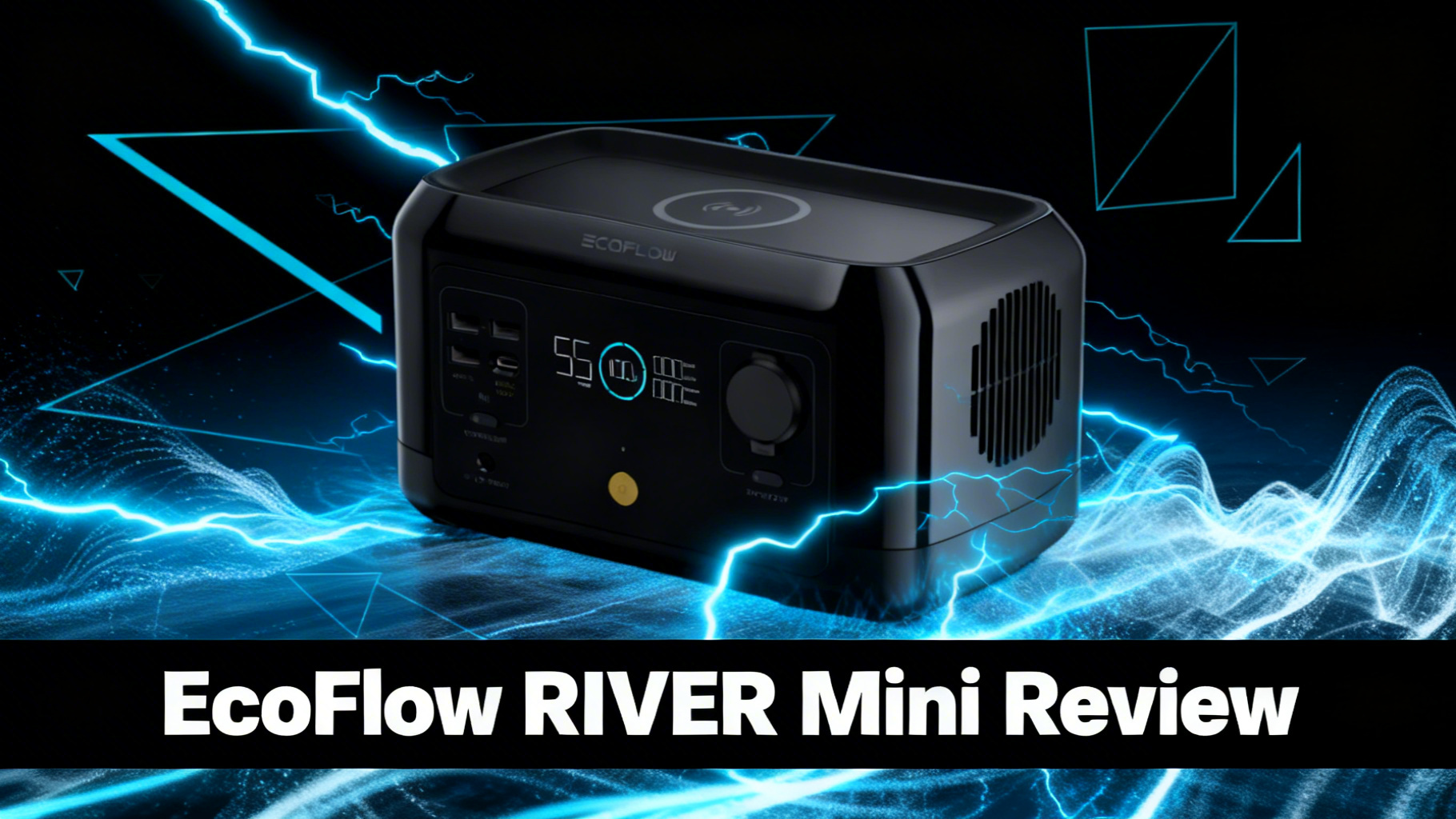
Looking for a portable power station that fits in your daypack and keeps your devices charged without the cable clutter? The EcoFlow RIVER Mini takes a bold swing at the ultralight segment with a feature most competitors ignore: a built-in Qi wireless charging pad.
With dozens of models competing for a spot in our best portable power stations of 2026 ranking, EcoFlow’s smallest unit takes a different approach. Instead of chasing bigger batteries or higher output, the RIVER Mini portable power station bets on convenience. At $399 for the Wireless variant, with 210Wh of capacity and a featherweight 6.3 lbs, it’s clearly designed for a specific kind of user. But is that wireless charging pad a genuine innovation, or just a marketing gimmick that drains your battery faster?
Our analysis dives deep into the specs, real-world performance data, and owner feedback to answer that question. Here’s what the numbers reveal.

EcoFlow RIVER Mini (Wireless)
$399
- 210Wh capacity, 6.3 lbs ultralight
- X-Stream charging: 0-80% in 1 hour
- Built-in wireless charging pad
Price verified March 2026 | Free shipping available
Quick Specs & Key Features
Before getting into the details of this EcoFlow RIVER Mini review, here’s a snapshot of what the Wireless variant brings to the table. The specs tell an interesting story: this is a unit that prioritizes speed and convenience over raw capacity.

Key Feature Highlights
Three features stand out from the EcoFlow RIVER Mini specs. First, the X-Stream fast charging: 0 to 80% in about an hour is remarkably fast for this price range. Second, the Qi wireless pad on top adds a cable-free charging option that no direct competitor currently matches. Third, the Bluetooth app control is a premium feature usually reserved for larger, more expensive units.
For full technical details, visit the official EcoFlow RIVER Mini product page.
What We Love About the RIVER Mini
Ultralight Portability at 6.3 Pounds
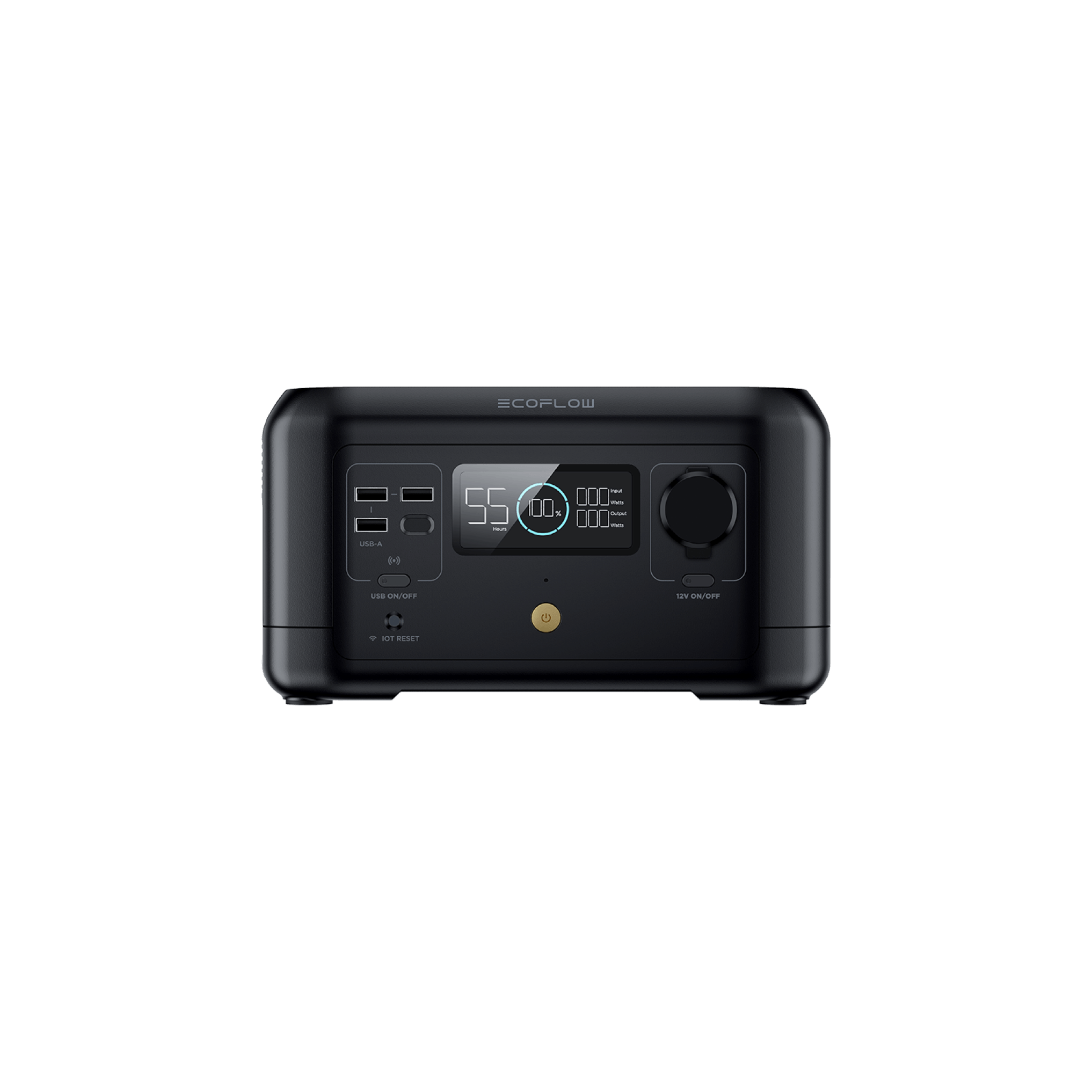
At 6.3 lbs, the EcoFlow RIVER Mini is among the lightest power stations with an AC inverter on the market. For context, that’s roughly the weight of a large water bottle plus a paperback book. You can toss it in a backpack, slide it under a car seat, or carry it one-handed without fatigue.
This matters for day hikers, festival-goers, and remote workers who need power on the move without the bulk. Performance data shows that most competing units in the 200-300Wh range weigh 7-10 lbs, making the RIVER Mini a clear winner on the portability front.
X-Stream Fast Charging in 1.5 Hours
EcoFlow’s proprietary X-Stream charging technology is a standout feature of this river mini portable power station. A full charge from zero to 100% takes approximately 1.5 hours via a standard wall outlet. That’s roughly 3-4 times faster than the Jackery Explorer 240 and comparable units that rely on standard charging methods.
What does this mean in practice? You can plug in the RIVER Mini during lunch, and it’s fully topped off before you head out for an afternoon adventure. For users who plan spontaneous trips, this eliminates the “forgot to charge the night before” problem entirely.
Full App Control via Bluetooth
The EcoFlow smartphone app connects via Bluetooth and gives you real-time monitoring of input/output wattage, battery percentage, and estimated runtime. You can also toggle AC output on and off, adjust charging speeds, and set custom power profiles.
This is a feature that typically appears on units costing $500 and above. Having it on a $399 ultralight model adds genuine value, especially for users who want to optimize battery life and track power consumption precisely.
Up to 8 Devices Simultaneously
The port diversity on the EcoFlow RIVER Mini wireless portable power station punches above its weight class. Two AC outlets, two USB-A ports, one USB-C, one DC barrel connector, and the wireless charging pad add up to 8 simultaneous connections. For a 210Wh unit, that’s an impressive count.
Keep in mind that running all 8 ports at once will drain the battery quickly. But for a typical scenario (phone on wireless pad, laptop on AC, camera on USB-C), the port variety means you won’t need adapters or a power strip.
Wireless Charging: Gimmick or Genius?

This is the question at the heart of the EcoFlow RIVER Mini review. The built-in Qi pad on top of the unit delivers up to 15W of wireless charging power. Drop a compatible phone on the pad, and it starts charging. No cables, no fumbling in the dark at a campsite.
So is it genuinely useful, or a battery-draining gimmick? The data paints a nuanced picture.
On the convenience side, wireless charging eliminates the need to carry and manage USB cables for your phone. At a campsite, in a tent, or on a road trip, simply placing your phone on top of the power station is undeniably easier. For overnight charging while camping, it works effortlessly.
On the efficiency side, this is where the math gets less flattering. Qi wireless charging operates at roughly 80-85% efficiency, compared to 95%+ for a direct USB-C cable. That means for every 15Wh your phone needs, the RIVER Mini actually expends around 18Wh via wireless, versus roughly 16Wh via cable. On a 210Wh battery, that efficiency gap adds up.
Runtime calculations tell the story: you can expect approximately 10-12 wireless phone charges versus 12-14 charges via USB cable. That’s a loss of 2-3 charges over the full battery capacity. For a weekend trip, this difference probably won’t matter. For extended use, it could.
The verdict on wireless charging? It sits somewhere between gimmick and genius. It’s a genuine convenience feature that works well for casual, short-trip use. But it’s not efficient enough to replace cable charging entirely, especially on a unit with just 210Wh of capacity. Think of it as a nice bonus rather than a core feature you should pay a premium for.
What Can the RIVER Mini Power?
With 210Wh of EcoFlow RIVER Mini capacity, this power station is built for electronics and small devices, not appliances. Here’s what runtime calculations show based on typical wattage draws.
What Can It Power? (210Wh)
📱
Smartphone
~14 charges
~15W
💻
Laptop
~3 charges
~60W
💡
LED Light (10W)
~18 hours
10W
📺
32″ TV
~4 hours
~50W

For a more precise estimate based on your own appliances, try our portable power station runtime calculator.
The sweet spot for the RIVER Mini is a day trip or single overnight where you need to keep phones, cameras, tablets, and a laptop charged. It handles a weekend of device charging comfortably for one person, or a single day for a couple sharing devices. For an emergency phone charging station during a short power outage, the EcoFlow RIVER Mini 210Wh capacity provides enough juice for the whole household to stay connected for a day or two.
Where it falls short: anything that draws sustained power. A mini-fridge, a CPAP machine, or power tools will either exceed the 300W output cap or drain the 210Wh battery in under 2-3 hours.
What Could Be Better
210Wh Limits Overnight Use
The RIVER Mini’s 210Wh capacity is the most significant constraint. For perspective, that’s about one-fifth the capacity of mid-range units like the EcoFlow RIVER 2 Pro or Jackery Explorer 1000. If you’re running anything beyond phone and laptop charging, you’ll burn through the battery in a few hours.
For multi-night camping trips or any scenario requiring sustained power, this EcoFlow RIVER Mini capacity simply isn’t enough. It’s a day-trip companion, not a basecamp workhorse.
300W Output Cap Excludes Most Appliances
The 300W continuous output (600W surge) rules out a long list of common devices. Electric kettles, hair dryers, space heaters, most coffee makers, and even some larger blenders exceed 300W. The surge rating helps with startup spikes, but anything that draws more than 300W sustained will trip the overload protection.
This isn’t a design flaw for the intended use case. But if you’re expecting a do-it-all power station, the RIVER Mini will disappoint.
No Battery Expansion Option
Unlike some competitors in EcoFlow’s own lineup (such as the RIVER 2 series with extra battery modules), the RIVER Mini offers no expansion path. What you see is what you get: 210Wh, period. If your power needs grow over time, you’ll need to purchase an entirely new unit rather than simply adding capacity.
$50 Premium for Wireless Charging
The Standard RIVER Mini is priced at $349, while the Wireless variant costs $399. That $50 premium gets you the Qi wireless pad and a USB-C fast-charge port. Is the EcoFlow RIVER Mini price justified?
The USB-C port alone adds meaningful value, since it enables faster device charging and is increasingly the universal standard. The wireless pad is a convenience layer on top. If you already carry USB-C cables everywhere, the Standard variant (when available) offers better value per dollar. Currently, only the Wireless version is in stock on the EcoFlow website, which makes the decision easier by default.
How It Compares
The RIVER Mini competes in the ultralight segment, where it faces stiff competition from other best compact portable power stations on the market. Two of its closest rivals are the Jackery Explorer 240 and the Anker SOLIX C300X.
On capacity, the RIVER Mini’s 210Wh trails the Jackery Explorer 240 (240Wh) and falls further behind the Anker SOLIX C300X (288Wh). That’s a meaningful gap when every watt-hour counts on a camping trip.
On charging speed, however, the EcoFlow RIVER Mini dominates. Its 1.5-hour X-Stream recharge crushes the Jackery’s roughly 5.5-hour charge time. The Anker matches at around 1.5 hours, making these two the speed leaders in this class.
On weight, the RIVER Mini edges out the Jackery (6.3 lbs vs 6.6 lbs) and beats the Anker more convincingly (6.3 lbs vs 7.5 lbs).
The RIVER Mini’s two exclusive advantages are wireless charging and app control. No other unit in this price and weight class offers a built-in Qi pad. App control is shared with the Anker SOLIX C300X but absent from the Jackery.
On price, the gap is significant. The Jackery Explorer 240 comes in at just $199, half the cost of the RIVER Mini. The Anker SOLIX C300X sits at $249, offering more capacity and comparable speed for $150 less. The EcoFlow RIVER Mini price of $399 is a tough sell on pure specs alone; you’re paying a premium for the wireless charging, app control, and the EcoFlow brand ecosystem.
Who Should Buy the RIVER Mini
✅ Buy this if…
- You need an ultralight power station under 7 lbs for day trips or backpacking
- You primarily charge phones, tablets, laptops, and small electronics
- Wireless phone charging convenience matters to you
- You want X-Stream fast charging for quick top-ups between adventures
❌ Skip this if…
- You need to power appliances above 300W (mini-fridges, power tools)
- You require more than a single overnight of power for camping
- You want expandable battery capacity for future growth
The EcoFlow RIVER Mini power station fits a specific profile. It excels for day trippers and weekend campers who prioritize weight above all else. If your pack is already heavy and you just need enough power to keep phones, cameras, and a tablet charged, the 6.3 lb RIVER Mini is an excellent companion. If camping is your primary use case, the RIVER Mini earns its place among top camping power stations thanks to its featherlight design.
It’s also a strong pick for remote workers and digital nomads who need a portable power backup for laptops and phones. The fast 1.5-hour recharge means you can top off between coffee shop sessions or before heading to a co-working space with unreliable outlets.
Festival-goers and event photographers will appreciate the compact size and the wireless charging convenience. Drop your phone on the RIVER Mini’s wireless pad between sets or shoots, and you’re always topped up.
FAQ
How long does the EcoFlow RIVER Mini take to charge wirelessly?
Wireless charging speed depends on the phone model. With Qi-compatible devices, the built-in pad delivers up to 15W, which translates to roughly 2-3 hours for a full smartphone charge. This is slower than a direct USB-C cable connection, but the convenience factor eliminates the need for carrying extra cables.
Can the EcoFlow RIVER Mini power a mini-fridge?
Not reliably. Most mini-fridges draw 50-80W continuously, but the startup surge can exceed the RIVER Mini’s 300W AC output. Even if it starts, the 210Wh capacity would only last 2-3 hours. For refrigerator use, consider a unit with at least 500Wh capacity.
Is the EcoFlow RIVER Mini compatible with solar panels?
Yes, it accepts up to 100W of EcoFlow RIVER Mini solar input via its XT60 connector. With a 100W solar panel in direct sunlight, the RIVER Mini can recharge in approximately 2 hours. It is compatible with EcoFlow’s own solar panels as well as third-party panels with the appropriate adapter cable.
What is the difference between the RIVER Mini Standard and Wireless?
The Standard version ($349) does not include the Qi wireless charging pad on top or the USB-C fast-charge port. The Wireless version ($399) adds both features. Currently, only the Wireless variant is available for purchase on the EcoFlow website.
How many phone charges can the RIVER Mini provide?
Based on the 210Wh capacity and typical smartphone batteries (10-15Wh), runtime calculations indicate approximately 12-14 full charges via USB port, or roughly 10-12 charges via the wireless pad (accounting for Qi efficiency losses of around 15-20%).
Is the EcoFlow RIVER Mini good for camping?
For day trips and single-night campouts focused on charging phones, tablets, cameras, and LED lights, the RIVER Mini excels thanks to its 6.3 lb weight and compact form factor. For multi-day camping trips requiring higher power draws, a larger unit in the 500-1,000Wh range would be more appropriate.
Final Verdict: Is the EcoFlow RIVER Mini Worth $399?
EcoFlow RIVER Mini (Wireless): Overall Rating
7.2/10
“The ultralight trailblazer with a wireless twist”
Portability 9/10
Charging Speed 8/10
Wireless Feature 6/10
Capacity 5/10
Value 7/10
Features 8/10
The EcoFlow RIVER Mini (Wireless) occupies a narrow but well-defined niche. It’s the lightest, fastest-charging, and most feature-rich ultralight power station available, and the wireless charging pad is a genuine (if imperfect) convenience feature. The data supports a 7.2/10 overall rating.
Where it shines: portability (9/10), charging speed (8/10), and feature set (8/10) for an ultralight unit. Where it falls short: capacity (5/10) and the debatable value of wireless charging at a 15-20% efficiency penalty (6/10). At $399, the value proposition (7/10) depends heavily on how much you prioritize weight and convenience over raw capacity.
Based on our analysis, the RIVER Mini makes sense for ultralight users who need a quick-charging, feature-packed companion for day trips, single-night camping, and device-focused use. It doesn’t make sense if you need sustained power for appliances or multi-day off-grid scenarios.
Is the wireless charging genius or gimmick? The honest answer: it’s a convenience feature that works well enough to justify the $50 premium, mainly because the Wireless variant also includes the USB-C fast-charge port. It won’t replace your cables, but it’s genuinely nice to have at a campsite or on your desk.
At $399, it also holds its own in our roundup of budget power stations under $500. And for a broader look at how it stacks up against the competition, check our best portable power stations of 2026 ranking.
EcoFlow RIVER Mini (Wireless)
$399
Best ultralight power station with wireless charging
Price verified March 2026 | Free shipping available