
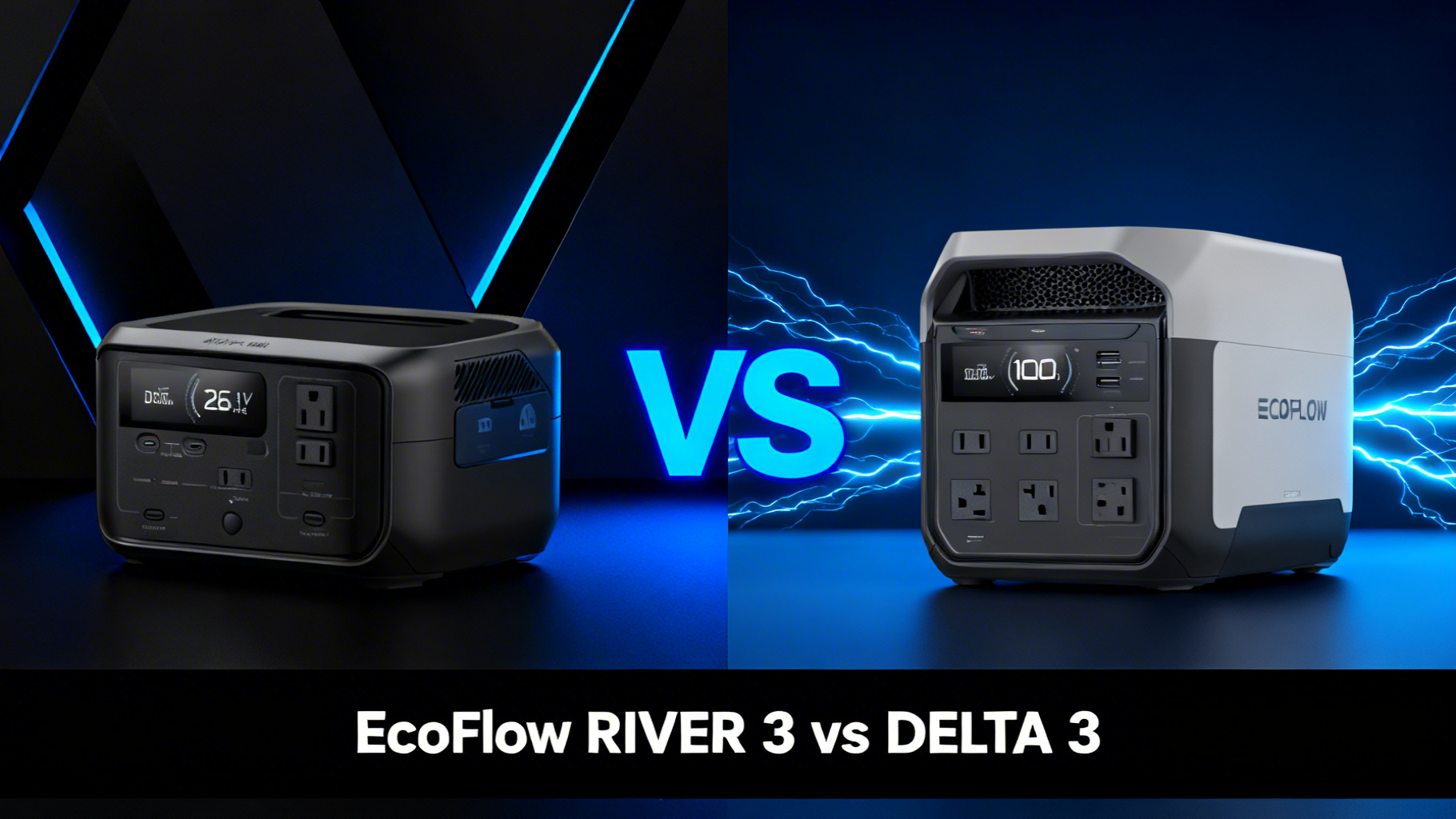
Choosing between the EcoFlow RIVER 3 and DELTA 3 feels like comparing a compact car to an SUV. Both get the job done, but what you’re hauling (and where you’re going) changes the equation completely. One costs $199, the other $499. One fits in a daypack, the other powers your entire campsite.
So is the $300 price difference justified? That depends entirely on what you need to run, for how long, and how portable your setup needs to be.
In this EcoFlow RIVER 3 vs DELTA 3 comparison, we break down every spec that matters: battery capacity, power output, charging speeds, portability, expandability, and long-term value. For a broader look at the full product range, check our complete EcoFlow lineup ranking before narrowing down your choice. By the end, you’ll know exactly which model fits your situation.
Spoiler: there’s no universal winner here. The RIVER 3 dominates in portability and budget. The DELTA 3 wins on raw power and expandability. The right choice comes down to your specific use case.

At a Glance: Key Differences
Before diving into the details, here’s a side-by-side look at how the EcoFlow RIVER 3 and DELTA 3 compare on paper. The differences are significant across nearly every category.
A few quick takeaways from the EcoFlow RIVER 3 specs and DELTA 3 specs side by side. The DELTA 3 offers over 4x the battery capacity and 6x the continuous AC output. The RIVER 3 counters with an IP54 weather rating, whisper-quiet operation under 30dB, and a significantly lower EcoFlow RIVER 3 price of just $199.
Both units use LFP (lithium iron phosphate) battery chemistry, which means long cycle life on either model. Both also feature sub-20ms UPS switchover for emergency backup scenarios.


Battery Capacity & Runtime Comparison
The EcoFlow RIVER 3 capacity of 245Wh versus the DELTA 3’s 1,024Wh represents a 4.2x difference in stored energy. Battery capacity is where the gap between these two models becomes impossible to ignore.
What does that mean in practice? Runtime calculations based on each unit’s capacity paint a clear picture. The RIVER 3 handles small electronics well: roughly 15 smartphone charges, about 3.5 hours of laptop use at 60W, or around 20 hours of LED lighting at 10W. It’s designed for light, efficient loads.
The DELTA 3 plays in a different league entirely. Based on its 1,024Wh capacity, it can keep a mini-fridge running for approximately 12 hours at 75W, power a 55-inch TV for around 8 hours, or even run a microwave for about 45 minutes at 1,000W. These are appliances the RIVER 3 simply cannot handle for any meaningful duration.
What Can Each Model Power?
RIVER 3 (245Wh)
📱
Smartphone
~15 charges
15W
💻
Laptop
~3.5 hrs
60W
💡
LED Lights
~20 hrs
10W
DELTA 3 (1,024Wh)
❄️
Mini-Fridge
~12 hrs
75W
📺
55″ TV
~8 hrs
120W
🔌
Microwave
~45 min
1,000W
Use our runtime calculator for portable power stations to estimate exact runtimes for your specific appliances.

If your power needs revolve around phones, tablets, and laptops, the RIVER 3’s 245Wh is perfectly adequate. The moment you need to power anything with a compressor, heating element, or motor, the DELTA 3 becomes the only realistic option.
Power Output: 300W vs 1,800W
Raw capacity only tells half the story. The other half is output wattage, which determines what appliances you can actually run.
The EcoFlow RIVER 3 delivers 300W continuous with X-Boost pushing it up to 600W for compatible devices. That’s enough for laptops, phone chargers, camera batteries, LED lights, and small fans. It won’t run a coffee maker, a hair dryer, or a microwave. You can review the official EcoFlow RIVER 3 specifications for the complete port breakdown.
The EcoFlow DELTA 3 steps up to 1,800W continuous with a 3,600W surge rating. With X-Boost, it can handle loads up to 2,200W. That opens the door to nearly every household appliance: microwaves, electric grills, power tools, space heaters, and full-size blenders. See the official EcoFlow DELTA 3 specifications for the full list of supported devices.
The practical difference here is significant. With the RIVER 3, you’re limited to charging and powering small electronics. With the DELTA 3, you can replicate most of your home’s electrical capabilities in the field or during an outage.

Charging Speed Comparison
Both models charge quickly via AC wall outlet, though through different approaches. The RIVER 3 reaches a full charge in approximately 1 hour thanks to its 1-hour fast charging technology with no battery damage. The DELTA 3, with its much larger battery, takes roughly 1.5 hours for a full AC charge. That’s impressive considering it holds over 4x the energy.
Solar charging is where the DELTA 3 pulls ahead decisively. It accepts up to 500W of solar input, allowing a full charge in approximately 2 hours under optimal conditions. The RIVER 3 caps at 110W solar input, though its smaller battery still reaches full in about 2.6 hours with a compatible panel.

The DELTA 3 also offers 5 recharging methods: AC, solar, 800W Alternator Charger, Smart Generator 3000 (Dual Fuel), and multicharging. The RIVER 3 is more limited on this front. If you plan to charge from a vehicle alternator or a generator while off-grid, the DELTA 3 provides more flexibility.
Portability & Design
This is where the RIVER 3 fights back, hard. EcoFlow designed the RIVER 3 to be 30% smaller than the industry average for its capacity class. It’s compact enough to fit in a backpack, light enough to carry one-handed, and operates at under 30dB, which is quieter than a whisper.

The RIVER 3 also carries an IP54 waterproof rating, protecting it against dust and water splashes. That’s a genuine advantage for outdoor use where unpredictable weather is a factor. You can confidently use it at a campsite, on a boat deck, or during light rain without worry.
The DELTA 3, being a 1,024Wh unit, is naturally heavier and bulkier. The EcoFlow DELTA 3 weight is noticeably higher than the RIVER 3’s compact frame. It doesn’t carry an IP rating, so you’ll want to keep it sheltered from direct rain. Noise levels run closer to an estimated 40dB under load. It’s still portable in the sense that one person can carry it, but it’s a two-hands, set-it-down-and-leave-it kind of portable.
Expandability & Future-Proofing
This category belongs entirely to the DELTA 3. The RIVER 3 is a standalone unit with no expansion options. What you get at 245Wh is what you keep.
The DELTA 3 supports expansion from 1kWh up to 5kWh using compatible extra batteries: the DELTA 3 Extra Battery, DELTA Pro 3 Extra Battery, DELTA 2 Extra Battery, or DELTA 2 Max Extra Battery. That scalability transforms the DELTA 3 from a portable power station into a modular home backup system.
If you think your power needs might grow over time, this is a critical factor. Buying the DELTA 3 now and adding batteries later is far more cost-effective than replacing an entire unit down the road. The DELTA 3 also comes with a 5-year warranty, adding confidence to the long-term investment.
Ports & Connectivity
The RIVER 3 offers 6 output ports total, including USB-C, USB-A, and AC outlets. That’s enough to charge up to 6 devices simultaneously, which covers most travel and camping scenarios.

The DELTA 3 provides a wider array of ports with higher-wattage USB-C delivery, more AC outlets, and additional DC options. For users running multiple appliances or devices at once (think: a campsite with a fridge, lights, phone chargers, and a laptop), the DELTA 3’s port selection handles the load more comfortably.
Value Analysis: Price Per Wh
Here’s where the numbers get interesting. The RIVER 3 at $199 for 245Wh works out to $0.81 per Wh. The DELTA 3 at $499 for 1,024Wh comes to $0.49 per Wh. On a per-watt-hour basis, the DELTA 3 delivers significantly better value.
Not sure which capacity tier is right for you? Our guide to choosing the right portable power station walks through every factor.
Both models use LFP battery chemistry, which means thousands of charge cycles before meaningful degradation. Over the lifetime of either unit, the cost-per-use drops considerably. But the DELTA 3’s lower cost per Wh, combined with its expandability, makes it the stronger long-term investment for users who rely on portable power frequently.
That said, value isn’t just about cost per watt-hour. If you only need 245Wh for weekend phone and laptop charging, spending $499 on capacity you’ll never use isn’t smart budgeting. The EcoFlow RIVER 3 price of $199 is excellent value for its intended use case.
Who Should Buy Which?
After breaking down every comparison category, the picture is clear. Each model serves a distinct user profile.
⚡ Choose the RIVER 3 ($199) if…
- You need a travel-friendly unit under 10 lbs
- Your main use is charging phones, laptops, and cameras
- Budget is a top priority (under $200)
- You want whisper-quiet (<30dB) overnight use
- IP54 weather resistance matters (camping, outdoors)
🔋 Choose the DELTA 3 ($499) if…
- You need to power appliances over 300W (microwave, coffee maker, hair dryer)
- Home backup during outages is a priority
- You want expandability (up to 5kWh with extra batteries)
- High-wattage solar charging (up to 500W) is important
- You need 1,800W continuous AC output
The RIVER 3 is the right pick for weekend campers who need phone, laptop, and camera charging. It’s ideal for digital nomads who prioritize weight and packability. Budget-conscious buyers who need reliable portable power under $200 will find it hits the mark. Its IP54 rating and sub-30dB noise make it the better outdoor companion in unpredictable conditions.
The DELTA 3 makes sense for extended camping trips, van life setups, and home emergency backup. If you need to run appliances over 300W (microwaves, coffee makers, hair dryers, power tools), there’s no substitute for 1,800W of continuous output. Its expandability to 5kWh makes it a long-term investment that grows with your needs. If camping is your primary use case, see our guide to the best power stations for camping, which includes options from all four major brands.
For users caught in the middle, consider the EcoFlow RIVER 3 Plus ($249), which offers 286Wh, 600W output (1,200W X-Boost), and expansion capability up to 858Wh. It bridges the gap between the EcoFlow RIVER 3 vs RIVER 3 Plus nicely without jumping to the DELTA tier.
Final Verdict: RIVER 3 vs DELTA 3
The EcoFlow RIVER 3 and DELTA 3 aren’t really competitors. They’re built for different people with different power needs. Comparing them is less about which is “better” and more about which matches your reality.
If you need a lightweight, affordable, weather-resistant power station for small electronics and occasional use, the RIVER 3 at $199 is a confident buy. It does what it’s designed to do, quietly and reliably.
If you need serious capacity, high-wattage output, and the ability to scale up over time, the DELTA 3 at $499 is the smarter investment. The $0.49/Wh cost and 5kWh expansion ceiling make it a platform you can build on, not just a product you’ll replace.
The data points clearly in both directions. Your use case is the deciding factor.
Our Final Picks
Prices verified March 2026. Free shipping available on both models.
Frequently Asked Questions
Can the EcoFlow RIVER 3 power a mini-fridge?
The RIVER 3’s 300W output (600W with X-Boost) can technically start a small mini-fridge. However, with only 245Wh capacity, runtime would be limited to roughly 2-3 hours. For overnight fridge operation, the DELTA 3’s 1,024Wh capacity is the better choice. To verify whether a specific appliance will work with either model, try our power station compatibility checker.
Is the EcoFlow DELTA 3 expandable?
Yes. The DELTA 3 supports expansion from 1kWh up to 5kWh using the DELTA 3 Extra Battery, DELTA Pro 3 Extra Battery, DELTA 2 Extra Battery, or DELTA 2 Max Extra Battery. The RIVER 3 does not support expansion.
Which EcoFlow model charges faster with solar panels?
The DELTA 3 accepts up to 500W of solar input, allowing a full charge in approximately 2 hours with optimal panels. The RIVER 3 caps at 110W solar input, which still delivers a full charge in about 2.6 hours due to the smaller battery.
Is the EcoFlow RIVER 3 waterproof?
The RIVER 3 carries an IP54 rating, meaning it is protected against dust and water splashes. The DELTA 3 does not have an official IP rating, so the RIVER 3 is the better choice for outdoor use in unpredictable weather.
Is there a model between the RIVER 3 and DELTA 3?
Yes. The EcoFlow RIVER 3 Plus ($249) offers 286Wh capacity, 600W output (1,200W X-Boost), and expansion capability up to 858Wh. It bridges the gap between the two models for users who need more power than the RIVER 3 but don’t require the DELTA 3’s full 1,800W output.