
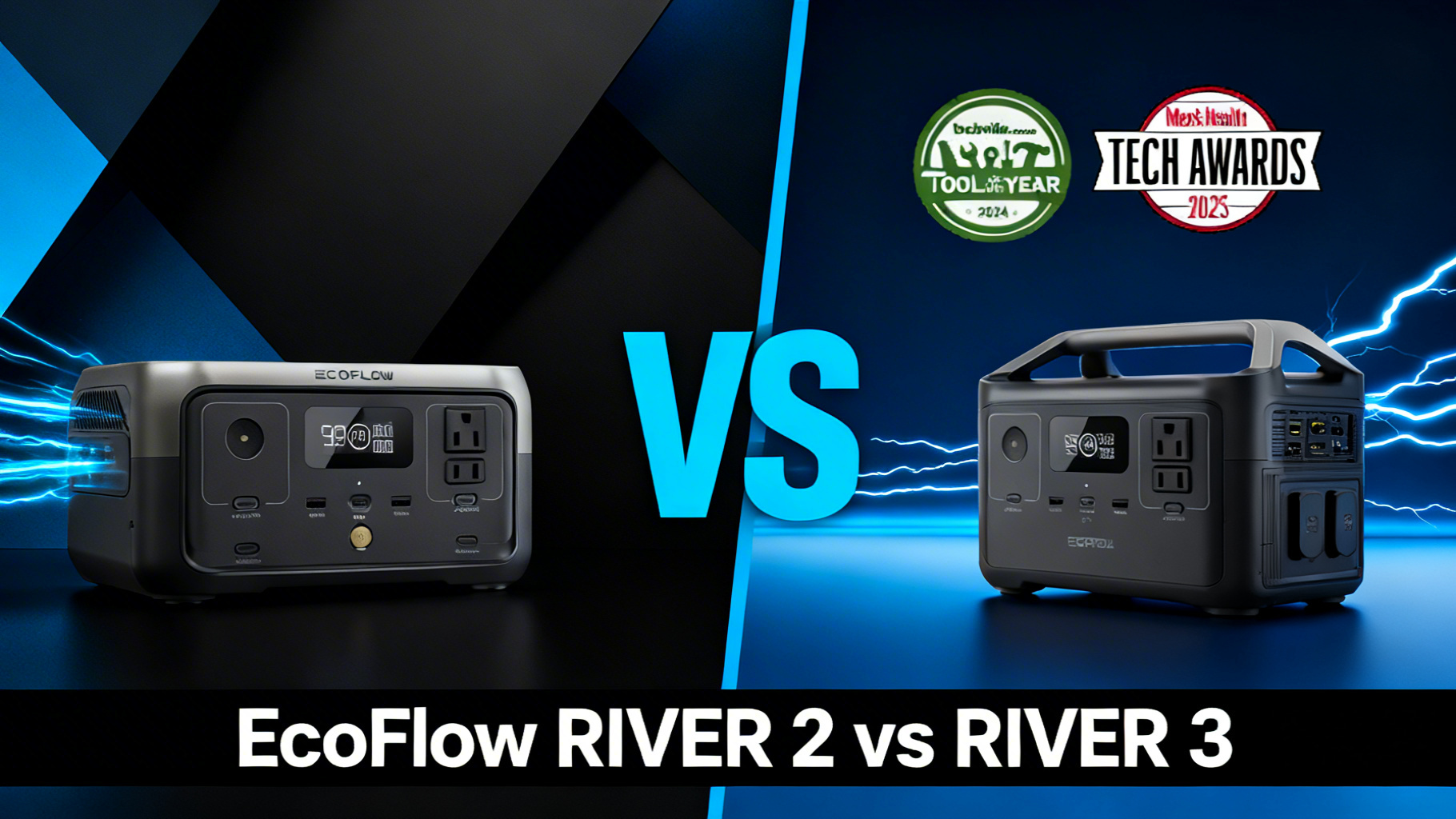
Choosing between the EcoFlow RIVER 2 and RIVER 3 feels like a trick question. Both are compact LiFePO4 power stations from the same brand, both charge in about an hour, and the price gap is just $10. So what exactly does that extra $10 buy you?
The RIVER 2 launched in late 2022 as EcoFlow’s entry-level LiFePO4 unit, replacing the original lithium-ion RIVER series. The RIVER 3, released in 2024, builds on that foundation with a handful of targeted upgrades: IP54 waterproofing, sub-20ms UPS switchover, whisper-quiet operation, and a 2x runtime mode for low-draw appliances.

In this comparison, we’ll break down both generations across capacity, output power, charging speed, UPS performance, design, and value. The goal is simple: help you figure out which one actually makes sense for your needs and budget.
Spoiler: there’s a clear winner for most buyers, but the RIVER 2 still earns its place in specific scenarios.
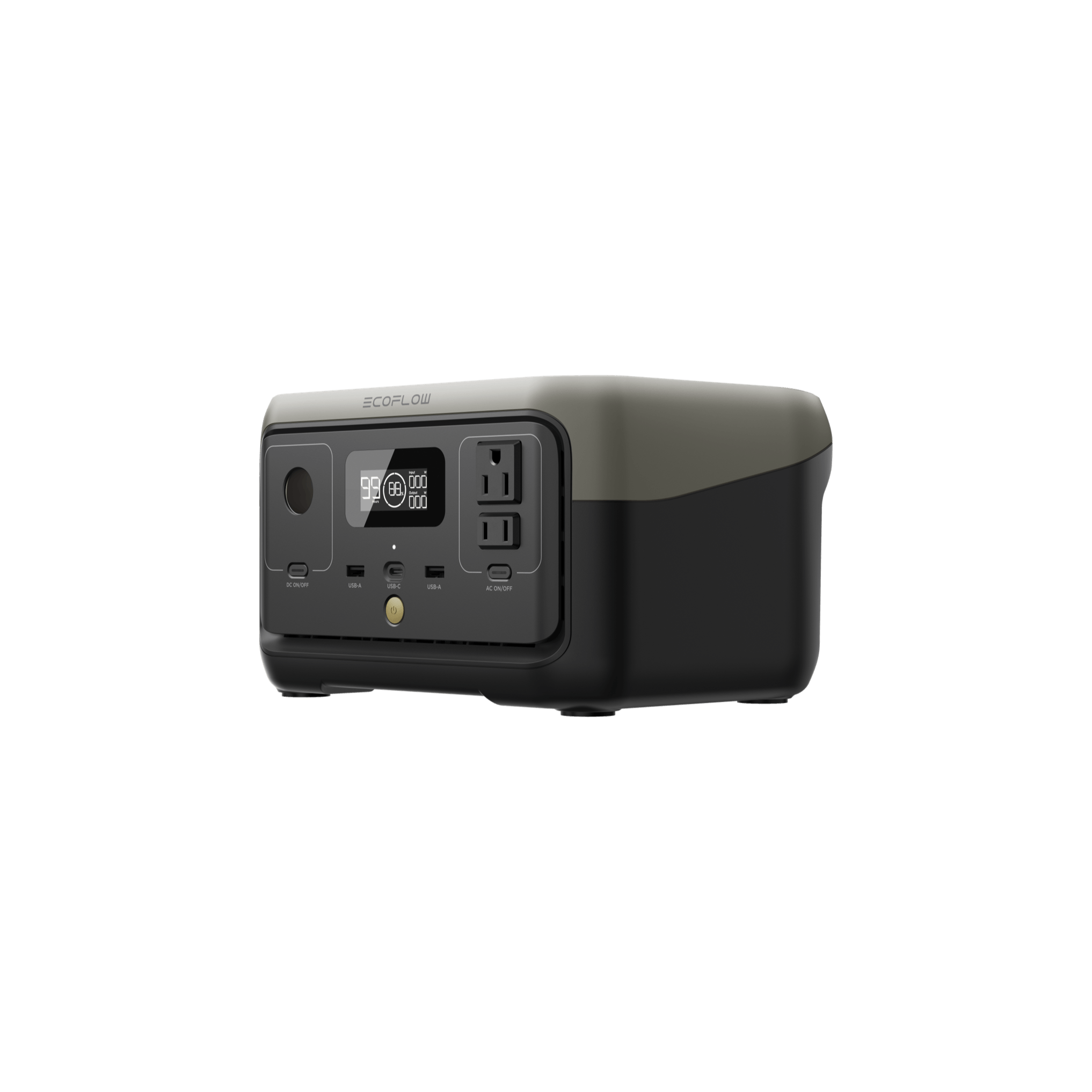
EcoFlow RIVER 3
$199 $239
- 245Wh capacity, 300W output (X-Boost 600W)
- IP54 waterproof, <20ms UPS backup
- 30% smaller than industry average
At a Glance: Key Differences
Before diving into each category, here’s a side-by-side snapshot of where these two units differ. The specs that overlap are just as telling as the ones that don’t.

RIVER 3: What’s New vs RIVER 2?
Key generational improvements for just $10 more
🛡️
IP54 Waterproof
New for RIVER 3
🔇
<30dB Quiet
Whisper mode
⚡
<20ms UPS
Faster than 30ms
🔋
2x Runtime
For <100W loads
The pattern is clear from the table: both units share the same core platform (300W output, LiFePO4 chemistry, 60-minute fast charging), but the RIVER 3 adds meaningful refinements in durability, noise, UPS speed, and efficiency. The RIVER 2’s only spec advantage is 11 extra watt-hours of capacity.
Battery & Capacity Compared
The RIVER 2 packs 256Wh of LiFePO4 capacity. The RIVER 3 comes in slightly lower at 245Wh. On paper, that’s an 11Wh difference in favor of the older model.
But raw capacity doesn’t tell the whole story. The RIVER 3 introduces a 2x runtime mode that can nearly double runtime for appliances drawing under 100W. That means a 10W LED light or a phone charger runs significantly longer on the RIVER 3, despite the smaller battery. For high-draw devices above 100W, the RIVER 2’s extra 11Wh provides a marginal edge.
Both units use LiFePO4 (lithium iron phosphate) battery chemistry, rated for approximately 3,000 charge cycles to 80% capacity. At one cycle per day, that translates to roughly 8 to 10 years of daily use. Neither unit has a meaningful longevity advantage here.
Winner: Tie. The RIVER 2 has slightly more raw capacity, but the RIVER 3’s 2x runtime mode compensates for low-wattage use cases.
What Can Each Unit Power? (Side-by-Side Runtime Estimates)
📱
Phone Charges
R2: ~16x
R3: ~15x
~15W per charge
💡
LED Light (10W)
R2: ~22 hrs
R3: ~21 hrs
10W draw
💻
Laptop Charge
R2: ~3-4x
R3: ~3-4x
~60W draw
📺
Mini Fridge
R2: ~4 hrs
R3: ~4 hrs*
~60W avg (*2x mode)
*RIVER 3’s 2x runtime mode can nearly double runtime for appliances drawing under 100W.
To see exactly how long each unit can power your specific devices, try our portable power station runtime calculator.
Performance & Output Power
Both the RIVER 2 and RIVER 3 deliver 300W of continuous AC output with X-Boost technology pushing that to 600W for short bursts. That’s enough to run most small appliances: blenders, mini fridges, laptop chargers, LED TVs, and phone chargers. You won’t be powering a hair dryer or microwave, but for a sub-$200 power station, the output is competitive.

Where the RIVER 3 pulls ahead is its 2x runtime mode for appliances drawing under 100W. This isn’t just a marketing number. Runtime calculations show that a 60W mini fridge or a 10W LED light runs nearly twice as long on the RIVER 3 compared to standard mode. Both models also support charging up to 6 devices simultaneously.
Not sure whether your appliances fall within the output limits? Use our compatibility checker tool to verify.
Winner: RIVER 3. The 2x runtime mode for low-wattage devices is a tangible, measurable advantage that the RIVER 2 simply doesn’t offer.
Charging Speed Comparison
Speed is one area where these two units are essentially identical. Both the EcoFlow RIVER 2 and RIVER 3 charge from 0 to 100% in approximately 60 minutes via AC wall outlet. That’s fast enough to top off a dead unit during a lunch break.

Solar charging is also available on both models. Pair either unit with EcoFlow’s portable solar panels (45W, 60W, or 110W) and expect full charge times ranging from approximately 2.5 to 6 hours depending on panel wattage and sunlight conditions. Car charging via 12V is supported as well.
EcoFlow’s 1-hour fast charging technology is consistent across both generations, and spec data confirms no meaningful battery degradation from regular fast charging on LiFePO4 cells.
Winner: Tie. Identical AC charge speeds and comparable solar input make this a wash.
UPS & Home Backup
Both units can function as an emergency backup power source (UPS mode), but the switchover speed differs significantly. The RIVER 2 offers a 30ms switchover, while the RIVER 3 cuts that to under 20ms.

Does 10 milliseconds matter? For most appliances like lamps or fans, no. But for sensitive electronics like networking equipment, NAS drives, or desktop computers, a faster switchover reduces the risk of data loss or unexpected shutdowns. The RIVER 3’s sub-20ms response time puts it closer to true UPS-grade performance.
Keep in mind that neither unit replaces a dedicated whole-home UPS system. But for protecting a home office router or keeping a modem alive during brief outages, the RIVER 3’s faster response is the safer choice.
Winner: RIVER 3. The sub-20ms switchover is a clear upgrade for anyone using UPS mode with sensitive devices.
Design, Portability & Durability
The RIVER 3 is 30% smaller than the industry average for its capacity class, making it one of the most compact sub-300Wh power stations available. It’s designed as true grab-and-go power. The RIVER 2, while still portable, follows EcoFlow’s earlier, slightly bulkier design language.
The biggest design upgrade is durability. The RIVER 3 carries an IP54 waterproof rating, protecting against dust ingress and water splashes from any direction. The RIVER 2 has no official IP rating, which means you’ll want to keep it dry and sheltered during outdoor use.
Noise is the other standout difference. The RIVER 3 operates at under 30dB, which EcoFlow describes as “whisper quiet.” That’s quieter than a library. Spec data for the RIVER 2 doesn’t include a specific dB rating, and owner reports suggest it’s noticeably louder under load. For tent camping or nighttime use in a van, the RIVER 3’s quiet operation is a real advantage.
Winner: RIVER 3. Smaller, waterproof, and significantly quieter. The design improvements are hard to ignore.
Value & Price Analysis
Let’s talk numbers. The EcoFlow RIVER 2 sells for $189 (down from $239). The EcoFlow RIVER 3 is priced at $199 (also down from $239).
On a cost-per-watt-hour basis, the RIVER 2 comes in at approximately $0.74/Wh, while the RIVER 3 sits at $0.81/Wh. The RIVER 2 wins on raw value per watt-hour. However, that metric alone misses what the $10 premium actually buys you: IP54 waterproofing, faster UPS switchover, 2x runtime mode, quieter operation, and a more compact form factor.
Both the RIVER 2 and RIVER 3 rank among our best budget power stations under $500, but they serve different niches. The RIVER 2 is the strict budget pick. The RIVER 3 offers better long-term value when you factor in durability and feature upgrades.
Over 3,000 charge cycles, that $10 difference amounts to roughly $0.003 per cycle. In practical terms, the cost difference is negligible over the product’s lifespan.
Winner: RIVER 3. The $10 premium buys meaningful upgrades that justify the slightly higher cost per watt-hour.

Which One Should You Buy? (Winner by Use Case)
If you’re still unsure about your power needs, our guide on how to choose a portable power station walks through the key decision factors. But here’s the quick breakdown by scenario.
Camping and outdoor use: The RIVER 3 wins. IP54 waterproofing means you don’t need to worry about rain or splashes, and the sub-30dB noise level won’t disturb your campsite at night. For a broader comparison of camping-focused options beyond EcoFlow, check our ranked list of the best portable power stations for camping.

Home UPS backup: The RIVER 3 wins again. The sub-20ms switchover protects sensitive electronics like routers, modems, and NAS drives more reliably than the RIVER 2’s 30ms response.
Budget-conscious indoor use: The RIVER 2 is the better pick. If you’re using the unit exclusively indoors (home office, apartment, garage workshop), the waterproofing and quiet operation matter less, and you save $10 while getting 11Wh more capacity.
Van life and travel: The RIVER 3’s smaller footprint and IP54 rating make it the practical choice for confined spaces and unpredictable weather.
Already own RIVER 2 accessories: If you’re invested in the RIVER 2 ecosystem with compatible cables and panels, sticking with the RIVER 2 avoids any compatibility questions.
✅ Buy the RIVER 3 if…
- You need IP54 waterproofing for outdoor or wet environments
- You want whisper-quiet (<30dB) operation for nighttime use
- You need faster UPS switchover (<20ms) for sensitive electronics
- You plan to use the 2x runtime mode for low-draw devices
💰 Buy the RIVER 2 if…
- You want to save $10 and get slightly more capacity (256Wh vs 245Wh)
- You primarily use it indoors where waterproofing is unnecessary
- You already own the RIVER 2 ecosystem (same charging cables)
- Budget is the top priority and you do not need the latest features
Frequently Asked Questions
Is the EcoFlow RIVER 3 worth $10 more than the RIVER 2?
For most buyers, yes. The $10 premium adds IP54 waterproofing, sub-20ms UPS switchover (versus 30ms on the RIVER 2), whisper-quiet operation below 30dB, a 2x runtime mode for low-wattage devices, and a more compact design. The only scenario where the RIVER 2 makes more financial sense is strictly indoor, budget-focused use where waterproofing and noise level are irrelevant.
Can both the RIVER 2 and RIVER 3 charge via solar panels?
Yes. Both models accept solar input and can pair with EcoFlow portable solar panels (45W, 60W, or 110W). Solar charge times depend on panel wattage and sunlight conditions, with both units reaching full charge in approximately 2.5 to 6 hours depending on the panel used.
Does the RIVER 3 have a longer battery lifespan than the RIVER 2?
Both units use LiFePO4 battery chemistry rated for approximately 3,000 charge cycles to 80% capacity. At one full cycle per day, that translates to roughly 8 to 10 years of daily use for either model. There is no significant lifespan difference between the two generations.
Can the EcoFlow RIVER 2 or RIVER 3 power a mini fridge?
Yes, both models can run a small mini fridge (typically 40 to 60W average draw) for approximately 3 to 5 hours on a full charge. The RIVER 3’s 2x runtime mode can extend runtime for mini fridges drawing under 100W, giving it a slight edge in this category.
Is the EcoFlow RIVER 3 waterproof?
The RIVER 3 carries an IP54 waterproof rating, meaning it is protected against dust ingress and water splashes from any direction. This makes it suitable for outdoor use in light rain or near water sources. The RIVER 2 does not have an official IP rating, so it should be kept dry during use.
For full specifications, visit the official EcoFlow RIVER 3 specifications and the EcoFlow RIVER 2 product page.
Final Verdict: Our Recommendation
Based on our analysis of both generations, the EcoFlow RIVER 3 is the better buy for most people in 2026. For just $10 more than the RIVER 2, you get IP54 waterproofing, a faster UPS switchover, whisper-quiet operation, 2x runtime for low-draw devices, and a smaller overall footprint. That’s a lot of meaningful upgrades for the price of a coffee.
The RIVER 2 isn’t a bad product. It remains a solid, reliable entry-level LiFePO4 power station with slightly more raw capacity (256Wh vs 245Wh). If your use case is strictly indoors and every dollar counts, it’s still a reasonable choice.
But for camping, van life, home UPS backup, or any situation where durability and noise matter, the data consistently points to the RIVER 3 as the smarter investment.
EcoFlow RIVER 3
$199
Best compact power station under $200 for 2026
Price verified March 2026 · Free shipping available