
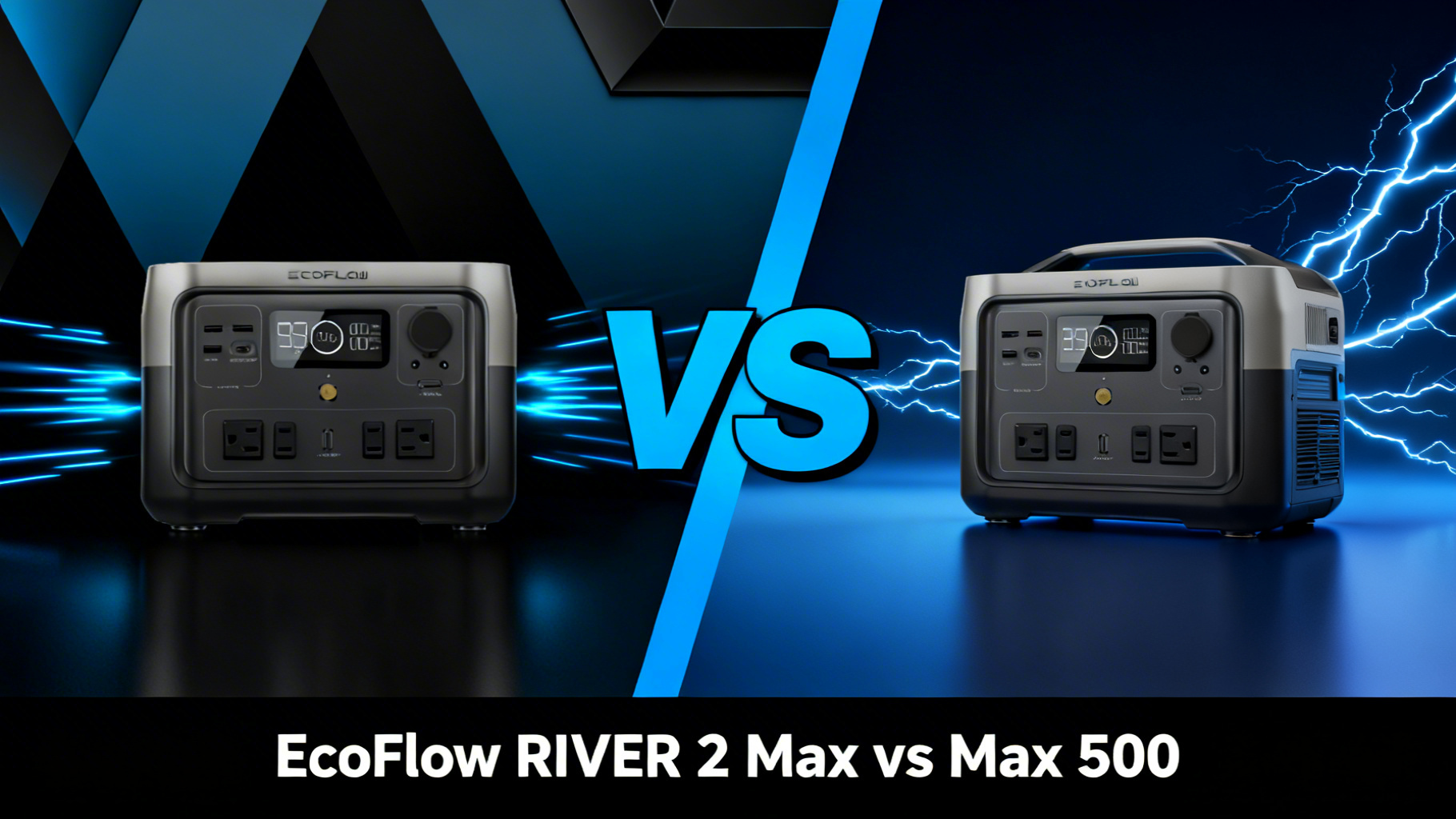
Choosing between the EcoFlow RIVER 2 Max and the RIVER 2 Max 500 feels straightforward at first glance. Both are mid-range portable power stations from the same brand, both charge in about an hour, and both deliver 500W of continuous AC output. So what exactly does the extra $50 buy you?
Here’s the part that trips people up: the RIVER 2 Max, the older and cheaper model, actually has more battery capacity than the RIVER 2 Max 500. The original packs 512Wh at $249, while the newer EcoFlow RIVER 2 Max 500 portable power station holds 499Wh at $299. The “500” in the name refers to the 500W output rating, not the battery size.


If you are still deciding on capacity and budget, our guide to choosing the right portable power station covers all the basics. But if you’ve narrowed it down to these two EcoFlow models, this comparison breaks down every difference that matters.
At a Glance: Key Differences
Before diving into details, here’s how these two EcoFlow RIVER 2 Max models stack up on paper. The table below covers the specs that actually differ between them, plus the ones that stay identical.


A few things jump out immediately. The RIVER 2 Max wins on raw capacity and price. The RIVER 2 Max 500 wins on safety certification and updated internals. Everything else, from output power to charging speed to app connectivity, is essentially the same.
What does this mean in practice? For most users, the real decision comes down to whether TUV Rheinland certification and a slightly newer design are worth $50 and 13 fewer watt-hours. Let’s break it down category by category.
Battery Capacity and Runtime
This is where the EcoFlow RIVER 2 Max review gets interesting. The RIVER 2 Max holds 512Wh of usable capacity. The RIVER 2 Max 500 holds 499Wh. That’s a 13Wh difference, or roughly 2.5% more energy stored in the cheaper unit.
In everyday terms, that gap is almost invisible. Runtime calculations based on rated capacity show both units powering a 60W laptop for about 7.5 to 7.7 hours. A 10W LED light runs for approximately 45 to 46 hours on either model. Smartphone charges come out to around 30 to 31 full cycles.
Runtime Comparison: RIVER 2 Max (512Wh) vs RIVER 2 Max 500 (499Wh)
Based on rated capacity and typical appliance draws. Actual runtime varies by conditions.
📱
Smartphone (15W)
~31 vs ~30
charges
💡
LED Light (10W)
~46 vs ~45
hours
💻
Laptop (60W)
~7.7 vs ~7.5
hours
❄️
Mini Fridge (60W)
~7.7 vs ~7.5
hours
Difference: approximately 2.5% more runtime on RIVER 2 Max (512Wh vs 499Wh)
Use our power station calculator to estimate exactly how long each model will run your specific devices.
To put this in perspective, 13Wh is roughly the energy needed to charge a smartphone once. It’s the kind of difference that disappears entirely when you factor in real-world efficiency losses, ambient temperature, and the age of the battery. Rated capacity and usable capacity are never the same number anyway.
The honest takeaway: you won’t notice 13Wh of difference in the field. If the EcoFlow RIVER 2 Max capacity is your primary concern, neither model has a meaningful advantage over the other. Both sit comfortably in the 500Wh class, which is ideal for overnight camping trips, short power outages, and keeping small electronics running for a weekend.
One thing worth noting: both models support solar charging and can provide up to 1.5kWh per day when paired with compatible panels. If you plan to recharge via solar during multi-day trips, the slight capacity gap becomes even less relevant since you’re topping off regularly.
Battery Technology and Lifespan

Both the RIVER 2 Max and RIVER 2 Max 500 use LiFePO4 (lithium iron phosphate) battery chemistry. This is a significant advantage over older lithium-ion models, because LiFePO4 cells are rated for approximately 3,000 charge cycles before degrading to 80% capacity. That translates to roughly 10 years of daily use.
If you’re unfamiliar with LiFePO4, here’s the short version: it’s more thermally stable than standard lithium-ion, meaning it handles heat better and has a lower risk of thermal runaway. It also retains capacity more consistently over time. The tradeoff is slightly lower energy density per pound, but at 13.4 lbs for roughly 500Wh, neither model suffers from that limitation in any practical way.
Where the RIVER 2 Max 500 edges ahead is in its internal design. As the newer model in the lineup, it benefits from incremental refinements to the battery management system and internal components. These aren’t dramatic improvements, but they reflect EcoFlow’s ongoing engineering updates.
For occasional users who charge their power station a few times per month, the cycle life difference is irrelevant. Both units will last well beyond a decade at that usage rate. Frequent users who rely on their power station daily may appreciate the marginally updated internals of the RIVER 2 Max 500, though the practical difference remains small.
Ports, Output, and Charging Speed

On the output side, these two models are nearly identical. Both deliver 500W of continuous AC power with EcoFlow’s X-Boost technology, which allows them to handle appliances drawing up to 1,000W by reducing voltage. This means both can run small kitchen appliances, laptops, phone chargers, mini-fridges, LED lights, and similar devices.
A quick note on X-Boost: this feature works by lowering voltage to high-draw appliances, which means they may run slightly less efficiently. A hair dryer rated at 1,000W will work, but it won’t blow at full heat. For most camping and backup scenarios, this is a reasonable tradeoff that significantly expands the range of compatible devices.
Charging speed is another area where they match. Both units charge from 0 to 100% in approximately 60 minutes via AC wall outlet. This is one of EcoFlow’s standout features across the RIVER 2 lineup, and it applies equally to both models. You can also charge via car adapter, solar panel, or USB-C input, giving you four charging methods for maximum flexibility on the road.
The port layout is similar on both units, with AC outlets, USB-A, USB-C, and a car output port. According to the EcoFlow RIVER 2 Max product page, the original model includes the same connectivity options that carry over to the 500 variant.
If you’re choosing between these two based on output capabilities or charging speed, save your time. There’s no meaningful difference here.
Design, Weight, and Portability
Both units weigh approximately 13.4 lbs (6.1 kg), making them genuinely portable for car camping, tailgating, or keeping in a closet for emergencies. The form factor is compact enough to fit in a backpack or slide under a car seat. At this weight class, you can comfortably carry either model with one hand using the built-in handle.
Build quality on both models is solid. The exterior shell is a durable composite plastic that handles minor bumps and scrapes without issue. Neither unit feels cheap or flimsy. EcoFlow’s design language is consistent across both, with a clean front panel, clear LCD display, and logically arranged ports.
The big differentiator in this category is certification. The RIVER 2 Max 500 is the first EcoFlow power station to carry TUV Rheinland safety certification, an independent third-party validation of electrical safety and quality standards. The original RIVER 2 Max does not have this certification.
Does TUV Rheinland certification make the RIVER 2 Max 500 safer to use? Not necessarily in a way you’d notice day-to-day. Both models meet standard safety requirements. But for buyers who value independent verification, especially those using the unit near children or in enclosed spaces like vans and RVs, the certification adds a layer of confidence. It’s worth mentioning that both units connect to the EcoFlow app via WiFi and Bluetooth, giving you remote monitoring and control of charging settings regardless of which model you choose.
Winner by Use Case

✔ Choose the RIVER 2 Max ($249) if…
- You want the lowest price for nearly identical performance
- You prioritize raw capacity (512Wh vs 499Wh)
- You already own EcoFlow accessories and want compatibility
- Weekend camping trips and occasional power outages are your main use case
✔ Choose the RIVER 2 Max 500 ($299) if…
- TUV Rheinland safety certification matters to you
- You plan to use this unit frequently (daily or near-daily)
- Long-term reliability and updated internals are worth $50
- You value having the latest model with incremental refinements
Best for Weekend Camping (Winner: RIVER 2 Max)
For occasional camping trips, the RIVER 2 Max at $249 is the clear pick. It offers 13Wh more capacity at a $50 lower price, and the performance difference between the two models is negligible in outdoor scenarios. The $50 you save could go toward a solar panel or carrying case.
Best for Daily Use (Winner: RIVER 2 Max 500)
If you plan to use your portable power station frequently, even daily, the RIVER 2 Max 500’s updated internals and TUV Rheinland certification start to matter more. The $50 premium buys you incremental improvements in build quality and independent safety verification, which add up over thousands of charge cycles.
Best for Emergency Backup (Winner: Tie)
For home emergency backup, both models perform identically in practice. The 13Wh capacity difference won’t change your experience during a power outage. Both offer EcoFlow’s 30ms automatic switchover mode for UPS-like functionality, which means they can keep critical devices running during a brief interruption without you noticing the switch.
During extended outages, either unit keeps your phone, a few lights, and a small fan running for hours. If you need to power a router to maintain internet access, both handle it easily. The 60-minute recharge time also means you can quickly top off from a car charger or generator if the outage stretches beyond a day.
Best Overall Value (Winner: RIVER 2 Max)
On pure value, the RIVER 2 Max wins. More capacity, lower price, and nearly identical features make it the rational choice for most buyers.
For a broader look at camping options across all brands, check our guide to the best power stations for camping.
Value Analysis: Price Per Watt-Hour
Price-Per-Watt-Hour Analysis
RIVER 2 Max
$0.49
per Wh ($249 / 512Wh)
RIVER 2 Max 500
$0.60
per Wh ($299 / 499Wh)
The RIVER 2 Max offers 22% better value per watt-hour, but the RIVER 2 Max 500 offsets this with TUV certification and updated internals.

The numbers tell a clear story. The EcoFlow RIVER 2 Max price comes out to $0.49 per watt-hour ($249 divided by 512Wh). The RIVER 2 Max 500 costs $0.60 per watt-hour ($299 divided by 499Wh). That’s a 22% difference in cost efficiency favoring the original model.
Both the RIVER 2 Max and RIVER 2 Max 500 rank among the best budget power stations under $500, though they take different approaches to value. The RIVER 2 Max maximizes capacity per dollar. The RIVER 2 Max 500 spreads its cost across safety certification and updated hardware.
When you factor in long-term cost per cycle, the gap narrows slightly. Both units are rated for 3,000+ cycles, which means the RIVER 2 Max costs roughly $0.08 per cycle while the RIVER 2 Max 500 comes in at about $0.10 per cycle. Over a decade of use, the total cost difference is modest.
For complete specs on the newer model, see the official RIVER 2 Max 500 specifications.
Final Verdict: Which RIVER 2 Max Should You Buy?
Here’s the honest answer: these two portable power stations are remarkably similar. The differences come down to 13Wh of capacity, $50, and a TUV Rheinland sticker. For most people, that’s not a lot to agonize over.
If you want the best value and don’t care about third-party safety certification, go with the RIVER 2 Max at $249. You get more capacity for less money, and the performance is functionally identical.
If you use your power station frequently and value independent safety verification, the RIVER 2 Max 500 at $299 is a reasonable upgrade. The $50 premium is modest, and the updated internals provide a small edge for heavy users.
One more thing to consider: both models are currently discounted from their original retail prices. The RIVER 2 Max is down from $469 to $249, and the RIVER 2 Max 500 is down from $499 to $299. At these sale prices, both represent strong value in the 500Wh portable power station category. Coupon codes may further reduce the price, so it’s worth checking the current deals before committing.
Both models earn a spot on our list of the best portable power stations for 2026, but for different reasons. The RIVER 2 Max is the value champion. The RIVER 2 Max 500 is the long-term reliability pick.
Spoiler: there’s no wrong choice here. Both are solid, well-built power stations from a reputable brand. Your decision should come down to budget and how often you plan to use it.
Our Verdict: Which RIVER 2 Max Should You Buy?
Prices verified March 2026. Free shipping available on both models.
Frequently Asked Questions
What is the difference between EcoFlow RIVER 2 Max and RIVER 2 Max 500?
The RIVER 2 Max offers 512Wh capacity at $249, while the RIVER 2 Max 500 provides 499Wh at $299. The “500” in the name refers to the 500W output rating, not battery capacity. The RIVER 2 Max 500 adds TUV Rheinland safety certification and slightly updated internal design, but both share the same LiFePO4 battery chemistry, 500W AC output with X-Boost to 1,000W, and 60-minute fast charging.
Does the EcoFlow RIVER 2 Max 500 have more capacity than the RIVER 2 Max?
No. The RIVER 2 Max actually has slightly more capacity at 512Wh compared to the RIVER 2 Max 500 at 499Wh. The “500” in the newer model’s name refers to its 500W continuous AC output, not its battery capacity. In practice, the 13Wh difference (about 2.5%) is negligible for most users.
Is the $50 price difference worth it for the RIVER 2 Max 500?
It depends on your priorities. The RIVER 2 Max 500 costs $50 more but offers TUV Rheinland safety certification and marginally updated internals. For frequent users who value third-party safety certification, the $50 premium makes sense. For occasional campers or budget-conscious buyers, the original RIVER 2 Max delivers more capacity for less money.
Can both models power the same appliances?
Yes. Both the RIVER 2 Max and RIVER 2 Max 500 deliver 500W continuous AC output with X-Boost technology that handles devices up to 1,000W. This means both can run the same appliances, including small kitchen appliances, laptops, phone chargers, mini-fridges, and LED lights.
Which EcoFlow RIVER 2 Max is better for camping?
For camping, the original RIVER 2 Max at $249 is the better pick. It offers 13Wh more capacity (512Wh vs 499Wh) at a $50 lower price point, and the performance difference between the two models is negligible in outdoor scenarios. The savings can go toward accessories like a solar panel or carrying case.