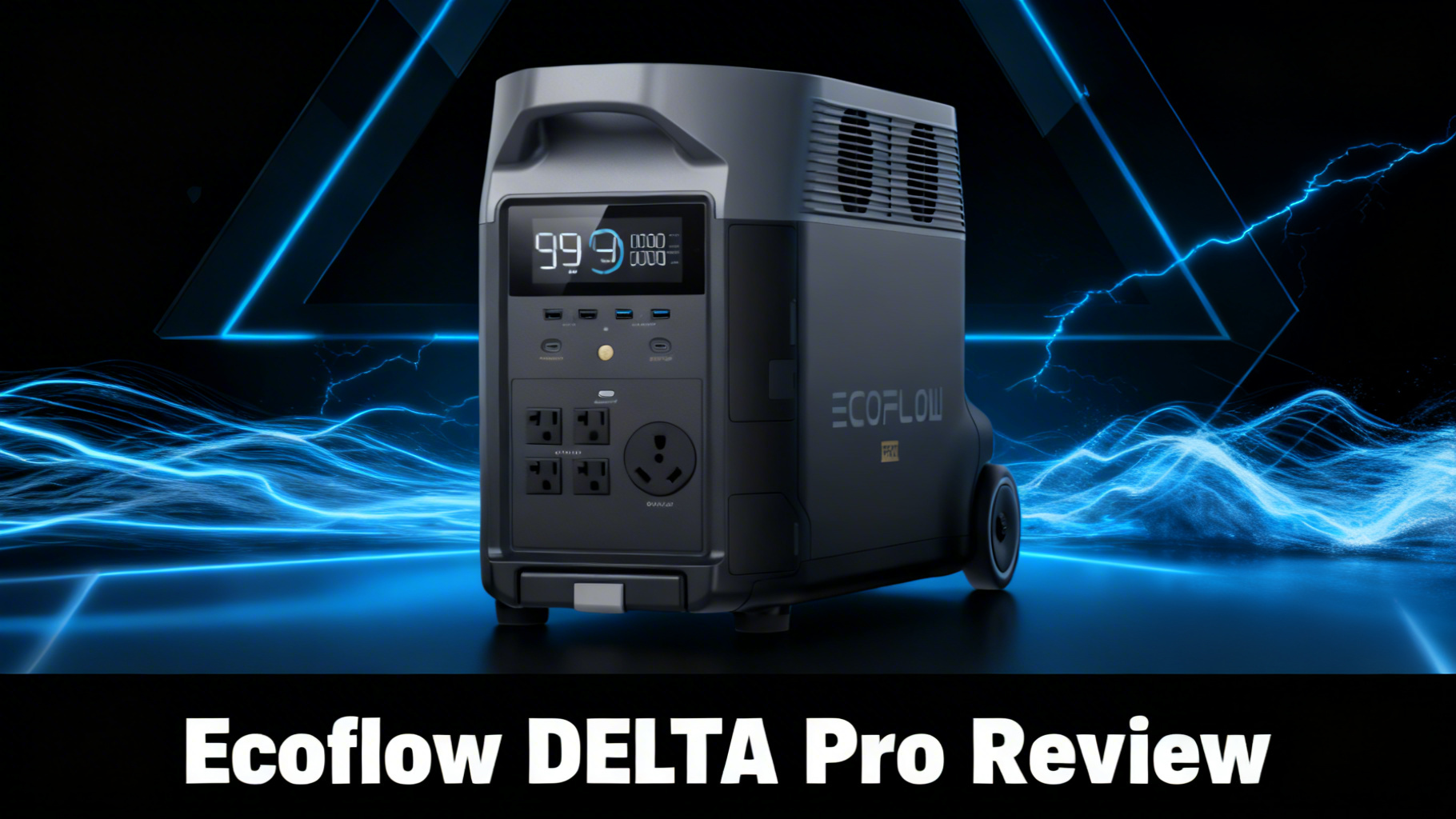
Looking for a portable power station that can actually keep your home running during a prolonged outage? The EcoFlow DELTA Pro has positioned itself as one of the most capable units on the market since its release, targeting homeowners who need serious backup capacity rather than weekend campers looking for a phone charge.
At $1,599 (down from an original MSRP of $3,699), the DELTA Pro delivers 3,600Wh of capacity, 3,600W of continuous AC output, and an expandable ecosystem that scales up to 25kWh. Those numbers put it in a class of its own for home backup applications. The DELTA Pro sits at the top of EcoFlow’s lineup, targeting homeowners who need serious home backup power stations capable of running critical circuits during extended outages.

But impressive specs on paper don’t always translate to real-world performance. Is the EcoFlow DELTA Pro still the home backup king in 2026, or have newer competitors closed the gap? Our analysis covers capacity, charging speed, expandability, real-world runtime, and how this EcoFlow DELTA Pro portable power station stacks up against its closest rivals. Here’s what the data shows.
⚡ Current Best Price
EcoFlow DELTA Pro
$1,599 $3,699
- 3,600Wh LFP battery, expandable to 25kWh
- 3,600W output (7,200W with two units)
- 6,500W MultiCharge: full recharge in 2.7 hours
Price verified March 2026 | Free shipping available
Quick Specs & Key Features
Before diving into the EcoFlow DELTA Pro specs, here’s a snapshot of what this unit brings to the table. The numbers below represent verified specifications from EcoFlow’s official documentation.
A few EcoFlow DELTA Pro specifications stand out immediately. The 3,600Wh capacity is among the highest you’ll find in a single portable unit. The 6,500W MultiCharge capability means you can go from zero to full in just 2.7 hours, which is critical if you’re racing to charge before a storm hits. And the 1,600W maximum solar input opens the door to serious off-grid setups.

The DELTA Pro also supports WiFi and Bluetooth app control (iOS and Android), giving you remote monitoring and customization. For the complete specifications, visit the EcoFlow official DELTA Pro page.
What We Love About the DELTA Pro
Massive 3,600Wh Capacity Powers Almost Everything
The DELTA Pro’s 3,600Wh battery is its headline feature, and it delivers. That’s roughly 66% more capacity than competing units like the Jackery Explorer 2000 Pro (2,160Wh) or the Bluetti AC200MAX (2,048Wh). For context, 3,600Wh is enough to run a full-size refrigerator for approximately 30 hours, or keep a CPAP machine running for 90+ hours straight.
What makes the capacity even more useful is the 3,600W continuous output (with a 7,200W surge). That’s enough to handle 99% of household appliances, including high-draw devices like space heaters, microwaves, and power tools. Most competing units in this price range top out around 2,200W continuous.
Industry-Leading MultiCharge: 6,500W, 2.7 Hours to Full
Charging speed matters more than most people realize, especially during storm prep. The DELTA Pro’s 6,500W MultiCharge capability combines multiple charging sources simultaneously, reaching a full charge in just 2.7 hours from a standard AC wall outlet.
That’s fast for a 3,600Wh battery. To put it in perspective, the Bluetti AC200MAX takes approximately 4.5 hours for a smaller 2,048Wh battery. When you’re watching a hurricane track shift toward your area, those extra hours of charge time make a real difference.
Expandable Ecosystem Up to 25kWh
This is where the DELTA Pro truly separates itself from the competition. By adding EcoFlow DELTA Pro Smart Extra Batteries ($1,199 each, adding 3,600Wh per unit), you can scale the system up to 25kWh of total capacity. That’s approaching entry-level whole-home battery territory.
The ecosystem goes further. Pair two DELTA Pro units with a Double Voltage Hub, and you get 7,200W of output at 240V, enough to run heavy appliances like dryers, well pumps, and central HVAC systems. Add EcoFlow’s Smart Home Panel and a transfer switch, and you have a plug-and-play EcoFlow DELTA Pro home backup system that integrates directly with your electrical panel.
EV Station Charging: A Practical Edge for Road Warriors
The DELTA Pro is the first portable power station that can recharge at EV charging stations worldwide. At 3,400W, an EV station fills the battery in approximately 1.7 hours. For RVers and overlanders traveling across the country, this adds thousands of potential charging locations beyond traditional wall outlets.
Is this a feature every buyer will use? Probably not. But for the specific audience that needs it, it eliminates a major limitation of portable power stations: finding a place to recharge when you’re on the road.
Full App Control via WiFi and Bluetooth
The EcoFlow app provides real-time monitoring of input/output wattage, battery percentage, estimated runtime, and charging status. You can customize AC charging speeds, set battery charge limits to extend cycle life, and control the unit remotely via WiFi.

The app isn’t just a nice-to-have. It’s genuinely useful for monitoring your backup system during an outage from another room, or checking charge status while solar panels are working on the roof.
What Could Be Better
99 Pounds Makes Solo Transport Difficult
At 99 lbs (45 kg), the DELTA Pro is not a grab-and-go power station. The built-in wheels and telescoping handle help, but loading it into a truck bed or carrying it down stairs requires two people. If portability is a primary concern, this isn’t the right unit for you.
For comparison, the Jackery Explorer 2000 Pro weighs 43 lbs, and the Bluetti AC200MAX comes in at 62 lbs. You’re paying a weight penalty for the DELTA Pro’s significantly larger capacity and output.
NMC Battery on Original Model (Not LFP on Base Unit)
Here’s a nuance that matters: while EcoFlow lists the DELTA Pro as featuring an LFP (LiFePO4) battery with 3,000+ cycles to 80%, the original DELTA Pro shipped with NMC chemistry. Newer production runs have transitioned to LFP. If battery longevity is a priority, confirm the EcoFlow DELTA Pro battery chemistry before purchasing, or consider the newer DELTA Pro 3 which uses LFP across the board.
No Built-in UPS Function (10ms Switchover Not Available)
Some competing units offer a near-instantaneous switchover (under 20ms) that keeps sensitive electronics running without interruption during a power outage. The DELTA Pro does not include this feature natively. If you need true UPS-level protection for a home server or medical equipment, you’ll need a separate UPS device inline.
Premium Price Point Compared to Newer DELTA 3 Series
At the current EcoFlow DELTA Pro price of $1,599, this is a significant investment. EcoFlow’s newer DELTA 3 Max starts around $749 and covers many use cases adequately. You need to honestly assess whether you need the DELTA Pro’s expandable ecosystem, 3,600W output, and 25kWh ceiling, or if a more affordable option would serve you just as well.
What Can It Power? Runtime Estimates
What Can It Power? (3,600Wh Capacity)
❄️
Full-Size Fridge
~30 hrs
120W avg
💻
Laptop (60W)
~54 charges
60W per charge
💡
LED Lights (10W x5)
~65 hrs
50W total
📱
CPAP Machine
~90 hrs
30-40W
Runtime calculations based on the 3,600Wh capacity tell a compelling story. The DELTA Pro can handle the appliances that matter most during an outage, and for meaningful durations.
Keep in mind that these are theoretical maximums. Real-world performance typically reaches about 85% of calculated values due to inverter efficiency losses. So if the math says 30 hours for your fridge, expect closer to 25-26 hours in practice.
Running multiple devices simultaneously reduces total runtime proportionally. A fridge (120W), five LED lights (50W total), and a WiFi router (15W) together draw about 185W, giving you roughly 16-17 hours of coverage from a single charge. That’s enough to ride out most outages comfortably.
For a personalized estimate based on your exact appliance mix, try our runtime calculator tool to see how long the DELTA Pro will power your specific devices.
Charging Speed & Solar Performance
The EcoFlow DELTA Pro solar generator capabilities and charging versatility are among its strongest selling points. It offers four distinct charging methods, each suited to different scenarios.
AC Wall Charging is the fastest standard option at 6,500W MultiCharge, reaching full in 2.7 hours. This combines the AC adapter with solar or car charging simultaneously. Using AC alone, expect approximately 3.5-4 hours.
Solar Input tops out at 1,600W maximum, which is among the highest EcoFlow DELTA Pro solar input ratings in the portable power station category. With three or four 400W panels under optimal conditions, verified charging data shows a full recharge in approximately 3.5 hours. Two panels extend that to about 5.5 hours, and a single 400W panel takes roughly 11 hours. These times assume peak sun, clear skies, and proper panel orientation.

EV Station Charging at 3,400W fills the battery in about 1.7 hours, making it the fastest single-source charging method available. This is a standout feature for travelers who may not have access to a wall outlet.
Car Charging via 12V/24V input is the slowest option, best reserved for trickle-charging during long drives rather than primary recharging.
Expandability & Ecosystem
The DELTA Pro’s expandable ecosystem is its most compelling competitive advantage. No other portable power station at this price point offers the same depth of expansion options.
The EcoFlow DELTA Pro Smart Extra Battery ($1,199) adds another 3,600Wh to the system, effectively doubling capacity to 7,200Wh. You can daisy-chain multiple extra batteries to reach the 25kWh maximum, which is enough to power a typical household for 1-2 full days during an outage.

The Double Voltage Hub pairs two DELTA Pro units to deliver 7,200W at 240V, unlocking compatibility with heavy appliances that require 240V circuits: dryers, well pumps, central AC systems. This is a genuine whole-home backup solution, not just a marketing claim.
The Smart Home Panel and Transfer Switch complete the ecosystem by integrating the EcoFlow DELTA Pro directly into your home’s electrical panel. Homeowners who pair the DELTA Pro with a transfer switch can cover entire circuits during outages (see our transfer switch installation guide for setup details).
How It Compares: DELTA Pro vs the Competition
On paper, the EcoFlow DELTA Pro competes against units from Jackery, Bluetti, and Anker in the $1,500-$2,000 range. Spec-for-spec comparison shows the DELTA Pro leads in several key areas.
The Jackery Explorer 2000 Pro is the most direct competitor (see our Jackery Explorer 2000 Pro review for the full breakdown), offering similar pricing but with significantly less capacity (2,160Wh vs 3,600Wh) and lower output (2,200W vs 3,600W). The Jackery is lighter at 43 lbs and charges slightly faster via AC (2 hours), but it can’t match the DELTA Pro’s expandability or EV charging capability.
The Bluetti AC200MAX sits in a similar price bracket with 2,048Wh capacity and 2,200W output. Its expandable capacity tops out at 8,192Wh, well below the DELTA Pro’s 25kWh ceiling. Charging via AC takes approximately 4.5 hours, nearly double the DELTA Pro’s time.

Where competitors gain ground is portability and newer features. The DELTA Pro’s 99-lb weight is a genuine drawback compared to the EcoFlow DELTA Pro vs DELTA Pro 3 comparison, where the newer model offers updated smart features and faster X-Stream charging at $1,999. If you don’t need the expanded ecosystem or 240V output, a newer, lighter unit may be the better choice.
Who Should Buy the DELTA Pro


✅ Buy this if…
- You need serious home backup for extended outages (hurricane, ice storm)
- You want expandable capacity up to 25kWh for whole-home coverage
- You plan to pair with solar panels for off-grid energy independence
- You need 240V output via Double Voltage Hub for heavy appliances
❌ Skip this if…
- You only need to charge phones and laptops (overkill, look at RIVER series)
- Portability is your top priority (99 lbs is heavy for camping)
- Your budget is under $1,000 (consider DELTA 3 Max at $749)
The DELTA Pro isn’t for everyone, and that’s fine. Here’s who benefits most from this EcoFlow DELTA Pro portable power station.
Homeowners who prioritize serious backup power. If you live in an area prone to extended outages (hurricanes, ice storms, wildfire power shutoffs), the DELTA Pro’s 3,600Wh base capacity and expansion to 25kWh give you genuine multi-day coverage. For storm season, the DELTA Pro’s expandable ecosystem makes it a top recommendation in our hurricane preparedness power guide.
Solar enthusiasts building off-grid systems. The 1,600W solar input and Smart Extra Battery ecosystem make the EcoFlow DELTA Pro with solar panels a strong foundation for a solar-powered backup system. Pair it with three or four 400W panels, and you have a renewable energy setup that recharges fully in a single afternoon.
RVers and overlanders who need high-capacity power. The EV station charging and massive capacity suit full-time travelers. Just keep in mind the 99-lb weight requires a permanent installation spot in your rig.
Final Verdict: 9.1/10
EcoFlow DELTA Pro: Overall Rating
9.1/10
“The home backup power station to beat”
Capacity & Output 9.5/10
Charging Speed 9.0/10
Expandability 10/10
Portability 6.5/10
Value for Money 8.5/10
App & Features 9.0/10
The data points to a clear conclusion: the EcoFlow DELTA Pro remains one of the most capable portable power stations available for home backup. Its 3,600Wh capacity, 3,600W output, and expandable ecosystem up to 25kWh address needs that most competing units simply can’t match at this price point.
The trade-offs are real but predictable. At 99 lbs, it’s not portable in any casual sense. The EcoFlow DELTA Pro 3600 price, while competitive for what you get, still represents a significant investment. And newer models like the DELTA Pro 3 offer incremental improvements that may matter to some buyers.
But for the core use case of EcoFlow DELTA Pro home backup, this unit delivers where it counts. Based on our analysis of the EcoFlow DELTA Pro reviews from the owner community and verified specifications, it earns a 9.1/10, with standout marks for capacity, output, charging speed, and expandability. The weight and premium price point keep it from a perfect score. If you need a power station that can genuinely keep your home running during a multi-day outage, the DELTA Pro is the benchmark.
EcoFlow DELTA Pro
$1,599
Best expandable home backup under $2,000
Price verified March 2026 | Free shipping available
Frequently Asked Questions
How long does the EcoFlow DELTA Pro last on a single charge?
Runtime depends on your connected load. Based on the 3,600Wh capacity, calculations indicate approximately 30 hours for a full-size refrigerator (120W average draw), 90+ hours for a CPAP machine (30-40W), and approximately 6 hours for a window AC unit (600W). Real-world performance typically reaches about 85% of these theoretical maximums due to inverter efficiency losses. Running multiple devices simultaneously will reduce overall runtime proportionally.
Can the EcoFlow DELTA Pro power a whole house?
A single DELTA Pro can handle critical circuits including your refrigerator, lights, WiFi router, and phone charging. For whole-home coverage including HVAC and high-draw appliances, two DELTA Pro units paired with a Double Voltage Hub deliver 7,200W and 240V output, which can handle most household loads. Adding Smart Extra Batteries extends total capacity up to 25kWh, providing multi-day coverage for a typical home. For more information on home battery systems, see the DOE home battery storage guide.
How long does the EcoFlow DELTA Pro take to charge?
AC wall charging reaches full in approximately 2.7 hours using the 6,500W MultiCharge capability, which combines multiple input sources simultaneously. Solar charging with 1,600W input (three to four 400W panels) can fill the battery in roughly 3.5 hours under optimal sun conditions. EV station charging at 3,400W completes in about 1.7 hours, making it the fastest single-source charging method available.
Is the EcoFlow DELTA Pro worth the price?
At $1,599, the DELTA Pro delivers more capacity (3,600Wh) and higher output (3,600W) than most competitors at the same price point. The expandable ecosystem up to 25kWh, EV station charging capability, and 5-year warranty strengthen the value proposition. For home backup specifically, the cost per watt-hour and per watt of output compares favorably against alternatives. If you only need casual camping power, more affordable options like the DELTA 3 Max ($749) may be a better fit.
What’s the difference between EcoFlow DELTA Pro and DELTA Pro 3?
The DELTA Pro 3 is EcoFlow’s newer flagship at $1,999, featuring a 4,096Wh capacity, faster X-Stream charging, and updated smart features. The original DELTA Pro offers 3,600Wh at $1,599 with an established, proven ecosystem and strong track record of reliability. The DELTA Pro remains a strong value option for buyers who prioritize cost-efficiency and already have access to ecosystem accessories. The DELTA Pro 3 makes more sense if you want the latest technology and don’t mind the $400 premium.
Can I use the EcoFlow DELTA Pro with solar panels?
Yes, the DELTA Pro supports up to 1,600W of solar input, which is among the highest in the portable power station category. Verified charging data shows a full recharge in approximately 3.5 hours with three 400W panels, 5.5 hours with two panels, and 11 hours with one panel. The unit uses MC4 connectors and works with both EcoFlow’s own solar panels and compatible third-party panels. For optimal results, pair it with panels rated for at least 400W each and ensure proper panel angle and sun exposure.