
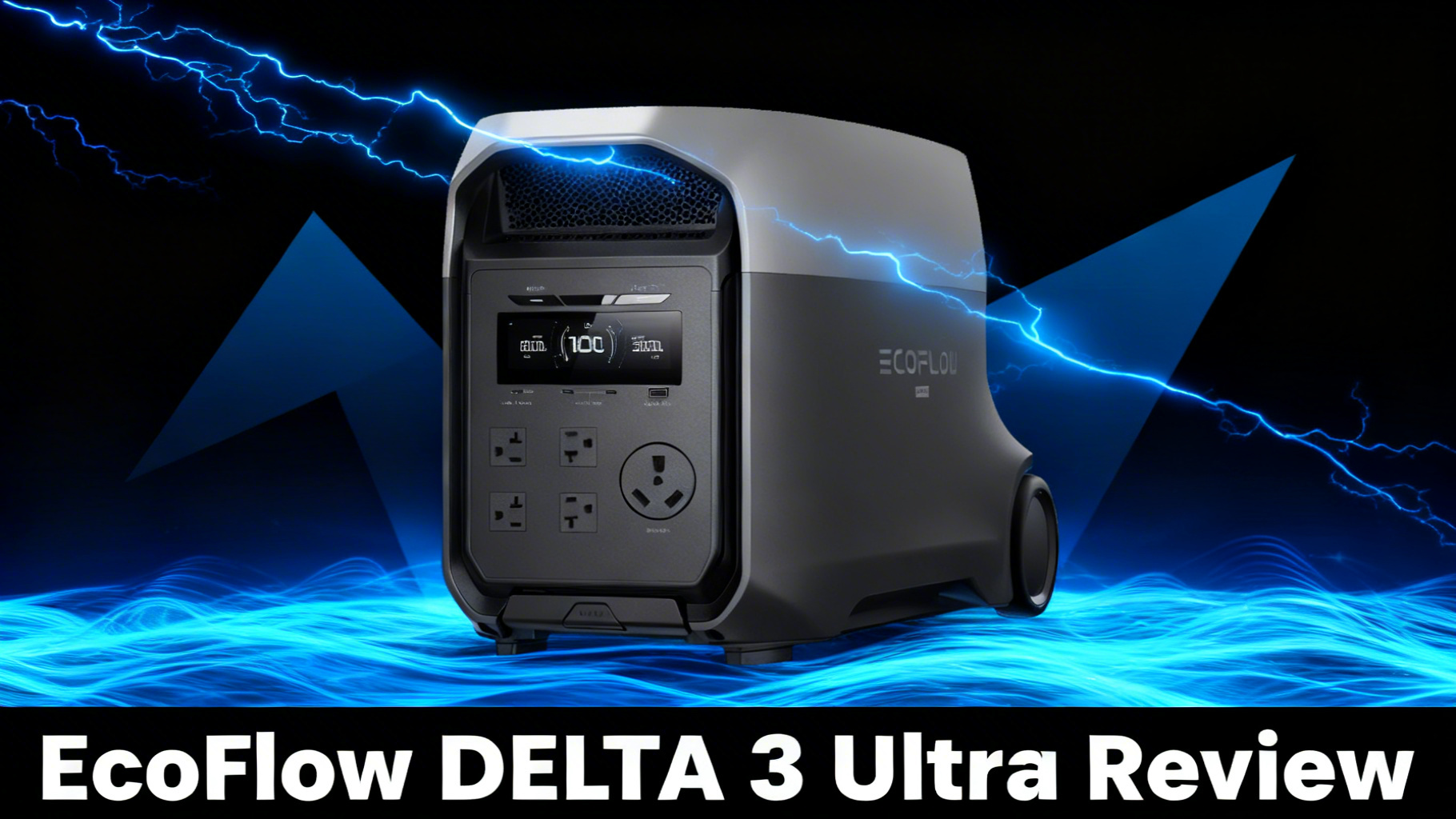
How much portable power is too much? It’s a legitimate question, especially when a single unit packs 3,072Wh of LiFePO4 capacity and pushes 3,600W of continuous AC output. The EcoFlow DELTA 3 Ultra sits at the very top of EcoFlow’s DELTA 3 lineup (below the Pro tier), and at $1,099, it costs significantly less than you’d expect for this level of performance.
But here’s the thing: most people don’t need 3,072Wh. The DELTA 3 Ultra targets a specific audience, and this review is designed to help you figure out if you’re in that group or if a smaller (and cheaper) unit makes more sense for your situation.

The DELTA 3 Ultra sits at the top of our best EcoFlow power stations roundup for users who prioritize capacity above all else. But “most capacity” doesn’t automatically mean “best choice.” Our analysis covers every critical angle: output performance, charging speed, noise levels, smart features, home integration options, and honest comparisons against both siblings and competitors. Let’s get into it.
⚡ EcoFlow DELTA 3 Ultra (3072Wh) – Current Best Price
$1,099
$2,499
-56% OFF
- ✅ 3,072Wh LFP capacity, 10-year lifespan
- ✅ 3,600W output (7,200W surge), X-Boost to 4,600W
- ✅ 0-80% in 89 minutes, 10ms UPS auto-switch
💡 Price verified March 2026 | Free shipping available
Key Specifications at a Glance
Before diving deeper, here’s what the EcoFlow DELTA 3 Ultra brings to the table on paper. The numbers tell a clear story: this is a high-capacity, high-output portable power station built for heavy loads and extended runtimes.

| Specification | EcoFlow DELTA 3 Ultra |
|---|---|
| Battery Capacity | 3,072Wh (LFP) |
| AC Output | 3,600W (Surge 7,200W) |
| X-Boost Output | Up to 4,600W |
| Battery Type | LiFePO4 (LFP), automotive-grade full-tab cells |
| Lifespan | 10 years of reliable power |
| Recharge Time (Wall) | 89 min (0-80%) |
| Charging Methods | 4 (AC wall, car, solar, generator) |
| UPS Auto-Switch | 10ms |
| Noise Level | ≤25dB at 600W |
| Home Integration | Manual Transfer Switch, Inlet Box |
| Smart App | OASIS 3.0 (WiFi + Bluetooth) |
| Certifications | Class-B certified, EV-grade CTC structure |
| Warranty | 3 years + 2 years extended (via app registration) |
| Price | $1,099 (MSRP $2,499) |
The headline specs are straightforward. You get 3,072Wh of LFP battery capacity, 3,600W continuous AC output with a 7,200W surge rating, and EcoFlow’s X-Boost technology that handles appliances up to 4,600W. Wall charging reaches 0-80% in 89 minutes, and the unit includes a 10ms UPS auto-switch for seamless backup power.
EcoFlow rates the LFP cells for 10 years of reliable use, backed by a 3-year warranty (extendable to 5 years through app registration). The unit connects to your home via a Manual Transfer Switch or Inlet Box, and EcoFlow’s OASIS 3.0 app provides remote monitoring through WiFi and Bluetooth. For the full breakdown, refer to the official EcoFlow DELTA 3 Ultra specs page.
Design, Build Quality, and Portability
EcoFlow built the DELTA 3 Ultra around what they call an EV-grade CTC (Cell-to-Chassis) structure. In practical terms, this means the battery cells are integrated directly into the chassis rather than mounted in separate modules. The result is a more compact and rigid unit compared to older designs that use traditional battery packs.
The automotive-grade full-tab LFP cells are a notable upgrade over standard LiFePO4 configurations. Full-tab design reduces internal resistance, which translates to better heat management and more consistent power delivery under heavy loads. Combined with EcoFlow’s 24/7 BMS (Battery Management System) and Class-B EMC certification, the build quality data points to a unit engineered for long-term reliability.

Noise is where this unit genuinely stands out. At 600W output, the DELTA 3 Ultra operates at just 25dB, which is roughly equivalent to a quiet whisper. For home backup scenarios where the unit sits in a living space or bedroom, this is a significant advantage over competitors that can push 40-50dB under similar loads.
The trade-off, predictably, is weight. A 3,072Wh LFP battery is not light. If portability ranks high on your priority list (camping, tailgating, car trips), you should seriously consider whether this much capacity is worth the extra bulk compared to the DELTA 3 Plus or DELTA 3 Max.
Output Power and Performance
The 3,600W continuous output with 7,200W surge is the DELTA 3 Ultra’s most compelling specification. This isn’t just a bigger battery; it’s a fundamentally more capable 3072Wh power station than most portable units in the sub-$1,500 range.
What does 3,600W actually mean in practice? It means you can run a full-size microwave, a clothes dryer (on low heat), a table saw, or a small window AC unit without worrying about tripping the overload protection. The 7,200W surge handles the startup spike that motor-driven appliances demand, such as refrigerator compressors and power tools.
X-Boost extends the effective range to 4,600W for resistive loads like space heaters and hair dryers. Keep in mind that X-Boost reduces waveform quality slightly, so sensitive electronics (medical devices, high-end audio) should run on the standard pure sine wave output.
The 10ms UPS auto-switch function is particularly relevant for home backup users. When grid power drops, the DELTA 3 Ultra switches to battery power within 10 milliseconds, fast enough that NAS systems, servers, and networking equipment won’t reboot or lose data. For anyone running a home office or small business with critical uptime requirements, this feature alone could justify the purchase.
What Can the DELTA 3 Ultra Power?
Runtime calculations based on the 3,072Wh capacity (factoring in approximately 85% inverter efficiency) give a clear picture of what this unit handles across different scenarios.
What Can It Power? (3,072Wh)
🔌
Full-Size Fridge
~25 hrs
120W avg
💡
LED Lights (10x)
~256 hrs
12W each
❄️
Window AC Unit
~2.5 hrs
1,200W
📱
Smartphone Charges
~200+
15Wh each
*Runtime calculations based on 3,072Wh capacity with ~85% inverter efficiency. Actual results vary by conditions.
A full-size refrigerator drawing 120W average runs for roughly 25 hours. Ten LED light bulbs (12W each) last over 250 hours. A window AC unit pulling 1,200W gets about 2.5 hours, enough to cool a room during the hottest part of a summer outage. And you can charge a smartphone over 200 times before the battery is depleted.
For a more practical scenario, consider a 24-hour home outage: running a refrigerator (120W), a WiFi router (15W), a few LED lights (36W), and charging phones and laptops intermittently (50W average) totals roughly 220W continuous draw. That gives you around 12 hours of comfortable backup on a single charge, with capacity to spare. Double the scenario with a transfer switch, adding a sump pump that cycles intermittently (300W average when running), and you’re still looking at 8-10 hours of comprehensive home coverage.
Van life and camping scenarios paint a different picture. Running a 12V compressor fridge (50W), charging devices, powering LED lights, and occasionally using a coffee maker or induction cooktop means the DELTA 3 Ultra can realistically cover 2-3 full days of off-grid use before needing a recharge. That’s a meaningful improvement over 2,000Wh-class units that typically last 1.5-2 days under similar conditions.
For a personalized estimate based on your specific appliances, use our runtime calculator.
Charging Speed and Options
The DELTA 3 Ultra supports four charging methods: AC wall outlet, car adapter, solar panels, and generator input. Wall charging is the headliner here, reaching 0-80% in approximately 89 minutes. That’s fast for a 3,072Wh unit, and it makes the EcoFlow DELTA 3 Ultra practical as a “charge it before the storm hits” backup solution.

Solar charging performance depends entirely on your panel setup. EcoFlow’s ecosystem supports high-wattage solar input, which pairs well with this unit’s large capacity. Under optimal conditions (full sun, proper angle, quality panels), you can achieve meaningful charge rates. Realistically, expect 4-8 hours for a full solar charge depending on panel wattage and weather.
One important comparison point: the DELTA 3 Ultra Plus ($1,449) offers six charging methods instead of four, including dual solar plus generator input simultaneously. It also charges to 80% in just 48 minutes, nearly twice as fast. If rapid recharge matters for your use case (frequent cycling, unreliable grid), the Ultra Plus premium may be worth evaluating.
Smart Features and App Control
EcoFlow’s OASIS 3.0 app connects via WiFi and Bluetooth, providing real-time monitoring of input/output power, battery status, and estimated runtime. The interface is clean and functional, not cluttered with unnecessary features.
Three app features stand out for practical use. Storm Guard Mode automatically charges the unit to 100% when severe weather is detected in your area. Self-Powered Mode optimizes battery usage around Time-of-Use electricity rates, charging during off-peak hours and discharging during peak pricing. Scheduled Tasks let you automate charge/discharge cycles for specific times and scenarios.


The EcoFlow OASIS 3.0 app is available for both iOS and Android. Setup takes a few minutes, and the Bluetooth fallback means you don’t lose control if your WiFi goes down during an outage. For a portable power station at this price point, app integration is expected, and EcoFlow delivers a solid implementation.
Home Integration Options
The DELTA 3 Ultra supports two methods for integrating with your home’s electrical system: a Manual Transfer Switch and an Inlet Box. Both allow you to power specific circuits in your home directly from the unit, rather than running extension cords to individual appliances.

EcoFlow supports two home integration methods (Manual Transfer Switch and Inlet Box), both detailed in our transfer switch installation guide. The Manual Transfer Switch is the more robust option, letting you select which circuits receive backup power during an outage. The Inlet Box provides a simpler plug-in connection point.
Either method requires professional installation by a licensed electrician. This is not a DIY project, and skipping professional installation creates serious safety risks. Budget $200-500 for installation depending on your location and electrical panel complexity.
DELTA 3 Ultra vs DELTA 3 Ultra Plus: Worth the Extra $350?
This is the EcoFlow DELTA 3 series comparison most buyers will face. At $1,099 versus $1,449, the price gap is significant, but so are the feature differences.
Both units share the same 3,072Wh capacity and 3,600W continuous output. The core power delivery is identical. Where they diverge is in expandability, charging speed, and smart features.
The Ultra Plus adds expandable capacity through extra batteries (scalable from 3,072Wh up to 11kWh), which is a fundamental advantage for whole-home backup over multiple days. It also offers 6 charging methods versus 4, including dual solar input. The faster 48-minute charge time (0-80%) is nearly twice as fast as the standard Ultra’s 89 minutes. And Smart Output Priority via the app lets the Ultra Plus intelligently manage which devices get power first during high-demand situations.
The verdict on this comparison is fairly clear. If you need expandable capacity or plan to scale your backup system over time, the Ultra Plus is the better long-term investment. If you need a standalone, fixed-capacity unit and don’t plan to add batteries, the standard Ultra at $1,099 delivers the same core performance for $350 less.
How Does It Compare to Alternatives?
Beyond the Ultra Plus, several alternatives deserve consideration depending on your priorities.
If 3,072Wh feels like overkill, the 2,048Wh EcoFlow DELTA 3 Max (see our DELTA 3 Max review) saves $350 while keeping the same 3,600W output. You lose about a third of the capacity, but for weekend camping or short outages (under 8 hours), the Max handles most scenarios comfortably. At $749, it’s the better value-per-dollar option for the majority of users.

The EcoFlow DELTA Pro ($1,599, 3,600Wh) offers more capacity and a more established ecosystem, but at a higher price and with older technology. If you’re specifically looking for the best EcoFlow for home backup without going to the Pro line, the DELTA 3 Ultra hits a sweet spot.
From competing brands, options like the Jackery Explorer 2000 Plus and the Bluetti AC200MAX occupy similar territory. Each has distinct strengths in solar charging ecosystems, app functionality, or expandability options. The DELTA 3 Ultra’s primary advantages in this competitive landscape are its aggressive pricing ($1,099 for 3,072Wh is among the lowest cost-per-Wh in the 3kWh class), the 89-minute fast wall charge, and the 25dB quiet operation that competitors simply haven’t matched at this capacity tier.
Who Should Buy the EcoFlow DELTA 3 Ultra?
✅ Buy the DELTA 3 Ultra if…
- You need multi-day home backup for essentials (fridge, lights, router, medical devices)
- You want 3,600W output to run heavy appliances like dryers or power tools
- You plan to add a transfer switch for seamless home integration
- You want expandable capacity (pairs with extra batteries up to 11kWh)
❌ Skip the DELTA 3 Ultra if…
- Portability matters: this unit is heavy for camping or tailgating
- You only need weekend camping power (the DELTA 3 or DELTA 3 Plus is enough)
- Your budget is under $800 (look at DELTA 3 Max at $749)
- You want the Ultra Plus features (expandable capacity, 6 charging methods, Smart Output Priority)
The DELTA 3 Ultra makes the most sense for four specific buyer profiles.
Home backup for extended outages. If you live in an area prone to multi-day power outages (hurricane zones, ice storm regions, rural areas with unreliable grid), the 3,072Wh capacity keeps essentials running for 24+ hours on a single charge. Pair it with a transfer switch for seamless integration.
Small business or home office backup. The 10ms UPS auto-switch protects servers, NAS systems, and networking equipment. Combined with 3,600W output, you can keep a full home office running through extended outages without data loss.
Long-term van life or off-grid cabin. For users who need sustained power over days (not just a weekend), 3,072Wh provides a meaningful buffer that smaller units can’t match. Solar charging keeps it topped off between sunny days.
Power tool users and job sites. The 3,600W output and 7,200W surge comfortably runs table saws, compressors, and heavy-duty tools. The 89-minute wall recharge means you can charge overnight and have a full day of power on site.
Homeowners planning for extended outages should also consult our home backup power guide for a complete setup strategy.
Conversely, if you’re a weekend camper, occasional tailgater, or just need backup for short outages (under 6 hours), the EcoFlow DELTA 3 Max at $749 or the DELTA 3 Plus covers your needs at a lower price and weight. Don’t pay for capacity you won’t use.
EcoFlow DELTA 3 Ultra (3072Wh): Overall Rating
8.5/10
“Maximum capacity for serious home backup, at a competitive price”
Capacity & Output 9/10
Value for Money 8.5/10
Build Quality 9/10
Charging Speed 8/10
Portability 7/10
Smart Features 9/10
Final Verdict
Score: 8.5/10
The EcoFlow DELTA 3 Ultra delivers a compelling combination of high capacity (3,072Wh), serious output power (3,600W/7,200W surge), and competitive pricing ($1,099). The LFP battery chemistry ensures a 10-year lifespan, the 89-minute fast charge is practical for emergency scenarios, and the 25dB noise floor makes it one of the quietest high-capacity units available.
The limitations are honest and predictable. It’s heavy, not expandable (that’s the Ultra Plus), and offers four charging methods rather than six. For users who need expandable capacity or the fastest possible recharge, the Ultra Plus at $1,449 is the better investment. For everyone else who wants a high-capacity standalone unit at an aggressive price, the DELTA 3 Ultra represents excellent value.
The data points to a clear recommendation: buy the DELTA 3 Ultra if you need 3,000+ Wh of reliable backup power and don’t plan to expand. Skip it if your needs are met by 2,000Wh or less, because the DELTA 3 Max at $749 delivers the same output power for $350 less.
EcoFlow DELTA 3 Ultra
$1,099
Best 3kWh power station under $1,100
Price verified March 2026 | Free shipping available
Frequently Asked Questions
How long can the EcoFlow DELTA 3 Ultra power a refrigerator?
Based on 3,072Wh capacity and a typical refrigerator drawing 100-150W average (with compressor cycling), runtime calculations indicate approximately 20-30 hours of continuous operation. Actual results depend on the fridge model, ambient temperature, and how often the door is opened.
What is the difference between the DELTA 3 Ultra and the DELTA 3 Ultra Plus?
The DELTA 3 Ultra Plus ($1,449) adds expandable capacity (3-11kWh with extra batteries), Smart Output Priority via the app, 6 charging methods (versus 4), and faster 48-minute charging (0-80%) with dual solar plus generator input. The base DELTA 3 Ultra ($1,099) has the same 3,072Wh capacity and 3,600W output but without expandability or Smart Output Priority.
Can the DELTA 3 Ultra power a central air conditioner?
The 3,600W continuous output (7,200W surge) can technically start and run a small central AC system. However, central AC units typically draw 2,000-5,000W, so runtime would be limited to 1-2 hours at most. The DELTA 3 Ultra is better suited for window AC units, portable AC, or running the fan-only mode of a central system during an outage.
How fast does the EcoFlow DELTA 3 Ultra charge?
Wall charging reaches 0-80% in approximately 89 minutes. Four charging methods are available: AC wall outlet, car adapter, solar panels, and generator. Solar charging speed depends on panel wattage and sun conditions.
Is the DELTA 3 Ultra worth it over the DELTA 3 Max?
The DELTA 3 Max ($749, 2,048Wh) offers the same 3,600W output at $350 less. The DELTA 3 Ultra’s advantage is 50% more capacity (3,072Wh versus 2,048Wh), which matters for extended outages or high-consumption scenarios. If your primary use is weekend camping or short outages, the DELTA 3 Max provides better value per dollar.
Does the DELTA 3 Ultra work as a UPS?
Yes. The 10ms auto-switch function means connected devices experience virtually no interruption during a power outage. This makes it suitable for protecting sensitive electronics like NAS systems, servers, and networking equipment.