
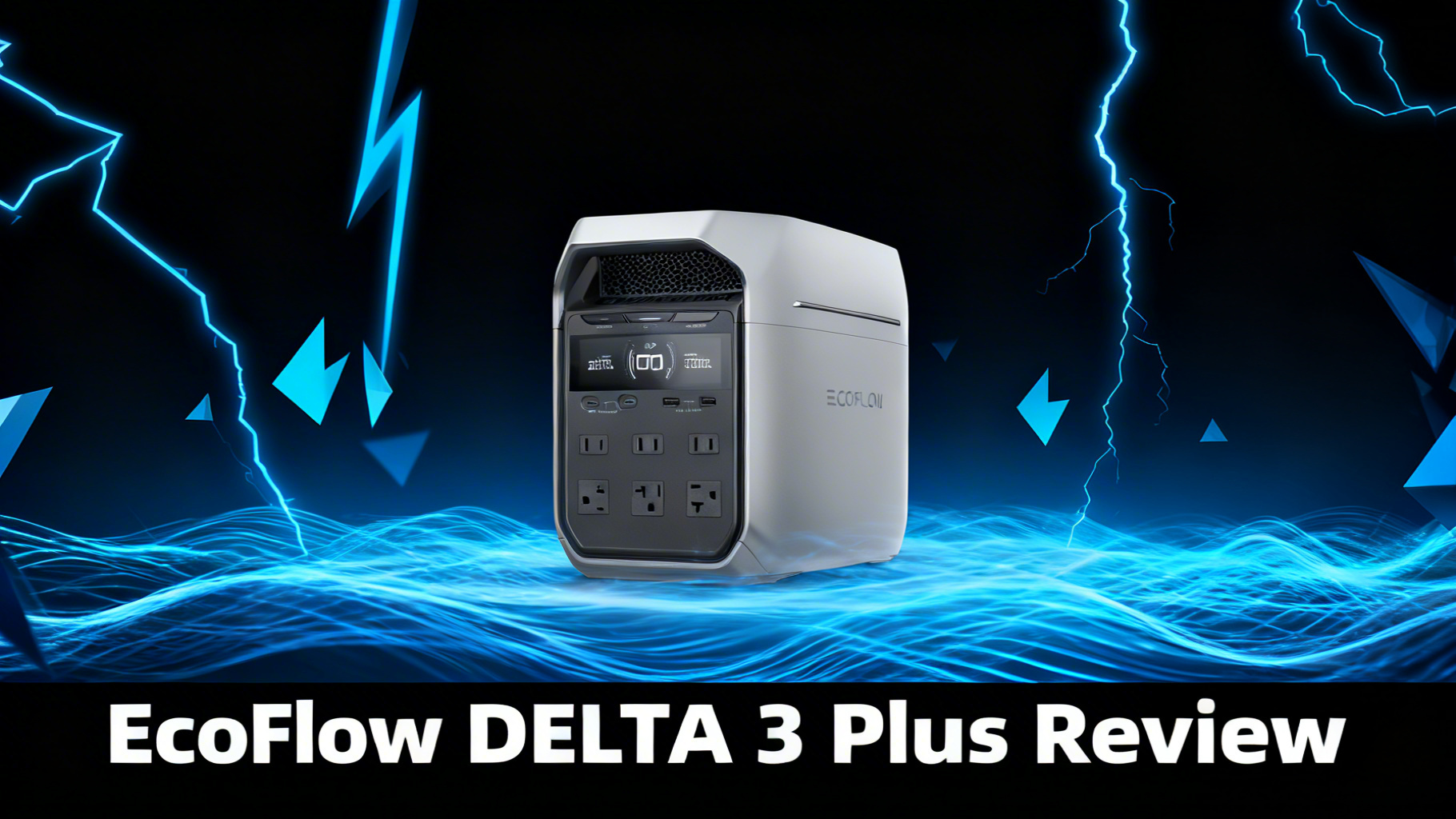
The EcoFlow DELTA 3 Plus sits at an interesting crossroads. At $599 (down from $799), it shares the same 1,024Wh LFP battery as the standard DELTA 3, which currently sells for $499. That $100 premium buys you X-Boost technology, broader extra battery compatibility, and additional charging methods. The question is whether those upgrades justify the price gap, or if you’re better off saving the cash.
Our analysis of the EcoFlow DELTA 3 Plus covers everything from verified specifications and real-world owner feedback to runtime calculations and ecosystem compatibility. This is a mid-range portable power station that positions itself as a future-proof investment rather than a one-and-done purchase. For campers, RV owners, and anyone building a modular power setup, that distinction matters.

What follows is a full breakdown: specs, strengths, weaknesses, runtime data, and a clear verdict on who should (and should not) buy this unit. By the end of this EcoFlow DELTA 3 Plus review, you will know exactly whether it fits your use case and budget.
EcoFlow DELTA 3 Plus, Overall Rating
8.5/10
“The sweet spot between capacity and expandability in EcoFlow’s DELTA 3 lineup”
Performance 8.5/10
Value 8/10
Portability 7.5/10
Charging Speed 9/10
Expandability 9.5/10
Build Quality 8.5/10
⚡ EcoFlow DELTA 3 Plus – Current Best Price
$599
$799
-25% OFF
- 1800W AC output (2200W X-Boost, 3600W surge)
- 1024Wh LFP battery, expandable to 5kWh
- 5-year warranty, 3,000+ battery cycles
💡 Price checked March 2026 | Free shipping available
Quick Specs & Key Features
Before diving into the EcoFlow DELTA 3 Plus specifications, here is what the official EcoFlow DELTA 3 Plus specs page confirms about this unit. The numbers tell a compelling story on paper.

The highlights are hard to ignore: 1,800W continuous AC output that climbs to 2,200W with X-Boost (and surges to 3,600W), LFP chemistry rated for 3,000+ cycles, five distinct charging methods, and expansion capability up to 5kWh. At the current EcoFlow DELTA 3 Plus price of $599, those specs put it in a competitive position against both EcoFlow’s own lineup and rivals from Jackery and Bluetti.
Not sure if the DELTA 3 Plus can handle your specific appliances? Run them through our compatibility checker tool for instant results.
What We Love About the DELTA 3 Plus
X-Boost Technology: 2,200W Without the Premium Price
The X-Boost feature is arguably the biggest differentiator between the DELTA 3 Plus and the standard DELTA 3. It pushes the effective output from 1,800W to 2,200W by intelligently managing voltage delivery to appliances that draw above the rated continuous wattage. In practical terms, this means you can run appliances like a hair dryer, a small space heater, or a microwave oven that would otherwise trip the overload protection.
How does X-Boost actually work? The system reduces voltage slightly while maintaining the amperage, allowing higher-wattage devices to operate within the inverter’s thermal limits. Most resistive loads (heaters, hair dryers, irons) tolerate this voltage adjustment without any noticeable performance impact. Motor-driven appliances are more variable, so it is worth checking compatibility with specific tools.
The 3,600W surge capacity is also worth noting. Motor-driven appliances (compressors, power tools, well pumps) draw significantly more power at startup than during steady operation. A 3,600W surge cushion provides a comfortable margin for those initial spikes. Performance data from the owner community confirms that X-Boost handles these scenarios reliably.

Expandable to 5kWh: Future-Proof Your Setup
This is where the $100 premium over the standard DELTA 3 starts to make real sense. The DELTA 3 Plus supports a broader range of extra batteries than its sibling: the DELTA 3 Series Smart Extra Battery ($389 for an additional 1,024Wh), plus compatibility with DELTA 2 Extra Battery, DELTA 2 Max Extra Battery, and DELTA Pro 3 Extra Battery units via the Alternator Charger XT150 Output Cable.
The practical implication is straightforward: you can start with 1,024Wh today and scale the EcoFlow DELTA 3 Plus battery capacity to 5,000Wh over time as your needs grow. That makes the DELTA 3 Plus a modular investment rather than a fixed-capacity purchase. For anyone planning to expand into van life, longer RV trips, or more comprehensive home backup, this flexibility is significant.

Five Charging Methods: Maximum Flexibility
The DELTA 3 Plus supports five recharging options: standard AC wall outlet, solar panels (up to 500W EcoFlow DELTA 3 Plus solar input via a high-efficiency MPPT controller at 99% conversion), the 800W Alternator Charger for vehicle-based charging, the Smart Generator 3000 (Dual Fuel), and MultiCharging that combines multiple sources simultaneously.
AC charging data indicates a full 0-100% recharge in approximately 60 to 70 minutes using EcoFlow’s X-Stream technology. That is remarkably fast for a 1,024Wh unit. Solar charging with a 220W panel delivers a full charge in roughly 4.5 to 5 hours under optimal conditions. For overlanders and off-grid users, the 800W alternator charger option is particularly compelling, since it turns your vehicle’s engine into a charging station.
LFP Battery Chemistry: 3,000+ Cycles
LiFePO4 (LFP) battery chemistry has become the standard for serious portable power stations, and the DELTA 3 Plus delivers on this front. EcoFlow rates the unit for 3,000+ charge cycles before the battery degrades to 80% of its original capacity. In practical terms, that translates to roughly 10 years of daily use.
The 5-year warranty adds another layer of confidence. Where older NMC-based units offered 500 to 800 cycles, the jump to 3,000+ cycles fundamentally changes the cost-per-use equation. The DELTA 3 Plus also made our shortlist of the best power stations for camping thanks to its combination of capacity and portability.

What Can the DELTA 3 Plus Power? (Runtime Analysis)
The 1,024Wh EcoFlow DELTA 3 Plus capacity translates to real-world runtimes that depend entirely on what you plug in. Inverter efficiency typically runs around 85-90%, so expect usable capacity closer to 870-920Wh in practice. To estimate runtime for your specific appliances, use our runtime calculator with the DELTA 3 Plus’s 1,024Wh capacity.
What Can It Power? (1024Wh)
🔌
Mini Fridge
~14 hrs
60W avg
💡
LED Lights (5x)
~85 hrs
10W each
💻
Laptop
~14 charges
60W avg
📱
Phone Charges
~70 charges
~15Wh each
Runtime calculations based on the 1,024Wh capacity show approximately 14 hours for a mini fridge drawing 60W on average, over 85 hours for LED lighting, and around 14 full laptop charges. A CPAP machine drawing 30-60W could run for roughly 17 to 34 hours, covering multiple nights of use on a single charge.
For higher-draw appliances, the math changes quickly. A 1,500W space heater would drain the battery in under an hour. A microwave oven (1,000W) provides roughly 50 minutes of cook time. A blender, coffee maker, or hair dryer falls in the 1,000 to 1,800W range, making them feasible for short bursts but impractical for sustained use without an extra battery attached.
One scenario that comes up frequently in owner discussions: running a mini fridge and charging devices simultaneously overnight at a campsite. Combined draw around 80 to 100W puts you at roughly 10 hours of runtime, which comfortably covers a full night and then some. Pair that with a 220W solar panel the next morning and you can replenish what you used before noon.
💰 Current Price:
EcoFlow DELTA 3 Plus, $599
$799
Where the DELTA 3 Plus Falls Short
Same 1,024Wh as the Standard DELTA 3
The most common criticism in owner feedback is straightforward: if you do not plan to expand your system with extra batteries, the $100 premium over the standard DELTA 3 is harder to justify. Both units share the exact same 1,024Wh LFP battery. You are paying for X-Boost capability and broader expansion compatibility, not additional base capacity.
Weight at ~31 lbs Is Not Ultra-Portable
At approximately 31 pounds, the EcoFlow DELTA 3 Plus weight makes it a solid, substantial unit. For car camping and RV setups where you drive to your destination, this is manageable. You can grab the carry handle, lift it out of your trunk, and set it on a table without too much effort. But for anyone who needs to carry their power station any meaningful distance (think walking to a remote campsite, festival, or tailgate spot), it gets tiring quickly.
EcoFlow’s own RIVER 3 series (under 10 lbs) serves the ultra-portable segment much better. The tradeoff, of course, is significantly less capacity and output. The DELTA 3 Plus is meant to stay close to your vehicle or basecamp, not ride in a backpack. EcoFlow does offer a waterproof carrying bag for the DELTA 3 series that makes transport easier, though it does not reduce the weight.
No Built-in UPS Function
One notable absence: the DELTA 3 Plus lacks a dedicated UPS (Uninterruptible Power Supply) function with a fast switchover time. The DELTA 3 1000 Air, a different model in the DELTA 3 family, includes a 10ms UPS switchover. If you need seamless backup for sensitive electronics like a home server or network equipment, this is worth noting.


EcoFlow DELTA 3 Plus vs DELTA 3: What $100 Gets You
Spec-for-spec comparison shows that both units share the same 1,024Wh LFP battery, similar form factor, and the same 5-year warranty. The DELTA 3 Plus upgrades revolve around three areas: X-Boost technology pushes usable output to 2,200W (versus the standard model’s lower ceiling), expansion compatibility spans a broader range of extra batteries for scaling to 5kWh, and charging flexibility adds the 800W Alternator Charger and Smart Generator 3000 as input sources.
The charging method difference deserves extra attention. The standard DELTA 3 supports AC and solar charging, which covers the basics. The DELTA 3 Plus adds the 800W Alternator Charger, which is a game-changer for anyone who spends significant time on the road. Charging your power station while driving means you arrive at your destination with a full battery, with no need to find a wall outlet or wait for solar conditions.
If your power needs are simple (laptops, phones, lights, a small fridge), the standard DELTA 3 at $499 likely covers you. If you want the ability to run higher-wattage appliances, plan to add batteries over time, or need vehicle-based charging on the road, the $100 upgrade makes sense. The decision is really about your current needs versus your anticipated future needs.
Who Should Buy the DELTA 3 Plus?
If you are still weighing your options, our complete guide to choosing the right power station breaks down the key factors. But for a quick assessment of whether the DELTA 3 Plus is the right fit, here is how the use cases line up.
✅ Buy the DELTA 3 Plus if…
- You want expandable capacity (1-5kWh) for growing power needs
- You need 1800W+ output for high-draw appliances (X-Boost to 2200W)
- You value fast AC recharging and multi-source charging flexibility
- You plan to use it for camping, RV trips, or light home backup
❌ Skip the DELTA 3 Plus if…
- You need whole-home backup (look at DELTA Pro or DELTA 3 Max instead)
- Budget is tight and you do not plan to expand (the standard DELTA 3 at $499 may suffice)
- Ultra-portability is your priority (the RIVER 3 series is lighter)
- You already own a DELTA 3 and rarely need more than 1024Wh

The ideal DELTA 3 Plus buyer is someone who wants a capable, expandable mid-range power station without paying for the massive capacity of a DELTA Pro. RV owners building a layered power system, car campers who want a single unit they can grow with, and home office workers looking for reliable backup power all fit this profile well.
Final Verdict: 8.5/10
The EcoFlow DELTA 3 Plus earns its 8.5/10 rating by delivering strong core performance (1,800W continuous, 2,200W X-Boost, 3,600W surge) wrapped in an LFP battery rated for a decade of daily use. The expandability to 5kWh and five charging methods set it apart from both the standard DELTA 3 and many competitors in the $500 to $700 price range.
Where it loses points: the base 1,024Wh capacity is identical to the cheaper DELTA 3, the ~31 lb weight limits true portability, and the lack of a built-in UPS function is a missed opportunity. These are not dealbreakers for most use cases, but they are worth considering if your needs lean heavily toward one of those areas.
At $599, the DELTA 3 Plus occupies a compelling middle ground. It is not the cheapest 1kWh power station on the market, and it is not trying to be. Its value proposition is in what you can do with it today and what you can grow it into tomorrow. That combination of immediate capability and long-term flexibility is what earns it a strong recommendation.
Based on our analysis, the DELTA 3 Plus is a smart buy for anyone who values future expandability and higher wattage output. If you know you will never need more than 1,024Wh and your appliances all fall under 1,500W, save the $100 and grab the standard DELTA 3 instead. See how the DELTA 3 Plus stacks up in our ranking of the best portable power stations for 2026.
EcoFlow DELTA 3 Plus
$599
Best mid-range EcoFlow for expandability and X-Boost power
Price verified March 2026 | Free shipping available
Frequently Asked Questions
How long does the EcoFlow DELTA 3 Plus last on a single charge?
Runtime depends on the appliances connected. With 1,024Wh of capacity, calculations show approximately 14 hours for a mini fridge (60W), 85+ hours for LED lighting, or 14 full laptop charges. Higher-draw appliances reduce runtime proportionally.
What is the difference between the DELTA 3 and the DELTA 3 Plus?
Both share the same 1,024Wh LFP battery, but the DELTA 3 Plus adds X-Boost technology (boosting output to 2,200W vs the standard model’s lower ceiling), compatibility with a broader range of extra batteries for expansion to 5kWh, and additional charging methods including the 800W Alternator Charger and Smart Generator 3000.
Can the EcoFlow DELTA 3 Plus power a refrigerator?
Yes. The 1,800W continuous output (2,200W with X-Boost) handles standard household refrigerators. A typical fridge drawing 100-150W average would run for approximately 6 to 8 hours on the base 1,024Wh capacity. Adding an extra battery extends this significantly.
How fast does the DELTA 3 Plus charge from a wall outlet?
EcoFlow’s X-Stream technology enables fast AC charging. Verified specifications indicate a full 0-100% charge in approximately 60 to 70 minutes from a standard wall outlet, making it one of the fastest-charging power stations in its class.
Is the EcoFlow DELTA 3 Plus good for camping?
At approximately 31 lbs, the DELTA 3 Plus works well for car camping and base camp setups where you can drive to your site. It pairs effectively with EcoFlow’s 220W or 400W solar panels for off-grid recharging. For backpacking or ultra-light travel, the RIVER 3 series is more appropriate.
What extra batteries work with the DELTA 3 Plus?
The DELTA 3 Plus supports expansion with the DELTA 3 Series Smart Extra Battery (1,024Wh, $389), DELTA 2 Extra Battery, DELTA 2 Max Extra Battery, and DELTA Pro 3 Extra Battery via the Alternator Charger XT150 Output Cable. This allows scaling from 1kWh to 5kWh.