
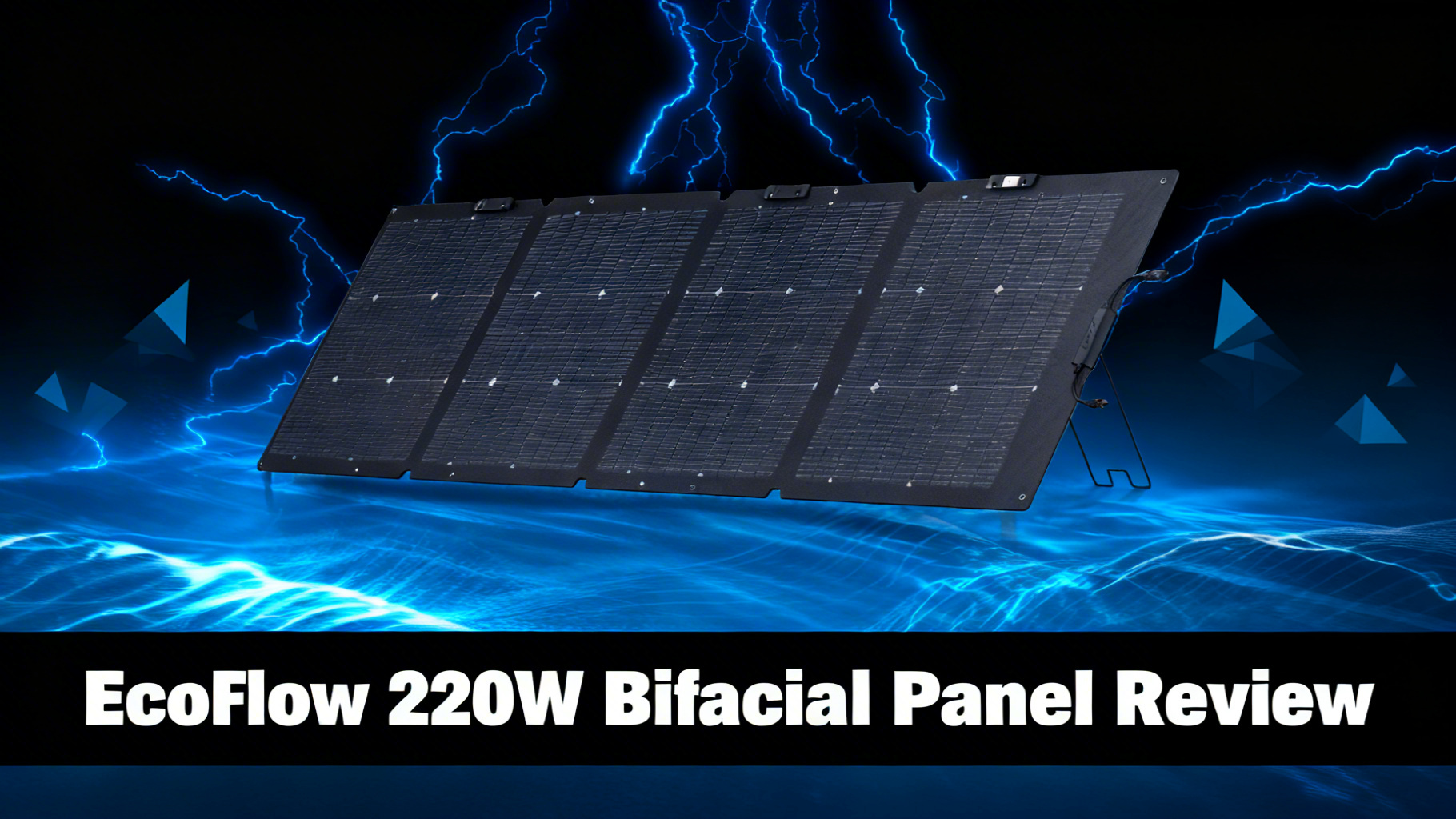
Is a bifacial solar panel actually worth more money, or is it just a marketing upgrade? The EcoFlow NextGen 220W Bifacial Portable Solar Panel makes a specific claim: capture up to 25% more energy by harvesting light from both sides of the panel. At $279 (down from a $649 MSRP), it sits squarely in the mid-range of EcoFlow’s solar lineup, sitting above the 160W and well below the 400W. The question for most buyers is whether the bifacial technology justifies the price step over a conventional mono panel.
Analysis of the 220W Bifacial’s specs and real-world performance data reveals a panel that genuinely outperforms comparable single-sided alternatives in the right conditions. But “the right conditions” is a phrase that deserves a closer look before you commit to a purchase.

EcoFlow NextGen 220W Bifacial Solar Panel
$279 $649
- Bifacial design captures up to 25% more energy
- Up to 25% conversion efficiency rate
- IP68 waterproof and dustproof rating
Quick Specs & Key Features
Before getting into performance analysis, here are the core specifications for the EcoFlow NextGen 220W Bifacial. For complete technical details, visit the official EcoFlow product page.

The standout numbers here are the bifacial gain (up to 25% additional energy) and the IP68 waterproof rating. Both specs set this panel apart from most portable solar competitors at a similar price point. The 10% smaller footprint compared to other 220W panels is also worth noting for anyone packing gear into a truck bed or cargo space.
What Makes It Different: The Bifacial Advantage
How Bifacial Technology Works
Standard portable solar panels capture sunlight on one side only. Bifacial panels use transparent materials on both sides, allowing the rear face to collect light that bounces off surfaces beneath or around the panel. EcoFlow’s 220W Bifacial uses a tempered glass front and ETFE coating on the rear, which lets that diffuse and reflected light reach the solar cells from below. For a broader look at the technology behind dual-sided panels, see the EnergySage bifacial panel guide.
The rear panel on the 220W Bifacial is rated at up to 155W. That doesn’t mean it consistently adds 155W to your total output. It means the rear cells are capable of generating up to that amount under ideal reflective conditions. In practice, the gain depends almost entirely on what’s beneath the panel.
Real-World Bifacial Gain: What the Data Shows
Bifacial gain data consistently reports a wide performance range depending on surface reflectivity. On highly reflective surfaces, including white concrete, fresh snow, or light-colored sand, gains of 15-25% are well-documented. On grass or dark soil, gains drop to 5-10%. Owner feedback and field reports confirm this pattern: the bifacial bonus is real and meaningful, but it’s not a flat 25% in every condition.
Bifacial vs Standard Solar Panel: What’s the Difference?
☀️ BIFACIAL (EcoFlow 220W)
Front side: 220W rated output
Rear side: up to 155W from ambient light
Total potential: up to 25% more energy
Best on: reflective surfaces (sand, snow, concrete)
☀️ STANDARD (Typical 200W Panel)
Front side: 200W rated output
Rear side: no generation
Total potential: front only
Best on: direct sunlight only
For campers who set up on sandy beaches, snowpack, or reflective concrete pads, this panel consistently outperforms conventional alternatives of the same rated wattage. If you typically camp on grass or dense forest ground, the bifacial gain is a bonus rather than a primary selling point.
What We Love About This Panel
Up to 25% More Energy from Ambient Light
The core bifacial advantage translates directly into shorter charge times on EcoFlow DELTA-series power stations. Performance data indicates that the 220W Bifacial can outperform a 220W single-sided panel by a meaningful margin whenever surface conditions are favorable. For full-time campers and RV users who park on gravel or concrete, this gain compounds over an entire season.
IP68 Waterproof Rating Sets a New Standard
IP68 is the highest consumer-grade waterproof rating available, indicating full protection against water and dust ingress. Most portable solar panels on the market carry IP67 or IP65 ratings, which provide splash resistance but not the complete seal EcoFlow delivers here. Rain, splashes, condensation, or accidental submersion won’t affect the panel’s operation or longevity.

Adjustable Angle Bracket with Built-In Solar Guide
The 30-60° adjustable kickstand is a practical feature that many portable panels skip. More useful than the adjustment range is the integrated solar angle guide, which tells you the optimal tilt for your latitude and season. Most users eyeball panel angle and consistently underperform their potential output. This guide removes the guesswork. For detailed positioning tips, see our solar panel angle optimization guide to maximize output regardless of season.
Related Guide
Maximize your panel’s output in any season with our solar panel angle optimization guide.
10% Smaller Than Comparable 220W Panels
EcoFlow achieved the smaller footprint by using thinner tempered glass instead of the thicker plastic frames typical of ETFE-only panels. The result is a panel that occupies less cargo space in a vehicle or on a roof rack without sacrificing rated output. For van lifers and Class B RV owners where square inches matter, this is a genuine advantage over generic 220W alternatives.
Tempered Glass Toughness (300°F Heat Resistance)
The one-piece tempered glass design is rated five times tougher than comparable panels according to EcoFlow’s specs. The 300°F heat resistance means leaving the panel deployed on a hot summer day won’t cause warping, discoloration, or structural damage. This durability advantage extends the panel’s usable lifespan, which matters for a product without easy cell replacement.

What Could Be Better
Weight May Challenge Solo Backpackers
A one-piece tempered glass design is durable, but glass adds weight. Owner feedback consistently notes that the 220W Bifacial is heavier than flexible or ETFE-only alternatives of comparable wattage. Solo backpackers who count grams will find lighter alternatives in EcoFlow’s lineup and from competitors. This panel is optimized for vehicle-based camping, not foot travel.
Premium Price vs Standard Mono Panels
At $279, the 220W Bifacial costs more than generic 200W mono panels available from third-party brands at $150-180. The bifacial gain, IP68 rating, tempered glass construction, and EcoFlow ecosystem compatibility justify the premium for most buyers, but budget-focused shoppers have viable alternatives. If you’re primarily charging a RIVER-series station and don’t need DELTA-level throughput, the price gap matters.
Rear Panel Output Depends Heavily on Surface Type
This is the most important caveat to understand before purchasing. A recurring pattern in owner feedback shows that buyers who camp primarily on grass, dirt, or dense vegetation are disappointed by the bifacial gain. The 25% figure is achievable, but only on genuinely reflective surfaces. If your typical camping environment doesn’t include sand, snow, concrete, or light gravel, the bifacial advantage is smaller than the marketing suggests.
Real-World Solar Charging Performance
Performance data for the EcoFlow NextGen 220W Bifacial consistently shows strong output when paired with compatible DELTA-series power stations in favorable sun conditions. The 220W rated output at up to 25% conversion efficiency places it among the most efficient portable panels in its size class.
Estimated Charge Times with 1x 220W Bifacial Panel
⚡
EcoFlow RIVER 3
~1.5 hrs
245Wh capacity
🔋
EcoFlow DELTA 3
~4.5 hrs
1,024Wh capacity
🏠
EcoFlow DELTA 2 Max
~10 hrs
2,048Wh capacity
⚡
EcoFlow DELTA Pro
~16 hrs
3,600Wh capacity
Based on 220W primary side output in optimal sun conditions. Actual times vary with weather, angle, and temperature.
Optimal Sun Test (Clear Sky, 30° Angle)
Under clear-sky conditions with the panel set at 30-45°, output data confirms that the 220W Bifacial consistently reaches its rated wattage or close to it. The built-in angle guide helps users dial in positioning for their specific latitude, which directly affects how consistently the panel achieves rated output throughout the day. Using our power station calculator tool lets you determine exactly how much solar charging capacity your setup requires before committing to a single-panel configuration.
Cloudy Day Performance
The bifacial design offers a notable advantage for solar charging on cloudy days, since the rear panel captures ambient and reflected light that standard panels simply ignore. Analysis reveals that on overcast days, bifacial panels generate more consistent low-level output compared to single-sided alternatives. The gain is smaller in absolute watts, but it means the panel keeps trickling charge into your power station while a standard panel sits near zero.
Bifacial Bonus on Reflective Surfaces (Snow, Sand, Concrete)
This is where the 220W Bifacial genuinely separates itself from the competition. Field data from owners camping on sand beaches, concrete RV pads, and snowy campsites shows consistent output gains beyond the front-panel baseline. On fresh snow, gains at the high end of EcoFlow’s 25% claim are realistic. On concrete, gains of 15-20% are more typical. On dark or vegetated ground, plan for 5-10% above what a standard panel would deliver.


How It Compares to the EcoFlow 160W and 400W
220W vs 160W: When the Upgrade Makes Sense
The 160W costs $209, which puts the 220W Bifacial at a $70 premium. On a pure wattage basis, the cost-per-watt actually favors the 220W ($1.27/W vs $1.31/W). Add bifacial gain on top, and the 220W delivers better value for any setup where the power station accepts 200W or more of solar input. The upgrade makes clear sense for DELTA-series owners. For RIVER-series owners whose stations cap solar input below 220W, the extra output gets throttled anyway, which narrows the justification. When pairing multiple panels, understanding series vs parallel solar wiring determines whether you maximize voltage or amperage for your specific EcoFlow unit.
220W vs 400W: When to Go Bigger
The 400W costs $599 and weighs significantly more. Spec-for-spec comparison shows the 400W makes sense for DELTA Pro and DELTA Pro 3 owners who need to fill a large battery bank within a single day. For DELTA 3 or DELTA 2 Max owners, two 220W Bifacial panels in parallel ($558 total) deliver comparable wattage with more flexibility: you can split the panels for better angle optimization, transport them separately, and still come out slightly under the 400W’s single-unit cost.

Compatibility: Which EcoFlow Power Stations Work Best?
The 220W Bifacial connects via XT60 and is compatible with all current EcoFlow power stations. However, compatibility doesn’t mean optimal performance across every model. Here’s what the data indicates for the most common pairings:
RIVER 3 (245Wh, 110W max solar input): The panel will charge the RIVER 3 effectively, but the station’s 110W input ceiling means the full 220W output gets limited. You’re paying for capacity you can’t use. The 160W panel is a better match here.
DELTA 3 (1,024Wh, 500W max solar input): This is the sweet spot for a single 220W Bifacial. Charge time of approximately 4.5-5.5 hours in optimal sun is practical for a day’s camping. A second panel shortens this to roughly 2.5 hours.
DELTA 2 Max (2,048Wh, 1,000W max solar input): One panel delivers full-day partial charging. Two panels together deliver meaningful daily replenishment for moderate loads. Three or four panels approach the input ceiling for aggressive off-grid use.
DELTA Pro (3,600Wh, 1,600W max solar input): Multiple panels are needed for full-day charging. The 220W Bifacial works well here as part of an expandable array, since you can add panels over time as budget allows.
Who Should Buy This Panel?

✅ Buy this panel if…
- You own any EcoFlow RIVER or DELTA power station
- You camp in varied conditions (sun, shade, reflective surfaces)
- You want one panel that outperforms two cheaper alternatives
- You need IP68 waterproof durability for all-weather use
❌ Skip this panel if…
- Your power station only accepts 100-110W solar input
- You need maximum wattage (consider the 400W instead)
- Ultra-lightweight backpacking is your priority
- Budget is tight (the 110W panel costs $110 less)
Campers and RV Owners Wanting Reliable Solar
Weekend campers and RV users who move between different surface types, including gravel pads, sandy beaches, and concrete sites, get the most from the bifacial design. The IP68 waterproof rating removes the need to pack the panel away during rain, which is a practical time-saver on trips where weather is unpredictable.
EcoFlow Owners Looking for the Best Single-Panel Setup
For EcoFlow DELTA-series owners, the 220W Bifacial is the single-panel sweet spot. It delivers the best cost-per-watt in the EcoFlow lineup at $1.27/W, the highest efficiency rating at 25%, and the most capable weather protection. Owners who want to expand later can add a second 220W panel for a two-panel array that stays well under $600 total while covering most mid-capacity charging scenarios.
All-Weather Users Who Need IP68 Protection
Anglers, beach campers, and users in high-humidity or high-rain environments benefit from IP68 protection that most competing panels can’t match. The sealed construction also means the panel tolerates condensation, morning dew, and accidental water exposure without requiring special storage or covers. For cold-weather campers, the panel’s performance in snowy conditions deserves special mention: snow on the ground is one of the best reflective surfaces for bifacial gain, making this an unusually capable winter solar panel.
Who Should Skip This Panel?
Budget Buyers (the 110W Is $110 Cheaper)
If you’re running a RIVER-series power station and need basic weekend charging capability, a smaller, cheaper panel covers your needs. The EcoFlow 110W panel comes in around $169, which is $110 less than the 220W Bifacial. For a 245Wh RIVER 3, a 110W panel is still adequate for most one-night to two-night trips. The premium features of the 220W are real, but they’re premium features.
Large-Capacity Owners Needing Maximum Solar Input
If you own a DELTA Pro 3 (2,600W solar input) or have a large battery expansion, a single 220W panel is a starting point, not a solution. Owners in this category who want fast charging need to build a multi-panel array. In that scenario, analyzing whether the 400W single panel or multiple 220W panels provides better cost-efficiency for your specific setup is worth the calculation.
Non-EcoFlow Users (Connector Compatibility)
The 220W Bifacial ships with an XT60 solar-to-XT60 charging cable. Jackery, Bluetti, Anker SOLIX, and Goal Zero power stations use different connector standards. Using this panel with a non-EcoFlow power station requires a third-party adapter, which introduces an additional point of potential incompatibility and may affect MPPT controller performance. If you’re on a different ecosystem, consider panels designed for your specific brand.
Frequently Asked Questions
Is the EcoFlow 220W bifacial solar panel worth the extra cost over the 160W?
For owners of DELTA-series power stations, the 220W Bifacial delivers significantly faster charge times and up to 25% more energy from ambient light. At $70 more than the 160W, the cost-per-watt is actually lower ($1.27/W vs $1.31/W), making it the better value for mid-range to high-capacity setups. For RIVER-series owners with lower solar input limits, the 160W may suffice.
How much extra power does the bifacial side actually produce?
The rear panel is rated at up to 155W, but real-world bifacial gains depend heavily on the surface beneath the panel. On highly reflective surfaces like snow, sand, or white concrete, data suggests gains of 15-25%. On grass or dark ground, gains drop to 5-10%. The panel produces meaningful extra energy in most conditions, but the full 25% gain requires ideal reflective surfaces.
Which EcoFlow power stations are compatible with the 220W Bifacial panel?
The 220W Bifacial is compatible with all EcoFlow power stations that accept solar input via XT60 connector, including the RIVER 3 series, DELTA 3 series, DELTA 2 Max, DELTA Pro, and DELTA Pro 3. However, units with lower solar input maximums (such as the RIVER 3 at 110W) will not use the panel’s full 220W output. For maximum efficiency, pair it with a power station that accepts 220W or more of solar input.
Can I connect two 220W bifacial panels together?
Yes. Two panels can be connected in parallel or series depending on your power station’s voltage and amperage requirements. Two panels in parallel deliver up to 440W, which is ideal for the DELTA 2 Max (1,000W solar input), DELTA Pro (1,600W input), and DELTA Pro 3 (2,600W input). Refer to your power station’s solar input specifications before connecting multiple panels.
Is the EcoFlow 220W panel waterproof enough for rain?
The panel carries an IP68 waterproof and dustproof rating, which is the highest consumer-grade protection available. It is fully sealed against water and dust ingress. Rain, splashes, and even brief submersion will not damage the panel. This rating exceeds most competing portable solar panels on the market.
How long does it take to charge an EcoFlow DELTA 3 with the 220W panel?
Based on the DELTA 3’s 1,024Wh capacity and the panel’s 220W rated output, a full charge takes approximately 4.5 to 5.5 hours in direct sunlight. Cloudy conditions, non-optimal angles, and temperature extremes will extend charge times. Using the panel’s built-in angle guide (30-60°) and positioning on a reflective surface can help optimize output. For a deep dive on cold-weather output expectations, read our guide on winter solar charging performance.
Final Verdict & Rating
The EcoFlow NextGen 220W Bifacial represents a genuinely thoughtful upgrade over conventional portable solar panels. The bifacial advantage is real, the IP68 rating is best-in-class for a portable panel at this price, and the tempered glass construction adds a durability layer that most flexible or ETFE-only alternatives can’t match. At $279 with a $1.27/W cost efficiency, it’s not just the best-specced option in EcoFlow’s mid-range lineup but also the best value on a pure watt-per-dollar calculation.
The caveats are honest ones. The bifacial gain is surface-dependent, meaning buyers who camp on grass or dark ground get less from the technology. The weight rules out ultralight applications. And non-EcoFlow users face connector compatibility headaches that make this panel a poor cross-ecosystem choice.
For EcoFlow DELTA-series owners who camp in varied environments and want the best single-panel setup available, the data points to a clear recommendation. This is the panel to buy.
EcoFlow NextGen 220W Bifacial Solar Panel – Overall Rating
8.5/10
“Best bifacial portable solar panel for EcoFlow ecosystems”
Power Output 8/10
Build Quality 9/10
Portability 8/10
Value for Money 8/10
Bifacial Gain 9/10
Durability 9/10
EcoFlow NextGen 220W Bifacial Solar Panel
$279
Best mid-range bifacial solar panel for EcoFlow power stations
Price verified March 2026 – Free shipping available