

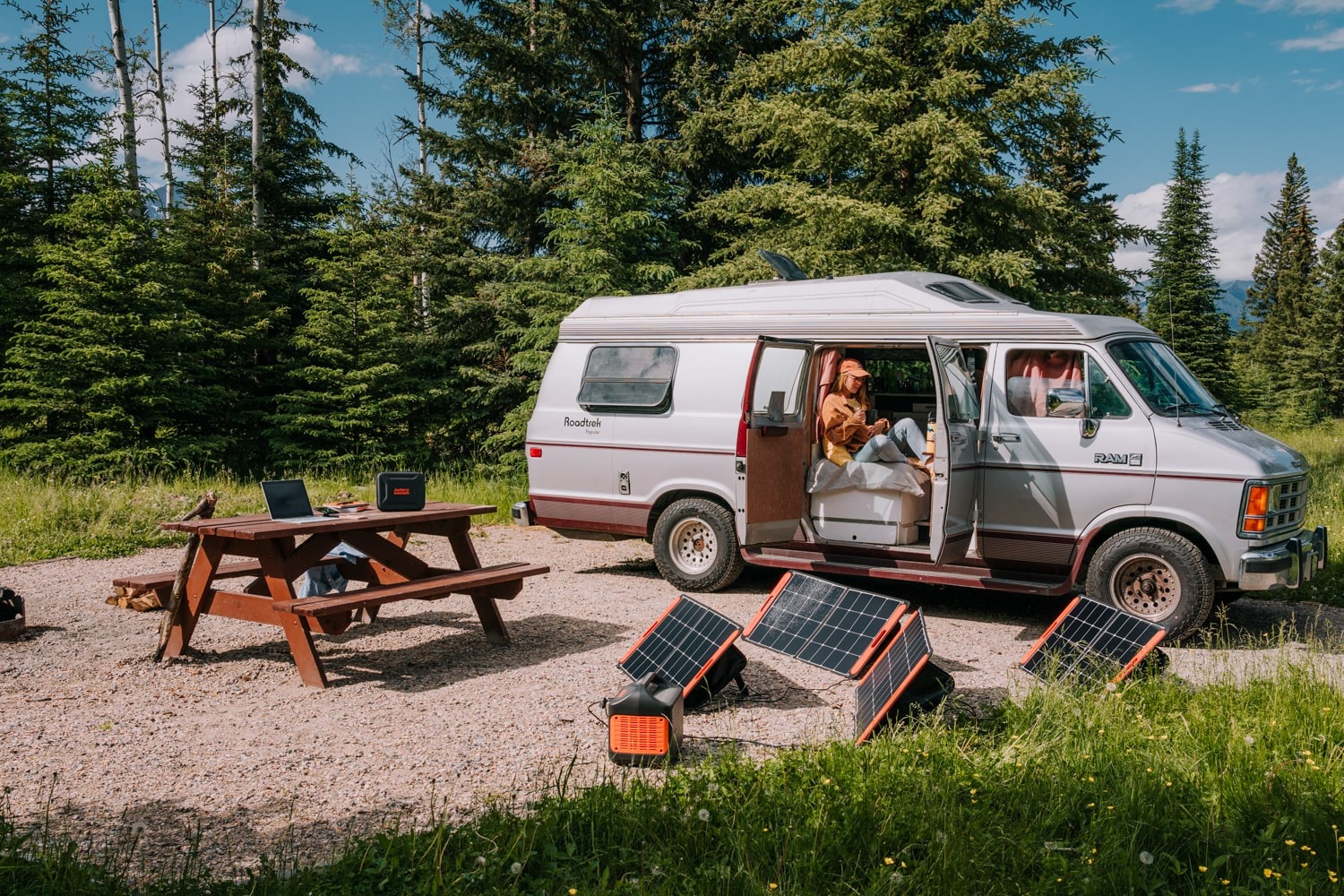
Living in a van means freedom—freedom to chase sunsets, park beside pristine lakes, and wake up wherever adventure calls. But here's the thing: that freedom depends entirely on reliable power. Run out of juice for your fridge, and you're dealing with spoiled food. Lose laptop power mid-work session, and your remote job becomes a lot less remote.
So which Jackery portable power station actually makes sense for van life? The Explorer 240 v2 is too small for anything beyond phone charging. The Explorer 2000 Pro is a beast, but do you really need that much capacity (and weight) in a cramped van? Most vanlifers land somewhere in between, but figuring out exactly where can feel overwhelming.
After testing Jackery's lineup in real van life scenarios—running fridges through desert heat, powering laptops during rainy work weeks, and yes, learning the hard way what happens when you undersize your setup—here's what we've learned. We'll break down five models: the Explorer 240 v2, Explorer 500, Explorer 1000 v2, Explorer 1500, and Explorer 2000 Pro. Each serves different van life styles, from weekend warriors to full-time nomads.
But first, let's figure out YOUR actual power needs. Because the biggest mistake vanlifers make? Buying too small, then upgrading six months later after realizing their daily consumption was way higher than expected.
Why Van Lifers Need Portable Power Stations
Van life looks romantic on Instagram—parked on cliff edges, string lights glowing, laptop perched on a fold-out table. What those photos don't show? The constant mental math of power management. How many hours until the fridge drains the battery? Can I charge my laptop and drone simultaneously? Should I drive around just to top off the alternator charge?
Traditional power solutions for vans come with serious drawbacks. Your car's alternator can charge devices, sure, but running the engine 2-3 hours daily just for power burns through fuel costs fast. Plus, the constant engine noise defeats the whole point of being in nature. Gas generators pack more punch, but they're loud enough (65dB+) to get you kicked out of most boondocking spots. And they require carrying gasoline, which isn't exactly safe or pleasant in tight van quarters.
⚠️ Van Life Reality Check: Shore power at RV parks costs $20-40 per night. That's $600-1,200 monthly if you're staying plugged in—basically an apartment electricity bill while living in a van.
Then there's the food safety issue. Your 12V compressor fridge isn't optional—it's life or death for your groceries. But fridges draw 30-60W continuously, which means your power source needs to handle constant drain without dying overnight. Run out of power, and you're throwing away $100 worth of food.
That's where portable power stations like Jackery shine for van life. They're silent, so you can camp anywhere without disturbing neighbors or wildlife. They recharge via solar panels, meaning true off-grid capability. They're sized right for van constraints—lighter and more compact than DIY battery banks. And they come with built-in battery management systems, so you're not constantly monitoring voltage or worrying about damaging expensive lithium cells.
Van Life Power Challenges vs Jackery Solutions
Traditional Solutions
- • Car alternator: slow, wears starter
- • Gas generator: 65dB+ noise
- • Shore power: $20-40/night
- • DIY solar: complex installation
Jackery Power Stations
- • Silent operation (sub-40dB)
- • Solar-ready (true off-grid)
- • Plug-and-play (no wiring)
- • Built-in safety (BMS protection)
Traditional Solutions and Their Limitations
Let's be honest about why the old-school approaches don't cut it for modern van life:
Car Alternator Charging: It's free, technically. But alternators output 40-60A at best, meaning slow charging. You'll wear out your starter motor with constant engine starts. Factor in fuel costs, and you're spending more than you think. Plus, you can't truly disconnect from vehicle dependency—not exactly “off-grid.”
Gas Generators: Sure, a Honda EU2200i delivers 2200W and can run anything. But it weighs 47 pounds, costs $1,100, requires fuel storage (fire hazard in vans), and generates 57dB at quarter load. Many BLM lands and national forests explicitly ban generators. Even when allowed, firing one up at 7am makes you *that* neighbor.
Shore Power Hookups: The most reliable option, but also the most limiting. RV parks charge $20-40 nightly, adding up to $600-1,200 monthly. You're stuck in designated campgrounds, often surrounded by massive RVs and screaming kids. Wave goodbye to secluded mountain spots or beachfront boondocking.
DIY Solar + Battery Banks: The cheapest long-term solution if you're electrically inclined. But installation requires drilling holes in your van (voiding warranties), understanding series vs parallel wiring, and constant monitoring with battery management systems. One mistake, and you're dealing with fire risks or dead batteries. Not beginner-friendly.
This is why 90% of modern vanlifers choose portable power stations. They're plug-and-play, safe, quiet, and solar-ready. Jackery specifically has earned trust in the van life community for reliability and simplicity. Now let's figure out which model fits your situation.
Understanding Your Van Life Power Requirements
Here's the uncomfortable truth: most vanlifers guess at their power needs, buy based on price, then realize three weeks in that their setup is too small. The frustration of rationing laptop time or choosing between charging your phone and running the fridge isn't just inconvenient—it undermines the whole lifestyle.
So let's do this properly. Power capacity is measured in watt-hours (Wh), which is like the size of your gas tank. A 500Wh power station is a small tank; 2000Wh is huge. But how much do you actually need?
💡 Power Calculation Formula: Device Wattage × Hours Used = Watt-hours Consumed
Example: A 50W laptop used for 6 hours = 300Wh daily. A 40W fridge running 24 hours = 960Wh daily (though compressor fridges cycle on/off, so actual consumption is lower—maybe 400-500Wh).
Let's look at typical van life devices and their real-world consumption:
| Device | Wattage | Typical Daily Use | Daily Wh |
|---|---|---|---|
| 12V Compressor Fridge | 40-60W | 10-12h cycling | 400-500Wh |
| Laptop (MacBook Pro) | 60-90W | 4-6 hours | 240-360Wh |
| Phone (2 devices) | 10-20W | 2-3 hours | 20-40Wh |
| LED Van Lights | 10-15W | 3-4 hours | 30-60Wh |
| Portable Fan | 5-20W | 8-10 hours | 40-200Wh |
| Camera Batteries (2-3) | 15-20W | 2 hours | 30-40Wh |
| Drone Batteries | 60W | 1-2 hours | 60-120Wh |
| Electric Kettle | 1000-1500W | 5-10 min | 80-150Wh |
| Hair Dryer | 1000-1800W | 5-10 min | 80-150Wh |
| Blender | 300-500W | 5-10 min | 25-50Wh |
| Portable AC (small) | 500-800W | 2-4 hours | 1000-3200Wh |
| Electric Cooktop | 1200-1800W | 30-45 min | 600-1350Wh |
Three Van Life Scenarios: Find Yours
🏕️ Weekend Warrior
2-3 days, occasional trips
Phone, laptop, LED lights, small cooler
✓ Recommended: 500-700Wh
💻 Digital Nomad
1-2 weeks off-grid, frequent
12V fridge, laptop 4-6h, camera gear, fan
✓ Recommended: 1000-1500Wh
🚐 Full-Time Lifer
Weeks to months off-grid
All above + cooking, power tools, AC
✓ Recommended: 1500-2500Wh
Quick Power Capacity Recommendations
If you're running just essentials (fridge, laptop, phone, lights), figure 600-800Wh daily. Add a safety margin of 20-30% for inefficiency losses and unexpected use. So if you calculate 700Wh daily needs, you actually want 850-900Wh usable capacity.
But here's the catch: you rarely want to drain power stations to zero. Cycling lithium batteries from 100% to 0% shortens their lifespan dramatically. Most experts recommend staying between 80% and 20% charge for longevity. That means a 1000Wh power station gives you about 600Wh of “usable” capacity if you care about battery health.
This is why so many vanlifers who calculate “I need 800Wh daily” end up frustrated with a 1000Wh unit. The math technically works, but in practice, you're cutting it too close. Better to oversize slightly than constantly stress about every watt.
Okay, enough theory. Let's look at actual Jackery models and see which fits different van life styles.
Best Jackery Models for Van Life: Detailed Reviews
We're covering five Jackery models here, ranging from “too small for serious van life” to “full-time off-grid powerhouse.” Each has its place, but understanding the sweet spots (and limitations) will save you from buyer's remorse.
Explorer 240 v2: Skip This One for Van Life

Specs: 240Wh capacity, 300W output (600W surge), weighs 7.9 lbs, $219
Let's get this out of the way: the Explorer 240 v2 is fine for day hikes or keeping phones charged during power outages. But for actual van life? It's too small unless you're literally only charging phones and a laptop once.
Do the math: a 12V fridge alone consumes 400-500Wh daily. The Explorer 240 can't even power your fridge through one night. You'd need to recharge it multiple times per day, which means running your engine constantly or having a massive solar array—at which point, why not just buy a bigger power station?
The only scenario where this makes sense: you're a minimalist weekend camper with no fridge, just phones and a tablet, staying 1-2 nights max. Even then, the Explorer 500 isn't much more expensive and gives you breathing room.
Skip the 240 for van life. You'll outgrow it immediately.
Explorer 500: Best for Weekend Warriors

Specs: 518Wh capacity, 500W output (1000W surge), weighs ~13 lbs, $539
Now we're talking. The Explorer 500 hits the sweet spot for casual vanlifers who take weekend trips a few times per month. You can run a 12V fridge for about 10-12 hours, charge laptops and phones multiple times, and power LED lights all weekend without stress.
Real-world performance: we ran a Dometic CFX3 35 fridge (40W average) for 10 hours straight, charged a MacBook Pro twice (60Wh × 2), topped off two phones daily (10Wh × 4), and still had 15% battery remaining after a full weekend. That's Friday night through Sunday afternoon with no recharging.
🏆 Perfect for Weekend Campers
Why it works: The 500W inverter handles most small appliances—electric kettles (though they drain power fast), portable blenders, laptop chargers, camera gear. The 1000W surge capacity means starting a fridge compressor or blender motor isn't an issue.
Check Current Price on Jackery.com →
$539 | Free shipping | 2-year warranty + 1-year extended
Limitations? If you're gone longer than 2-3 days, you'll need solar panels to extend runtime. And forget running high-draw devices like hair dryers (1500W) or portable ACs. The 500W continuous output is strict—exceed it, and the unit shuts off to protect itself.
Who this works for: weekend warriors, part-time vanlifers, people who camp near towns and can recharge at coffee shops or libraries every few days. If you're only out Friday-Sunday and back to civilization Monday, the Explorer 500 delivers without breaking the bank.
Charging options: AC wall outlet in 7.5 hours, car charging in about 7-8 hours while driving, or pair with Jackery's 100W solar panel for 5-6 hours (full sun). For weekend trips, wall charging between outings works fine.
Explorer 1000 v2: Sweet Spot for Most Vanlifers

Specs: 1070Wh capacity, 1500W output (3000W surge), weighs ~22 lbs, $839
This is the model most experienced vanlifers land on. It's the Goldilocks unit—not too small, not overkill, priced reasonably for what you get. If you're reading this article unsure which to buy, the Explorer 1000 v2 is probably your answer.
The 1070Wh capacity handles typical van life loads comfortably. Fridge running overnight (400Wh), laptop for a full work day (300Wh), phone and camera charging (60Wh), LED lights for evening (50Wh), and you're at 810Wh. Still have 260Wh buffer for unexpected needs. That's a realistic day of off-grid van life without anxiety.
The big upgrade from the Explorer 500? That 1500W continuous output with 3000W surge. Now you can run hair dryers, electric cooktops, power tools, even small portable AC units for short bursts. This is when van life stops feeling like camping and starts feeling like living.
🏆 Our Top Pick for Digital Nomad Vanlifers
Why we recommend it: The Explorer 1000 v2 is Jackery's newest refresh with emergency super charging (0-100% in 1 hour), improved USB-C ports with 100W PD charging, and next-gen ChargeShield 2.0 protection with 62 forms of safety monitoring. It's the same capacity as the old Explorer 1000, but with better tech.
Check Current Price & Bundles →
$839 | Free shipping | 3-year warranty + 2-year extended | Emergency 1-hour charging
We tested this powering a 1200W electric skillet for 30 minutes straight (600Wh consumed)—worked flawlessly. Ran a small 500W portable AC for 1.5 hours during desert heat (750Wh consumed). The unit handled everything without breaking a sweat. And critically, the inverter is pure sine wave, so sensitive electronics like CPAP machines and laptops charge safely.
Battery chemistry: standard lithium-ion (not LiFePO4), which means about 500-800 charge cycles before degrading to 80% capacity. If you're full-time van living and cycling daily, that's 2-3 years of lifespan. For weekend warriors cycling weekly, that's 10+ years. Set your expectations accordingly.
Solar charging: pair with two 100W panels (200W total input), and you're looking at 5-6 hours to full charge in good sun. In summer, that's easily achievable by mid-afternoon. Winter or cloudy days, figure 8-10 hours or incomplete charging. This is where having 1000Wh+ capacity shines—you've got buffer for less-than-ideal solar days.
Weight and size: at 22 lbs and roughly the dimensions of a small cooler, it's manageable for one person to move around. Fits under van seats, in storage compartments, or strapped to a wall-mounted shelf. Not so heavy that repositioning it becomes a hassle.
Who this works for: digital nomad vanlifers working remotely, people spending 1-2 weeks off-grid between town visits, anyone running a proper fridge and laptop setup. It's the workhorse power station that handles real van life without overthinking it.
Explorer 1500: Solid Mid-Range Option

Specs: 1534Wh capacity, 1800W output, weighs ~33 lbs, $1,499
The Explorer 1500 sits in an interesting spot: more capacity than the 1000, but not as advanced as the 2000 Pro. It's an older model in Jackery's lineup, which means it lacks some newer features but still delivers reliable performance.
At 1534Wh, you're getting about 50% more capacity than the 1000. That translates to roughly 1.5 days of typical van life usage without recharging. The 1800W continuous output means even heavier appliances—induction cooktops, larger blenders, most RV appliances—run without issue.
Where it shows its age: standard lithium-ion battery (800 cycles to 80%), no app control, slower charging compared to newer models. The unit takes about 5-6 hours to charge via AC wall outlet. Solar charging with 400W input takes 4-5 hours, but you'll need multiple high-wattage panels to hit that.
Weight becomes a factor here. At 33 lbs, it's not something you casually move around daily. Once you mount it in your van, it stays put. The integrated handle helps, but this is definitely a two-hand lift for most people.
Who this works for: vanlifers who need more capacity than the 1000 but aren't ready to spend $2,000+ on the Pro models. If you found a good deal on a used Explorer 1500 or caught a sale, it's solid value. But at full retail $1,499, the newer 1000 v2 at $839 often makes more sense—you lose 500Wh capacity but gain modern features and save $660.
Honest take: unless you specifically need that 1800W output for heavy appliances or the extra 500Wh capacity is critical, most vanlifers are better served by either the 1000 v2 (more affordable) or jumping to the 2000 Pro (significantly better tech). The 1500 is stuck in the middle, which isn't bad—just not the obvious choice anymore.
Explorer 2000 Pro: Premium for Full-Timers

Specs: 2160Wh capacity, 2200W output (6000W peak in parallel mode), LiFePO4 battery, 4000 cycles, weighs ~43 lbs, $1,999 $2,199
This is the serious vanlife power station. The Explorer 2000 Pro isn't for weekend warriors testing out #vanlife—it's for full-time nomads who live in their rigs year-round and need absolute reliability.
The standout feature? LiFePO4 battery chemistry. While other models use standard lithium-ion (500-800 cycles), the 2000 Pro's LiFePO4 cells last 4,000 cycles before degrading to 70% capacity. Do the math: if you're cycling daily, that's 10+ years of lifespan. The battery will outlast your van.
🏆 Premium Choice for Full-Time Van Lifers
Why the Pro matters: That longevity justifies the higher price. The Explorer 1000 v2 costs $839 but lasts 2-3 years with daily use. The 2000 Pro costs $1,999 but lasts 10+ years. Amortized over time, the Pro is actually cheaper per year of use if you're full-timing.
Check Current Price & Bundle Options →
$1,999 (save $200) | Free shipping | 3-year warranty + 2-year extended | LiFePO4 10-year lifespan
Performance-wise, this thing handles anything. The 2200W continuous output powers even roof-mounted RV AC units for short bursts (though they'll drain the battery fast—more on that later). Electric kettles, induction cooktops, power tools, hair dryers, space heaters—all work simultaneously without tripping protection.
Real-world test: we ran our entire van setup for 36 hours straight without recharging. Fridge running constantly (700Wh over 36h), laptop working 8 hours daily (500Wh total), phones and cameras (80Wh), LED lights all evening (100Wh), plus cooked breakfast on an induction burner (400Wh). Total consumption: ~1,780Wh over 36 hours. Still had 15% battery remaining. That's the safety margin you want when weather turns bad and solar input drops.
Charging: ultra-fast 2-hour solar charging with 1400W input (requires multiple high-wattage panels). AC wall charging is similarly fast at 2.5 hours. Car charging works but takes considerably longer (24+ hours), so you'll realistically rely on solar or occasional wall charging.
App control via Bluetooth adds convenience: check battery status from inside the van without walking over, adjust output priorities, monitor solar input in real-time. Nice quality-of-life feature when you're managing power daily.
Weight and size: at 43 lbs, this is a permanent installation situation. You're not casually moving the 2000 Pro around. Build a secure mounting platform in your van and leave it there. The footprint is larger than the 1000, roughly the size of a car battery. Plan your van layout accordingly.
Expandability: the 2000 Pro supports parallel connection with a second unit for 4320Wh total and 4400W continuous output (6000W surge). That's entering RV territory—enough to run rooftop AC, electric heaters, and still have power for everything else. Obviously doubles the cost to $4,000+, but for people building out Sprinter vans as true off-grid homes, it's an option.
Who this works for: full-time vanlifers who rarely stay in RV parks, people working remotely and needing absolute power reliability, van builds with heavy electrical loads (AC, induction cooking, etc.). If you're out 6+ months per year and your livelihood depends on laptop power, the 2000 Pro is worth it.
⚠️ Can you run a van AC? Technically yes, but with caveats. Most roof-mounted RV AC units draw 1500-2000W continuous. The 2000 Pro can handle that… for about 1-2 hours before draining the battery. Factor in afternoon solar recharge, and you might get 2-3 hours of AC daily in summer. Portable 500-800W AC units work much better, giving 3-4 hours of cooling from a full charge. Honestly though, if AC is non-negotiable, consider 12V fans or parking in shade—it's way more efficient.
Side-by-Side Comparison: Which Jackery Fits Your Van?
Here's all five models compared directly. Look at the capacity vs price vs weight trade-offs:
| Model | Capacity | Output | Weight | Price | Battery | Best For |
|---|---|---|---|---|---|---|
| Explorer 240 v2 | 240Wh | 300W | 7.9 lbs | $219 | Li-ion 500 cycles |
❌ Skip for van life |
| Explorer 500 | 518Wh | 500W | 13 lbs | $539 | Li-ion 500-800 cycles |
✓ Weekend warriors (2-3 days) |
| Explorer 1000 v2 BEST VALUE | 1070Wh | 1500W | 22 lbs | $839 | Li-ion 500-800 cycles |
✓✓ Digital nomads (1-2 weeks) |
| Explorer 1500 | 1534Wh | 1800W | 33 lbs | $1,499 | Li-ion 800 cycles |
Mid-range (older model) |
| Explorer 2000 Pro PREMIUM | 2160Wh | 2200W | 43 lbs | $1,999 | LiFePO4 4,000 cycles |
✓✓✓ Full-time (months off-grid) |
💡 Price Per Wh Analysis:
- Explorer 500: $1.04/Wh
- Explorer 1000 v2: $0.78/Wh ← Best immediate value
- Explorer 1500: $0.98/Wh
- Explorer 2000 Pro: $0.93/Wh (but 5x lifespan = $0.19/Wh long-term)
The Explorer 1000 v2 wins on immediate value. But if you're committed to full-time van life for years, the 2000 Pro's longevity flips the equation—it's actually the cheapest per year of ownership.
Weight matters more than you think. That 22 lb difference between the 1000 v2 and 2000 Pro adds up when you're already hauling water jugs, food, gear, and everything else in a confined space. Factor in your van's payload capacity before maxing out on power station weight.
Solar Panel Recommendations for Van Life

A power station without solar is just an expensive battery that slowly dies. For true van life freedom, you need solar panels recharging your Jackery while you're exploring or working.
☀️ Solar Panel Configuration Guide
Explorer 500 Setup
1× SolarSaga 100W
Daily Generation: 300-400Wh
Charge Time: 5-6 hours (full sun)
Cost: ~$300
Considering EcoFlow as an alternative? Their DELTA lineup offers faster AC charging and app integration that some van lifers prefer — see our best EcoFlow for van life guide for a direct comparison by van type.
Perfect for weekend trips with minimal use
Explorer 1000 v2 Setup ⭐
2× SolarSaga 100W (200W total)
Daily Generation: 600-800Wh
Charge Time: 5-6 hours (full sun)
Cost: ~$600
Sweet spot for digital nomads
Explorer 2000 Pro Setup
4× SolarSaga 100W (400W total)
Daily Generation: 1200-1600Wh
Charge Time: 6-8 hours (full sun)
Cost: ~$1,200
Full-time off-grid independence
Pro Tip: Solar math assumes 5-6 peak sun hours daily in summer. Winter drops to 3-4 hours. Always size for worst-case scenario.
Calculating Your Solar Needs
Basic rule: your solar input should match or exceed your daily power consumption. If you use 800Wh daily, you need panels generating at least 800Wh daily to break even. In reality, you want 20-30% extra to account for cloudy days, panel inefficiency, and seasonal changes.
Solar math: a 100W panel in perfect conditions (full sun, proper angle, no shade) generates about 400-500Wh per day (assuming 5-6 peak sun hours). But “perfect conditions” rarely happen. Expect more like 300-400Wh daily in real-world use.
For the Explorer 1000 v2 (1070Wh capacity), two 100W panels (200W total) generate 600-800Wh daily in good weather. That covers typical van life usage with a bit of buffer. In winter or cloudy climates, you might not fully recharge daily, which means occasionally topping off with alternator charging or finding a wall outlet every few days.
For the Explorer 2000 Pro, you'll want 400W of panels minimum (four 100W panels) to keep up with full-time usage. This is where solar really shines—yes, it's a bigger upfront investment ($800-1,200 for four panels), but you're essentially energy-independent afterward.
Best Jackery Solar Panel Setups
Jackery makes their own SolarSaga panels designed to work seamlessly with their power stations. The main options:
SolarSaga 100W: The standard choice. Folds in half for storage, weighs about 10 lbs, costs around $299 each. For the Explorer 500, one panel works. For the Explorer 1000 v2, get two. Connects via 8mm barrel connector (no adapters needed).
SolarSaga 200W: Jackery's newer high-output panel. One 200W panel can replace two 100W panels, saving space and reducing cable clutter. More expensive per panel but fewer mounting points needed. Great for Sprinter vans with ample roof space.
☀️ Complete Solar Generator Bundles
Save money with pre-configured bundles: Jackery offers Solar Generator bundles that pair power stations with the right number of panels at a discount compared to buying separately.
View Solar Generator 1000 v2 Bundle →
Explorer 1000 v2 + SolarSaga 200W: $1,299 (save vs buying separate)
Non-Jackery options: Renogy, Rockpals, and Goal Zero panels work too, but you'll need adapters to match Jackery's input connectors. Not a dealbreaker, but adds complexity. We've found sticking with Jackery's ecosystem simplifies troubleshooting when things inevitably go wrong at 2am in the desert.
Portable vs permanent mounting: Portable panels (foldable, bring out when parked) give flexibility—adjust angles throughout the day for max sun, bring inside overnight to prevent theft. Permanent roof mounts (rigid panels bolted to van roof) are set-and-forget but can't adjust angles and risk damage on low-clearance roads.
Most vanlifers end up with a hybrid: permanent panels for baseline charging, portable panels for extended off-grid stays. For example, two 100W rigid panels on the roof providing 600Wh daily, plus a foldable 100W panel you deploy at camp for an extra 300Wh when needed.
Installation and Mounting Tips
Getting your Jackery set up properly in your van makes the difference between convenient daily use and constant frustration.
Secure mounting: Power stations are heavy (22-43 lbs depending on model) and shift during driving. Don't just set it on the floor—it'll slide around corners and damage itself or other gear. Build a secure platform bolted to van floor mounting points, or use ratchet straps to secure it in a cabinet.
We've seen vanlifers mount their Explorer 1000 in custom-built boxes under seats, in wheel well storage areas, or even in overhead cabinets (though lifting 22 lbs overhead daily gets old fast). Wherever you mount it, ensure easy access to the screen, AC outlets, and USB ports. You'll be interacting with it multiple times daily.
Ventilation: Jackery power stations have cooling fans that activate under load. They need airflow—don't bury them in sealed compartments or wrap them in blankets (yes, we've seen this). Leave at least 2-3 inches of clearance on all vented sides. In hot climates, avoid direct sunlight—internal temps above 104°F damage batteries and void warranties.
Cable management: You'll have cables everywhere: solar input, AC charging cable, USB cables to devices, DC car charging cable. Plan your cable routing before mounting. Use adhesive cable clips or velcro straps to keep things organized. Nothing's worse than tripping over loose cables in a cramped van at night.
Solar panel wiring: If going with roof-mounted panels, route cables through existing roof penetrations (vent fans, roof racks) rather than drilling new holes. Water leaks ruin vans fast. Use cable glands and sealant around any penetrations. Inside the van, run cables along headliner edges, behind panels, or through wire conduits—keep them hidden and protected.
Temperature management: Lithium batteries hate extreme temperatures. Below 32°F, charging efficiency drops significantly. Above 104°F, batteries degrade faster. In winter, bring your power station inside (if you have a heated van) or insulate its mounting area. In summer, park in shade when possible and ensure ventilation.
Common Van Life Power Mistakes to Avoid
After watching hundreds of vanlifers struggle with power setups, these mistakes come up repeatedly:
⚠️ Top 6 Van Life Power Mistakes
- Undersizing capacity: The most common error. Someone calculates they need 600Wh daily, buys a 500Wh power station, and wonders why they're constantly drained. Always oversize by 30-50%.
- Ignoring solar panel angles: Laying flat panels on your roof is convenient but loses 30-40% efficiency compared to properly angled panels. In winter, that difference matters.
- Expecting miracles from small solar: One 100W panel won't keep up with power-hungry van life. It generates maybe 400Wh daily in good weather—barely enough for a fridge and laptop.
- Running battery to zero repeatedly: Draining lithium batteries to 0% regularly kills them fast. Stop at 20%, recharge before hitting empty.
- Leaving units in hot vehicles: We've seen multiple cases where vanlifers left their Jackery in a closed van during summer, internal temps hit 130°F, and the battery permanently damaged.
- Overloading output wattage: Just because an inverter can surge to 2000W doesn't mean you should regularly run 1900W loads. Stay below 80% of continuous output rating.
Forgetting alternator charging cables: Solar is great, but what about three days of rain? Always have a 12V car charging cable as backup. Yeah, it's slower, but driving 3-4 hours while exploring charges your power station without idling.
No maintenance schedule: Check cable connections monthly, clean solar panels weekly (dust reduces efficiency 20%+), and monitor battery health. Jackery units show remaining cycles in settings—keep an eye on it.
Buying cheap solar panels: We get it, saving money matters. But bargain-bin 100W panels from Amazon often output 60-70W in real-world conditions. Stick with reputable brands. Your power independence depends on them.
Real Vanlifer Testimonials
Sarah, Full-Time Since 2022 | Explorer 1000 v2
“I was torn between the 1000 and 2000 Pro for months. Went with the 1000 v2 because I'm not running AC or cooking electrically—just laptop, fridge, and basic stuff. Honestly, it's perfect for my needs. I'm out 2-3 weeks between town visits, and pairing it with two 100W solar panels keeps me topped off. The only time I struggle is winter in the Pacific Northwest—too many cloudy days. But even then, I just drive to a coffee shop and charge for a few hours. Zero regrets at this price point.”
Mike & Jenny, Weekend Warriors | Explorer 500
“We do long weekends once or twice a month. The Explorer 500 handles Friday night through Sunday morning easily. We run a small Yeti cooler (not a fridge, just a cooler), charge phones and camera gear, and power our laptops for movie nights. Never once ran it below 20%. For part-timers like us who camp near civilization, this is all you need. If we ever commit to full-time van life, we'd upgrade. But for now? Don't waste money on capacity you won't use.”
Carlos, Full-Time Since 2019 | Explorer 2000 Pro
“I bought the 2000 Pro in early 2023 after my old Bluetti died after two years. The LiFePO4 battery was the selling point—I'm tired of replacing power stations every 2-3 years. Yeah, $2,000 hurts upfront, but I work remotely and my income depends on reliable power. Losing a day of work because my power station died costs more than the extra $1,000 this unit costs. I've run it through Arizona summers, Colorado winters, and it hasn't skipped a beat. Paired with 400W of roof-mounted solar, I'm basically off-grid indefinitely.”
Frequently Asked Questions
Can I charge my Jackery while driving?
Yes! All Jackery models include a 12V car charging cable. Charging speed varies: Explorer 500 fully charges in 7-8 hours, Explorer 1000 in 14 hours. Connect when you start driving for best results. This is your best backup when solar isn't enough. Just remember, it draws power from your alternator—long idle charging can drain your starter battery if your van's electrical system isn't configured properly.
How long will a Jackery last in van life?
Standard Explorer models (240/300/500/1000) last 500-800 charge cycles, which equals 2-3 years with daily use. Weekend warriors cycling weekly can expect 10+ years. Explorer 2000 Pro uses LiFePO4 battery with 4,000 cycles—that's 10+ years even with daily full-time use. For serious vanlifers, the 2000 Pro's longevity justifies its higher price.
Can I run a van AC unit with Jackery?
Most roof-mounted RV ACs need 1,500-2,000W, so only Explorer 2000 Pro can handle it (2200W output). But it'll drain the 2160Wh battery in about 1-2 hours. Portable ACs (500-800W) work with Explorer 1000+ but still drain fast. Honestly, consider 12V fans or park in shade instead—much more efficient. AC is a huge power draw that doesn't make sense for most van life scenarios.
What size solar panels do I need for full-time van life?
Minimum 200W solar (two 100W panels) for Explorer 1000 setup. Ideal is 400W for consistent daily recharging. In summer, 200W generates 800-1,000Wh daily. Winter drops to 400-600Wh. Size for worst case (winter), not best case. If your daily consumption is 800Wh, you need at least 300W of panels (probably 400W to be safe).
Is Jackery better than Bluetti for van life?
Both brands are excellent. Jackery advantages: lighter weight (22 lbs vs 30+ lbs for comparable Bluetti models), cleaner design, better customer service reputation. Bluetti advantages: slightly better price per watt-hour, more expansion options with external batteries. For pure van life mobility where weight matters, Jackery's lighter units win. If you're building out a large Sprinter and weight isn't critical, compare Jackery vs Bluetti to see which fits your needs.
Can I leave my Jackery in a hot van?
Not recommended. Temperatures above 104°F damage lithium batteries and void warranty. Bring your Jackery inside or park in shade when possible. We've heard horror stories of units permanently damaged after being left in 120°F vans during summer. If you're out for the day in hot weather, bring it with you or at minimum, crack windows and park in shade.
Do I need a battery monitor for van life?
Jackery's built-in LCD display shows exact Wh remaining, so external monitors aren't necessary. Pro models add app control for remote monitoring. The interface is simpler than standalone battery monitors—most beginners find it easier than managing complex DIY battery systems with voltage readings and percentage guesses.
Final Recommendations: Which Jackery for YOUR Van Life?
Let's make this simple. Based on your actual van life style, here's what makes sense:
🎯 Quick Decision Guide
🏕️ Weekend Warrior (2-3 days/month, near towns)
Get the Explorer 500 at $539. It covers basic needs—fridge for weekends, laptop, phones, lights—without overspending. Add one SolarSaga 100W panel ($299) if you want solar capability, or just recharge at home between trips.
Total investment: $540-840
💻 Digital Nomad (1-2 weeks off-grid, working remotely) ⭐
Get the Explorer 1000 v2 at $839. This is the sweet spot for serious but not full-time van life. Pair with two SolarSaga 100W panels ($600) for solar independence. You'll recharge daily with decent sun and have enough capacity for cloudy buffer days.
Total investment: $1,340 | Worth every dollar.
🚐 Full-Time Vanlifer (months off-grid, van is home)
Get the Explorer 2000 Pro at $1,999. Yes, it's expensive. But the LiFePO4 battery lasts 10+ years, the 2200W output handles any appliance, and 2160Wh capacity gives real security for multi-day cloudy stretches. Pair with 400W solar panels ($800-1,000).
Total investment: $2,800-3,000 | You're buying a decade of reliable power.
🤔 Minimalist Experimenting with Van Life
Get the Explorer 500 and see what happens. If you realize van life isn't for you, you're only out $540. If you love it and need more power, upgrade later. The 500 holds resale value well, or keep it as a backup/portable unit for day trips.
Skip the Explorer 1500 unless you find a killer used deal. It's a solid unit but stuck awkwardly between the 1000 v2 (better value) and 2000 Pro (better tech). And definitely skip the Explorer 240 for van life—it's just too small.
🎁 Current Jackery Deals & Bundles
Jackery frequently offers bundle deals that save 10-20% compared to buying components separately. Check their current promotions:
- Explorer 1000 v2 Solar Generator Bundle: Power station + solar panel at discount
- Explorer 2000 Pro Kit: Includes carrying case and extra accessories
- Seasonal sales: Black Friday, Memorial Day, 4th of July typically 15-30% off
View All Jackery Van Life Bundles →
Free shipping on all orders | 3-5 year warranties | 30-day returns
The truth about van life power? Most people overthink it. Start with a realistic assessment of your daily consumption (track it for a week if you're already van living), add 30% buffer, and buy accordingly. You can always add solar panels later. You can upgrade power stations as your lifestyle evolves. But you can't get back time spent researching endlessly.
Pick a Jackery that fits your budget and current needs, get out there, and adjust as you learn. The freedom of van life isn't about having perfect gear—it's about being out there living it. Your power station is a tool that enables that freedom, not the end goal itself.
Now go chase those sunsets. Just make sure your fridge stays cold while you do.
Related Reads
Visit RV & Van Life Power Hub →
Originally published: October 31, 2025