
Correction, August 14, 2026. An earlier version of this review described the Elite 100 V2 as a 2-pound, pocketable, TSA-compliant power bank. That was wrong, and the specs appear to have been mixed with a much smaller product. A reader, Kai, flagged the weight, and checking the rest of the sheet against Bluetti turned up more.
What we corrected: weight is 25 lbs (11.5 kg), not 2 lbs. Dimensions are 12.6 x 8.5 x 9.8 in. Cycle life is 4,000+ cycles to 80%, not 3,500. There are two USB-C ports (140W and 100W), two USB-A at 15W, one 12V/10A car port and two DC5521 ports. Charging is 1,200W AC (45 minutes to 80%) and up to 1,000W solar, not 30-40W over USB-C. The unit has an LCD display and a WiFi and Bluetooth app, not simple LED indicators.
Most important: the earlier version called this power station TSA-compliant and suitable for air travel. It is not. Airlines limit lithium batteries to 100Wh in the cabin, or 160Wh with prior airline approval. At 1,024Wh, the Elite 100 V2 cannot be flown in carry-on or checked baggage. We are sorry for the error.
Update, September 30, 2026. After another reader comment, we also rewrote the sections that still described a much smaller battery (what it can power, runtime estimates, use cases, alternatives), plus the charging details and the list of what’s in the box.
What if a full kilowatt-hour of backup power still fit under one arm? The Bluetti Elite 100 V2 makes that question surprisingly practical. At $429, this compact power station is Bluetti’s answer to people who want a full 1,024Wh of backup capacity in a box they can still carry by hand.
The Elite 100 V2 belongs to Bluetti’s premium Elite series, packing 1,024Wh of LiFePO4 battery capacity into a 12.6 x 8.5 x 9.8 inch chassis. Unlike the larger AC-series units that dominate camping gear lists, this compact power station targets a different crowd: car campers, van dwellers, remote workers who need a laptop kept charged, and anyone who wants a full kilowatt-hour in a small footprint.
We compared the Bluetti Elite 100 V2’s published specs against three common uses: a weekend of car camping, a remote workday and an evening blackout at home. We estimated runtime for common devices from its capacity, compared its rated charging speeds, and weighed it against other 1kWh power stations. The estimates cover everything from smartphones and laptops to LED lights, a portable fridge and small kitchen appliances.

Here’s what stood out. This portable small power station delivers surprisingly practical performance for its size. At 25 pounds (11.5 kg) it is a two-hand carry, not a bag item, and at 1,024Wh it cannot be taken on a plane. The LiFePO4 battery chemistry promises 4,000+ cycles before degrading to 80% capacity, which translates to years of reliable service for most users. However, the 1,800W continuous output easily powers laptops and most common appliances.
The verdict? The Bluetti Elite 100 V2 excels as a compact 1kWh backup unit for specific use cases, but you need to understand its limitations before buying.
🏆 Best Compact 1kWh Power Station
Why we recommend it: 1,024Wh of LiFePO4 capacity, premium LiFePO4 battery with 4,000+ cycles, and the smallest chassis Bluetti offers at this capacity. Best for car camping, RV use and home backup rather than travel.
Check Current Price on Bluetti →
$429.00 $799.00 | 46% OFF | Free shipping | In Stock
Get our Black Friday alerts for BLUETTI
We track live prices on 40+ models from Jackery, EcoFlow, BLUETTI and Anker SOLIX. When a deal beats the lowest price we've recorded, you'll hear from us. During Black Friday week, one short recap a day at most.
Unsubscribe in one click. We may earn a commission when you buy through our links, at no extra cost to you. Privacy Policy
Quick Specs & What’s in the Box
Real-World Look: The Bluetti Elite 100 V2 in Use
Studio renders only tell part of the story. Here is the Bluetti Elite 100 V2 as it actually looks in a real owner’s hands, away from the polished marketing shots.
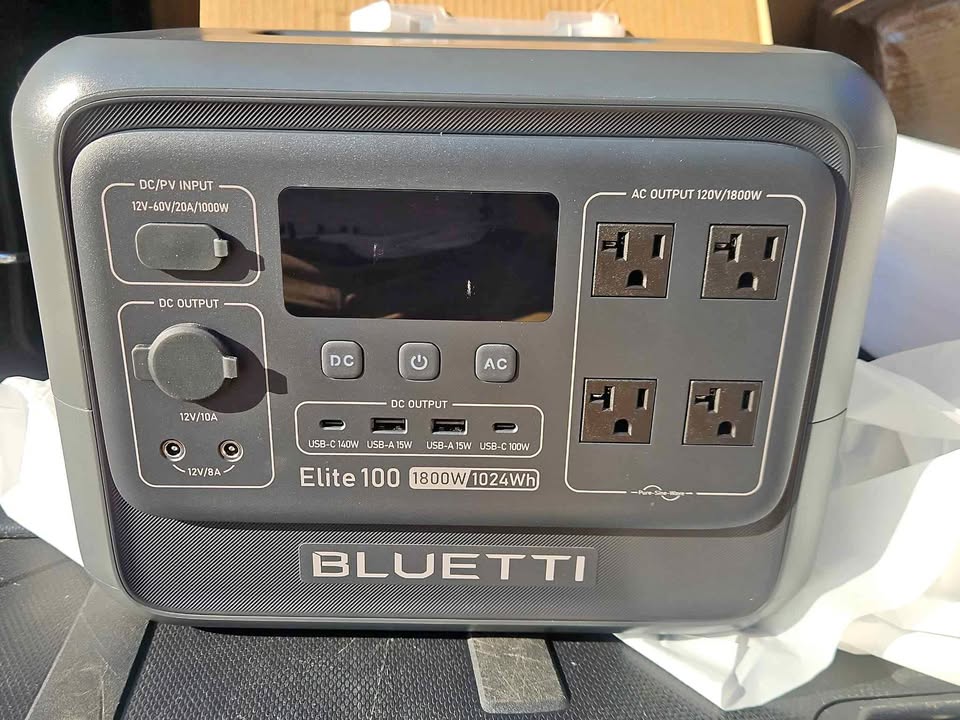
Real-world photos of the Bluetti Elite 100 V2.
Technical Specifications
The Bluetti Elite 100 V2 delivers 1,024Wh of capacity from a LiFePO4 battery, which differs from the lithium-ion chemistry found in older portable power stations. That matters because LiFePO4 lasts significantly longer—about 4,000+ cycles compared to 500-800 for standard lithium-ion. In practical terms, if you charge this daily, it should maintain 80% capacity for nearly a decade.
| Specification | Details |
|---|---|
| Battery Capacity | 1,024Wh (20Ah) |
| Battery Type | LiFePO4 (Lithium Iron Phosphate) |
| Cycle Life | 4,000+ cycles to 80% capacity |
| Power Output | 1,800W continuous, 3,600W surge |
| Weight | 25 lbs / 11.5 kg |
| USB-C Port | 2 ports: 1 × 140W, 1 × 100W (PD) |
| USB-A Ports | 2 × 15W |
| DC Output | 1 × 12V/10A car port, 2 × DC5521 12V/5A |
| Charging Input | AC: 1,200W max (45 min to 80%) Solar: 1,000W max, 12-60V |
| Display | LCD display, plus WiFi and Bluetooth app |
| Operating Temp | Discharge -4°F to 104°F, charge 32°F to 104°F |
| Airline legal | No (1,024Wh is 10x the 100Wh carry-on limit) |
| Warranty | 5-year Bluetti standard warranty |
| Current Price | $429.00 $799.00 |
Bluetti rates the AC output at 1,800W continuous, with 2,700W of Lifting Power and a 3,600W surge, fed by a 1,024Wh LiFePO4 battery. According to Bluetti, that’s enough for high-powered appliances like induction cooktops, kettles and power tools. The compact form factor measures 12.6 x 8.5 x 9.8 inches, and at 25 pounds (11.5 kg), it’s genuinely portable in a way larger portable power stations simply aren’t.
The port configuration includes two USB-C outputs rated at 140W and 100W, enough for most USB-C laptops. You also get two 15W USB-A ports for legacy devices, a 12V/10A car outlet and two DC5521 ports alongside the AC outlets, for 11 ports in total according to Bluetti. Instead of simple LED indicators, the unit has a built-in display, and the BLUETTI app adds WiFi and Bluetooth monitoring and control.

Charging happens through the AC input at up to 1,200W: Bluetti rates it at 45 minutes to 80% and 70 minutes to 100% from a wall outlet. The Elite 100 V2 also accepts up to 1,000W of solar input (12-60V), so Bluetti’s SP100L foldable panel is compatible but uses only a tenth of that input. You can charge while simultaneously powering devices, a feature called pass-through charging.
What’s in the Box
Bluetti lists five items in the box: the Elite 100 V2 itself, an AC charging cable, a solar charging cable, a grounding screw and the user manual.
There’s no separate power brick in that list: wall charging only needs the AC charging cable.
The Bluetti Elite 100 V2 packs its 1,024Wh into about 17 liters of volume, by Bluetti’s count, which is genuinely impressive for the capacity.
Get our Black Friday alerts for BLUETTI
We track live prices on 40+ models from Jackery, EcoFlow, BLUETTI and Anker SOLIX. When a deal beats the lowest price we've recorded, you'll hear from us. During Black Friday week, one short recap a day at most.
Unsubscribe in one click. We may earn a commission when you buy through our links, at no extra cost to you. Privacy Policy
Design & Build Quality
Design Overview
The Elite 100 V2 commits fully to its minimalist design philosophy. The matte gray finish differentiates it from Bluetti’s signature blue AC series, signaling this belongs to a different product tier.


You carry it by a single handle, which Bluetti describes as hidden. At 25 pounds, it’s heavier than small units like the power stations like the EB3A, which is the trade you make for almost four times their capacity.
The density is the core appeal here. Getting 1,024Wh into a box this size is tight packaging, but what it is not is an emergency power bank you carry on your person. At 25 pounds it is a two-hand lift into the back of a car. For travelers dealing with airline carry-on restrictions, the 1,024Wh capacity is more than ten times the TSA’s 100Wh carry-on limit for lithium batteries.
📊 Elite 100 V2 Capacity Breakdown: What 1,024Wh Powers
⚠️ Note: All six figures are Bluetti’s own estimates for the Elite 100 V2. Actual results vary with device battery condition, ambient temperature and conversion losses. For other devices, our formula is 1,024Wh × 0.85 ÷ watts = hours of runtime.
Durability Assessment
This isn’t marketed as a ruggedized outdoor unit like some competitors, so expectations should adjust accordingly.
Bluetti lists no IP rating, and its FAQ states plainly that the Elite 100 V2 is not waterproof and should be kept in a dry, well-ventilated area. You wouldn’t want to use this in heavy rain or dusty environments without protection.
Bluetti also asks owners to keep the unit upright, in storage and while moving it, because laying it on its side may damage the internal structure. In a car or an RV, strap it in upright so it can’t slide or tip over.
Bluetti rates it for charging between 32°F and 104°F (0°C to 40°C) and for discharging between -4°F and 104°F (-20°C to 40°C). LiFePO4 chemistry generally handles temperature extremes better than lithium-ion, though very cold conditions will still reduce capacity temporarily.
Performance & Runtime Estimates
Power Output Reality Check
Understanding what the Bluetti Elite 100 V2 can and cannot power determines whether this camping portable power station fits your needs. The 1,024Wh capacity and 1,800W output create specific limitations you need to grasp before purchasing.
What It CAN Power:
- ✅ Smartphones: 52 full charges of a 15Wh phone (Bluetti estimate)
- ✅ Laptops: 12.6 charges of a 60Wh laptop (Bluetti estimate), and the 140W and 100W USB-C ports can charge most USB-C laptops directly
- ✅ Tablets and Cameras: About 31 charges of a 28Wh tablet, or about 79 of an 11Wh camera battery
- ✅ Lights: 51.8 hours for a 10W camping light (Bluetti estimate)
- ✅ Fans: 18 hours for a 40W fan (Bluetti estimate)
- ✅ Portable Fridges: 14.3 hours for a 50W fridge running nonstop (Bluetti estimate), and longer when the compressor cycles off
- ✅ TVs: 8.9 hours for an 85W TV (Bluetti estimate)
- ✅ Kitchen Appliances: A 1,000W coffee maker, kettle or microwave, for about 52 minutes of total run time (1,024Wh × 0.85 ÷ 1,000W)
What It CANNOT Do:
- ❌ Several Big Loads at Once: 1,800W is the continuous total for all outlets, so two or three high-wattage appliances running together can exceed it
- ❌ Hours of Heating: A 1,500W space heater would drain the battery in about 34 minutes (1,024Wh × 0.85 ÷ 1,500W)
- ❌ A Full Day of Fridge Backup: A full-size refrigerator averaging 150W runs for about 5.8 hours (1,024Wh × 0.85 ÷ 150W), so longer outages need solar or more battery
- ❌ 240V Appliances: The AC outlets are 120V, so a dryer, a range or a 240V well pump is out
- ❌ Air Travel: At 1,024Wh, it’s more than ten times the 100Wh carry-on limit for lithium batteries
| Device | Power Draw | Estimated Runtime | Full Charges |
|---|---|---|---|
| Smartphone | 15Wh | N/A | 52× |
| iPad Pro 11″ | 28Wh | N/A | 31× |
| GoPro Hero 12 | 5Wh | N/A | 174× |
| Sony A7 Battery | 11Wh | N/A | 79× |
| Camping Light (10W) | 10W | 51.8 hours | N/A |
| Bluetooth Speaker | 10Wh | N/A | 87× |
The key insight? The Elite 100 V2 goes well beyond keeping phones charged: it can run laptops, a portable fridge, a TV or a kitchen appliance for a short time. In the table, the smartphone and camping light figures are Bluetti’s estimates, and the other rows use our formula (1,024Wh × 0.85 ÷ battery size), rounded down. It doesn’t replace larger power stations for running several household appliances for hours, or anything that needs 240V.

Use Cases and Runtime Estimates
Great pick for Bluetti van life and CPAP users.
Scenario #1: Weekend Camping Trip
Picture a two-night car camping trip with minimal gear. The goal is keeping a phone, a camera and some lighting powered without running the car.
Over two days, three smartphone charges (15Wh each), two camera battery charges (11Wh each) and 8 hours of a 5W LED lantern add up to about 107Wh, or about 126Wh drawn from the battery once conversion losses are counted (107Wh ÷ 0.85). That’s about 12% of the 1,024Wh available.
The verdict? Good for weekend camping when you drive to the site. At 25 pounds it rides in the car rather than in a backpack, and a load this light barely dents the battery. The spare capacity leaves room for a 50W portable fridge, which Bluetti estimates the Elite 100 V2 can run for 14.3 hours nonstop (longer when the compressor cycles off). For longer trips with a fridge, add solar charging.
Scenario #2: Remote Work Backup
Working remotely from a van, a cabin or a home office with a shaky grid means you can’t always count on an outlet. Here the Elite 100 V2 is the daily power source for a laptop and a phone.
A typical day might include 2-3 phone top-ups from 20% to 100% (about 12Wh each on a 15Wh battery) plus two full charges of a 60Wh laptop. That’s roughly 144-156Wh a day, so the Elite 100 V2 covers about 5 to 6 days of this routine between recharges (1,024Wh × 0.85 ÷ daily use).
The compact footprint lets it tuck under a desk without taking over the room. The verdict here? Excellent as “just in case” power insurance for laptop-first workers, since the 140W and 100W USB-C ports can charge most USB-C laptops directly.
Scenario #3: Evening Blackout at Home
Now picture an evening blackout, with the Elite 100 V2 covering essential communications and lighting: a 5W LED light for 4 hours, two phone charges (15Wh each) and a 5W portable radio for 3 hours.
That adds up to about 65Wh, or about 76Wh drawn from the battery at 85% efficiency, under 8% of the 1,024Wh. For a typical emergency lasting 6-12 hours, that leaves most of the battery for bigger essentials, like a CPAP machine or a refrigerator. However, multi-day outages would require solar charging or larger capacity units.
The takeaway? The Elite 100 V2 works as part of a compact emergency kit, especially for urban dwellers in apartments where larger power stations feel impractical. It can also run a full-size refrigerator for several hours (about 5.8 hours at a 150W average, longer when the compressor cycles off) or a microwave for short reheats, while keeping you connected and providing lighting.
📏 Energy Density Comparison: Elite 100 V2 vs Competitors
💡 Pro Tip: The Elite 100 V2’s 25-pound weight makes it one of the densest ways to buy a full kilowatt-hour, but no 1,024Wh battery is allowed on a plane in any form. Airlines cap lithium batteries at 100Wh in the cabin, or 160Wh with prior approval.
Charging Speed & Solar Performance
The Elite 100 V2 charges from a wall outlet through its AC input at up to 1,200W. Bluetti rates it at 45 minutes to 80% and 70 minutes to 100% with its TurboBoost fast charging, and the BLUETTI app also offers Standard and Silent charging modes.
That’s fast for a 1,024Wh power station, and it comes from the high 1,200W input rather than from a small battery. Compared to larger units that take 7-8 hours to fully charge, this quick turnaround time matters for users who need to top up between uses.
Solar input goes up to 1,000W (12-60V), and Bluetti lists a full solar charge in 70 minutes, which requires panels delivering close to that full 1,000W. Bluetti’s SP100L panel provides 100W maximum output, so on its own it would need more than 10 hours at its full rating to fill the battery (1,024Wh ÷ 100W). Panels rarely deliver their full rating for long, so with a single 100W panel, plan on more than one sunny day for a full charge.
The Elite 100 V2 includes MPPT (Maximum Power Point Tracking) technology, which optimizes power harvest from the panel. This matters because it extracts the maximum available power across varying sunlight conditions, improving efficiency by 20-30% compared to simpler PWM controllers.
Pass-through charging is supported: Bluetti confirms the Elite 100 V2 can charge and discharge at the same time, with up to 1,800W of combined charging and bypass input from the wall. It can also act as a UPS, switching to battery power in 10 ms or less when the grid drops.
☀️ Solar Bundle: Elite 100 V2 + 100W Panel

Get unlimited off-grid power: The SP100L 100W foldable solar panel pairs perfectly with the Elite 100 V2 for extended camping trips. On its own, one 100W panel needs more than 10 hours of full-rated sun to fill the 1,024Wh battery, so it works best for topping up during the day.
- 100W maximum panel output (the Elite 100 V2 accepts up to 1,000W)
- Built-in MPPT charge controller
- Foldable portable design
- Integrated kickstands
$599.00 $1,028.00 | Save $429 (42% OFF) | Free shipping
User Experience & Daily Living
Day to day, the Bluetti Elite 100 V2 has clear strengths and limitations. The compact size means it lives under a desk or in a closet rather than needing dedicated storage space. You grab it like you’d grab a full toolbox—it’s genuinely that portable.
Charging devices is simple: plug a USB-C or USB-A cable into the matching port. For more control, the BLUETTI app lets you monitor real-time usage, switch outputs on and off and adjust settings from your phone over WiFi or Bluetooth.
The built-in display shows how much charge remains at a glance, and the app adds low-battery and full-charge alerts. For users who just want their devices charged without diving into power management details, the display alone is enough.
Weight distribution matters when you’re carrying this daily. At 25 pounds, it’s noticeable but not burdensome. Compare this to the EB3A at 10 pounds or the AC70 at 23 pounds and it is the heaviest of the three, though it also carries the most energy for its size. Plan on short carries by the handle, and a cart or a second pair of hands for anything longer.
Noise? Low. Bluetti rates it at 30dB under loads up to 600W, which suits quiet spaces like a bedroom, an RV or a tent at night.

The main user experience limitation comes from capacity management. With only 1,024Wh available, you need to think about power consumption more carefully than with larger units. You can’t just plug in multiple devices and forget about it—you’re managing a limited resource that depletes faster than you might expect.
Price & Value Analysis
At $429, the Bluetti Elite 100 V2 sits in an interesting price position. The original $799 MSRP seems inflated for marketing purposes—no 1,024Wh power station justifies $800. However, the discounted $429 price competes reasonably within the portable power market.
Compare this to other 1kWh power stations. The closest match is the Jackery Explorer 1000 v2: a 1,070Wh LiFePO4 battery, around 23.8 pounds, and 1,500W of AC output (3,000W surge). The Elite 100 V2 weighs a little more but adds 300W of continuous output, accepts up to 1,000W of solar input against 400W for the Jackery, and is rated for 4,000+ cycles to 80% capacity where Jackery quotes 4,000 cycles to 70%.
Small power stations like the Jackery Explorer 240 at $219 offer 240Wh capacity, about a quarter of the Elite 100 V2’s, at 6.6 pounds and without the premium LiFePO4 chemistry. The Bluetti EB3A at $299 provides 268Wh with an AC outlet at 10 pounds. Both are lighter, but you’d need about four of either to match the Elite 100 V2’s capacity.
So what are you paying for with the Elite 100 V2 price? Primarily three things: a full kilowatt-hour in a compact 25-pound package, LiFePO4 longevity, and fast 1,200W wall charging. If these factors matter significantly to your use case, the price makes sense. If you need more than a kilowatt-hour, a larger unit is the better fit.
💰 Long-Term Value: The LiFePO4 battery with 4,000+ cycles means this unit should outlast 4-5 generations of lithium-ion competitors. Even with daily charging, you’re looking at 10+ years before capacity drops to 80%. That longevity justifies the premium pricing for frequent users.
Competitors & Alternatives
Step up to the Bluetti AC180 or Elite 200 V2. Browse the complete best Bluetti power stations 2026 guide. For a premium option, step up to the AC180P Premium with enhanced features. For the complete picture, see all new Bluetti models for 2026.
Related Reads
Originally published: December 5, 2025
Why are you saying the Elite 100 V2 only has 150w continuous output and 100Wh total battery capacity? It’s easily verifiable that this unit outputs 1800w continuous and is a 1024Wh battery. Makes it difficult to take any reviews here seriously.
You’re absolutely right, and we appreciate you catching that. The specs listed were completely wrong. The Elite 100 V2 is 1,800W continuous output and 1,024Wh capacity. We’ve corrected all occurrences throughout the article. Thanks for taking the time to flag it.
This article claims the power station weighs 2 lbs when it is actually 25lbs. Seems information of different Bluetti products was mixed here.
Hi Kai, you were absolutely right, and thank you for flagging it. The review had mixed in specs from a much smaller product: the Elite 100 V2 weighs 25 lbs (11.5 kg), not 2 lbs. We fixed the spec sheet in August, and we’ve now rewritten the rest of the review, including what it can power and how it charges, to match Bluetti’s specs.