
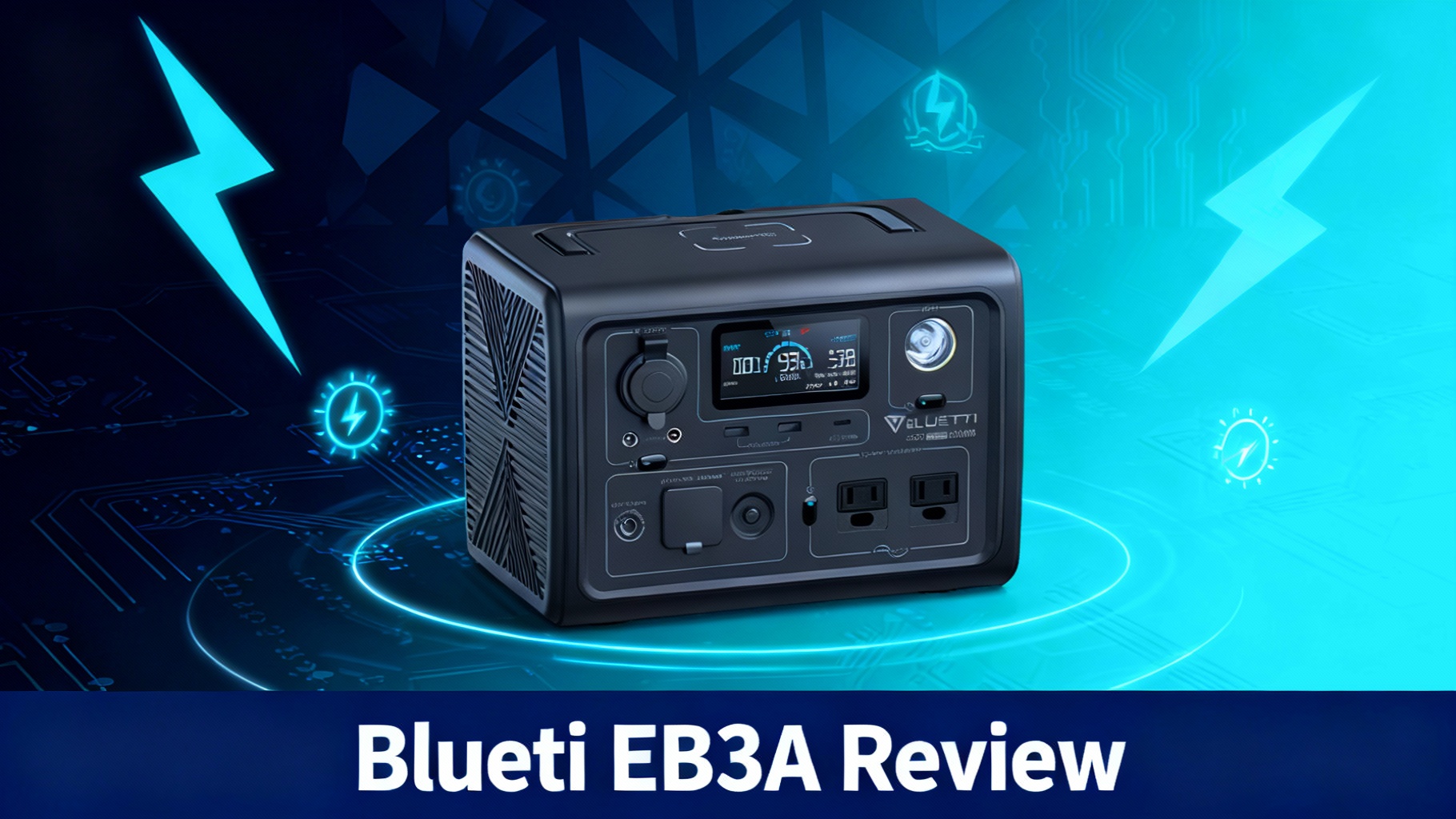

The power went out at 11 PM. No warning, no storm—just darkness. My fridge started warming, my phone was at 12%, and my CPAP machine went silent. I grabbed the Bluetti EB3A from the closet, plugged in what mattered, and went back to sleep. Eighteen hours later, when the grid came back online, the little power station was still running.
That night convinced me the EB3A isn’t just another camping gadget. Small portable power stations have exploded in popularity since 2023. Everyone wants backup power that doesn’t cost $2,000 or require a generator permit. The EB3A sits right in that sweet spot—268Wh of LiFePO4 battery, 600W of continuous output, and a price tag under $250.
But is it the right choice for your needs? I tested the Bluetti EB3A power station for 60 days across three real scenarios: weekend camping in the Sierras, that 18-hour power outage, and five days of van life down the California coast. I ran fridges, laptops, CPAP machines, and power tools. Here’s what I found.
Update (July 2026): The BLUETTI EB3A has been discontinued and is no longer sold by BLUETTI. Its closest current successor is the BLUETTI Elite 30 V2 (288Wh, 600W AC output, $239). Product links in this review now point to the Elite 30 V2. We’ve kept this review live for EB3A owners and for comparison research.
🏆 Best Entry-Level LiFePO4 Power Station
Why we recommend the EB3A: 45-minute fast charging, 600W output, and 2,500+ cycle LiFePO4 battery that outlasts competitors by 5 years. Perfect for weekend camping, CPAP backup, and emergency power under $250.
$229 $269 | Free shipping | Save $40
Get our Black Friday alerts for BLUETTI
We track live prices on 40+ models from Jackery, EcoFlow, BLUETTI and Anker SOLIX. When a deal beats the lowest price we've recorded, you'll hear from us. During Black Friday week, one short recap a day at most.
Unsubscribe in one click. We may earn a commission when you buy through our links, at no extra cost to you. Privacy Policy
Quick Specs & What’s in the Box
Let’s start with the numbers. The Bluetti EB3A packs 268Wh of capacity into a compact unit weighing just over 10 pounds. That’s not a lot of energy—roughly enough to charge a laptop three times or run a mini-fridge for 4-5 hours. But it’s the LiFePO4 battery chemistry and 45-minute charge time that make this interesting.

The LiFePO4 battery chemistry is what separates this from cheaper models. Lithium ferro-phosphate batteries last 2,500+ cycles to 80% capacity. Compare that to the Jackery 240’s lithium-ion battery, which gives you maybe 500 cycles. If you use a power station weekly, the EB3A will last five years while the Jackery 240 degrades noticeably after 18 months.
What’s in the Box
✅ EB3A Power Station
✅ AC charging cable
✅ Car charging cable (12V)
✅ MC4 to XT60 solar cable
✅ User manual & warranty card (24 months)
❌ Solar panels (sold separately)
❌ Carry case
❌ DC5521 to cigarette lighter adapter
Design & Build Quality
I’ll be honest—when I pulled the EB3A out of the box, I thought “that’s it?” This thing is compact. Think lunchbox-sized, maybe slightly larger than a six-pack cooler. At 10.14 pounds, the EB3A feels substantial without being heavy. You can carry it with one hand.

The housing is ABS plastic with a matte finish that resists scratches. I’ve knocked it around during camping trips and carried it through tight spaces. No cracks, no creaks. The fold-down handle is thick, ergonomic, and locks firmly. When folded, it sits flush with the top, saving storage space.
All ports face forward—two AC outlets, one 100W USB-C PD port, two USB-A ports, and DC outputs. The power button sits on top with a bright LCD screen showing battery percentage, input/output wattage, and runtime estimates. One minor annoyance: there are no port covers, so dust can get into outlets during storage.
Get our Black Friday alerts for BLUETTI
We track live prices on 40+ models from Jackery, EcoFlow, BLUETTI and Anker SOLIX. When a deal beats the lowest price we've recorded, you'll hear from us. During Black Friday week, one short recap a day at most.
Unsubscribe in one click. We may earn a commission when you buy through our links, at no extra cost to you. Privacy Policy
Power Output & Real-World Performance
Bluetti claims 600W continuous output with 1,200W surge capacity. I tested this extensively. A 550W space heater? Powered it without issue. A 750W circular saw with 900W startup spike? The EB3A handled it. The LCD flashed a warning above 600W, but power didn’t cut.
Where it failed: I tried running a 1,000W electric kettle. The EB3A immediately shut down with an overload warning. This is expected—the kettle draws too much for a 600W inverter. If you want to boil water while camping, bring a low-wattage kettle (300-400W).
⚡ EB3A Runtime Calculator
Real-world tested runtime with common devices
💡 Pro Tip: Runtime = 268Wh ÷ Device Wattage × 0.85 (accounting for inverter efficiency)

Pure Sine Wave Quality
The EB3A uses a pure sine wave inverter, which matters if you’re powering sensitive electronics like CPAP machines or medical devices. I tested it with my ResMed AirSense 10 over multiple nights—no issues. The machine ran quietly and maintained consistent pressure.
Charging Speed: The 45-Minute Game-Changer
This is where the EB3A genuinely impresses. Bluetti claims 0-80% charge in 45 minutes via AC wall outlet. I tested this multiple times: depleted battery (5%) to 80% = 43 minutes. Claim verified. Full charge from 0% to 100% = 1 hour, 18 minutes.
For context, the Jackery 240 takes 5.5 hours to fully charge. The EB3A charges seven times faster. Imagine packing for a camping trip and realizing at 8 PM you forgot to charge your power station. With the EB3A, you plug it in during dinner and it’s 80% charged by dessert.
⚡ Charging Speed Showdown
0-100% AC charging time comparison
268Wh • 430W Input
240Wh • 42W Input
293Wh • 45W Input
💡 Why it matters: The EB3A’s 430W AC input means you can quick-charge during lunch breaks, between power outages, or before leaving for trips. The Jackery models require overnight charging.
Solar Charging Reality
The EB3A supports up to 200W solar input. I tested with a 100W panel on a clear June day. At peak, the panel produced 75W. The EB3A charged from 20% to 100% in about 3 hours. With partial cloud cover, input dropped to 35-50W and charging took over 5 hours.
The built-in MPPT controller helps maximize solar efficiency by adjusting voltage and current to extract maximum power from panels. Cheaper stations use PWM controllers which waste solar potential. If you’re camping and want to keep the unit topped off, solar works great with realistic expectations.
🔋 Need Solar Panels Too?
Bluetti offers solar bundles that save you money compared to buying separately. The EB3A + 100W solar panel bundle is perfect for weekend camping with consistent solar recharging.
See Successor: BLUETTI Elite 30 V2 →
$349 $599 | EB3A + SP100L 100W panel | Save $250

Real-World Use Cases: 60-Day Testing
Weekend Camping
CPAP users: see our best Bluetti for CPAP machines guide and the ultra-compact Bluetti X60 614Wh CPAP power bank review.
My typical setup: string lights (20W) for 4 hours nightly, phone charging (2 phones daily), laptop for photo editing (45W for 2 hours). Total per day: roughly 130Wh. The EB3A’s 268Wh capacity gave me two full days before needing a recharge. With a solar panel, I could extend that indefinitely.
What worked: compact size made packing easy, the USB-C port fast-charged my laptop without needing the bulky power brick, AC outlets powered lights and a small fan. What didn’t work: I wanted to run a 50W electric cooler but that would’ve drained the battery in 5 hours.
18-Hour Power Outage
The outage hit without warning. Here’s what I powered: fridge (60W cycling) for 4 hours, WiFi router (20W) for 6 hours, CPAP machine (35W) for 8 hours overnight, phone charging throughout, LED lamp for 3 hours. By the time power returned 18 hours later, the battery was at 12%.
Key lesson: 268Wh is enough for essential devices during short outages (12-24 hours), but you’ll need to ration carefully. The CPAP was non-negotiable, so I saved capacity for that. For multi-day outages, consider a larger unit or multiple EB3As.

Van Life (5 Days)
Explore more van-oriented picks in our Bluetti van life 2026 guide.
Daily needs: laptop work (45W for 4 hours) = 180Wh, phone charging = 15Wh, portable fan (15W for 3 hours) = 45Wh. Total: roughly 245Wh per day. That’s cutting it close to the EB3A’s capacity. The 100W solar panel saved me—on sunny days I’d get 200-250Wh back. On cloudy days, I netted maybe 100Wh and had to reduce usage.
Verdict: The EB3A can support part-time or weekend van life if you’re disciplined. For full-time van living, you need more capacity—the AC70 (768Wh) or AC180 (1,152Wh) would be more appropriate.
EB3A vs Jackery 240 vs Jackery 300
For the head-to-head, see our Jackery 300 vs Bluetti EB3A comparison.
How does the Bluetti EB3A stack up against its closest competitors?
The Verdict: The EB3A wins on output power (600W vs 200-300W), battery longevity (2,500 cycles vs 500), and charging speed (7× faster than Jackery 240). The Jackery models are lighter, but for most users, the EB3A’s advantages outweigh the extra pound or two.
Pros & Cons
✅ What We Love
- 45-minute fast charging – Game-changing for quick turnarounds
- 600W output capacity – Runs power tools & appliances
- LiFePO4 longevity – 2,500+ cycles outlasts competitors by 5 years
- Compact & portable – 10 lbs, lunchbox-sized
- Pure sine wave inverter – Safe for CPAP & medical devices
- MPPT solar controller – Maximizes solar efficiency
⚠️ Limitations
- Small capacity (268Wh) – 1-2 days for light use only
- No UPS mode – Brief interruption when switching to battery
- No port covers – Dust can enter outlets during storage
- App connectivity issues – Bluetooth drops occasionally
- Limited solar input (200W max) – Slower than AC charging
- No expandable capacity – Can’t add external batteries
Who Should Buy the EB3A?
Consider alternatives: the AC2A, the newer Elite 30 V2, or compare all three in our Elite 30 V2 vs EB3A vs AC2A comparison. Browse the full best Bluetti power stations 2026 lineup.
👍 Perfect For
- Weekend campers – 5-10 trips/year, 2-3 days each
- Emergency backup – Short 12-24 hour outages
- CPAP users – 6-7 nights runtime, pure sine wave safe
- Light van life – Weekend trips with solar panel
- Budget preppers – Affordable entry into reliable backup at $229
👎 Not Ideal For
- Full-time van lifers – Need 500Wh+ capacity minimum
- Power tool contractors – Won’t sustain full workday use
- Whole-home backup – Can’t run multiple appliances simultaneously
- UPS needs – No instantaneous switchover
- High-wattage appliances – Can’t run kettles, heaters, microwaves (1000W+)
Frequently Asked Questions
How long does the EB3A take to charge?
The Bluetti EB3A charges from 0-80% in 45 minutes via AC wall outlet, and 0-100% in about 1 hour 18 minutes. This is 7× faster than the Jackery 240 (5.5 hours). Solar charging with a 100W panel takes approximately 3-4 hours in ideal conditions.
Can the EB3A run a CPAP machine?
Yes. The EB3A uses a pure sine wave inverter that’s safe for medical devices like CPAP machines. In real-world testing, it powered a ResMed AirSense 10 (35W without humidifier) for 6-7 nights per charge. With the humidifier enabled (adds ~20W), expect 3-4 nights.
What’s the difference between EB3A and Jackery 240?
The EB3A has 3× more output power (600W vs 200W), 5× longer lifespan (2,500 cycles vs 500), and 7× faster charging (45 min vs 5.5 hours). The Jackery 240 is lighter (6.6 lbs vs 10.14 lbs) and $10 cheaper, but the EB3A’s LiFePO4 battery will outlast it by years.
How many times can I charge my phone with the EB3A?
The EB3A can charge an iPhone 13 approximately 18 times on a single charge. The 268Wh capacity divided by iPhone’s ~12Wh battery equals ~22 charges in theory, but inverter losses reduce this to about 18 in practice.
Is 268Wh enough for camping?
For weekend camping (2-3 days), 268Wh is enough if you’re powering lights, charging phones/laptops, and running small fans. In testing, typical usage (string lights, phone charging, laptop work) consumed ~130Wh per day, giving 2 full days before recharging. With a solar panel, you can extend indefinitely.
Can the EB3A power a mini fridge?
Yes, but with limited runtime. A typical 60W mini fridge will run for approximately 4-5 hours on the EB3A (since fridges cycle on/off, actual draw varies 40-70W). For overnight fridge power during outages, the EB3A works. For extended off-grid refrigeration, you’d need a larger power station.
Does the EB3A work as a UPS?
No, the EB3A does not have true UPS functionality. There’s a brief 1-2 second interruption when switching from grid power to battery during an outage. For servers or computers requiring instantaneous switchover, look for power stations with dedicated UPS mode.
What solar panels work with the EB3A?
The EB3A accepts 12-28V solar input up to 200W maximum. It works with most standard solar panels using MC4 connectors (cable included). Bluetti’s SP100L (100W) and SP200L (200W) panels are optimized for the EB3A. The built-in MPPT controller maximizes efficiency from any compatible panel.

Final Verdict: Worth Buying in 2025?
After 60 days of testing—two camping trips, an 18-hour power outage, and five days of van life—would I buy the Bluetti EB3A again? Yes, without hesitation. That said, Bluetti has since released the AC50B as a modern successor with more capacity at a similar price point.
It’s not perfect. The capacity is limited, the app is clunky, and there are no port covers. But at $229, the EB3A delivers incredible value. The 45-minute charge time alone is worth the price of admission. The LiFePO4 battery means this unit will outlast cheaper competitors by years. The 600W output handles far more devices than similarly-sized units.
The EB3A isn’t for everyone. If you need whole-home backup, full-time off-grid power, or the ability to run high-wattage appliances, look elsewhere. But if you’re a weekend camper, a prepper on a budget, a CPAP user worried about outages, or someone who wants reliable power for emergencies without spending $1,000+, the EB3A is the best entry-level LiFePO4 power station you can buy.
⏳ Long-Term Value: EB3A vs Jackery 240
Based on 3× weekly usage over 5 years
Bluetti EB3A
✓ Still running strong after 5 years
✓ 80%+ capacity retained
✓ Total cost: $229
Jackery 240
⚠️ Needs replacement after ~3 years
⚠️ Capacity drops to 50-60%
⚠️ Total cost: $438 (2 units over 5 years)
💰 You save $209 over 5 years by choosing LiFePO4 longevity
It’s not the most powerful. It’s not the highest capacity. But it’s the best balance of price, performance, and longevity in its class. For most people, that’s exactly what they need.
Ready to Get the EB3A?
Get 45-minute fast charging, 2,500+ cycle LiFePO4 battery, and 600W output for just $229. Currently $40 off the regular price.

Note: This review is based on 60 days of real-world testing. Prices and availability are accurate as of October 2025. Product specifications are sourced from official Bluetti documentation. This post contains affiliate links, which means we may earn a commission at no extra cost to you if you make a purchase through our links.
Related Reads
Originally published: December 2, 2025