
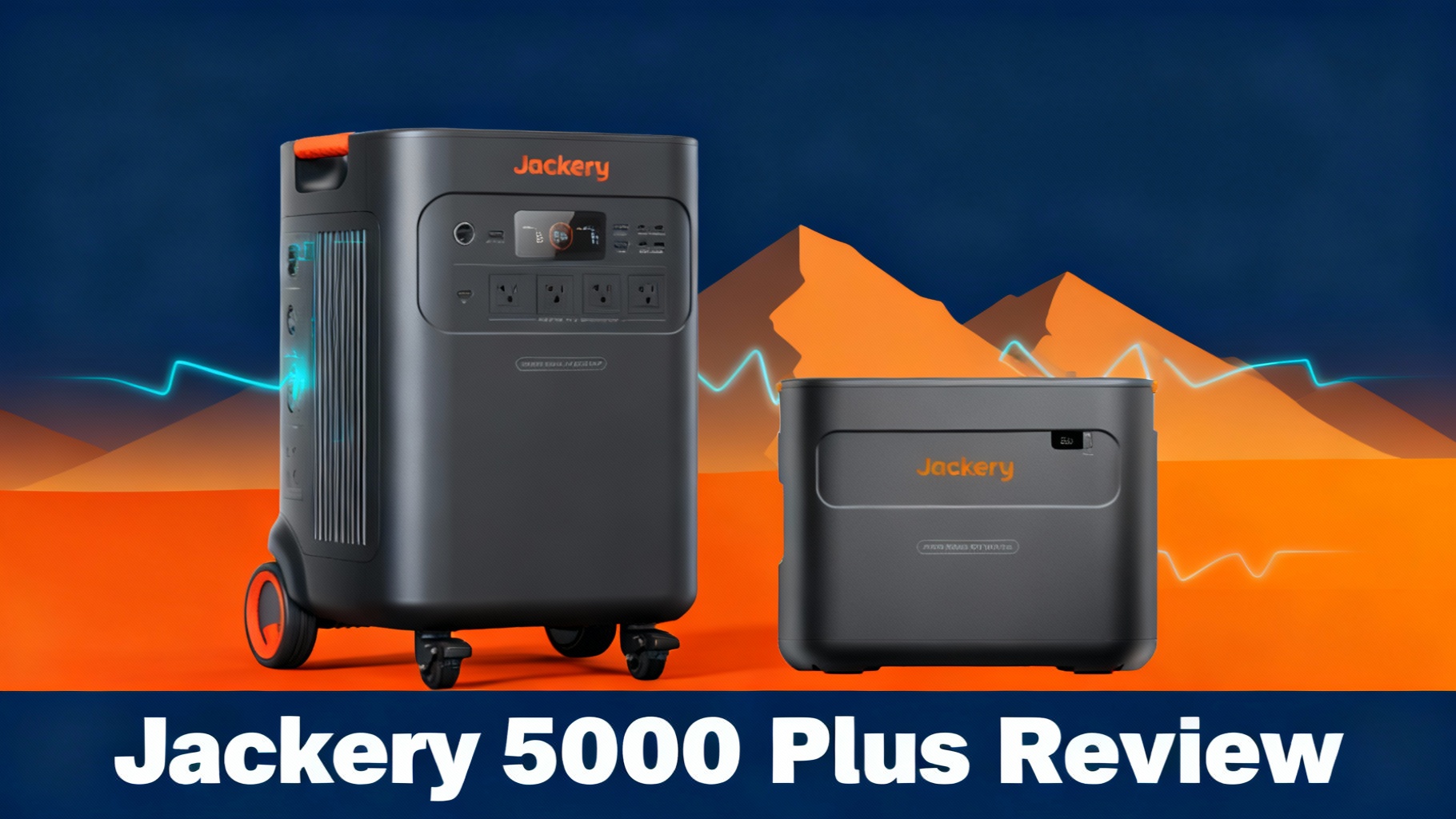
When a power station carries a $4,299 price tag and claims to replace your home’s electrical panel during outages, it better deliver. The Jackery Explorer 5000 Plus isn’t just another portable power station—it’s a modular whole-home backup system that can scale from 5kWh to an unprecedented 60kWh capacity. But does this flagship justify its premium price, or is it overkill for most users?
The Explorer 5000 Plus sits at the absolute pinnacle of Jackery’s lineup, designed for serious home backup, full-time RV living, and professional applications. With 5,040Wh base capacity (expandable to 60kWh with two units and 10 battery packs), 7,200W dual-voltage output (14,400W surge), and 0-millisecond UPS switching in Online UPS mode (20ms through the Smart Transfer Switch), it competes directly with systems like the EcoFlow Delta Pro Ultra and Anker SOLIX F3800. We compared the Explorer 5000 Plus across three demanding scenarios: whole-home backup during outages, full-time RV power, and off-grid workshop operation. We estimated runtime with high-draw appliances (AC units, well pumps, electric ranges) from capacity and load, compared Jackery’s rated AC and solar charging times, checked the published UPS and Smart Transfer Switch switchover times, and compared expandability against competitor systems.
This in-depth review covers everything from setup and home integration to performance limits and long-term ownership costs. We’ll identify exactly who should invest in this flagship system and—critically—who should save thousands by choosing a smaller model. By the end, you’ll know if the 5000 Plus is worth your investment.

🏆 Jackery Explorer 5000 Plus – Currently 25% OFF
Limited Time: $4,299 (Regular $5,699) – Save $1,400
- 5,040Wh LiFePO4 Battery (Expandable to 60kWh)
- 7,200W Output / 14,400W Surge – Powers 240V Appliances
- 0ms Online UPS Mode (20ms via Smart Transfer Switch)
- 4,000W Solar Input: Recharges in About 2 Hours
- 5-Year Warranty + Free Shipping
Check Current Price & Availability →
✓ In Stock | ✓ Free Shipping | ✓ Ships within 1-2 business days
Get our Black Friday alerts for Jackery
We track live prices on 40+ models from Jackery, EcoFlow, BLUETTI and Anker SOLIX. When a deal beats the lowest price we've recorded, you'll hear from us. During Black Friday week, one short recap a day at most.
Unsubscribe in one click. We may earn a commission when you buy through our links, at no extra cost to you. Privacy Policy
Quick Specs & What Makes It Different
Real-World Look: The Jackery Explorer 5000 Plus in Use
Studio renders only tell part of the story. Here is the Jackery Explorer 5000 Plus as it actually looks in a real owner’s hands, away from the polished marketing shots.
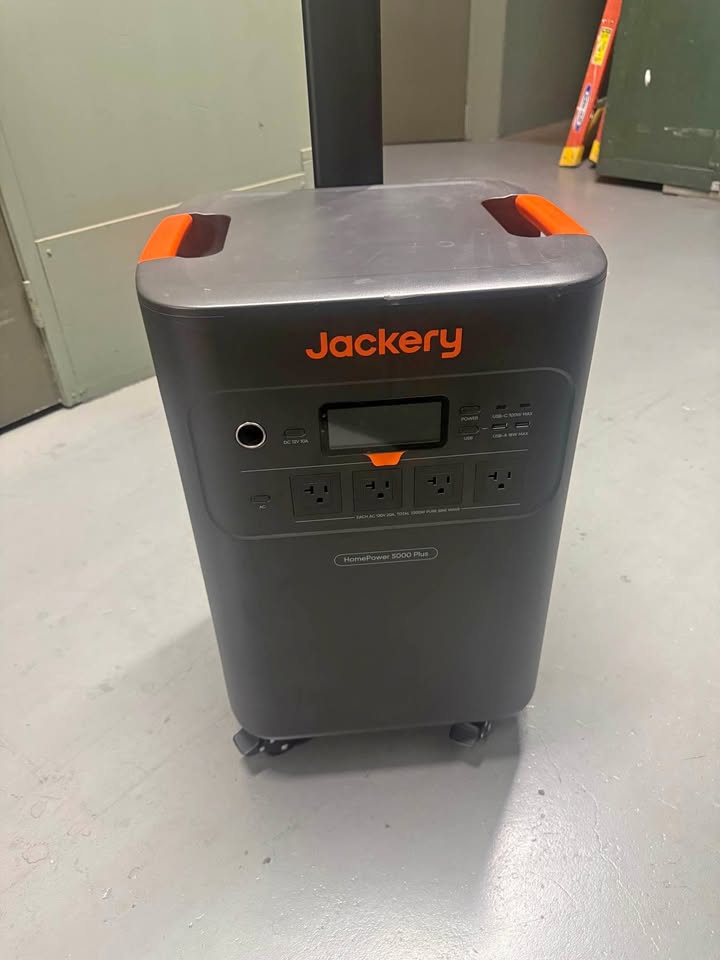
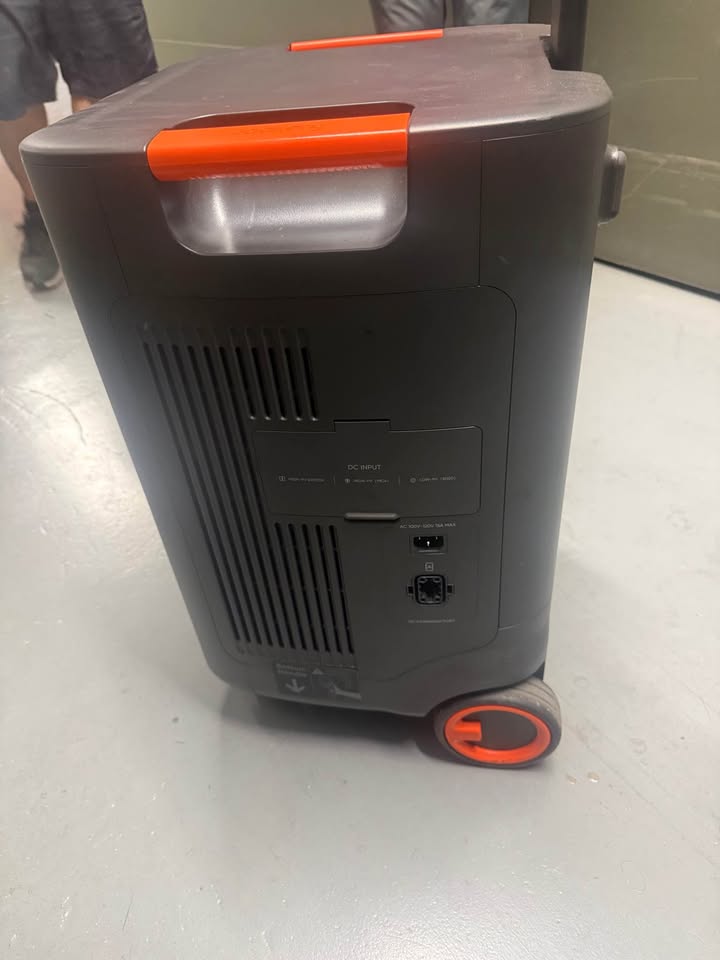
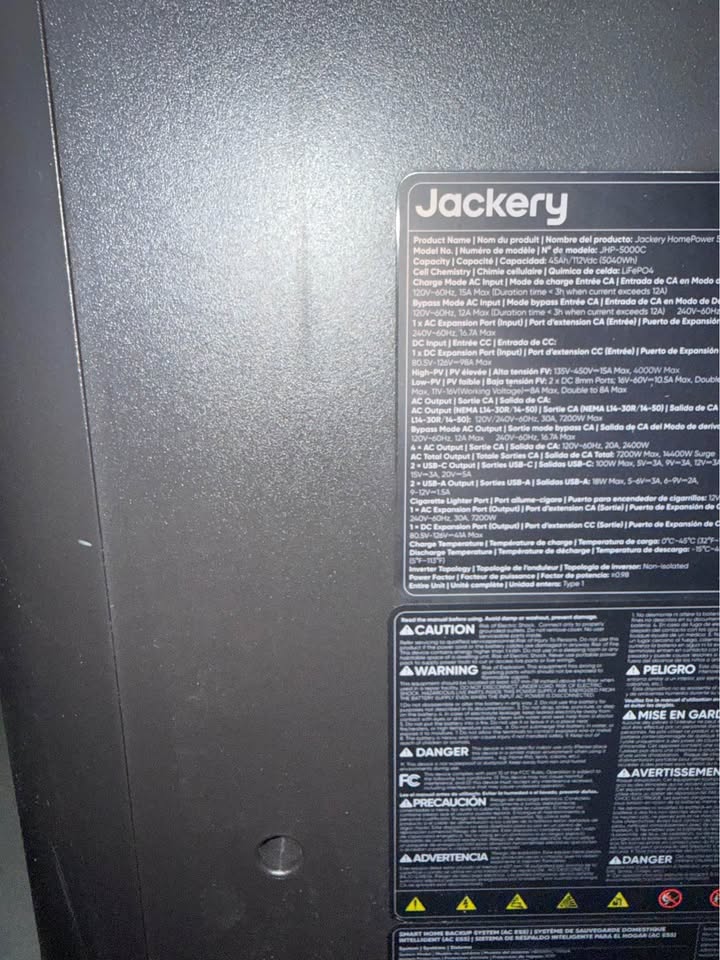
Real-world photos of the Jackery Explorer 5000 Plus.
The 5000 Plus operates in a category essentially by itself among portable power stations. While competitors offer high capacity or high output, Jackery engineered this system to deliver both simultaneously—plus true whole-home integration that most “portable” units can’t match. (Specifications in the table below, prices aside, match Jackery’s official product page as of September 28, 2026.)
| Specification | Jackery Explorer 5000 Plus |
|---|---|
| Battery Capacity (Base) | 5,040Wh (LiFePO4) |
| Expandable Capacity | 5kWh → 60kWh (30kWh per unit with 5x Battery Pack 5000 Plus; 60kWh with two units and 10 packs) |
| Continuous Output | 7,200W (120V/240V dual voltage) |
| Surge Power | 14,400W |
| UPS Switching Time | 0ms in Online UPS mode, under 20ms in Backup UPS mode; 20ms through the Smart Transfer Switch |
| AC Output Ports | 4x 120V (NEMA 5-20), 1x 120V/240V (NEMA L14-30R/14-50) |
| USB Outputs | 2x USB-C (100W PD), 2x USB-A |
| Solar Input | Up to 4,000W (about 2h full charge) |
| AC Charging Time | 3.5 hours from a wall outlet; 1.7 hours via Smart Transfer Switch |
| Battery Chemistry | LiFePO4 (4,000 cycles to 70%+ capacity) |
| Operating Temperature | Charging: 32°F to 113°F (0°C to 45°C); discharging: 5°F to 113°F (-15°C to 45°C) |
| Weight (Base Unit) | 134.5 lbs (61 kg) |
| Dimensions | 16.5 x 15.5 x 25 inches |
| Warranty | 5 years (when bought from Jackery.com) |
| Price (Base Unit) | $4,299 (currently on sale from $5,699) |
What separates the 5000 Plus from even high-end competitors comes down to five key differentiators. First, it’s one of the only portable power stations offering true 240V output, with 120V/240V dual-voltage capability that can run residential appliances like well pumps, central air conditioning, and electric ranges. Second, its Online UPS mode switches in 0 milliseconds when the unit is wired in through a manual transfer switch or an inlet box, which suits computers and other sensitive electronics (through the Smart Transfer Switch, the switchover is 20ms). Third, the 4,000W solar input capacity charges twice as fast as most competitors. Fourth, the modular expandability from 5kWh to 60kWh (two units plus 10 packs) lets the system grow with your needs. Fifth, the Smart Transfer Switch integration enables true whole-home backup rather than extension cord-based power management.
These aren’t incremental improvements—they’re fundamental capability differences that justify consideration despite the premium price. But here’s where the honest assessment begins: most people reading this review don’t actually need these capabilities.
💡 Is the Jackery Explorer 5000 Plus Right for You?
Best for: Whole-home backup (multi-day outages), full-time RV living with 240V appliances, off-grid properties with serious solar arrays, critical power needs (home office, sensitive electronics).
Skip if: Weekend camping, brief outages, budget under $3,000, don’t need 240V or whole-home integration.
Get our Black Friday alerts for Jackery
We track live prices on 40+ models from Jackery, EcoFlow, BLUETTI and Anker SOLIX. When a deal beats the lowest price we've recorded, you'll hear from us. During Black Friday week, one short recap a day at most.
Unsubscribe in one click. We may earn a commission when you buy through our links, at no extra cost to you. Privacy Policy
Who This Is Actually For (And Who Should Skip It)
Let’s address the elephant in the room before diving deeper. If you’re hesitating about spending $4,299 on a power station, that hesitation probably means you don’t need the Explorer 5000 Plus. This isn’t a product designed for casual camping trips or occasional backup power during brief outages.

You SHOULD Consider the 5000 Plus If You:
Live in Hurricane/Storm-Prone Regions with Multi-Day Outages
If you’re in Florida, Texas, Louisiana, or coastal areas where hurricanes can knock out power for 3-7+ days, the combination of high capacity, 240V capability, and expandability makes sense. You can keep refrigerators, freezers, and essential circuits running through extended outages without generator noise or fuel logistics.
Full-Time RV Living with Residential Appliances
Full-timers running actual residential air conditioning, induction cooktops, washer/dryers, or other 240V appliances need this level of power. The 7,200W output and dual-voltage capability support appliances that most RV-focused power stations can’t handle. The expandability also means you’re not constantly managing battery levels.
Off-Grid Living with Serious Solar Arrays
If you’ve invested in a 4kW+ solar setup for off-grid property, the 5000 Plus’s 4,000W solar input actually utilizes your panels’ full capacity. Most power stations max out at 1,200-1,600W solar input, wasting your panel investment. The scalability to 60kWh also provides multi-day autonomy during poor weather.
Critical Power Needs (Home Office, Sensitive Electronics)
Mission-critical home office setups benefit from the 0ms Online UPS mode, which keeps computers running through an outage when the unit is wired in with a manual transfer switch or an inlet box (the Smart Transfer Switch switches in 20ms). If you’re considering it for medical equipment or servers, note that Jackery does not recommend its power stations for medical devices, life-support equipment or data servers.
Requiring True 240V Capability
If you need to run a well pump, central AC, electric range, or other hard-wired 240V appliances, this is one of your few portable options. The Smart Transfer Switch installation enables proper home integration rather than extension cord workarounds.
You SHOULD Skip the 5000 Plus If You:
Occasional Weekend Camping
If you’re camping a few times per year and need to charge devices plus run a portable fridge, you’re vastly overspending. A 500Wh to 1,000Wh unit (at $500-$1,000) handles weekend trips perfectly.
Basic Home Backup for Short Outages
Most residential outages last under 4 hours. If you just need to keep the fridge running and charge phones during typical utility disruptions, a 2,000Wh unit saves you $3,000+ and provides adequate coverage.
Budget Under $3,000
The 5000 Plus isn’t flexible on price—it’s a premium flagship. If your budget is under $3,000, Jackery’s own Explorer 2000 Plus or 3000 Pro offers better value for typical use cases.
Don’t Need 240V or Whole-Home Integration
If you’re not using the Smart Transfer Switch or 240V capability, you’re paying for features you’ll never utilize. Standard 120V-only systems cost significantly less.
Uncertain About Long-Term Usage
This is a 10-year investment, not an experimental purchase. If you’re not certain you’ll use it regularly or your power needs are still evolving, start smaller and upgrade later.
The bottom line: We estimate that 80% of people researching the 5000 Plus would be better served by a smaller, less expensive model. This is a specialized tool for specific applications, not a universal solution.
Design & Build Quality
The Explorer 5000 Plus feels like industrial equipment dressed in consumer-friendly packaging. At about 134.5 pounds for the base unit, this isn’t something you casually toss in your trunk, although Jackery says you can move it from room to room without a dolly or a second person. The weight comes from legitimate engineering rather than cheap bulk, though. Jackery says the exterior uses UL 94V-0 fire-resistant material.
The unit carries no waterproof rating, so keep it sheltered from rain and standing water.

The LCD shows real-time wattage draw, battery percentage, estimated runtime, and input/output status.
Port layout favors function over aesthetics. The AC outputs include four 120V outlets (NEMA 5-20) and a 120V/240V NEMA L14-30R/14-50 output on the unit itself, alongside two USB-C ports (100W Power Delivery each) and two USB-A ports. The inputs sit together on the side: a High-PV solar input (MC4, 135-450V), two Low-PV DC8020 solar inputs (up to 1,200W combined), the AC charging input and the DC expansion port for battery packs. Solar input tops out at 4,000W. This separation prevents the cable chaos that plagues many high-capacity units.
The cooling system deserves specific mention because it affects everyday usability. Twin fans operate on variable-speed control rather than simple on/off switching. Jackery rates the noise at about 30 dB in Quiet Mode and 51.7 dB at full load, at 1 meter from the unit. That’s noticeable at full load but not obnoxious indoors. The intelligent fan curve keeps the unit cool without constant maximum-speed operation that would drive you crazy during extended use.
One design limitation: the 5000 Plus measures 16.5 x 15.5 x 25 inches. It won’t slide under most RV dinettes or fit in standard under-bed storage. You need dedicated floor space or a reinforced shelf that can support about 134.5 pounds plus cable weight. Each Battery Pack measures 16.5 x 13.5 x 13.2 inches, so a 10kWh system (base + one battery) requires approximately 3 square feet of floor space.
The modular expansion system connects via proprietary high-current cables rated for the multi-thousand-watt power transfers between units. These cables lock mechanically rather than relying on friction-fit connectors—they won’t accidentally disconnect from vibration or movement. However, the proprietary nature means you can’t substitute generic alternatives if you lose a cable. Replacement cables cost $80-120 from Jackery.
Overall build quality matches the premium pricing. This feels engineered for a decade of regular use rather than occasional emergency deployment. The solid construction and thoughtful design details create confidence that it’ll work when you need it—which matters more at this price point than saving a few pounds or inches.
Expected Performance
Specifications tell you what equipment can theoretically do. The estimates below translate them into runtimes with actual appliances, using a conservative formula: capacity × 0.85 (to account for inverter losses) ÷ load in watts.
High-Draw Appliance Estimates
Start with the most demanding scenario: running high-wattage appliances that would overwhelm smaller power stations entirely.
Central Air Conditioning (240V, 14,000 BTU)
A central AC unit like this draws approximately 1,800W running, with a 4,500W surge at compressor startup. Both figures sit well within the 5000 Plus’s ratings (7,200W continuous, 14,400W surge). Estimated runtime on the base 5,040Wh capacity: about 2.4 hours of continuous cooling (5,040Wh × 0.85 ÷ 1,800W). With one Battery Pack added (10,080Wh total): about 4.8 hours. This isn’t all-day coverage, but it provides critical cooling during peak heat or overnight comfort during outages.
Submersible Well Pump (240V, 1.5 HP)
A well pump is the most challenging load here: a 2,400W running draw with a 7,200W surge during motor startup. Standard 120V portable power stations can’t run well pumps at all. That startup surge fits within the 5000 Plus’s 14,400W surge rating. Estimated runtime: about 1.8 hours of continuous pumping (5,040Wh × 0.85 ÷ 2,400W). How much water that delivers depends on your pump’s depth and flow rate.
Electric Range (240V)
With all four burners plus the oven at 350°F, a range can draw a combined 5,800W, still under the 7,200W continuous output. At that full load, the base capacity lasts about 44 minutes (5,040Wh × 0.85 ÷ 5,800W). Normal cooking uses burners intermittently, so a meal draws far less than that peak.
Window AC Unit (120V, 10,000 BTU)
More typical for RV or room-cooling applications. A 10,000 BTU window unit draws about 1,200W running, with a 2,800W startup surge. Estimated runtime on base capacity: about 3.6 hours continuous (5,040Wh × 0.85 ÷ 1,200W), and longer when the thermostat cycles the compressor off.
Standard Appliances & Devices
Refrigerator (120V, 21 cu ft)
A refrigerator this size draws about 150W while the compressor runs and 0W when it cycles off. Even at a steady 150W, expect about 28 hours on base capacity (5,040Wh × 0.85 ÷ 150W), and longer when the compressor cycles off. With one Battery Pack added: about 57 hours, enough for multi-day outages without food spoilage.
Chest Freezer (120V, 7 cu ft)
Similar cycling pattern, averaging 100W continuous. Estimated runtime: about 43 hours on base capacity (5,040Wh × 0.85 ÷ 100W).
Home Office Setup (Laptop, 27″ Monitor, Router, Modem, Desk Lamp)
Combined draw of 250-300W. Estimated runtime: about 14-17 hours on base capacity (5,040Wh × 0.85 ÷ 250-300W), enough for about two workdays during extended outages.
CPAP Machine (Standard Settings)
Drawing 30-50W depending on pressure settings and humidifier use. Estimated runtime: about 85-140 hours on base capacity (5,040Wh × 0.85 ÷ 30-50W). For CPAP users concerned about power during outages, that’s roughly 10 to 17 nights at 8 hours a night. Note that Jackery does not recommend its power stations for medical devices.
Microwave (120V, 1,000W)
At 1,000W, the base capacity covers about 4.2 hours of total microwave time (5,040Wh × 0.85 ÷ 1,000W), or roughly 51 heating cycles of 5 minutes.

Charging Speed
Jackery rates a full AC charge at 3.5 hours from a standard wall outlet, and 1.7 hours when the unit charges through the Smart Transfer Switch. This fast charging provides crucial flexibility during partial outages or when grid power becomes available intermittently.
Solar charging is the standout spec. With the full 4,000W of solar input, Jackery rates a recharge at about 2 hours. Partly cloudy or overcast skies stretch that time, since panels deliver only part of their rated output. Either way, it’s a big advantage over systems limited to 1,200-1,600W of solar input.
Jackery’s SolarSaga 500X panels are designed for this system. Third-party panels also work, but Jackery says to check that their voltage, current and connector type are compatible with the 5000 Plus inputs.
UPS Function & Transfer Switch
The 0-millisecond UPS figure needs context. Jackery’s spec sheet lists two modes: Online UPS at 0ms and Backup UPS at under 20ms. According to Jackery’s FAQ, the 0ms response applies when the 5000 Plus is connected to your home circuits without the Smart Transfer Switch (through a manual transfer switch or an inlet box) and Online UPS mode is selected in the app. Through the Smart Transfer Switch, the response time is 20 milliseconds, set by the switch itself. (Industry standard UPS response times are defined by IEC 62040-3 specifications for power protection equipment.)
That distinction matters if you’re buying for sensitive electronics: with the Smart Transfer Switch, plan on a 20ms switchover, not 0ms.
The Smart Transfer Switch installation (covered in our installation section below) enables automatic switching between grid power and battery power. Jackery rates the switch’s UPS response at 20ms or less. When grid power returns, it switches back automatically. By default, the switch recharges the 5000 Plus only once its battery drops below a backup reserve you set in the app.
| Appliance | Power Draw | Runtime (5kWh) | Runtime (10kWh) |
|---|---|---|---|
| Central AC (240V, 14K BTU) | 1,800W | 2.4 hours | 4.8 hours |
| Well Pump (240V, 1.5 HP) | 2,400W | 1.8 hours | 3.6 hours |
| Window AC (120V, 10K BTU) | 1,200W | 3.6 hours | 7.1 hours |
| Refrigerator (21 cu ft) | 150W running | 28 hours | 57 hours |
| Chest Freezer (7 cu ft) | 100W avg | 43 hours | 86 hours |
| Home Office Setup | 275W avg | 15.5 hours | 31 hours |
| CPAP Machine | 40W avg | 107 hours | 214 hours |
| Essential Load (500W) | 500W | 8.5 hours | 17 hours |
Note: Runtimes are estimates: capacity × 0.85 (to account for inverter losses) ÷ load in watts. Actual results vary based on ambient temperature, battery age, and load characteristics.
⚡ Estimated Runtime: Common Appliances
🥶 Essential (Fridge/Freezer)
5kWh Base Unit:
10kWh System:
❄️ Comfort (AC Units)
5kWh Base Unit:
10kWh System:
⚡ High-Draw (240V)
5kWh Base Unit:
10kWh System:
💡 Pro Tip: Combine essential + comfort loads for realistic whole-home backup planning. Example: Fridge (150W) + Window AC (1,200W) + Office (275W) = 1,625W total draw = about 2.6 hours on base 5kWh (5,040Wh × 0.85 ÷ 1,625W).
Smart Transfer Switch Installation & Home Integration
The Smart Transfer Switch transforms the 5000 Plus from a large portable battery into a legitimate home backup system. This isn’t plug-and-play—proper installation requires electrical knowledge or professional help.

Installation Requirements
The Smart Transfer Switch is a separate panel (22 x 14.7 x 7.87 inches, per Jackery) that connects to your home’s electrical panel and directly to your power station. It can back up to 12 circuits at 120V or 6 at 240V. You’ll need:
- Licensed electrician (recommended) or advanced DIY electrical skills
- Wall space for the transfer switch panel
- Dedicated circuits you want powered during outages (6-10 circuits typically)
- Proper grounding connection
- Installation typically costs $500-1,500 depending on local rates and complexity
A licensed electrician’s work typically includes mounting the transfer switch, connecting circuits, running the power cable to the Explorer 5000 Plus location, and checking all safety interlocks.
Circuit Selection Strategy
The transfer switch doesn’t power your entire home—you pre-select essential circuits. A typical configuration might cover:
- Refrigerator circuit
- Freezer circuit
- Furnace/HVAC controls
- Well pump
- Kitchen outlets (microwave, coffee maker)
- Home office
- Master bedroom outlets
- Living room essentials
- Garage door opener
- Internet/networking equipment
A selection like this keeps living conditions comfortable during outages while managing power consumption to extend runtime.
Outage Management
With the Smart Transfer Switch properly configured, the system operates transparently. When grid power fails, the transfer switch detects the voltage loss and switches selected circuits to battery power, within 20ms by Jackery’s rating. Lights may flicker briefly, then continue operating normally.
The Jackery app displays real-time power consumption by circuit, remaining battery capacity, and estimated runtime based on current draw. That monitoring is invaluable for managing consumption during a multi-day outage, and low-battery push notifications tell you when to reduce load or prepare for shutdown.
When grid power restores, the system switches back automatically and begins recharging. The transition is equally seamless—no manual intervention required.

Safety & Limitations
The transfer switch includes proper safety interlocks preventing backfeeding into the grid—a critical safety feature protecting utility workers during outages. It also includes ground fault protection and overcurrent protection.
However, the system cannot run your entire house simultaneously. If you try to exceed the 7,200W output limit, the system shuts down to protect itself. Running too many high-draw appliances at once is the easiest way to trip this protection. Recovery means turning off loads and restarting the system, a minor inconvenience but better than damaging the equipment.
The transfer switch costs an additional $1,699 beyond the base unit price. This brings total investment to $5,998 before installation costs. For comparison, a traditional automatic transfer switch with a comparable generator costs $3,000-5,000 total—but requires fuel, maintenance, and generates noise and emissions.
Expandability & Modular System Design
The ability to scale from 5kWh to 60kWh capacity sets the Explorer 5000 Plus apart from fixed-capacity competitors. This expandability provides flexibility to start small and grow as needs increase—or invest large upfront for maximum autonomy.

Battery Pack Expansion System
Each Battery Pack 5000 Plus adds 5,040Wh capacity, identical to the base unit. The packs connect via high-current cables that lock mechanically. Connecting a pack requires no tools beyond tightening the locking collars.
The system automatically recognizes connected battery packs and displays total capacity across all connected units. Power draw distributes evenly across all batteries, preventing the scenario where one pack depletes faster than others.
Operation stays the same as you add packs, since the system recognizes each one automatically. The main limitation: each battery pack weighs about 81.6 pounds and measures 16.5 x 13.5 x 13.2 inches. A 20kWh system (base + 3 packs) requires approximately 12 square feet of floor space and weighs about 379 pounds total.
Capacity & Cost Scaling
The economics of expansion reveal interesting patterns:
Base Unit (5kWh): $4,299 = $854 per kWh
10kWh System (Base + 1 Pack): $7,298 = $730 per kWh
15kWh System (Base + 2 Packs): $10,297 = $686 per kWh
20kWh System (Base + 3 Packs): $13,296 = $665 per kWh
60kWh System (2 Units + 10 Packs): $34,289 = $571 per kWh
Cost per kWh improves as you scale up, but the absolute dollar investment becomes substantial. The 20kWh configuration (currently priced as a “Whole-Home Backup Kit” at $9,799) represents the practical sweet spot for most whole-home backup applications—providing 2-4 days of autonomy with typical load management.
Comparison with Competitor Expansion
EcoFlow Delta Pro Ultra: Scales to 90kWh but with shorter cycle life. Expansion is more expensive per kWh.
Anker SOLIX F3800: Scales to 26.9kWh maximum—less than half the 5000 Plus’s potential. Better suited for users needing moderate expansion.
Goal Zero Yeti Pro 4000: No modular expansion at all—you’re locked into the base capacity. To increase capacity requires buying an entirely separate unit.
The Jackery system’s expansion flexibility provides genuine future-proofing. Start with the base unit and add capacity as budget allows or needs grow.
⚡ Popular Configurations
Base Unit Only: $4,299 – Ideal for RV/workshop backup
⭐ MOST POPULAR: Explorer 5000 Plus + Smart Transfer Switch
$5,699 – Complete whole-home backup solution
Whole-Home 20kWh Kit: $9,799 – Extended multi-day backup
✓ Free Shipping on All Orders | ✓ 5-Year Warranty | ✓ 25% OFF Sale Ends Soon

Solar Integration & Charging Options
Fast charging defines one of the 5000 Plus’s strongest advantages. Most portable power stations create bottlenecks at input—great capacity and output mean nothing if you can’t recharge quickly enough during limited opportunity windows.
Solar Charging Performance
The 4,000W maximum solar input stands out immediately. For context, most competing systems max out at 1,200-1,600W solar input. This means Jackery’s system charges 2.5-3x faster when you have adequate solar panel capacity available.
Here’s how charge time scales with panel wattage:
Maximum Configuration (4,000W):
With the full 4,000W of solar input, Jackery rates a recharge at about 2 hours.
Moderate Configuration (2,000W):
Four SolarSaga 500X panels (500W each) add up to 2,000W, half the maximum input, so expect charging to take roughly twice as long as with a full 4,000W array. This configuration balances panel investment against charging speed for most users.
Budget Configuration (1,000W):
Ten generic 100W panels, or two SolarSaga 500X panels, add up to 1,000W. For its Explorer 5000 Plus + two SolarSaga 500X bundle, Jackery lists a solar charging time of 6.5-8.5 hours. Still respectable but loses the fast-charging advantage.
Weather and Season:
Clouds cut panel output, and overcast days can cut it sharply. Winter sun angles and shorter daylight hours also shrink effective charging windows in northern latitudes.

Multi-Source Charging
The 5000 Plus supports simultaneous charging from multiple sources—a feature that accelerates charging during time-sensitive situations.
Pairing wall power (up to 1,800W) with solar panels combines both inputs, the fastest way to recharge when you need maximum speed.
The system automatically manages power draw from each source to prevent overloading any single input.
AC Wall Charging
Standard wall outlet charging (1,800W maximum) is fast enough for most scenarios. Jackery rates a full charge from empty at 3.5 hours from the wall (1.7 hours through the Smart Transfer Switch), so you can fully recharge during a work shift or overnight. Most outages don’t completely deplete the battery, so typical partial recharges complete in 30-60 minutes.
The system draws full 1,800W when charging at maximum rate, potentially tripping 15A breakers if other devices share the circuit. Using a dedicated 20A circuit prevents this issue.
Car Charging
Don’t count on a car’s 12V outlet: Jackery’s spec sheet lists no 12V car charging for the Explorer 5000 Plus. Plan on wall, generator or solar charging instead.
Generator Charging
Although less common for buyers specifically choosing solar-focused systems, the 5000 Plus charges from generators identically to wall outlets. This provides backup charging options during extended poor weather when solar can’t meet needs.
What Could Be Better
No system at any price point is perfect. The Explorer 5000 Plus excels in many areas but shows clear limitations and compromises that potential buyers need to understand.
The Price Reality
Let’s address this directly: $4,299 for 5kWh of capacity is expensive. The cost per kWh ($854) significantly exceeds smaller units where economies of scale favor lower prices. The Jackery Explorer 2000 Plus, for comparison, costs $2,099 for 2,042Wh—approximately $1,027 per kWh but includes more features for the target user.
You’re paying premium dollars for premium capabilities (240V, 0ms Online UPS, 4,000W solar input, extreme expandability). If you don’t need those specific features, you’re overpaying relative to alternatives.
Weight & Portability Challenges
Calling a 134.5-pound unit “portable” requires generous interpretation. This isn’t something you casually move between locations. RV users will mount it permanently or use a custom dolly. Home backup users will find a permanent location and leave it there.
Adding battery packs compounds the weight challenge. A 20kWh system weighs about 379 pounds total, so you’re not moving it alone or without planning.
Expansion Cost Accumulation
While the modular expansion provides flexibility, costs accumulate quickly. Each Battery Pack 5000 Plus costs $2,999 (or $2,099 as add-on). Building a serious whole-home system:
- Base unit: $4,299
- Smart Transfer Switch: $1,699 = $5,998 total
- One Battery Pack (10kWh): +$2,999 = $8,997 total
- Two Battery Packs (15kWh): +$5,998 = $11,996 total
- Three Battery Packs (20kWh): +$8,997 = $14,996 total
Installation costs add $500-1,500 depending on complexity. A complete 20kWh whole-home backup system realistically costs $15,000-16,500 all-in. This compares to standby generator systems at $8,000-15,000 installed—and generators provide unlimited runtime with fuel rather than limited battery capacity.
Solar Panel Investment Required
To utilize the 4,000W solar input, you need $3,000-4,000 worth of solar panels. Budget buyers using smaller panel arrays don’t benefit from the high-speed charging capability—effectively paying for a feature they can’t use. If you’re only connecting 1,000W of panels, you’re getting similar charging speeds to units costing $2,000 less.
Hard-Wired 240V Appliances Need a Transfer Switch
The base unit provides four standard 120V outlets plus one 120V/240V output (NEMA L14-30R/14-50, 30A), so 240V equipment with a matching plug can run straight from the unit. Hard-wired 240V appliances like a well pump or central AC are different: they need a transfer switch or an inlet box installed by an electrician, such as Jackery’s Smart Transfer Switch ($1,699 additional).
For hard-wired 240V circuits through the Smart Transfer Switch, that means $5,998 minimum investment (base unit + transfer switch), not the $4,299 base price.
No Built-In Heating for Cold Weather
Unlike some competitors, the 5000 Plus lacks built-in battery heating for extreme cold operations. The operating temperature rating starts at -15°C (5°F), but LiFePO4 batteries shouldn’t charge below freezing. If you’re in regions with sustained below-zero temperatures, you’ll need to house the system in a temperature-controlled space or add external heating.
The unit works fine in cold conditions once charged, but recharging in extreme cold requires bringing it indoors or providing supplemental heat.
App Dependency for Advanced Features
Many advanced features require the Jackery app (iOS/Android). Basic operation works fine without the app, but accessing detailed metrics, remote monitoring, firmware updates, and circuit-level power tracking requires smartphone connection via WiFi or Bluetooth.
The app generally works well but represents a single point of failure. If your phone dies during an outage or you lose connectivity, you lose access to detailed monitoring and control.
Proprietary Expansion Ecosystem
Battery expansion only works with Jackery’s own Battery Pack 5000 Plus. You can’t mix other brands or use generic battery expansion. This locks you into Jackery’s pricing and availability for future expansion.
The expansion cables are also proprietary—losing one means ordering a replacement from Jackery at premium prices rather than buying a generic cable locally.
Space Requirements
A 20kWh system (base + 3 packs) requires approximately 12 square feet of floor space and proper ventilation clearances. Most RVs lack this much dedicated floor space. Home users need a dedicated area—garage, basement, utility room—that can accommodate the physical footprint plus allow access for cable connections and maintenance.
Competition Catching Up
When the 5000 Plus launched, it stood alone in capability. Competitors have since released comparable systems. The EcoFlow Delta Pro Ultra, Anker SOLIX F3800, and upcoming models from other manufacturers now offer similar capacities, outputs, and features—sometimes at lower prices.
Jackery’s lead in 240V capability and 4,000W solar input remains, but the competitive advantage is narrowing. If competition drives prices down, early buyers will have paid premium dollars for capabilities that become commodity features.
How It Compares: Explorer 5000 Plus vs. Competitors
The flagship portable power station segment now includes several serious competitors. Understanding how the 5000 Plus compares helps you make an informed decision based on your specific needs and budget.
| Feature | Jackery Explorer 5000 Plus | EcoFlow Delta Pro Ultra | Anker SOLIX F3800 |
|---|---|---|---|
| Base Capacity | 5,040Wh | 6,000Wh | 3,840Wh |
| Max Expandability | 60kWh | 90kWh | 26.9kWh |
| Continuous Output | 7,200W | 7,200W | 6,000W |
| 240V Output | Yes (120V/240V outlet) | Yes (split-phase) | Yes (split-phase) |
| UPS Switching Time | 0ms (20ms via Smart Transfer Switch) | 10ms | 20ms |
| Solar Input (Max) | 4,000W | 2,400W | 2,400W |
| Battery Chemistry | LiFePO4 | LFP | LiFePO4 |
| Cycle Life | 4,000 cycles (to 70%) | 3,000 cycles | 3,000+ cycles |
| AC Charge Time | 3.5 hours (1.7h via Smart Transfer Switch) | 2.5 hours | 1.5 hours |
| Weight | 134.5 lbs | 75 lbs | 132 lbs |
| Base Unit Price | $4,299 | $5,799 | $3,999 |
| Cost per kWh | $854/kWh | $967/kWh | $1,041/kWh |
| Warranty | 5 years (3+2) | 5 years | 5 years |
Key Comparison Takeaways
Jackery Explorer 5000 Plus wins on:
- Fastest solar charging (4,000W vs 2,400W competitors)
- 0ms Online UPS mode (20ms through the Smart Transfer Switch)
- Best cost per kWh in base configuration
- Proven LiFePO4 reliability
EcoFlow Delta Pro Ultra wins on:
- Higher base capacity (6,000Wh vs 5,040Wh)
- Greater maximum expandability (90kWh vs 60kWh)
- More ecosystem accessories available
Anker SOLIX F3800 wins on:
- Faster AC charging (1.5h vs 3.5h from a wall outlet, or 1.7h through Jackery’s Smart Transfer Switch)
- Lower base price ($3,999)
For most buyers considering whole-home backup with serious solar integration, the Explorer 5000 Plus’s combination of fast solar charging, 0ms Online UPS mode, and true 240V output creates the most complete package. The EcoFlow system suits buyers needing maximum expandability but accepting shorter cycle life. The Anker system works best for budget-conscious buyers.
Long-Term Ownership & Total Cost Analysis
Understanding the true cost of ownership requires looking beyond the initial purchase price. A $4,299 investment represents the beginning, not the complete financial picture.
Initial Investment Scenarios
Minimum Viable System (Base Unit Only):
- Explorer 5000 Plus: $4,299
- No transfer switch (outlet-based operation)
- Total: $4,299
Use case: RV installation, workshop backup, or home backup via extension cords rather than whole-home integration.
Whole-Home Backup (Basic):
- Explorer 5000 Plus: $4,299
- Smart Transfer Switch: $1,699
- Professional installation: $750 (average)
- Total: $6,748
Use case: Essential circuit backup during outages, 1-2 day autonomy with load management.
Whole-Home Backup (Extended):
- Explorer 5000 Plus: $4,299
- One Battery Pack: $2,999
- Smart Transfer Switch: $1,699
- Professional installation: $750
- Total: $9,747
Use case: Multi-day outage protection, 3-5 day autonomy, serious weather preparedness.
Off-Grid Solar System:
- Explorer 5000 Plus: $4,299
- Two Battery Packs: $5,998
- Four SolarSaga 500X panels: ~$4,000
- Installation/mounting: $500
- Total: $14,797
Use case: Off-grid property power, full-time remote living, complete energy independence.
Ongoing Costs
Annual Costs:
- Maintenance: $0 (no scheduled maintenance required)
- Battery degradation: Minimal until year 8-10
- Firmware updates: Free
- Energy cost for charging: Variable, but minimal ($20-50/year typical)
Unlike generators requiring oil changes, spark plugs, carburetor maintenance, and fuel stabilization, the Explorer 5000 Plus operates maintenance-free for its entire service life.
Lifecycle Cost Comparison
Explorer 5000 Plus (10-year ownership):
- Initial cost: $4,299
- Annual maintenance: $0
- Battery replacement (year 10): $0 (4,000 cycles = ~11 years at daily use)
- Total 10-year cost: $4,299
- Cost per day: $1.18/day
Comparable Gas Generator ($1,800 model, 10-year ownership):
- Initial cost: $1,800
- Annual maintenance: $200 (oil, filters, spark plugs)
- Fuel: $300/year (assuming 20 hours/year use at 0.75 gal/hour)
- Carburetor rebuild (year 5): $300
- Major service (year 8): $500
- Total 10-year cost: $7,600
- Cost per day: $2.08/day
The Explorer 5000 Plus costs more upfront but less over its lifetime. Factor in the convenience of zero maintenance, zero fuel logistics, zero emissions, and instant availability, and the value proposition strengthens for appropriate use cases.
💰 10-Year Total Cost of Ownership Analysis
⚡ Jackery 5000 Plus
Initial Cost: $4,299
Annual Maintenance: $0
Fuel Costs: $0
Major Repairs: $0
10-Year Total Cost
$4,299
$1.18 per day
✅ Zero Maintenance • ✅ Zero Fuel • ✅ Silent Operation
⛽ Gas Generator
Initial Cost: $1,800
Annual Maintenance: $200
Fuel Costs: $300/year
Major Repairs: $800
10-Year Total Cost
$7,600
$2.08 per day
The Explorer 5000 Plus’s closest EcoFlow competitor is the DELTA Pro 3, which also offers sub-20ms UPS switchover plus Smart Home Panel compatibility.
❌ Ongoing Maintenance • ❌ Fuel Costs • ❌ Noise/Emissions
🏠 Standby Generator
Initial Cost: $12,000
Annual Maintenance: $300
Fuel Costs: Nat. Gas
Major Repairs: $1,500
10-Year Total Cost
$16,500+
$4.52+ per day
✅ Unlimited Runtime • ❌ High Maintenance • ❌ Permanent Install
💡 Key Insight: The Jackery 5000 Plus costs $3,301 LESS than a gas generator over 10 years, while requiring zero maintenance and providing instant, silent operation. Break-even point: Year 2.
ROI for Different User Profiles
Hurricane Zone Resident:
Assuming three multi-day outages over 10 years, avoiding:
- Hotel costs: $600/outage × 3 = $1,800
- Spoiled food: $200/outage × 3 = $600
- Lost work productivity: $500/outage × 3 = $1,500
- Generator fuel: $200/outage × 3 = $600
- Total avoided costs: $4,500
The Explorer 5000 Plus essentially pays for itself over a decade while providing better comfort and convenience than alternatives.
Full-Time RV Liver:
Replacing campground electrical hookups with boondocking:
- Campground savings: $35/night × 100 nights/year = $3,500/year
- 10-year savings: $35,000
Initial investment recoups in 1.5-2 years, then generates net positive returns.
Off-Grid Property:
Avoiding utility connection fees:
- Rural grid extension: $15,000-50,000 (depending on distance)
- Monthly utility bills avoided: $150/month = $1,800/year
- 10-year utility costs avoided: $18,000
Solar + Explorer 5000 Plus system costs less upfront and provides energy independence without monthly bills.
Depreciation & Resale Value
LiFePO4 batteries retain capacity well over time. A 4-5 year old Explorer 5000 Plus with 1,000-1,500 cycles should retain 90%+ capacity and command 50-60% of original MSRP in the used market—assuming proper care and maintenance.
This compares favorably to generators, which depreciate rapidly and require full disclosure of maintenance history for resale.
Alternatives Worth Considering
The Explorer 5000 Plus represents a specific point on the price/performance curve. Depending on your actual needs, several alternatives might serve you better while saving significant money.
Within Jackery’s Lineup
Jackery Explorer 2000 Plus ($2,099)
For most residential backup needs, the 2000 Plus provides adequate capacity at half the price. It can’t run 240V appliances and maxes out at 3,000W output, but it handles refrigerators, electronics, and most standard appliances comfortably. If you don’t specifically need 240V or whole-home integration, this saves $2,200.
Jackery Explorer 3000 Pro ($2,534)
The middle-ground option offering 3,024Wh capacity and 3,000W output. It includes pull-rod wheels for easier transport and costs $1,765 less than the 5000 Plus. Good choice for serious RV users who don’t need whole-home backup capability.
Alternative Brands
Anker SOLIX F2000 ($1,599)
For weekend campers and occasional backup needs, Anker’s mid-range offering provides 2,048Wh and 2,400W output at a fraction of the cost. It’s genuinely portable at 60 pounds and handles most recreational applications easily.
Bluetti AC300 + B300 Battery ($3,299)
Bluetti’s modular system offers 3,072Wh base capacity (expandable to 12,288Wh) with similar capabilities to the Explorer 5000 Plus but at lower cost. It lacks the 4,000W solar input speed but provides good value for users prioritizing expandability on a budget.
Goal Zero Yeti 3000X ($2,999)
Goal Zero’s offering targets serious outdoor users with 2,982Wh capacity and robust construction. It can’t expand modularly and maxes at 2,000W output, but provides proven reliability for expedition-level applications.
Generator Alternatives
Honda EU7000iS Inverter Generator ($4,699)
For $400 more than the Explorer 5000 Plus base unit, Honda’s flagship inverter generator provides unlimited runtime with fuel. It produces cleaner power than traditional generators, runs quietly (52-60 dB), and delivers 7,000W continuous output. The tradeoff: requires gasoline, produces emissions, needs regular maintenance, and can’t operate indoors.
Whole-Home Standby Generator ($8,000-15,000 installed)
For homeowners committed to permanent backup, standby generators with automatic transfer switches provide unlimited runtime via natural gas connection. They’re more expensive upfront but may prove more practical for users in regions with frequent, long-duration outages.
Decision Framework
Choose Explorer 5000 Plus if:
- You specifically need 240V capability for well pumps, central AC, or ranges
- You want 0ms Online UPS switching for computers and sensitive electronics
- You want maximum solar charging speed (4,000W)
- You need modularity to scale from 5kWh to 60kWh
- You prioritize zero-maintenance operation
Choose a smaller Jackery model if:
- Your power needs stay below 3,000W
- You don’t need 240V or whole-home integration
- Budget constraints favor starting smaller
- Portability matters more than maximum capacity
Choose a competitor if:
- You need higher base capacity (EcoFlow)
- You want maximum cycle life (Anker)
- You prioritize lowest cost per watt-hour
- Brand loyalty matters to you
Choose a generator if:
- You need truly unlimited runtime
- You already have fuel storage and handling systems
- Outdoor installation is acceptable
- Initial cost matters more than long-term convenience
💰 Limited Time Offer
Save $1,400 on the Jackery Explorer 5000 Plus
Includes: Free shipping, 5-year warranty, 30-day money-back guarantee
⏰ Sale ends when stock runs out
App Experience & Smart Features
The Jackery app (iOS/Android) transforms the Explorer 5000 Plus from a standalone battery into an integrated smart power system. The app isn’t required for basic operation but unlocks significant functionality and convenience.
Core Features
Real-Time Monitoring:
The app displays current power draw (watts), remaining capacity (percentage and watt-hours), estimated runtime at current load, input power (when charging), and battery temperature. It gives you real-time visibility into the system.
This monitoring is invaluable for understanding actual power consumption patterns. The detailed breakdown can reveal “vampire loads” drawing power continuously that are easy to miss otherwise.
Circuit-Level Tracking (with Smart Transfer Switch):
When using the Smart Transfer Switch, the app shows power consumption by individual circuit. This granular visibility helps identify which circuits consume most power during outages, enabling better load management decisions.
Smart Notifications:
The app sends push notifications for:
- Battery dropping below 20% capacity
- Overload conditions approaching
- Charging complete
- Grid power loss detected (when using transfer switch)
- Firmware updates available
Remote Control:
You can remotely enable/disable specific outlets, adjust charging speed, configure power-saving modes, and trigger shutdown from anywhere with cellular/WiFi connectivity. This remote capability matters most for Smart Transfer Switch installations where the unit might be located in a garage or basement while you’re monitoring from inside the home.
Connectivity & Reliability
The Explorer 5000 Plus supports both WiFi (2.4GHz only, not 5GHz) and Bluetooth connectivity. WiFi provides longer range and persists even when your phone leaves Bluetooth range. Bluetooth works for setup and local monitoring when WiFi isn’t available.
If the app loses its connection, reopening it is the first thing to try, and the unit’s onboard display still shows the essentials in the meantime.
Firmware Updates
Jackery pushes firmware updates through the app to improve functionality, add features, and fix bugs.
Updates install automatically when the unit is connected to the app and has >50% charge. Beyond starting the update, no user intervention is required.
Data Visualization
The app maintains historical usage data showing:
- Daily/weekly/monthly power consumption charts
- Charging history and sources (solar vs AC)
- Battery health trends over time
- Cycle count and estimated remaining lifespan
This data becomes valuable for understanding long-term usage patterns and optimizing system configuration.
Limitations
The app requires maintaining a charged smartphone during outages to access monitoring and control. If your phone dies and the unit is outside Bluetooth range, you lose remote visibility until you can charge your phone or physically access the unit’s onboard display.
If a runtime estimate looks wrong or circuit-level data stops updating, force-closing and reopening the app is the first fix to try.
Final Verdict: Who Should Buy the Explorer 5000 Plus
Across the scenarios we compared, the conclusion is nuanced rather than universal. The Explorer 5000 Plus excels at specific applications while proving overkill for most typical users.
Buy It If You Match These Profiles
Hurricane/Storm Zone Residents Needing Multi-Day Backup:
If you experience regular multi-day outages from hurricanes, ice storms, or severe weather, the combination of high capacity, expandability, and Smart Transfer Switch integration provides genuine peace of mind. The ability to run essential circuits for days without generator noise or fuel logistics justifies the investment. Your refrigerator stays cold, your home office stays functional, and your family stays comfortable while neighbors rely on ice chests and candlelight.
Full-Time RV Livers with Residential Appliances:
If you’re living in your RV full-time and running actual residential appliances (induction cooktop, residential refrigerator, 240V AC), the Explorer 5000 Plus enables true off-grid freedom. The 7,200W output handles simultaneous appliance use that smaller systems can’t manage. The fast solar charging means you can recover capacity quickly during daylight hours without running a generator.
Off-Grid Property Owners with Serious Solar Arrays:
If you’ve invested in 3-4kW+ of solar panels for off-grid property, the 4,000W solar input capability actually utilizes your panels efficiently. Smaller power stations create bottlenecks that waste your panel investment. The scalability to 20-40kWh provides the multi-day autonomy needed for genuine off-grid living.
Home Offices with Sensitive Electronics:
If you run computers or other sensitive electronics, the 0ms Online UPS mode keeps them running through an outage when the unit is wired in with a manual transfer switch or an inlet box; through the Smart Transfer Switch, expect a 20ms switchover. Jackery does not recommend its power stations for medical devices, life-support equipment or data servers.
Users Requiring True 240V Capability:
If you need to run hard-wired 240V appliances (well pump, central AC, electric range, welder), this represents one of your few portable options. The Smart Transfer Switch enables proper integration rather than extension cord workarounds.
Don’t Buy It If You Match These Profiles
Weekend Campers & Occasional Outdoor Users:
If you camp occasionally and mainly need to charge devices plus run a portable fridge, you’re massively overspending. A 500-1,000Wh unit at $500-$1,000 handles weekend trips perfectly. Save the $3,300 difference.
Homeowners with Rare, Brief Outages:
If your typical outage lasts 2-4 hours and happens twice per year, a smaller 2,000Wh system provides adequate coverage at half the cost. You don’t need 5kWh+ capacity for brief interruptions.
Budget Under $3,000:
The Explorer 5000 Plus doesn’t fit flexible budgets—it’s a premium flagship with premium pricing. If your budget is under $3,000, Jackery’s own Explorer 2000 Plus or competitors’ offerings provide better value for typical needs.
Uncertain Long-Term Needs:
This is a decade-long investment, not an experimental purchase. If you’re still figuring out your power needs or your usage is evolving, start smaller and upgrade later based on actual experience.
Don’t Need 240V or Whole-Home Integration:
If you’re not using the transfer switch or 240V capability, you’re paying $1,700-4,000 for features you’ll never utilize. Standard 120V systems cost significantly less.
The Honest Bottom Line
The Jackery Explorer 5000 Plus is genuinely excellent at what it does—but what it does serves a narrow audience. We estimate that 80% of people researching this product would be better served by smaller, less expensive alternatives. The remaining 20% who genuinely need its capabilities will find it worth every dollar.
If you hesitated when you saw the $4,299 price tag, that hesitation probably indicates you don’t truly need this system. Users who need the 5000 Plus generally don’t question the cost because they recognize no alternative solves their specific requirements as completely.
For the minority who match the target profile—hurricane zone residents, full-time RVers, off-gridders, or critical power users—the Explorer 5000 Plus delivers exceptional value despite the premium price. It’s overkill for most, but perfect for few.

Final Verdict
4.5 / 5 Stars
✅ PROS
- Industry-leading 4,000W solar charging
- True 240V output capability
- 0ms Online UPS mode
- Scalable 5kWh → 60kWh
- LiFePO4, 4,000 cycles
❌ CONS
- Premium price ($4,299+)
- Heavy (134.5 lbs base unit)
- Hard-wired 240V circuits need a transfer switch
- Proprietary expansion system
- Overkill for most users
🎯 Best For:
Hurricane zone whole-home backup • Full-time RV living • Off-grid properties • Critical power applications • 240V appliance users
Currently 25% OFF: $5,699 $4,299
Check Availability & Order Now →
✓ Free Shipping | ✓ 5-Year Warranty | ✓ 30-Day Returns | ✓ In Stock
Rating: 4.5/5 Stars
Pros:
- Industry-leading 4,000W solar charging speed
- True 240V output (120V/240V outlet on the unit)
- 0ms Online UPS mode for sensitive electronics (20ms via Smart Transfer Switch)
- Unprecedented 5kWh→60kWh scalability
- LiFePO4 battery rated for 4,000 cycles
- Excellent build quality and durability
- Zero maintenance required
- Comprehensive app with circuit-level monitoring
Cons:
- Premium price ($4,299 base, $5,998 with transfer switch)
- Heavy and bulky (134.5 lbs, difficult to move frequently)
- Hard-wired 240V circuits require transfer switch investment
- Expansion costs accumulate quickly
- Proprietary ecosystem locks you into Jackery
- Overkill for 80% of typical users
Best For: Hurricane zone whole-home backup, full-time RV living, off-grid properties, critical power applications, users requiring 240V capability
Skip For: Weekend camping, occasional backup, budget under $3,000, users not needing 240V or whole-home integration
Frequently Asked Questions
How long will the Explorer 5000 Plus power my refrigerator?
A typical 21 cubic foot refrigerator cycles between 150W (compressor running) and 0W (compressor off). Even at a steady 150W, the base 5,040Wh capacity gives about 28 hours of runtime (5,040Wh × 0.85 ÷ 150W), and longer when the compressor cycles off. With one Battery Pack added (10,080Wh total), expect about 57 hours. This provides adequate coverage for most storm-related outages without food spoilage. (Learn more about calculating your power needs.)
Can I use the Explorer 5000 Plus without the Smart Transfer Switch?
Yes. The base unit functions independently as a high-capacity portable power station using its AC outlets (four 120V plus one 120V/240V) and USB ports. You simply plug appliances directly into the outlets rather than integrating with your home’s electrical panel. The Smart Transfer Switch is only required if you want whole-home backup integration; hard-wired 240V appliances also need a transfer switch or an inlet box.
How many Battery Packs can I connect to the Explorer 5000 Plus?
One Explorer 5000 Plus supports up to 5 Battery Pack 5000 Plus units, scaling capacity from 5kWh (base unit alone) to 30kWh. Reaching the 60kWh maximum takes two Explorer 5000 Plus units with 10 packs, run in parallel through the Smart Transfer Switch. Each pack adds 5,040Wh capacity. However, practical limitations exist: 10 battery packs require 55+ square feet of floor space, weigh about 816 pounds on their own, and cost $34,289.
What solar panels work with the Explorer 5000 Plus?
The Explorer 5000 Plus has a High-PV solar input (MC4, 135-450V, 15A max) and two Low-PV DC8020 inputs (16-60V, up to 1,200W combined), for up to 4,000W of solar input in total. Jackery’s SolarSaga series panels are optimized for compatibility. Third-party panels work if voltage specs match, but require careful configuration to avoid damaging the input circuitry. Using adapters outside Jackery’s ecosystem may void warranty. (See our complete solar panel compatibility guide for detailed specs.)
How long does it take to charge from solar panels?
Charging speed depends on total panel wattage and sunlight conditions. With the full 4,000W of solar input, Jackery rates a recharge at about 2 hours. At 2,000W, expect roughly twice as long. For the Explorer 5000 Plus + two SolarSaga 500X bundle (1,000W), Jackery lists 6.5-8.5 hours. Clouds and overcast skies stretch all of these times.
Does the Explorer 5000 Plus work in cold weather?
Jackery lists a discharge range of 5°F to 113°F (-15°C to 45°C) and a charge range of 32°F to 113°F (0°C to 45°C). The unit will discharge power in cold conditions but should not charge below freezing (0°C/32°F) to protect battery health. LiFePO4 batteries don’t have built-in heating, so cold-weather charging requires bringing the unit into a temperature-controlled space or adding external heating.
How does the 0ms UPS switching work?
Jackery lists two UPS modes: Online UPS at 0ms and Backup UPS at under 20ms. According to Jackery’s FAQ, the 0ms response applies when the 5000 Plus is connected to your home circuits without the Smart Transfer Switch (through a manual transfer switch or an inlet box) and Online UPS mode is selected in the app: the unit takes over as soon as it detects an outage. Through the Smart Transfer Switch, the response time is 20 milliseconds, set by the switch itself. Jackery also states that it doesn’t recommend its power stations for medical devices, life-support equipment or data servers.
Can I run my whole house on the Explorer 5000 Plus?
You can run selected essential circuits, not necessarily your entire house simultaneously. The 7,200W continuous output limits total simultaneous load. The Smart Transfer Switch lets you pre-select which circuits receive backup power (typically 6-10 circuits). You’ll need to manage high-draw appliances to avoid exceeding the 7,200W limit. Running your entire house requires careful load management or additional capacity via Battery Pack expansion.
What’s the difference between the Explorer 5000 Plus and the EcoFlow Delta Pro Ultra?
Key differences include solar charging speed (Jackery 4,000W vs EcoFlow 2,400W), UPS switching time (Jackery 0ms in Online UPS mode or 20ms through the Smart Transfer Switch, vs EcoFlow 10ms), base capacity (EcoFlow 6,000Wh vs Jackery 5,040Wh), maximum expandability (EcoFlow 90kWh vs Jackery 60kWh), cycle life (both use LFP cells, with a shorter rating for EcoFlow), and price (Jackery $4,299 vs EcoFlow $5,799).
How long will the battery last before replacement?
The LiFePO4 battery is rated for 4,000 charge cycles to 70%+ capacity. With daily charging (extreme case), this translates to about 11 years before degrading to 70% capacity. More realistic usage (3-4 charges per week) extends this to 15-20 years. The battery is not user-replaceable—replacement requires factory service. (Learn more about LiFePO4 battery technology from the U.S. Department of Energy.)
Can I use the Explorer 5000 Plus while it’s charging?
Yes. The unit supports pass-through charging, meaning you can charge while simultaneously using it to power devices. This is particularly useful with solar charging—you can run appliances during the day while solar panels simultaneously recharge the battery.
Is professional installation required for the Smart Transfer Switch?
Jackery recommends licensed electrician installation, and most jurisdictions require permitted electrical work by licensed professionals. While technically possible for experienced DIYers with electrical background, improper installation creates serious safety hazards including fire risk, electrocution hazard, and backfeeding into the grid (dangerous for utility workers). Budget $500-1,500 for professional installation depending on complexity and local rates.
What warranty does the Explorer 5000 Plus include?
The base unit includes a 5-year warranty (3-year standard + 2-year automatic extension when purchased from Jackery’s official website). The warranty covers manufacturing defects and component failures but excludes damage from misuse, improper installation, or accidents. Battery Pack expansion units receive the same 5-year warranty. Smart Transfer Switch includes a 2-year warranty.
Can I take the Explorer 5000 Plus on an airplane?
No. The 5,040Wh capacity far exceeds TSA and FAA limits for lithium batteries on aircraft (typically 100-160Wh for carry-on, 300Wh absolute maximum). This unit must ship via ground transportation or travel in vehicles—never on passenger aircraft.
Article last updated: October 2025
Prices and specifications current as of publication date
Related Reads
Originally published: November 28, 2025