
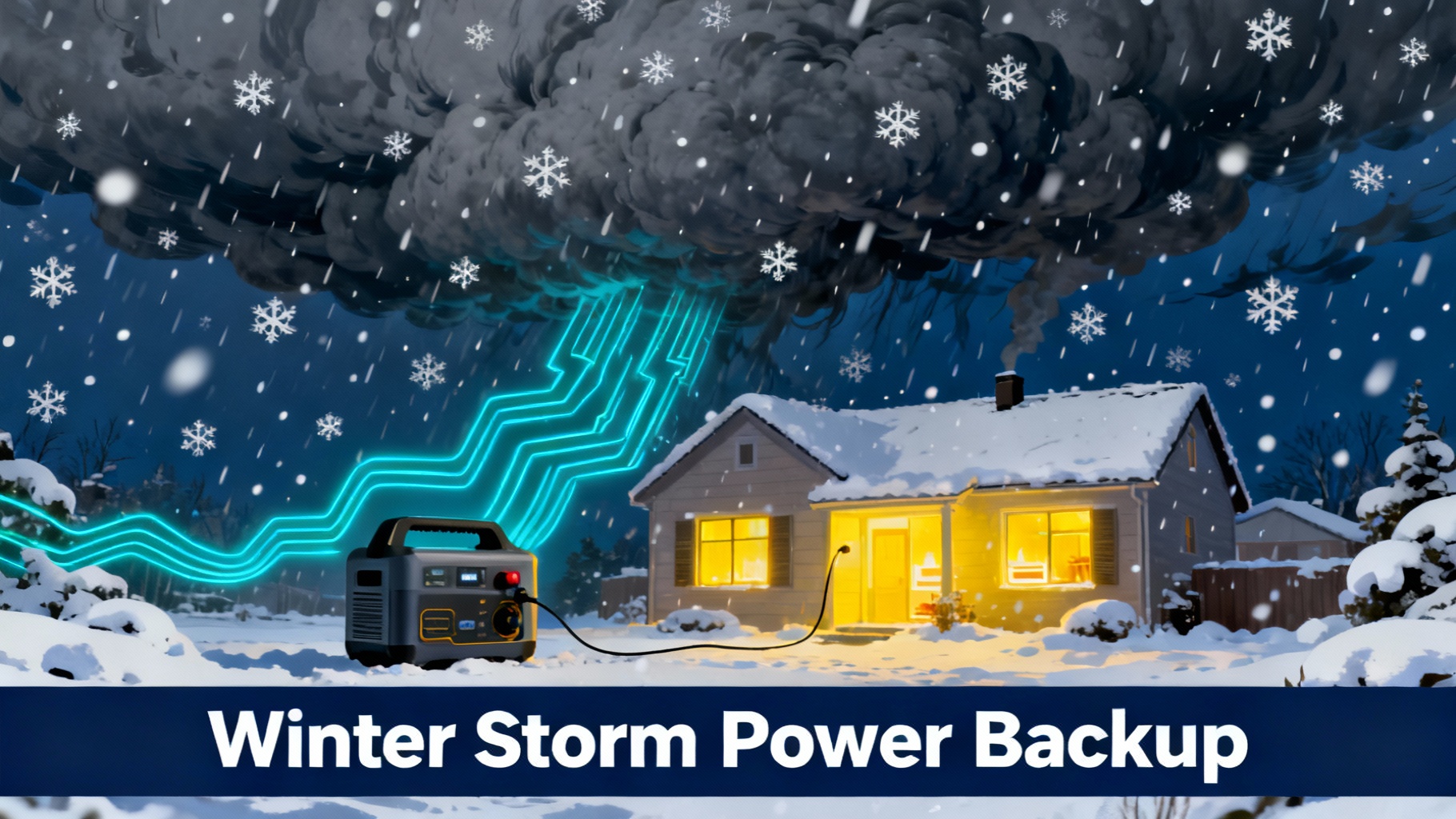

When the lights went out at 2 AM during last winter’s ice storm, the temperature inside dropped to 45°F within 6 hours. The pipes were at risk, the food was spoiling, and the portable heater sat useless without power. For homeowners in cold climates, losing electricity during a winter storm isn’t just an inconvenience—it’s a genuine emergency that threatens both your property and your family’s safety.
Winter power outages happen more often than most people realize. According to NOAA winter storm statistics, 36% of winter outages last 6 hours or longer, with some stretching into days. The Texas freeze in 2021 left 4.5 million people without power when temperatures plummeted to -2°F. The financial cost of frozen pipes alone averages $5,000 to $10,000 in repairs. Add spoiled food, medical device failures, and the sheer discomfort of sitting in a freezing house, and the stakes become crystal clear.
But here’s the challenge: winter storms create unique power demands that standard backup solutions struggle to meet. Your batteries lose 20-40% of their capacity when temperatures drop below freezing. Solar panels produce 25-50% less energy in winter due to snow cover and low sun angles. Traditional generators require fuel that can gel up below 15°F. And the devices you need most—space heaters, pipe heat tape, medical equipment—all draw significant continuous power.
This guide walks you through everything you need to keep your home powered safely through winter storms. We’ll cover three battery systems tested in extreme cold conditions, explain how temperature affects performance, calculate realistic heating runtimes, and help you prioritize which devices to keep running. By the end, you’ll know exactly which setup keeps your family warm and your home protected, even when the grid stays dark for days.
Get the 1-page outage plan
What to plug in first, how long a fridge really runs on a battery, and the 3 safety rules for connecting a power station to your home. Printable, sent by email.
About one email a week. Unsubscribe in one click. We may earn a commission when you buy through our links, at no extra cost to you. Privacy Policy
Why Winter Storms Require Different Power Solutions
Winter outages aren’t like summer blackouts. The challenges multiply when temperatures drop, creating demands that catch most homeowners unprepared.
Temperature Impact on Batteries
Battery chemistry changes dramatically in cold weather. Lithium-ion cells slow down as temperatures fall, causing voltage to drop from the nominal 3.7V down to 3.3V at 0°F. This internal resistance increase means your battery can’t deliver power as efficiently. The capacity reduction follows a predictable curve: you lose about 10% at 50°F, 20% at 32°F, and up to 40% at 0°F. What makes this particularly challenging is that these aren’t just numbers on a spec sheet—they represent real-world runtime that vanishes when you need it most.
❄️ Battery Capacity Loss by Temperature
Standard Li-ion vs LiFePO4 batteries used in modern Jackery systems. LiFePO4 chemistry maintains better performance in freezing temperatures.
The good news is that LiFePO4 batteries, which both Jackery and Bluetti use in their modern systems, handle cold significantly better than standard lithium-ion. LiFePO4 chemistry only loses 10-15% capacity at 32°F compared to 20-30% for regular lithium-ion. The thermal stability is better, the discharge rates stay more consistent, and some models even include battery warming systems that maintain optimal operating temperature.
Heating Loads Equal High Wattage
Heating devices demand entirely different power profiles than summer cooling. A space heater typically pulls 1,000 to 1,500W continuously, with startup surges reaching 1,800W. Electric blankets use 50-200W depending on the setting, making them a more viable long-term option. Ceramic and infrared heaters generally operate in the 750-1,500W range. The critical difference from summer? A fan might draw 50W, but winter heating requires 20-30 times more power. This fundamentally changes your runtime calculations. A 1,500Wh battery powering a 1,200W heater lasts only 1.25 hours—not nearly enough for a multi-hour outage.

Increased Critical Device Load
Winter storms also force you to run more critical devices simultaneously. You need space heaters for warmth and electric blankets for sleeping. Property protection requires pipe heat tape drawing 200-300W and possibly a sump pump at 800W. Food preservation becomes more urgent when you can’t easily replace spoiled groceries—your fridge pulls 150W and freezer another 200W. Communication stays essential with WiFi routers at 20W, phone charging at 40W, and weather radios at 10W. Medical devices like CPAP machines and oxygen concentrators can’t be postponed. Add LED lighting at 40W total, and you’re looking at potential simultaneous loads of 2,500-3,500W.
The realistic approach? You won’t run everything at once. Strategic device rotation keeps your critical systems operating while staying within your battery’s capacity. Most homeowners can manage 800-1,200W of prioritized loads through careful cycling—heat for a few hours, then switch to food preservation, then back to heating.
Understanding Your Winter Power Requirements
Before choosing a battery system, you need to understand what you’re actually trying to power and for how long. Check out our capacity calculator tool for personalized sizing recommendations.
Heating Strategy Calculations
Start with your heating strategy. Running a 1,500W space heater continuously for 8 hours requires 12,000Wh of capacity—that’s 12 kWh, which exceeds even the largest portable power stations for home backup. The math simply doesn’t work for all-day heating. Instead, think in terms of heating cycles. Run your heater for 2-3 hours to warm the space, then switch to insulated clothing and electric blankets drawing just 100-200W. This cycling approach extends your runtime dramatically. A 2,000Wh battery can provide 2 hours of space heating plus 8-10 hours of blanket warmth, getting you through a cold night safely.
⚡ Quick Runtime Calculator
⚠️ Cold Weather Note: Reduce these runtimes by 15-20% when temperatures drop below freezing.
Food Preservation Priority
Food preservation takes priority after immediate safety. Your refrigerator and freezer don’t need to run continuously. A full freezer stays frozen for 48 hours if you keep the door closed. Your refrigerator needs about 15 minutes of runtime per hour to maintain safe temperatures. This intermittent operation means a 2,000Wh battery can keep your fridge running for days with proper management.
Medical Devices Come First
Medical devices come first, always. CPAP machines typically use 30-60W, meaning a 2,000Wh battery provides 33-66 hours of runtime. Oxygen concentrators draw 250-350W, giving you 6-8 hours. Home dialysis machines need 200-400W. If someone in your household depends on medical equipment, size your backup system around these requirements first, then add other needs.


Communication and Lighting
Communication and lighting use minimal power but provide maximum value. Your WiFi router draws 15-20W, your phone charges at 10-15W, and LED bulbs use 8-12W each. Running these devices 24/7 for two days consumes maybe 2,000Wh total. You can—and should—keep communications running throughout any outage.
Get the 1-page outage plan
What to plug in first, how long a fridge really runs on a battery, and the 3 safety rules for connecting a power station to your home. Printable, sent by email.
About one email a week. Unsubscribe in one click. We may earn a commission when you buy through our links, at no extra cost to you. Privacy Policy
How Cold Weather Affects Battery Performance
Temperature doesn’t just reduce capacity—it changes how batteries behave in ways that directly impact your emergency preparedness.
Discharge Rate Limitations
Discharge rates slow down as temperature drops. That 3,000W inverter might only deliver 2,400W when the battery is cold. The voltage sag under load becomes more pronounced. Devices that normally start easily might struggle or fail to power on. This is why you can’t simply rely on the rated specs when planning for winter outages.
⚠️ Important: Most lithium batteries can’t safely charge below 32°F. The chemistry literally can’t accept electrons properly when it’s too cold. Forcing charge into a frozen battery damages the cells, reducing lifespan and creating safety risks. Some newer power stations include battery warming features that heat the cells before allowing charging to begin.
Solar Charging Challenges in Winter
Solar charging in winter presents compound challenges. Snow blocks your panels completely, requiring manual clearing. The low sun angle means panels produce less power even in clear conditions. Shorter days give you fewer charging hours. Cold temperatures actually improve solar panel efficiency slightly, but the reduced available sunlight overwhelms this small benefit. You might see 25-50% of your summer solar output during winter months. A panel array that fully charges your battery in 4 hours during summer might take 8-10 hours in winter—if you’re lucky.
Storage temperature matters too. If you keep your power station in an unheated garage or shed, it arrives at an emergency already cold-soaked and operating at reduced capacity. LiFePO4 batteries handle storage cold better than lithium-ion, but both perform best when kept in temperature-controlled environments.
The practical implications? When planning your winter backup system, reduce rated capacity by 20-30% for realistic cold-weather performance. Account for slower charging times. Keep your battery indoors when possible. And understand that the system performing great in your summer camping trips might struggle when it’s actually needed during a winter emergency.
Don’t miss our wildfire evacuation power guide for related preparation tips.
Best Battery Systems for Winter Storm Backup
Three systems stand out for homeowners facing winter power challenges, each targeting different needs and budgets.
Jackery Explorer 2000 Plus: Best for Expandable Winter Backup
The Explorer 2000 Plus brings 2,042Wh of LiFePO4 capacity with the ability to expand up to 12 kWh using additional battery packs. The inverter delivers 3,000W continuous power with 6,000W surge capability, handling space heaters and other high-draw devices without issue. At 43 pounds, it’s heavy but manageable for moving between rooms as needed.
For winter storms, the expandability makes the difference. Start with the base 2,042Wh unit at $1,999, then add Battery Pack 2000 Plus modules as your budget allows. Each expansion pack adds another 2 kWh of capacity. A fully expanded 12 kWh system can power critical loads for days, not hours.
The LiFePO4 cells handle cold better than standard lithium-ion, though you’ll still see that 10-15% capacity reduction below freezing. The solar charging accepts up to 1,000W of panel input, though winter conditions will limit your actual charging speed. The unit includes pass-through charging, letting you run devices while simultaneously recharging from solar or AC power.
Real-world winter performance shows this system handling a 1,200W space heater for about 1.5 hours on the base unit, or managing refrigerator and essential lighting for 36+ hours. Add expansion batteries and you extend that to multi-day outages. The 4,000 cycle lifespan means this investment lasts 10+ years with proper care. For detailed specs and testing results, see our full Jackery Explorer 2000 Pro review.
🏆 Our Top Pick for Winter Storm Backup
Why we recommend it: Expandable capacity handles multi-day outages, 3,000W output powers any space heater, LiFePO4 battery performs better in cold, and 10-year lifespan makes it a sound investment for winter preparedness.
$1,999 | Save $200 | Free shipping | 5-year warranty when purchased from official site
The limitation? That $1,999 base price puts it out of reach for some budgets. You’re paying for the expandability and premium LiFePO4 chemistry. If you don’t need expansion capabilities, the alternatives below might make more sense.
Jackery Explorer 2000 Pro: Best Value for Winter Power

The 2000 Pro offers 2,160Wh of capacity—slightly more than the 2000 Plus—at $1,599. You get 2,200W continuous output with 4,400W surge. The catch? No expandability. What you buy is what you get.
For many homeowners, this represents the sweet spot between capacity and cost. That 2,160Wh gives you similar runtime to the 2000 Plus base unit. You can run a 1,200W space heater for 1.8 hours, or manage your refrigerator for 14+ hours.
The LiFePO4 battery delivers the same cold-weather advantages and 4,000 cycle lifespan. The 2200W inverter handles most space heaters and common household devices. The 4,400W surge covers those brief startup spikes when motors kick on. Solar charging accepts up to 800W of panels—less than the 2000 Plus but still substantial. Charging from AC takes about 2 hours, which matters when you’re racing to recharge between storms.
At 43 pounds, it weighs the same as the 2000 Plus but costs $400 less. For homeowners who can calculate their maximum realistic needs and know they won’t exceed 2,160Wh, this delivers exceptional value. You’re getting essentially the same cold-weather battery performance and inverter quality, just without the expansion capability you might not need anyway.
💎 Best Value: Save $400 vs Expandable Model
Why consider this: Nearly identical capacity to 2000 Plus, handles same heating loads, proven cold-weather LiFePO4 performance, and significant cost savings if you don’t need expansion.
We also recommend reading our best Jackery for home backup.
$1,599 | Save $200 | Free shipping | 5-year warranty
The 2000 Pro works well for overnight backup or day-long outages when you’re managing loads carefully. Run your heater for a few hours, switch to electric blankets overnight, keep the fridge cycling, maintain communications—this capacity covers those needs. Where it falls short is multi-day outages without recharging. You can’t expand it, so what you have is what you have.
Jackery Explorer 1000 v2: Budget-Conscious Winter Option

At $799, the Explorer 1000 v2 makes winter backup accessible for budget-limited households. The 1,070Wh capacity and 1,500W output (3,000W surge) won’t power your whole home, but they can keep critical systems running.
This system forces hard choices about prioritization. You can run a 1,200W space heater for about 45 minutes—enough to warm a room but not maintain heat all night. Or you can power your refrigerator for 7+ hours. Or keep medical devices, lighting, and communications running for a full day.
The strategy with this capacity level involves strict cycling. Heat your bedroom for an hour before bed, then switch to electric blankets at 150W for overnight warmth. During the day, rotate between refrigerator, heating, and device charging. Keep communications and lighting running continuously—they barely impact the battery. This managed approach extends the system’s usefulness considerably.
The LiFePO4 battery still delivers 4,000 cycles and better cold performance than lithium-ion, though at 1,070Wh you’re starting with less capacity before the cold weather reduction. The unit weighs just 24 pounds, making it easy to move room to room as needs change.
💰 Budget Option: Essential Winter Backup Under $800
Best for: Single-person households, apartments, or supplement to a generator. Provides meaningful emergency capability with strategic load cycling—better than sitting in the dark.
$799 | Save $100 | Free shipping | 5-year warranty
Solar charging accepts up to 400W of panels, and AC charging takes about 2 hours. The smaller capacity actually becomes an advantage for charging—you can fully recharge during a 4-hour window of grid power, assuming you have time between storm waves.
This system works best for single-person households, apartment dwellers, or as a supplement to a generator. It won’t replace a whole-home backup solution, but it bridges the gap between having nothing and having comprehensive coverage. For $799, it provides meaningful emergency capability when the alternatives are sitting in the dark or running a noisy gas generator.
Setting Up Your Winter Storm Power System
Having the right equipment means nothing if it’s not positioned correctly when the storm hits.
✅ Pre-Storm Setup Checklist
• Fully charge when storm warning
• Check monthly during winter
• Minimize extension cord runs
• Seal doors to retain heat
• Tilt at latitude + 15°
• Keep accessible for snow clearing
• Heating: cycles
• Food: 15 min/hour
Start by keeping your power station indoors year-round. A cold-soaked battery already operating at reduced capacity doesn’t help anyone. Store it in a climate-controlled space—a closet, basement corner, or bedroom works fine. The battery needs to stay between 40-80% charge during storage for optimal longevity. Check it monthly during winter rather than assuming it’s ready.
💡 Pro Tip: Create a power priority list before the emergency. Write down which devices matter most and their wattages. Medical equipment tops the list, then heat, then food preservation, then everything else. When you’re cold, tired, and stressed during a multi-day outage, you don’t want to make these decisions in the moment.
Test your setup before winter arrives. Run your heater off the battery for an hour. Power your refrigerator overnight. Verify your runtime calculations match reality. Finding problems during a drill beats discovering them during an actual emergency.
Preparation is everything — see our best Bluetti for home backup.
Managing Power During Extended Winter Outages
When the grid stays down for days, battery management separates comfort from crisis.
Cycling strategies extend your runtime dramatically. Instead of running your 1,500W heater continuously until the battery dies, heat your space for 2-3 hours, then let thermal mass hold the temperature. Your house acts like a thermal battery itself. A well-insulated room heated to 68°F will stay comfortable for hours after you turn off the heater, especially if you’re using blankets and warm clothing. Windows are where that heat escapes fastest, so drawing lined curtains before dark is one of the cheapest ways to hold the temperature. Be careful what you buy on that front, though: “thermal” on a curtain label describes a lining, not a measured rating, and none of the major brands publish an insulation figure.
Monitor your battery percentage constantly. Most power stations show remaining capacity on their display. When you hit 50%, reassess your power use. Can you reduce heating? Consolidate refrigerated items to one appliance? Switch to lower-power alternatives? The time to adapt your strategy is at 50%, not at 10%.
For extended outages beyond 2-3 days, consider our comprehensive guide on multi-day outage planning strategies.
Staying Safe During Winter Power Outages
Battery systems eliminate some dangers but create others that deserve attention.
The absence of carbon monoxide is portable power stations’ biggest safety advantage over generators. You can run these systems indoors without poisoning risk. However, never assume any power source is completely safe. For more information on preventing carbon monoxide exposure during emergencies, see the CDC’s carbon monoxide poisoning prevention guidelines.
⚠️ Critical Safety Warning: Frozen pipes create thousands in damage within hours. Heat tape powered by your battery system can prevent disaster, but it draws 200-300W continuously. For most battery capacities, this competes directly with space heating. Prioritize pipe protection in unheated spaces—basements, crawl spaces, exterior walls. Let indoor pipes rely on residual heat from your intermittent space heating. Learn more about preventing frozen pipes during outages.
Extension cord fires cause more damage during outages than people realize. Use heavy-gauge cords rated for the wattage you’re drawing. A 1,500W heater needs 14-gauge or thicker wire. Never daisy-chain extension cords or power strips. One quality 25-foot cord beats three thin cords connected together. Check cords for warmth during use—if they feel hot, upgrade to heavier gauge.
Space heater safety becomes critical when you’re running them for extended periods. Keep heaters at least 3 feet from anything flammable. Never leave them unattended while running. Modern ceramic heaters include tip-over shutoffs, but older models don’t. If you’re using a battery to run a heater overnight, invest in a heater with multiple safety features.
Frequently Asked Questions
How long will a power station actually run my space heater in cold weather?
Expect about 1-1.5 hours from a 2,000Wh battery running a 1,200W heater, accounting for cold weather capacity reduction. This isn’t enough for continuous heating, but works well in cycling mode—heat for 2 hours, maintain with blankets for 6 hours, repeat. Realistic winter planning means accepting that you can’t heat continuously for days on battery power alone. The strategy is intermittent heating to warm spaces, then using insulation and electric blankets to maintain comfort.
Can I charge my power station in freezing temperatures?
Most lithium batteries cannot safely charge below 32°F without battery warming features. Forcing charge into cold cells damages them permanently. Systems with built-in warming features automatically heat the battery before allowing charging. Without this feature, bring your battery indoors and let it reach room temperature before charging—usually 30-60 minutes. Check your specific model’s manual for cold weather charging guidelines, as this varies by manufacturer and battery chemistry.
Which devices should I prioritize during a winter outage?
Medical equipment comes first, always—CPAP machines, oxygen concentrators, and critical health devices run continuously. Next prioritize moderate heating using cycling strategies rather than continuous operation. Food preservation runs third—your fridge needs about 15 minutes per hour, your freezer stays frozen for 48 hours with the door closed. Communications and lighting use minimal power so keep them running 24/7. Everything else gets power if capacity allows. Write this priority list before the emergency, not during it, so you’re not making critical decisions while cold and stressed. For CPAP users specifically, our complete CPAP backup power guide covers UPS-grade options that prevent any reset during winter outages.
How much does cold weather actually reduce battery capacity?
LiFePO4 batteries (used in modern Jackery and Bluetti systems) lose about 10-15% capacity at 32°F and 20-30% at 0°F. Older lithium-ion batteries lose 20-30% at freezing and up to 40% at 0°F. This means your 2,000Wh battery effectively becomes 1,700-1,800Wh in typical winter conditions. Plan your power needs using reduced capacity numbers, not rated specifications. This capacity loss is temporary—batteries return to full capacity when warmed back up.
Can solar panels charge my battery during winter storms?
Solar charging in winter faces multiple challenges. Snow blocks panels completely until you clear them. Cloud cover during storms reduces output to near zero. Even in clear conditions, low sun angles and short days cut production by 25-50% compared to summer. Solar works as a supplement during winter outages, not as the primary charging solution. Plan for AC charging or generator backup for reliable recharging. If you do rely on solar, position panels south-facing at your latitude plus 15 degrees, and keep them accessible for frequent snow clearing.
What’s the difference between the 2000 Plus and 2000 Pro for winter use?
The 2000 Plus ($1,999) offers expandability up to 12 kWh, making it ideal for multi-day outages or larger homes. The 2000 Pro ($1,599) provides similar base capacity (2,160Wh) but cannot expand. For winter performance, both use LiFePO4 batteries with similar cold-weather characteristics. Both handle the same heating loads and offer 4,000 cycle lifespans. Choose expandability if you might need more capacity later or face frequent multi-day outages. Choose the Pro if you’ve calculated your maximum needs and they fit within 2,160Wh—you’ll save $400 without sacrificing cold-weather performance.
How do I prevent my pipes from freezing during a power outage?
Pipe heat tape draws 200-300W continuously—manageable with a 2,000Wh+ battery but it competes with space heating. Prioritize heat tape in vulnerable areas: basements, crawl spaces, exterior walls. Let indoor pipes benefit from residual heat from your space heating cycles. If facing multi-day outage with limited battery capacity, heat the house to save the pipes rather than powering heat tape—a warm house protects all pipes, while heat tape only covers specific sections. Drip faucets slightly if you have water pressure, as moving water freezes more slowly. Property damage from frozen pipes averages $5,000-$10,000, so pipe protection deserves serious attention in your power planning.
Is it safe to run a battery power station indoors all night?
Yes, battery power stations produce no carbon monoxide, making them safe for indoor use unlike generators. Ensure adequate ventilation around the unit to prevent heat buildup. Place on a hard, flat surface with space on all sides. Never cover vents or place near flammable materials. While safe from CO poisoning, they still need basic electrical safety precautions like any device pulling significant power. The ability to run these systems indoors overnight is one of their biggest advantages for winter storm backup—you can keep essential devices powered in the rooms where you’re sleeping without any exhaust fume risks.
How long do these batteries actually last before needing replacement?
LiFePO4 batteries in modern power stations are rated for 4,000 cycles to 70% capacity. Using your system 50 times per year means 80 years before hitting that threshold—you’ll replace the unit for other reasons first. More realistically, expect 10-15 years of service even with frequent use. Cold weather doesn’t significantly accelerate degradation if you follow proper charging guidelines. The battery typically outlasts most other components in the system. These aren’t like phone batteries that degrade noticeably after 2-3 years—LiFePO4 chemistry is far more durable for long-term backup applications.
Can I use my power station while it’s charging?
Yes, most modern power stations support pass-through charging, letting you run devices while simultaneously charging from AC, solar, or generator power. This matters during storms when you might have brief grid restoration windows. Charge the battery while running critical devices, then continue on battery when power drops again. Check your specific model’s specifications—pass-through is standard on Jackery’s Plus and Pro lines but verify before counting on it. This feature transforms how you manage power during on-and-off grid situations common in winter storms.
Conclusion: Preparing for Winter Storm Blackouts
Winter power outages demand different preparation than summer blackouts. The cold amplifies every challenge—batteries lose capacity, heating draws massive power, and the stakes climb from inconvenience to genuine danger. Understanding these unique demands helps you choose the right backup system and use it effectively when the lights go out.
The Jackery Explorer 2000 Plus stands out for homeowners who need expandable capacity for multi-day outages. The 2000 Pro delivers exceptional value for those who’ve calculated their maximum needs and can live within 2,160Wh. And the 1000 v2 makes winter backup accessible for budget-conscious households willing to manage loads carefully.
Beyond the hardware, success comes from realistic planning. You can’t heat continuously for days on battery power. You can manage 2-3 hour heating cycles followed by blanket warmth. You can’t run everything simultaneously. You can prioritize medical devices, rotate between heating and food preservation, and keep communications running. The difference between comfort and crisis during a winter storm isn’t just capacity—it’s strategy.
Start preparing before the next storm warning. Keep your battery indoors at 40-80% charge. Create your device priority list now, not during the emergency. Test your heating cycles to verify runtime calculations. Position solar panels for winter sun angles. Because when that 2 AM ice storm knocks out power and temperatures start dropping, you’ll already know exactly what to do.
For broader emergency preparedness strategies beyond winter storms, see our guide on hurricane preparedness and power backup planning.
Ready to Protect Your Family This Winter?
Don’t wait for the next ice storm. The Jackery Explorer 2000 Plus gives you expandable capacity, cold-weather LiFePO4 performance, and the peace of mind that comes from knowing your family stays warm and safe—even when the grid goes dark for days.
Shop Winter Storm Backup Systems →
Limited Time: Save $200 | Free Shipping | 5-Year Warranty
Visit Emergency Preparedness Power Hub →
Originally published: December 31, 2025