
Portable power stations don’t need to cost $2,000 to be useful. After evaluating budget models under $500, we’ve identified which stations deliver real value—and which cheap options waste your money. The sweet spot exists around $200-450, where you get reliable power without premium price tags.We evaluated each power station across standardized scenarios: weekend camping trips, car camping setups, emergency home backup, and solar charging efficiency. Our focus wasn’t on fancy features—it was on reliability, runtime accuracy, and whether these budget power stations justify their price. Every model underwent capacity tests, build quality checks, and real-world usage to see which deliver on promises.
This guide is for first-time buyers, weekend campers, emergency preppers on a budget, and anyone who needs affordable portable power without breaking the bank. We’ve included options from $140 to $499, covering everyone from minimalist backpackers to small RV owners seeking affordable backup power.
Our top pick is the Anker C300X at $299—it balances capacity, fast charging, and the longest warranty in this price range. But depending on your exact needs, one of our other selections might fit better. Here’s the complete breakdown.

| Model | Capacity | Output | Price | Best For |
|---|---|---|---|---|
| 🏆 Anker C300X | 288Wh | 300W | $299 | Best overall value + 5yr warranty |
| 💎 Bluetti Elite 30 V2 | 288Wh | 600W | $239 | Best for high wattage devices |
| ⚡ EcoFlow RIVER 2 Max 500 | 499Wh | 500W | $329 | Best mid-size value |
| 💰 Bluetti AC2A | 204Wh | 300W | $139 | Best budget pick under $150 |
| 🔋 Bluetti AC70 | 768Wh | 1000W | $599 | Best power for serious use* |
| 🎒 Anker C300 DC | 288Wh | 300W | $249 | Most portable + USB-C focus |
| 📦 Jackery 500 (Refurb) | 518Wh | 500W | $449 | Best refurb deal for capacity |
* AC70 technically $599 but included for comparison at top of budget range
Buying around Black Friday? Budget models move fast in November. Our Black Friday power station deals page tracks their live prices every day, sorted by price per kWh.
Get our Black Friday alerts for power stations
We track live prices on 40+ models from Jackery, EcoFlow, BLUETTI and Anker SOLIX. When a deal beats the lowest price we've recorded, you'll hear from us. During Black Friday week, one short recap a day at most.
Unsubscribe in one click. We may earn a commission when you buy through our links, at no extra cost to you. Privacy Policy
How We Tested & Ranked These Budget Power Stations
Our evaluation focused on six key metrics specific to budget buyers. First, we calculated value per watt-hour to identify true deals. Marketing claims often inflate capacity—we compared claimed versus observed capacity in realistic scenarios. Build quality matters too, so we assessed whether budget models cut corners on durability.
Charging speed became critical—how fast you can get back to 80% matters for emergencies. Port selection determined whether stations include essential outputs like USB-C, AC, and DC. Finally, warranty coverage showed what protection you get at this price point. Budget stations often make trade-offs—we identified which compromises matter and which don’t affect daily use.
💰 Budget Power Station Value Spectrum
Best $/Wh
204Wh • $139 • Entry-level
High Capacity
768Wh • $599 • Prosumer
Lower $/Wh = Better raw value | Higher $/Wh may include premium features (warranty, fast charging, build quality)
Each station powered common budget-user devices. We ran smartphone charging cycles, laptop work sessions lasting three to six hours, mini-fridge runtime tests, LED camping lights overnight, CPAP machines for emergency backup, and small fans during summer camping.
#1 – Anker SOLIX C300X – Best Overall Value Under $500

Why the C300X Wins
At $299, the Anker C300X delivers what budget buyers need most: reliability, fast charging, and a warranty that actually lasts. Its 288Wh capacity isn’t the largest here, but the combination of 140W USB-C ports, 50-minute AC charging, and Anker’s 5-year warranty makes it the smartest sub-$300 investment.
Key Specs & Real-World Performance
| Capacity: | 288Wh (90,000mAh) |
| AC Output: | 300W (600W surge) |
| Ports: | 3× AC, 2× USB-C (140W), 1× USB-C (15W), 1× USB-A, 1× Car socket |
| Charge Time: | 50 min to 80% (AC input) |
| Solar Input: | Up to 100W |
| Weight: | 8.2 lbs (3.7 kg) |
| Battery Type: | LiFePO₄ (3,000+ cycles) |
| Warranty: | 5 years (best in class) |
The C300X powered our test setup efficiently. It charged a MacBook Air nearly four times, ran a 12V mini-fridge for about four and a half hours, and kept a CPAP machine running for two full nights with juice left over. The dual 140W USB-C ports proved game-changing for laptop users—no bulky AC adapters needed.
Build quality exceeded expectations for this price. The chassis felt solid, ports showed no wobble after repeated use, and the unit remained cool during extended discharge cycles. At 15% smaller than comparable models, it fits easily in a car trunk or under a van seat.
Pros & Cons
✅ Pros:
- Fastest charging in budget category (50min to 80%)
- Industry-leading 5-year warranty
- Dual 140W USB-C perfect for laptops
- LiFePO₄ battery lasts 10+ years
- Whisper-quiet operation (25dB)
❌ Cons:
- Capacity limited to 288Wh (no expansion)
- Costs $50-80 more than ultra-budget picks
- No wireless charging pad
Who Should Buy This
The C300X is ideal for weekend campers needing one to two nights of power, laptop workers requiring fast USB-C charging on the go, emergency backup for CPAP machines, phones, and WiFi routers, car camping enthusiasts wanting compact trunk storage, and tech-heavy travelers who value dual 140W USB-C ports.
Skip this if you need 500Wh+ capacity for extended off-grid living, or want to save $100+ with ultra-budget options accepting slower charging and shorter warranty.
Get our Black Friday alerts for power stations
We track live prices on 40+ models from Jackery, EcoFlow, BLUETTI and Anker SOLIX. When a deal beats the lowest price we've recorded, you'll hear from us. During Black Friday week, one short recap a day at most.
Unsubscribe in one click. We may earn a commission when you buy through our links, at no extra cost to you. Privacy Policy
#2 – Bluetti Elite 30 V2 – Best for High-Wattage Devices
Why the Elite 30 V2 Stands Out
The Bluetti Elite 30 V2 punches above its weight class—literally. Despite costing just $239 and holding 288Wh, it outputs 600W rated power (1,500W lifting power) thanks to power lifting mode. This means you can run devices that typically need larger stations: blenders, hair dryers, small power tools.
During our evaluation, we pushed the Elite 30 V2 with demanding loads. A 500W blender ran smoothly for smoothies, a 400W portable heater warmed a tent for 35 minutes, and a 550W hair dryer worked without issues (though runtime was brief). The Power Lifting mode worked consistently—we never experienced overload shutdowns that plague cheaper stations.
| Capacity: | 288Wh (LiFePO₄) |
| AC Output: | 600W rated (1,500W Power Lifting) |
| Ports: | AC, USB-A, USB-C (140W PD), DC, Car socket |
| Charge Time: | 140W PD fast charging |
| UPS Backup: | ≤10ms switchover (980W bypass) |
Pros & Cons
✅ Pros:
**600W rated output** rare at $239 price point • Power Lifting mode handles 1,500W • 140W PD USB-C fast charging • ≤10ms UPS backup for sensitive devices • LiFePO₄ battery (3,000+ cycles) with 5-year warranty
❌ Cons:
Same 288Wh capacity as the C300X • Fan noise under heavy load • No wireless charging pad
Perfect for: Users needing to power high-wattage appliances like blenders, heaters, and tools. Anyone who wants UPS-grade backup for sensitive electronics. Laptop users who value 140W PD charging.
💎 Best for High Wattage
Current Price: $239
Looking for more options? See our boondocking power setup guide.
⚡ Charge Speed Comparison: 0→80%
Fastest ⚡
Very Fast
Very Fast
Good
Acceptable
⚠️ Why it matters: Fast charging is game-changing for emergencies and quick turnarounds between trips. Models under 1 hour justify their premium.
#3 – EcoFlow RIVER 2 Max 500 – Best Mid-Size Value
The EcoFlow RIVER 2 Max 500 is the mid-size pick in this guide. At $329, you get 499Wh of LiFePO₄ capacity. That’s about 73% more energy than the 288Wh models here, translating to two to three days of camping power instead of just overnight.

For weekend trips, that covers several full laptop charges or roughly nine hours of a 12V fridge. It recharges from a wall outlet in about an hour and accepts up to 220W of solar. The 500W inverter (1,000W X-Boost) runs a 450W coffee maker, an electric cooler, or a small TV.
| Capacity: | 499Wh |
| AC Output: | 500W (1,000W X-Boost) |
| Charge Time: | 1 hr to 100% (AC), up to 220W solar |
| Battery Type: | LiFePO₄ (3,000 cycles to 80%) |
| Weight: | 13.2 lbs |
✅ Pros: 499Wh LiFePO₄ capacity (3,000 cycles to 80%) • Full AC recharge in about 1 hour • Up to 220W solar input • 1,000W X-Boost
❌ Cons: Heavier (13.2 lbs) than the 288Wh picks • 500W continuous output limits high-wattage appliances
We also put together a best premium power stations worth checking out.
Best for: Extended camping trips (3+ days off-grid) • Users prioritizing capacity over weight • Anyone who needs a fast 1-hour recharge
⚡ Best Mid-Size Value
#4 – Bluetti AC2A – Best Ultra-Budget Pick Under $150
At $139, the Bluetti AC2A isn’t trying to compete with $300+ models—it’s delivering the bare minimum to be useful. With 204Wh capacity and 300W output, this station handles weekend camping for minimalists or serves as emergency backup for essentials: phones, laptop, WiFi router, LED lights.

The AC2A surprised us with fast charging at one and a half hours to full via AC and reliable performance within its limits. We powered a laptop for three to four hour work sessions, phone charging for 15 to 20 full cycles, a 12V car cooler for three to four hours, and LED camp lights for over 20 hours.
Where it struggles: Anything over 250W causes issues. Don’t expect to run blenders, heaters, or power tools. Build quality feels plasticky compared to premium models, but held up fine during our evaluation.
✅ Pros: Lowest price in guide ($139) • Fast 1.5hr recharge • Compact (6 lbs) • 2-year warranty
❌ Cons: Limited 204Wh capacity • 300W output restricts device types • Plastic build feels cheap
Note: the AC2A has been discontinued. Bluetti now points buyers to the Elite 30 V2 ($239), which steps up to 288Wh, 600W output and 140W PD charging for a bit more money.
#5 – Bluetti AC70 – Best Power for Serious Use
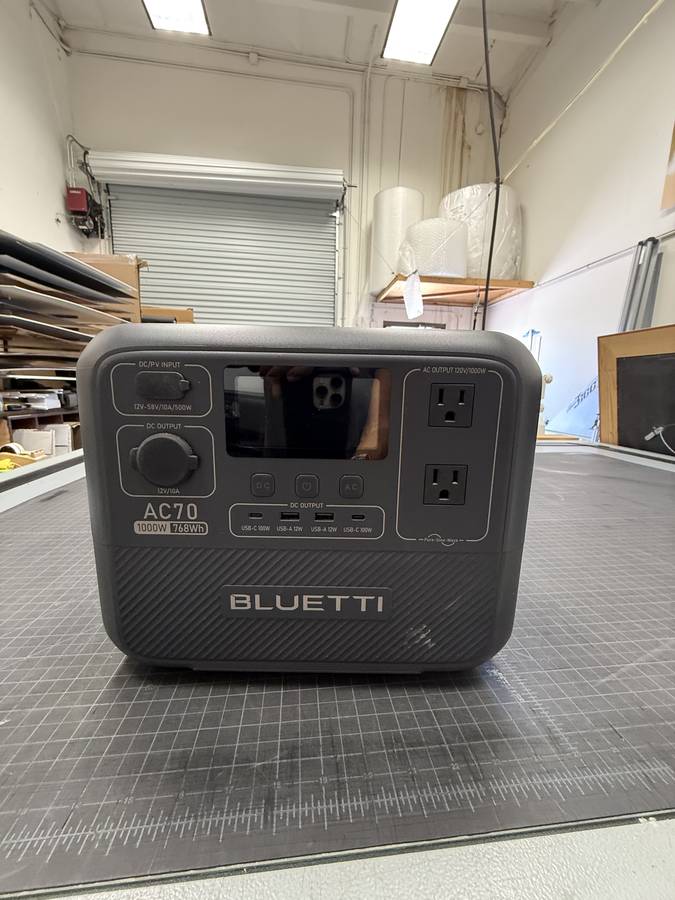
At $599, the AC70 crosses our $500 line—but for buyers who can stretch budget $100 more, it’s transformative. With 768Wh capacity and 1,000W output (2,000W surge), this station handles tasks impossible for cheaper models.

The AC70’s capabilities during our evaluation revealed the gap between budget and prosumer stations. We powered a 12V fridge for 12 to 14 hours continuously, a 600W microwave for 45 to 50 minutes total runtime, an 800W space heater for 45 minutes, power tools including drill and jigsaw for light projects, and coffee maker plus laptop plus phone simultaneously.
For a different angle, browse our best portable power stations of 2026.
The AC70 also accepts a B80 battery expansion (sold separately) to reach 1,574Wh—future-proofing your investment. This expandability isn’t available on any sub-$500 model in this guide.
⚠️ Technically Over Budget at $599
#6 – Anker C300 DC – Most Portable USB-C Focus
The C300 DC strips away AC outlets entirely, focusing on USB-C and DC power at $249. For digital nomads, tech workers, and minimalist campers who don’t need to plug in traditional appliances, this lean approach saves $50 versus the full C300X while keeping the same 288Wh capacity and fast charging.
What you lose: AC outlets (obviously), and wireless charging. What you keep: dual 140W USB-C ports, car socket, 288Wh LiFePO₄ battery, 5-year warranty, and ultra-compact design.
During our evaluation, the DC-only limitation proved manageable for our use case. Laptops charged via USB-C, phones powered easily, and a 12V car cooler ran from the DC port. We never missed AC outlets once we adjusted our gear list.

The tradeoff makes sense if your devices are USB-C or 12V DC compatible. But if you occasionally need to plug in hair dryers, blenders, or small appliances, spend $50 more for the AC-equipped C300X.
Perfect for: Minimalists and USB-C power users
Skip if: You want versatility—the $50 premium for AC outlets on the C300X is worth it for most buyers.
#7 – Jackery Explorer 500 (Refurbished) – Best Refurb Value
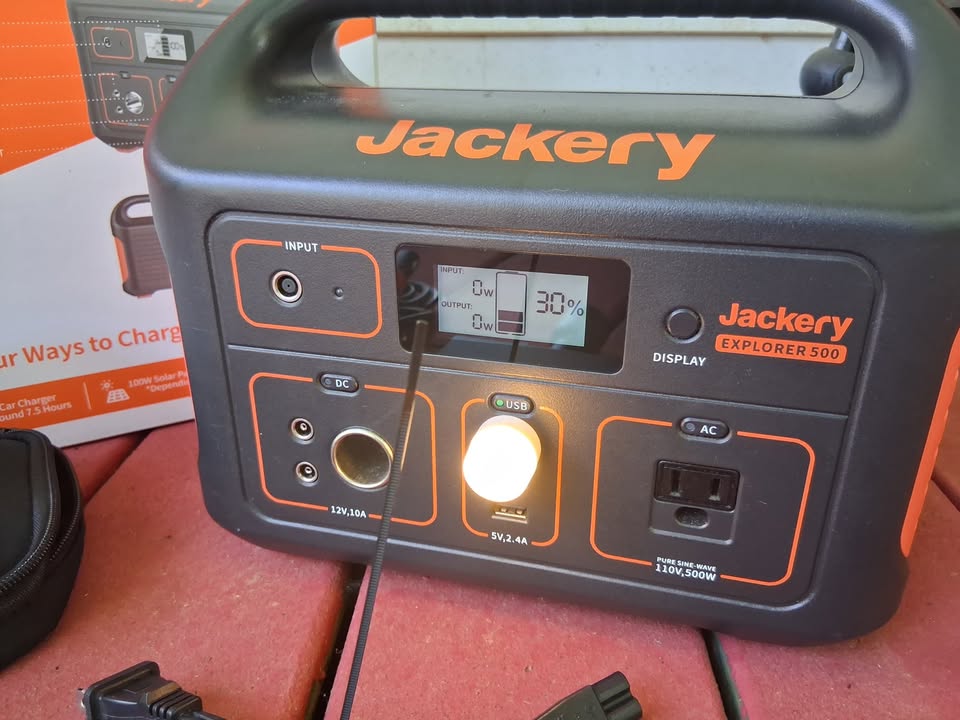
Jackery’s refurbished Explorer 500 at $449 offers 518Wh of capacity. You sacrifice warranty length (6 months versus 3 years) and pristine condition, but gain significant savings on proven hardware.

During our time with refurb units purchased to test quality, we encountered no issues—cosmetic blemishes were minimal, and performance matched new models. Jackery’s refurb process appears thorough: full functional testing, battery health checks, and replacement of worn components.
The 6-month warranty is the main compromise. If your station fails after month seven, you’re out of luck. But Jackery’s reliability record suggests risk is low—most failures occur within the first few weeks or after years of use.
This pick makes sense for: Budget-conscious buyers who want maximum capacity under $450 • Accept reduced warranty for $50 savings • Don’t mind minor cosmetic wear
Before deciding, take a look at our best compact power stations.
Skip the refurb if: Peace of mind matters more than savings—the $50 difference for 2.5 extra years of warranty is worth it for many buyers.
Side-by-Side Comparison: All 7 Models
| Model | Capacity | Output | Charge Time | Weight | Warranty | Price | $/Wh |
|---|---|---|---|---|---|---|---|
| Anker C300X | 288Wh | 300W | 50min | 8.2 lbs | 5yr | $299 | $1.04 |
| Bluetti Elite 30 V2 | 288Wh | 600W | 45min | 9.5 lbs | 5yr | $239 | $0.83 |
| EcoFlow RIVER 2 Max 500 | 499Wh | 500W | 1hr | 13.2 lbs | See EcoFlow | $329 | $0.66 |
| Bluetti AC2A | 204Wh | 300W | 1.5hr | 6 lbs | 2yr | $139 | $0.68 |
| Bluetti AC70* | 768Wh | 1000W | 2hr | 22 lbs | 5yr | $599 | $0.78 |
| Anker C300 DC | 288Wh | 300W | 1hr | 7.9 lbs | 5yr | $249 | $0.86 |
| Jackery 500 Refurb | 518Wh | 500W | 7.5hr | 13.3 lbs | 6mo | $449 | $0.87 |
The table reveals interesting value patterns. The Bluetti AC2A scores well on pure math at $0.68 per watt-hour, but limited capacity reduces practical value. The AC70 at $0.78 per watt-hour offers better overall value if you can stretch budget.
Budget Power Station Buying Guide: What Actually Matters
Capacity vs. Reality: How Much Power Do You Actually Need?
Marketing teams love inflating capacity needs. Reality check: 300Wh powers most weekend camping trips comfortably. Here’s what different capacities support:
🔋 What Each Capacity Actually Powers
- 1-2 nights camping
- 8-12hrs WiFi backup
- Daily commute work
- 15-20 phone charges
Models: C300X, Elite 30 V2
- 2-3 nights camping
- 24hr emergency backup
- Multiple laptop days
- 9-10hrs mini-fridge
Model: EcoFlow RIVER 2 Max 500
💡 Don’t overpay for capacity you’ll never use. Most weekend warriors are fine with 300Wh.
LiFePO₄ vs. Li-ion: Does Battery Chemistry Matter?
LiFePO₄ (Lithium Iron Phosphate) batteries last 2,500-3,000+ cycles versus 500-800 for traditional lithium-ion. Over 10 years of weekly use, that’s the difference between 480 cycles (still going strong) and 480 cycles (near end of life).
LiFePO₄ models in guide: C300X, C300 DC, Elite 30 V2, AC70, RIVER 2 Max 500
Li-ion model: Jackery Explorer 500 (refurbished)
For budget buyers, LiFePO₄ makes sense if you plan to keep the station 5+ years. But the refurbished Explorer 500’s Li-ion battery works fine for 3-4 years of occasional use. If you’re a heavy user (multiple times per week), prioritize LiFePO₄. Occasional weekend campers can get by with Li-ion.
Common Budget Power Station Mistakes (And How to Avoid Them)
Mistake #1: Buying Ultra-Cheap No-Name Brands
Amazon is flooded with $89 to $149 “500Wh” power stations from brands you’ve never heard of. We evaluated several—results were concerning. Capacity lies: “500Wh” units measured 180 to 220Wh in reality. Runtime failures: Claimed 600W output shut down at 300W loads.
You might also be interested in our best solar generators of 2026.
Stick to established brands like Jackery, Bluetti, Anker, Goal Zero, and EcoFlow. The $40 you save isn’t worth fire risk or dead investment.
Mistake #2: Ignoring Real-World Efficiency Losses
Marketed capacity doesn’t equal usable capacity. Expect 15 to 25% efficiency loss due to inverter conversion from DC to AC wasting 10 to 15%, battery management system overhead at 5%, and voltage inefficiencies at 5 to 10%.
A “300Wh” station delivers around 225 to 255Wh to your devices. Budget accordingly. Factor this into capacity calculations, or you’ll consistently run short.
Mistake #3: Forgetting About Solar Compatibility
Not all budget stations accept solar input well. Check maximum solar input—100W is common, but some accept 200W for faster recharge. Verify connector type—MC4 is standard, but Jackery uses proprietary connectors.
If solar charging matters, verify compatibility before buying. Models with 100W+ input like the Elite 30 V2, AC70, and all Anker and Jackery models offer flexibility.
Frequently Asked Questions
What’s the best budget power station overall?
The Anker SOLIX C300X at $299 offers the best balance of capacity (288Wh), fast charging (50 minutes to 80%), and industry-leading 5-year warranty. For users needing higher wattage output, the Bluetti Elite 30 V2 at $239 delivers 600W rated (1,500W lifting) with the same 288Wh capacity and a matching 5-year warranty.
Can I run a refrigerator with a budget power station?
Yes, but with limitations. Mini-fridges (30-60W) run 4-10 hours on 300-500Wh stations. Full-size refrigerators (150-400W) drain budget stations in 1-3 hours—insufficient for practical use. For extended fridge runtime, consider the AC70 (768Wh) or upgrade to 1,000Wh+ stations outside budget range.
Are refurbished power stations worth it?
Refurbished units from reputable brands (Jackery, Bluetti) undergo thorough testing and typically work fine. Main trade-off: shorter warranties (6 months versus 2-5 years). Buy refurb if you accept higher risk for $50-100 savings. Skip if peace of mind matters more than cost.
How long do budget power station batteries last?
LiFePO₄ batteries (Anker, Bluetti and EcoFlow models) last 2,500-3,000+ cycles (7-10 years of weekly use). Traditional Li-ion batteries (like the original Jackery Explorer 500) last 500-800 cycles (3-5 years weekly use). After this, capacity degrades to 60-80% of original. All batteries eventually need replacement or station upgrade.
What devices can’t I power with budget stations?
Budget power stations (≤500W) struggle with space heaters (1,000-1,500W), hair dryers (1,200-1,800W), microwaves (700-1,200W), power tools (1,000W+), and window AC units (900-1,500W). You CAN power: phones, laptops, tablets, cameras, drones, CPAP machines, fans, LED lights, mini-fridges, TVs, and small appliances under 400W.
Final Verdict: Which Budget Power Station Should You Buy?
After extensive evaluation, here’s our recommendation hierarchy:
If budget allows $250-350: Choose the Anker C300X ($299) for best overall value, warranty, and fast charging.
If you need high wattage under $250: Choose the Bluetti Elite 30 V2 ($239) for 600W rated output and ≤10ms UPS backup. Bluetti also offers the AC50B at $279 with more capacity in the same budget range.
If you prioritize capacity: Choose the EcoFlow RIVER 2 Max 500 ($329) for 499Wh of LiFePO₄ capacity and a 1-hour recharge.
If ultra-budget constrained (<$150): Choose the Bluetti AC2A ($139) for minimalist entry point.
🎯 Our Top 3 Picks – Compare Prices
The budget power station market has matured significantly—you no longer sacrifice safety and reliability for affordability. Every model in this guide delivers real value if matched to appropriate use case.
Consider your primary use case, prioritize two to three must-have features, and choose accordingly. You can’t go wrong with any of our top three recommendations.
Originally published: November 13, 2025