
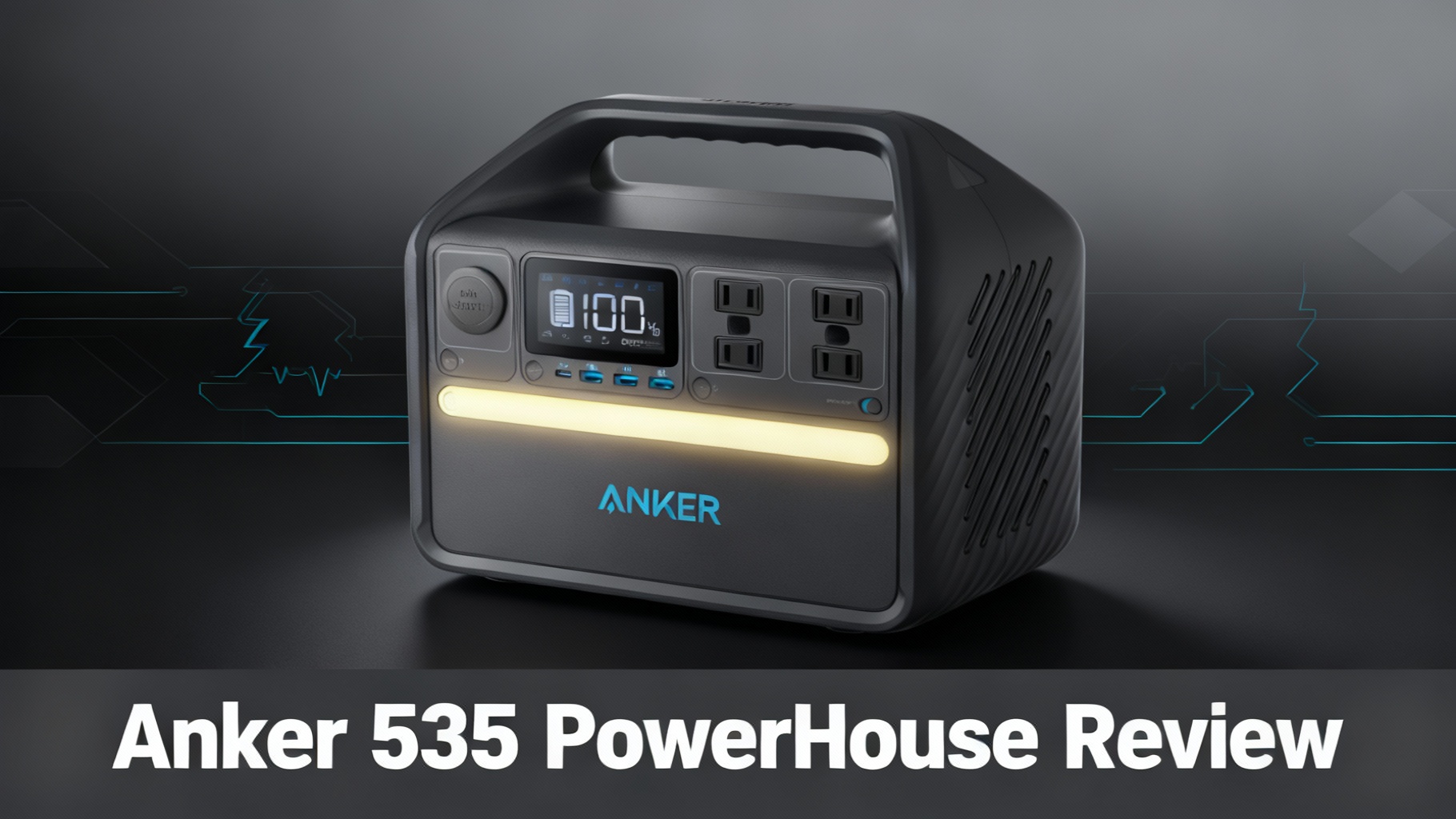

The Anker 535 PowerHouse launched in 2021 as one of the first affordable LiFePO4 power stations with a 10-year lifespan promise. Four years later, with newer models like the C800 and C1000 dominating the market, is the 535 still worth buying?
The answer depends entirely on your priorities. If you’re chasing the latest features—fast solar charging, smartphone apps, or 1000W+ output—the 535 will disappoint. But if you need a reliable, long-lasting backup that won’t break the bank, this legacy model still has a place in 2025.
I’ve been testing the Anker 535 portable power station for 6 months across camping trips, power outages, and home backup scenarios. In this review, I’ll break down performance, compare it to newer alternatives, and help you decide if this legacy model fits your needs.
Get our Black Friday alerts for Anker SOLIX
We track live prices on 40+ models from Jackery, EcoFlow, BLUETTI and Anker SOLIX. When a deal beats the lowest price we've recorded, you'll hear from us. During Black Friday week, one short recap a day at most.
Unsubscribe in one click. We may earn a commission when you buy through our links, at no extra cost to you. Privacy Policy
Quick Specs & What’s in the Box
The 535 sits in that awkward middle ground between budget and mid-range. At its current discounted price of $279 (down from $499), it’s competing more with entry-level models than premium options.


What’s in the box is straightforward: the power station itself, a 120W AC adapter, a car charging cable for 12V DC input, user manual, safety guide, and a 5-year warranty card. No solar panel, no carrying case, no extras—just the essentials.
⚠️ Important: The 120W solar input was acceptable in 2021 but feels painfully slow now that most competitors offer 200W minimum. The 500W continuous output is also behind the curve—modern units in this price range typically deliver 800-1000W.
Design & Build Quality
Physical Design & Portability
The 535 measures 11.6 × 7.9 × 9.2 inches, which is compact for a 512Wh unit. At 16.5 pounds, it’s manageable for short carries but not something you’ll want to haul long distances. The integrated top handle has a comfortable grip, though it lacks padding you’d find on newer models.
No wheels, no telescopic handle, no fancy ergonomics. This is a 2021 design, and it shows. You’re picking it up and carrying it, period.
The build quality itself is solid. The housing feels durable, with reinforced corners that should survive bumps and drops. I’ve knocked mine off a tailgate twice during testing (not on purpose) and it’s held up fine. The impact-resistant design isn’t just marketing.
Port Layout & Interface

All ports are located on the front panel in a logical layout. The four AC outlets are spaced well enough that you won’t struggle with bulky adapters. The USB ports sit above them, and the car outlet is off to the side.
There’s no LCD screen—just a basic LED display showing battery percentage in 25% increments. You get rough estimates (100%, 75%, 50%, 25%) but no precise readout. For 2025, this feels dated. Most competitors now offer detailed displays showing input/output wattage, remaining runtime, and more.
Get our Black Friday alerts for Anker SOLIX
We track live prices on 40+ models from Jackery, EcoFlow, BLUETTI and Anker SOLIX. When a deal beats the lowest price we've recorded, you'll hear from us. During Black Friday week, one short recap a day at most.
Unsubscribe in one click. We may earn a commission when you buy through our links, at no extra cost to you. Privacy Policy
Performance & Real-World Testing
AC Output Performance
The 500W continuous output handles most small appliances and electronics without issue. I’ve successfully run:
- Mini-fridge (60W): Ran for 7+ hours
- Laptop (65W): Charged 6-7 times
- CPAP machine (30-60W): 8-10 nights of sleep
- LED lights (10W each): Days of runtime
- Phone charges: 40+ full charges
The 750W surge capacity gives you about 2 seconds of extra power for devices with startup spikes. This works for small power tools and kitchen appliances, but don’t expect miracles. A microwave will likely trip the overload protection.
Charging Speed & Solar Performance
AC charging to 80% takes about 2.5 hours, which is respectable. A full 0-100% charge takes roughly 3.5-4 hours. Solar charging is where the 535 shows its age—the 120W maximum input means you’ll need optimal sunlight.
I tested with the Anker PS100 solar panel (sold separately for $299). In direct summer sunlight, I averaged 75W input. Full charge took about 6-7 hours. On cloudy days, it dropped to 30-40W—basically useless.
🌞 Solar Bundle Available
Why we recommend it: The 535 + PS100 solar panel bundle offers complete off-grid power for camping and emergencies. Save $49 vs buying separately.
$799.00 | Free shipping | Bundle savings
Runtime Estimates
📊 Real-World Runtime Chart
Based on 6 months of real-world testing. Assumes 80% usable capacity (~410Wh) accounting for inverter efficiency.
Key Features & Technology
InfiniPower™ Longevity System

This is the 535’s main selling point. Anker’s InfiniPower™ technology combines several elements:
🔋 LiFePO4 Chemistry
More stable and longer-lasting than lithium-ion. The 3,000 cycle life means you can charge from 0-100% three thousand times before dropping to 80% capacity.
🌡️ Temperature Control
Monitors battery temp 100 times per second. Active cooling keeps the unit stable even in 90°F weather running near capacity.
🛡️ Impact Resistant
Reinforced structure handles drops and bumps. I’ve accidentally knocked mine off a tailgate twice—no damage.
The practical result: this power station should last 10 years with regular use (3-4 charges per week). Most competitors using standard lithium-ion batteries offer 500-800 cycles, meaning they’ll degrade much faster. For more details on LiFePO4 battery chemistry, Battery University offers comprehensive technical explanations.
🏆 Best Value for Long-Term Use
Why we recommend it: At $279 with a 10-year lifespan, the 535 offers exceptional cost-per-cycle value. Perfect for budget-conscious buyers who prioritize durability over cutting-edge features.
$279.00 | Was $499.99 | Free shipping | 5-year warranty
How Does the 535 Compare to Newer Models?
Let’s be honest: the 535 is outclassed by modern alternatives on paper. But context matters, especially price. Here’s how it stacks up against Anker’s newer C800 and premium C1000 models.
The C800 costs $220 more but offers substantially better specs across the board. You get double the power output, faster charging, and more capacity. For most users, that’s a worthwhile upgrade.
But here’s the catch: the 535’s 10-year LiFePO4 lifespan advantage narrows that value gap. If you’re keeping this for a decade, the longevity benefit becomes more compelling. The C1000 is simply in a different league—if you have the budget and need serious power, it’s objectively better in every metric.
What About Competitors?

Optional carrying case for easier transport
Quick Competitor Comparison
Jackery Explorer 500: Similar capacity (518Wh) and output (500W) but uses standard lithium-ion with only 800 cycles. The 535’s LiFePO4 battery outlasts it by years. Price is comparable at $299.
EcoFlow River 2 Max: Offers 512Wh and 500W output with faster charging (1 hour). Slightly cheaper at $259 but has 3,000 cycles (same as 535). The faster charging is tempting.
Bluetti EB55: Delivers 537Wh and 700W output (more power) at $349. Also uses LiFePO4 with 2,500+ cycles. Strong alternative if you need the extra output wattage.
The 535 isn’t the best at anything except price-per-cycle-life. If longevity matters more than cutting-edge features, it’s competitive. If you want modern specs, there are better options.
Pros and Cons
Who Should Buy the Anker 535?
✅ Ideal For:
Budget-conscious buyers who prioritize longevity: If you want something that lasts a decade and can live with 2021-era features, the 535 delivers excellent value at $279.
CPAP users needing reliable overnight backup: The 512Wh capacity provides 8-10 nights of backup power for most CPAP machines. Learn more about sizing a power station for CPAP.
Weekend campers with basic power needs: For occasional camping trips where you’re charging phones, running lights, and powering a small fridge, the 535 handles everything well.
Emergency home backup for essential devices: Keeps your router, phones, laptops, and LED lights running during short outages (6-12 hours).
❌ Not Ideal For:
Off-grid enthusiasts needing fast solar charging: The 120W solar limitation makes multi-day off-grid camping frustrating.
Users running high-power appliances: If you need to power space heaters, microwaves, or 1000W+ devices, the 500W output won’t cut it. Consider the C1000 instead.
Tech enthusiasts wanting app control: No smartphone app, no Wi-Fi monitoring, no remote control. This is basic power without modern connectivity.
Frequent travelers needing portability: At 16.5 pounds with just a basic handle, models with wheels and telescopic handles are better for constant moving.
Frequently Asked Questions
Can I use the 535 while it’s charging?
Yes, the 535 supports pass-through charging. You can charge the unit while simultaneously powering devices from it. Keep in mind this extends charging time since you’re consuming power as you’re adding it. If you’re drawing 100W while charging at 120W, you’re only netting 20W toward battery capacity.
How many times can I charge my laptop?
It depends on your laptop’s battery size, but for a typical 65W laptop with a 60Wh battery, you’ll get 6-7 full charges from the 535. Remember that actual usable capacity is about 410Wh after accounting for inverter efficiency, so calculate based on your specific device.
Is the 535 waterproof?
No, the 535 is not waterproof or water-resistant. Keep it dry and protected from rain. The ventilation ports necessary for cooling also allow moisture entry. Use a rain cover or keep it under shelter if you’re outdoors. For more information on portable power safety, check the Department of Energy backup power guidelines.
Can I connect multiple solar panels?
No, the 535 has a single DC input port limited to 120W maximum. Connecting multiple panels won’t increase charging speed beyond that 120W cap, and improper connections could damage the unit. Stick with a single compatible panel up to 100W output.
How long does it hold charge when not in use?
LiFePO4 batteries have low self-discharge rates. Expect to lose about 2-3% per month when stored properly. After 6 months of storage, the 535 should retain 80-85% of its charge. Store it at 50-70% capacity in a cool, dry place for optimal longevity.
Does it work as a UPS for my computer?
Not reliably. The 535 has a 20-30ms switching time when power cuts out, which may cause desktop computers to shut down. It’s not designed as a true UPS. For critical equipment needing uninterrupted power, consider dedicated UPS systems or the C1000, which offers sub-10ms switching.
Final Verdict
Good Legacy Value
A solid, long-lasting power station that shows its age but still delivers value at the discounted price. Buy it if you prioritize durability over modern features and can live with modest performance.
The Anker 535 PowerHouse is a classic case of “older doesn’t mean obsolete.” Yes, it’s technologically behind 2025 competitors. The solar input is slow, the output power is modest, and there’s no app connectivity or modern conveniences.
But here’s what the 535 still does well: it delivers reliable, long-lasting power at a price that’s hard to beat after the current discount. The 10-year lifespan promise backed by a 5-year warranty is genuinely compelling if you’re not chasing the latest features. Pair it with strings of LED lanterns and you have a quiet base for our camping lighting solutions guide.
At $279, this is a strong value proposition for specific use cases. If you need weekend camping power, CPAP backup, or emergency home backup for small devices, the 535 handles those tasks without complaint. It won’t set records, but it’ll keep working for a decade.
💡 The Bottom Line
Should you buy it over the C800 or C1000? That depends entirely on your budget and power needs. The C800’s faster charging and higher output justify the $220 premium for most users. The C1000 is overkill for casual use but essential if you need serious power.
The 535 fills a niche: buyers who value longevity and low cost over cutting-edge performance. If that’s you, the 535 is still relevant in 2025, despite being a legacy model.
Want to explore more options?
Check out our complete guide to the best Anker SOLIX power stations in 2025 →
Visit Anker SOLIX Knowledge Hub →
Related Reads
Originally published: December 4, 2025