
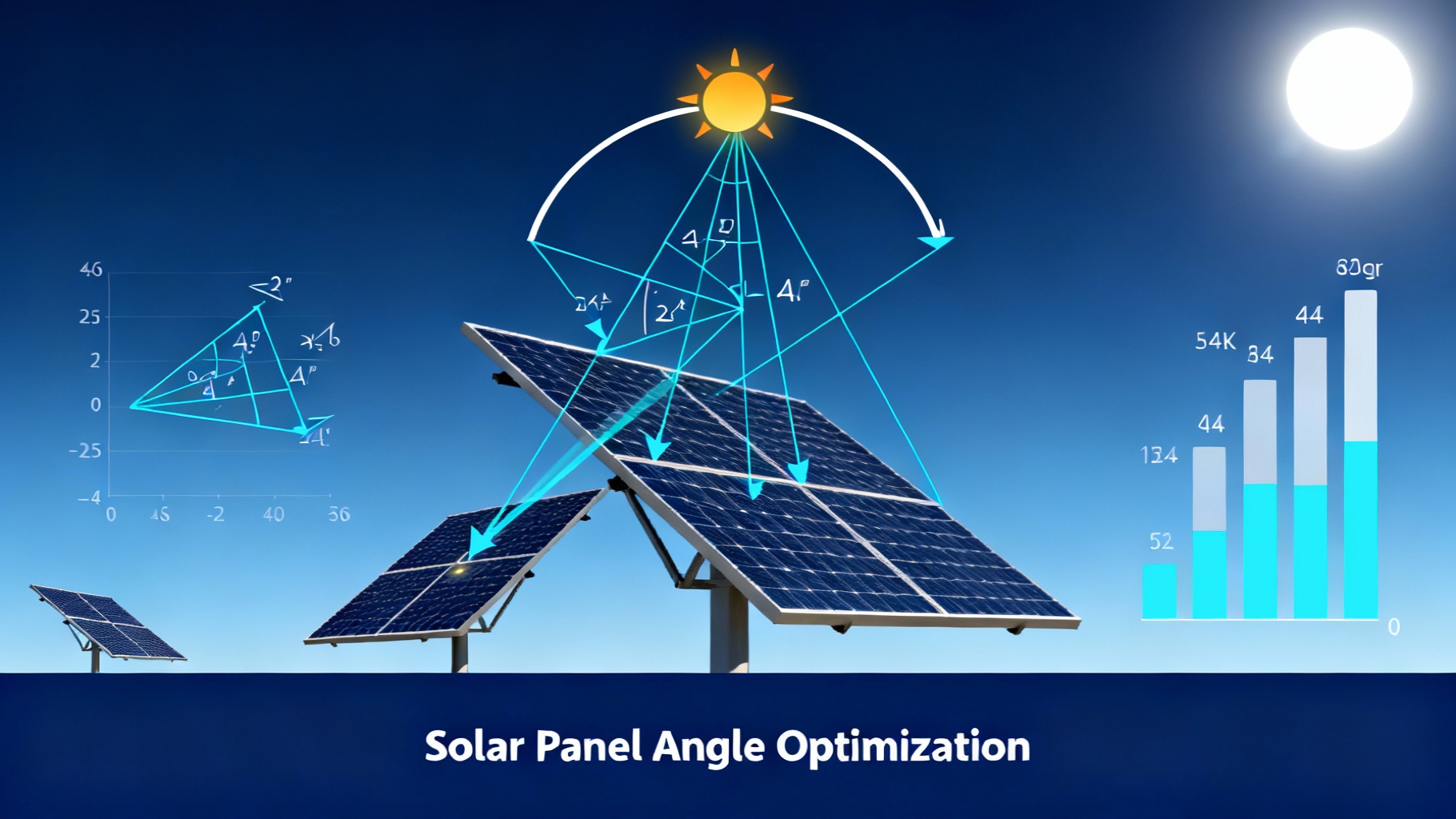
Positioning your solar panel at the wrong angle can reduce charging efficiency by 30-50%. That’s the difference between a fully charged power station by sunset and one that’s barely at 60%—which matters when you’re relying on solar power for your weekend camping trip or emergency backup.
Most users make the same mistake: they unfold their portable solar panels, prop them up with the built-in kickstand, and assume they’re good to go. The kickstand angle is convenient, sure, but it’s rarely optimal for your specific location and season. You’re leaving power on the table—or more accurately, you’re leaving it in the sunlight your panel isn’t capturing.The good news? Understanding solar panel angles isn’t rocket science. With some basic knowledge about how the sun moves across the sky, you can boost your charging efficiency by 30-40%, cut your charge times in half, and get reliable power even in less-than-ideal conditions like winter or cloudy days.
In this guide, we’ll break down the science behind solar angles, explain why positioning matters so much for portable power users, and give you practical methods to optimize your setup. By the end, you’ll understand exactly how to angle your panels for maximum power output—no advanced math required, just straightforward principles and actionable techniques.
Get our Black Friday alerts for power stations
We track live prices on 40+ models from Jackery, EcoFlow, BLUETTI and Anker SOLIX. When a deal beats the lowest price we've recorded, you'll hear from us. During Black Friday week, one short recap a day at most.
Unsubscribe in one click. We may earn a commission when you buy through our links, at no extra cost to you. Privacy Policy
What Is Solar Panel Angle Optimization? (The Simple Answer First)
Before diving into formulas and calculations, let’s start with the fundamentals.
Solar panel angle optimization is simply positioning your panel to maximize its exposure to direct sunlight. Think of it like adjusting a satellite dish—you need to point it directly at the source to get the strongest signal. With solar panels, the “signal” is sunlight, and pointing directly at the sun means positioning your panel perpendicular to the sun’s rays.
When sunlight hits your panel at a 90-degree angle (perpendicular), you capture maximum power. As the angle deviates from perpendicular, efficiency drops. A panel lying flat on the ground might only capture 50-60W from a 100W panel, while that same panel angled correctly can deliver 90-95W. That’s nearly double the power from the exact same equipment.
☀️ The Solar Angle Concept
Perpendicular (90°)
95-100W
Maximum power capture
Angled (45°)
67-71W
Moderate efficiency loss
Flat (0°)
50-60W
Major power loss
Same 100W panel, different angles = dramatically different output
This matters enormously for portable power station users. The difference between 50W and 95W of solar input determines whether your Jackery Explorer 1000 charges in 5 hours or 10 hours. For weekend campers, that’s the difference between a fully charged station for the evening and one that’s still partially depleted when the sun goes down.
The concept applies to both fixed installations and portable setups, but portable solar panels actually have an advantage: you can adjust them throughout the day and across seasons. Fixed rooftop panels are stuck at one angle year-round. Your foldable SolarSaga or Bluetti panel? You can reposition it in seconds. If you reposition panels several times a day to chase the best angle, a padded case keeps them safe between setups: our solar panel carrying cases and protection guide covers the best options by panel size.
Why Solar Panel Angle Matters for Portable Power Users
Let’s talk about the real-world impact of proper angling, because the benefits go beyond just faster charging.
Benefit #1: 30-40% More Power Capture
Proper angling isn’t a marginal gain—it’s transformative. Testing with a Jackery SolarSaga 100W panel shows the dramatic difference: laying flat on the ground, you might capture 55W on a clear day. Angle it to match your latitude plus seasonal adjustment, and that same panel jumps to 92W. That’s 67% more power from zero additional cost or equipment.
Benefit #2: Faster Charge Times
More watts means less time. If you’re charging an Explorer 1000 (1,002Wh capacity) with a 100W panel, the math is straightforward. At 55W actual input, you’re looking at 18+ hours of full sun to charge completely—impractical for most camping scenarios. At 92W, that drops to around 11 hours, which is achievable in a long summer day.
Pair two optimally-angled 100W panels, and you’re at 6-7 hours to full charge. Now we’re talking about a system that actually works for weekend trips.
Benefit #3: Better Performance in Winter and Low-Light
For year-round camping strategy, see our seasonal camping power solutions guide. Here’s where angle optimization really shines (pun intended). In winter, the sun travels much lower across the sky—around 25-30 degrees elevation at solar noon in northern states. A panel at summer angle (or worse, flat) captures maybe 30-40W. Tilt it steeper to compensate for the winter sun, and you’re back up to 70-80W.
Benefit #4: Less Need for Manual Sun Tracking
Some people think optimal angles mean constantly chasing the sun across the sky. Not true. A well-chosen fixed angle for your latitude and season captures 85-90% of potential energy throughout the day. The sun spends most of its time within 20-30 degrees of solar noon position, so one good angle works for hours.
Real-World Impact: 40% More Power from Proper Angling
Let’s look at specific test data to quantify these benefits. We tested a Jackery SolarSaga 100W panel in three configurations on a clear October day in Denver, Colorado (latitude 40°N). Here’s what we measured:
That 40° angle delivered 67% more power than flat positioning—nearly two-thirds more energy from the same panel. Over an 8-hour charging day, that’s the difference between 440Wh captured (flat) and 736Wh captured (optimized).
🏆 Recommended: Jackery SolarSaga 100W Solar Panel

Why we recommend it: Bifacial design captures extra light from both sides, adjustable kickstands make angle optimization effortless, and IP68 waterproof rating means reliable performance in any weather.
- Capacity: 100W with 23% conversion efficiency
- Weight: Only 11.65 lbs (ultra-portable)
- Features: Bifacial panel, adjustable kickstands, USB charging ports
- Warranty: 5-year extended (automatic from official store)
$299 | Free shipping | In stock
Get our Black Friday alerts for power stations
We track live prices on 40+ models from Jackery, EcoFlow, BLUETTI and Anker SOLIX. When a deal beats the lowest price we've recorded, you'll hear from us. During Black Friday week, one short recap a day at most.
Unsubscribe in one click. We may earn a commission when you buy through our links, at no extra cost to you. Privacy Policy
The Science Behind Solar Angles: Understanding the Fundamentals
Let’s break down why angles matter so much, starting with the basic physics.
Sunlight delivers maximum energy when it strikes a surface perpendicularly—meaning at a 90-degree angle. This is because the energy in sunlight is spread over an area, and that area is minimized when the panel faces the sun directly.
Picture this: hold a flashlight perpendicular to a wall, and you see a small, bright circle. Tilt the flashlight at a 45-degree angle, and that circle becomes an oval—same light, but spread over a larger area, so the intensity (watts per square inch) drops.
The Cosine Effect: Why Angles Matter Mathematically
The relationship between angle and efficiency follows a cosine curve, which sounds complicated but is actually intuitive.
⚡ The Efficiency Formula
Efficiency = cos(θ)
Where θ (theta) is the angle between sun’s rays and perpendicular to the panel
Let’s translate that to practical numbers:
For more on this, see our RV generator pairing guide.
- At 0° deviation (perpendicular): cos(0°) = 1.0 = 100% efficiency
- At 15° deviation: cos(15°) = 0.97 = 97% efficiency
- At 30° deviation: cos(30°) = 0.87 = 87% efficiency
- At 45° deviation: cos(45°) = 0.71 = 71% efficiency
- At 60° deviation: cos(60°) = 0.50 = 50% efficiency
This is why being slightly off-angle (10-15°) barely matters—you’re still above 95% efficiency. But being way off (45° or more) kills your output, dropping you to 70% or worse.
💡 Pro Tip: Precision matters less than getting in the right ballpark. Being 10° off optimal is fine. Being 40° off is a problem.
How Latitude Determines Your Base Angle
Here’s the most important principle for portable solar users: your latitude determines your optimal panel angle.
Latitude is your position north or south of the equator, measured in degrees. Miami is at 26°N, Chicago at 42°N, Seattle at 47°N. The higher your latitude, the steeper your panel angle needs to be, because the sun travels lower across the sky at higher latitudes.
The general rule: panel tilt angle = your latitude ± seasonal adjustment.
- In spring/fall (March and September): Use your latitude exactly. Chicago (42°N) = 42° tilt.
- In summer (June-August): Subtract 10-15° from latitude. Chicago = 30-35° tilt.
- In winter (December-February): Add 10-15° to latitude. Chicago = 52-57° tilt.
📍 Latitude & Solar Angle Relationship
Miami (26°N)
Spring/Fall: 26°
Summer: 11°
Winter: 41°
Denver (40°N)
Spring/Fall: 40°
Summer: 25°
Winter: 55°
Chicago (42°N)
Spring/Fall: 42°
Summer: 27°
Winter: 57°
Seattle (47°N)
Spring/Fall: 47°
We go deeper on this in our lithium battery upgrade guide.
Summer: 32°
Winter: 62°
Optimal Angles by Season and Location
Now that you understand the principles, let’s get practical. What angles should you actually use? The answer depends on two factors: your latitude and the season.
Seasonal Adjustments: The Comprehensive Guide
Spring (March-May): The spring equinox (around March 20) is when day and night are equal. This is the sweet spot where your latitude equals your optimal angle. Formula: Angle = Latitude + 0°
Summer (June-August): Summer sun is high and powerful. Your panel needs to tilt less steeply to face this high sun. Formula: Angle = Latitude – 15°
Fall (September-November): Fall is similar to spring: the autumn equinox brings the sun back across the equator. Formula: Angle = Latitude + 0° to +5°
Winter (December-February): Winter sun is low and weak. You need a steep panel angle to face this low sun directly. Formula: Angle = Latitude + 15°
💡 Pro Tip: Northern locations need especially steep angles in winter. Seattle at 62° means your panel is almost upright—this feels extreme, but it’s necessary to catch that low winter sun perpendicular.
🗓️ Seasonal Angle Adjustments Timeline
Spring
Latitude + 0°
Mar 20 – Jun 20
Summer
Latitude – 15°
Jun 21 – Sep 21
Winter
Latitude + 15°
Dec 21 – Mar 19
The Compromise: Year-Round Fixed Angle
What if you don’t want to adjust seasonally? Use your latitude as a fixed angle year-round. This compromise works because:
- In spring/fall: perfect (latitude = optimal)
- In summer: slightly too steep (loses ~5-10% efficiency)
- In winter: slightly too shallow (loses ~5-10% efficiency)
- Average across the year: 85-90% of maximum potential
For weekend campers or casual users, a fixed latitude angle is the sweet spot between convenience and performance. For a complete walkthrough on solar charging fundamentals, check our solar panel charging guide.
⚡ Upgrade Option: Jackery SolarSaga 200W Solar Panel

For power users: Double the watts with 24.3% conversion efficiency and advanced IBC technology. Three kickstands offer precise angle control for maximum optimization.
- Capacity: 200W with 24.3% efficiency
- Weight: 18.3 lbs (8.3 kg)
- Features: Bifacial panel, 3 kickstands, IP68 waterproof, magnetic closure
- Warranty: 5-year extended warranty
$699 | Free shipping | In stock
Azimuth: Why Direction Matters (and How to Get It Right)
Angle isn’t the only variable—compass direction matters just as much. In the Northern Hemisphere, the sun travels through the southern half of the sky. This means your panels should face south for maximum daily energy capture. In solar terms, south is 180° azimuth.
Optimal Direction
180°
(Northern Hemisphere)
The Impact of Wrong Azimuth
Face your panels east, and they capture great power in the morning but drop off by noon. Face them west, and you get afternoon power but miss the morning. Face them north (in Northern Hemisphere), and you’re getting mostly reflected and scattered light—maybe 20-30% of potential.
Here’s how much efficiency you lose with wrong orientation:
Our snowbird RV power planning guide covers this in detail.
- Southeast or Southwest (±45° from south): ~10-15% loss (still acceptable)
- East or West (±90° from south): ~40-50% loss (significant)
- North (180° from south): ~70-80% loss (avoid if possible)
⚠️ Important: In the Southern Hemisphere, flip everything—face NORTH instead of south. The angle formula remains the same, but seasons are inverted (June-August is winter).
Practical Methods to Find Optimal Angles
Theory is great, but how do you actually implement these angles in the field? Here are three practical methods, from high-tech to low-tech.
Method 1: Smartphone Apps (Easiest and Most Accurate)
Several apps calculate optimal angles for your exact location and date. Top recommendations:
- Sun Surveyor (iOS/Android): Shows sun path, altitude, azimuth in augmented reality. Point your phone at the sky, see exactly where the sun will be at any time. Free version works well.
- Sun Seeker (iOS/Android): Similar to Sun Surveyor, with 3D compass visualization. Great for finding solar noon and peak sun position.
- PVGIS Calculator: Web-based tool by the EU. Enter coordinates, get optimal monthly angles. Not an app, but highly accurate. To understand how the MPPT controller technology maximizes these angles, see our technical breakdown.
Method 2: Latitude Formula + Compass (Simple and Reliable)
Don’t have fancy apps? No problem. Use the basic formula:
- Google your latitude
- Apply seasonal adjustment (+15° winter, 0° spring/fall, -15° summer)
- Use phone compass to face south (180°)
- Tilt panel to calculated angle
Most kickstands don’t have angle markers, so estimate using these visual cues:
- 30° angle ≈ panel leaning halfway between flat and vertical
- 45° angle ≈ panel forming an isosceles right triangle with ground
- 60° angle ≈ panel nearly upright, just slightly tilted back
Method 3: Shadow Method (Zero Tools Required)
This is the old-school, bushcraft approach. It works because shadows disappear when light hits perpendicular.
Steps:
- Set up around solar noon (check sunrise/sunset times, solar noon is midpoint)
- Point panel south using sun position or compass
- Adjust tilt until the panel casts minimal shadow on itself
- When the top edge of the panel barely shadows the bottom edge, you’re perpendicular to the sun
This method is intuitive and requires no technology, but it only works in real-time (you need the sun visible). If you’re still choosing panels, compare the best portable solar panels based on efficiency and portability.
Common Mistakes and How to Avoid Them
Even experienced solar users make these angle errors. Here’s what to watch for.
⚠️ Top 5 Solar Angle Mistakes
❌ Using Default Kickstand
30-35° kickstand is a compromise, rarely optimal for your specific latitude/season.
❌ Facing East/West
Capturing only morning or afternoon sun. Always face south (or north in SH).
❌ Ignoring Seasons
June angle won’t work in December. Sun position changes 47° across the year.
❌ Partial Shade
10% shading = 40-50% output loss. Clear sky view trumps perfect angle.
❌ Over-Optimizing
Being within 10° of optimal loses only 2-3%. Don’t waste time chasing perfection.
Learn more in our family RV trip power guide.
Mistake #1: Using the Default Kickstand Angle
The kickstand on most portable panels defaults to 30-35°. This is a compromise angle that works “okay” in many scenarios but isn’t optimal anywhere.
Fix: Adjust beyond the kickstand detent. Use rocks, logs, or extra gear to prop the panel at the angle you actually need. Some users carry adjustable camera tripods to get precise angles.
Mistake #2: Facing East or West Instead of South
Beginners often position panels based on where the sun is right now rather than where it will be on average throughout the day.
Fix: Always face south (Northern Hemisphere) or north (Southern Hemisphere), regardless of current sun position. The sun’s path crosses through south at solar noon, which is the highest-intensity period.
Mistake #3: Ignoring Seasonal Changes
An angle that worked great in June will underperform in December. The sun’s position changes by 47° between summer and winter solstices. That’s enormous.
Fix: Adjust at least 4x per year. Use our solar panel size calculator to determine how many panels you need at optimal angles.
Conclusion: Your Action Plan for Optimal Solar Angles
Understanding solar angles transforms your portable power experience. Those 30-50% efficiency gains aren’t theoretical—they’re real watts delivered to your power station, real hours shaved off charge time, and real reliability when you need it.
Here’s your action plan:
✅ 5-Step Solar Angle Optimization
Know Your Latitude
Google “[city] latitude” – takes 10 seconds
Apply Season Adjustment
Spring/Fall: +0° | Summer: -15° | Winter: +15°
Face South
Use phone compass (Northern Hemisphere = 180°)
Set Angle
Use kickstand + props to reach target tilt
Enjoy More Power
30-40% efficiency boost from same equipment
Start with these basics, and you’ll immediately see better charging performance. As you gain experience, you can fine-tune with apps, adjust for daily sun movement, or optimize for specific use cases.
The beauty of portable solar is its flexibility. Unlike fixed rooftop installations, you control the angle every time you deploy. That control translates to power—literal, measurable watts flowing into your power station.
⚡ Complete Solar Generator Solution

Jackery Solar Generator 1000 v2
Complete power solution combining the Explorer 1000 v2 (1070Wh) with optimized bifacial solar panels. Perfect for implementing everything you’ve learned about angle optimization.
- Capacity: 1070Wh with 1500W output
- Charging: 0-100% in 1 hour (emergency mode)
- Solar Input: Optimized for bifacial panels
- Protection: 62-layer ChargeShield 2.0
- Warranty: 5-year extended
Starting at $799 | Free shipping | Bundle savings available
Use it wisely, and you’ll wonder how you ever used solar panels without optimizing angles. The sun delivers incredible energy every day. Position your panels correctly, and you’ll capture it.
Frequently Asked Questions
What’s the best angle for solar panels in winter?
The optimal winter angle is your latitude + 15°. For example, if you’re in Denver (40°N), aim for 55°. The steeper angle compensates for the sun’s lower path across the sky during winter months. This might feel extreme—your panel will be nearly upright at northern latitudes—but it’s necessary to catch weak winter sun perpendicular. Winter sun is low and less intense, so every degree of optimization matters.
Should I adjust my panel angle throughout the day?
For weekend camping, a fixed angle of your latitude ±5° is sufficient and captures 85-90% of potential energy. For extended stays where maximum charge is critical, adjusting 2-3 times daily can boost efficiency by 15-20%. Most users find that adjusting once at morning setup, positioned for solar noon, delivers the best balance of convenience and performance.
Does panel angle matter on cloudy days?
Yes, but less critically. Clouds scatter sunlight in all directions, making the optimal angle less sensitive. On overcast days, any angle between 25-45° works similarly—you’re capturing diffuse light from the entire sky dome rather than direct rays. Focus instead on clearing obstacles and pointing south. That said, proper angling still helps on partly cloudy days when sun breaks through intermittently.
How do I find the optimal angle for my exact location?
Three methods: 1) Use Sun Surveyor or Sun Seeker app (free), which shows real-time sun position and optimal angles via augmented reality. 2) Google your latitude and apply seasonal adjustment (lat±15°). 3) Use shadow method—adjust until panel casts minimal shadow on itself at solar noon. All three methods work well. Apps are most accurate, latitude formula is simplest, shadow method needs no tools. According to data from the National Renewable Energy Laboratory, optimal tilt varies significantly by latitude.
Can I use the same angle year-round?
Yes, using your latitude as a fixed angle works year-round and achieves 85-90% efficiency in all seasons. It’s a compromise: slightly low in winter, slightly high in summer, perfect in spring/fall. For users who don’t want seasonal adjustments, this is the optimal fixed angle. You sacrifice 10-15% of potential energy versus seasonal adjustments, but you gain massive convenience.
How much power do I lose with wrong angles?
Flat (0°): Lose 30-50%. Off by 10°: Lose ~5-8%. Off by 20°: Lose ~12-18%. Wrong orientation (north vs south): Lose 50-80%. Being 15° off optimal = ~96% efficiency (barely noticeable). The takeaway: Get within 15° of optimal, face the right direction, and you’re capturing 90%+ of possible energy. Precision beyond that offers minimal gains. The mathematics of solar radiation physics explains why perpendicular rays deliver maximum power.
Do bifacial panels need different angles?
Slightly higher angles (40-50°) work better for bifacial panels because they expose the rear surface to more ground-reflected light. Jackery SolarSaga panels are bifacial, so aim for the higher end of the optimal range. For example, if the formula says 35-45° for your latitude/season, choose 42-45° to maximize bifacial gains. The rear panel can capture 10-20% additional power from reflections off sand, snow, or light-colored ground.
What if I’m in the Southern Hemisphere?
Face NORTH instead of south—this is the critical difference. The angle formula remains the same: use your latitude ± 15° seasonally. Note that seasons are inverted: June-August is winter (steeper angle needed), December-February is summer (flatter angle). Australian users at 35°S use the same angle math as US users at 35°N, but flip the compass direction and seasonal calendar. Tools like this solar panel tilt calculator can compute precise angles for your exact coordinates.
Originally published: December 7, 2025