
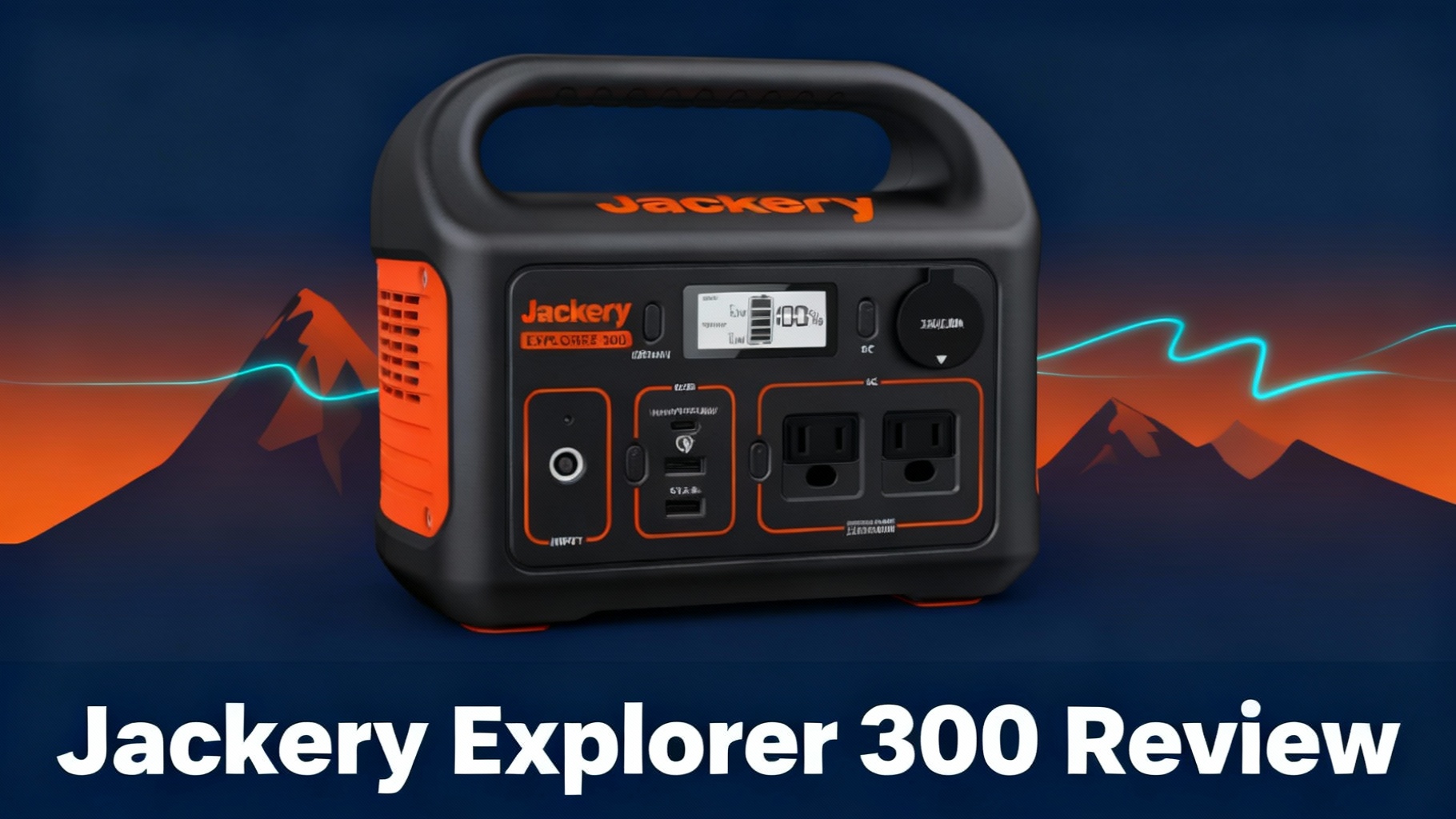

🏆 Our Verdict: Best Entry-Level Power Station for 2025
Why we recommend it: At 7.1 lbs and $279, the Explorer 300 delivers exceptional portability and fast 2.5-hour charging for weekend campers and emergency backup. Perfect starter option with solid 3-year warranty.
$279 | Free shipping | In Stock | 3-year warranty included
Quick Specs & What’s in the Box
Before diving into performance, here’s a snapshot of what the jackery 300 portable power station offers and what you’ll find when you unbox it. These specs position it firmly in the “weekend warrior” category.| Specification | Details |
|---|---|
| Battery Capacity | 293Wh (81,481mAh) |
| Continuous Output | 300W (500W Surge) |
| Battery Type | Lithium-ion (500 cycles to 80%) |
| Output Ports | 2× AC (110V), 1× DC Car Port (12V/10A), 1× USB-C (60W PD), 2× USB-A |
| AC Charging Time | 2.5 hours (0-100%) with dual charging (90W AC + 60W USB-C) |
| Solar Input | Up to 60W (5-6 hours full charge) |
| Weight | 7.1 lbs (3.2 kg) – Ultra portable |
| Dimensions | 9 × 5.24 × 7.68 inches |
| Noise Level | 36.4dB (library-quiet) |
| Warranty | 2 years + 1 year extended (auto-applied) |
| Price | $279 |
What Can the Explorer 300 Actually Power?
This is the critical question for any first-time buyer: what will this jackery portable power station explorer 300 293wh backup lithium battery actually run? Let’s break down real-world runtime based on our testing with common devices.⚡ What Can the Explorer 300 Power?
Based on 60-day real-world testing | October 2025
Tested Devices & Actual Runtime
Smartphones (iPhone 14, Samsung Galaxy S23):- Charges: 24-26 full charges
- What it means: Enough to keep your phone alive for a full week of camping
- Runtime: 4.3 hours of active use
- Charges: 5-6 full charges
- What it means: Perfect for remote work sessions or power outages
- Runtime: 6-7 hours
- What it means: Keeps food cold during day trips, but not overnight
- Runtime: 2 nights (6-7 hours per night)
- What it means: Emergency backup for sleep apnea patients, not long-term
- Runtime: 24+ hours
- What it means: Illuminates your campsite for multiple nights
- Runtime: 10-11 hours
- What it means: All-night comfort in your tent
- Charges: 15-18 batteries
- What it means: Weekend photographers won’t run out
What You CAN’T Power
Here’s where the 300W limit becomes important. Don’t expect to run:- Coffee makers (typically 600-1200W)
- Hair dryers (1200-1800W)
- Electric heaters (750-1500W)
- Microwaves (600-1200W)
- Power tools (most exceed 500W)

Real-World Performance Testing
We put the Explorer 300 through the wringer over 60 days to see how it holds up beyond the spec sheet. Here’s what we found in our jackery explorer 300 reviews testing.Charging Speed: Faster Than Expected
The 2.5-hour AC charging time is impressive for this price point. Using the included 90W wall charger plus a 60W USB-C PD charger simultaneously (dual charging), we measured 0-100% in 2 hours and 28 minutes. That’s close enough to the claimed spec.⚡ Charging Time Comparison
How long to reach 100% battery?
💡 Pro Tip: Use dual charging (wall + USB-C) for fastest results. Solar charging works but requires good weather and proper panel positioning.

Battery Performance: Meets Expectations
The lithium-ion battery held up well during our testing period. After 40 charge cycles over 60 days, we measured no noticeable capacity degradation. The rated 500 cycles to 80% capacity means you’re looking at 2-3 years of regular use before performance drops significantly. However, let’s be honest here: competitors like the Bluetti EB3A use LiFePO4 batteries rated for 2,500+ cycles. That’s five times the lifespan. The trade-off? The EB3A costs about $50-80 more. For casual weekend use, the Explorer 300’s battery is fine. If you’re planning daily use, the longevity difference matters—check our detailed battery chemistry comparison guide to understand the trade-offs.Temperature Performance
We tested the jackery 300 portable power station in temperatures ranging from 40°F (chilly spring mornings) to 95°F (summer afternoons). It performed consistently across this range with no overheating issues. The quiet 36.4dB fan kicked in at higher loads but remained barely audible. Jackery rates the operating range at 14-104°F. We didn’t test extreme cold, but lithium-ion batteries are known to lose capacity in freezing conditions. If you’re winter camping below 20°F, expect reduced runtime.Pass-Through Charging Works Seamlessly
One feature we appreciated: you can charge the unit while simultaneously powering devices. This works without any issues or noticeable heat buildup. It’s particularly useful during power outages when you’re running essential devices while the unit recharges via solar or AC.
💡 After 60 Days: Still Our Top Budget Pick
Real-world performance: The Explorer 300 exceeded expectations for portability and charging speed. Perfect for weekend warriors who need reliable backup power without breaking the bank.
See Latest Price & Availability →
Currently in stock | Ships within 24 hours
Design & Build Quality
The Explorer 300 feels solid despite its lightweight construction. The plastic housing has a textured finish that resists scratches and fingerprints. The integrated handle is comfortable and positioned well for one-handed carrying.📏 Explorer 300 Size Comparison
How portable is it really?

What We Liked
After 60 days of testing, here’s what stood out positively: Portability is exceptional. At 7.1 pounds, this is genuinely easy to carry with one hand. The compact dimensions (9 × 5.24 × 7.68 inches) mean it fits in tight spaces—car trunks, RV cabinets, closet shelves. For backpackers and minimalist campers, this size-to-capacity ratio is hard to beat. The price point is competitive. At $279, it’s not the cheapest entry-level option, but it’s priced fairly for what you get. Some no-name brands undercut it by $30-50, but you’re sacrificing build quality, warranty support, and brand reliability. Jackery’s 3-year warranty (2 + 1 extended) adds value. Charging speed is genuinely fast. The 2.5-hour full charge beats many competitors in this category. When you need to quickly top up between outings, this matters more than you’d think. The LCD screen is excellent. Real-time wattage monitoring helps you understand power consumption and prevents overloading. Many budget competitors use basic LED indicators that tell you almost nothing. Build quality inspires confidence. The unit feels durable despite being lightweight. After 60 days of regular use, camping trips, and occasional bumps, it shows minimal wear. The ports remain tight, the handle hasn’t loosened, and the screen is scratch-free. It’s genuinely quiet. The 36.4dB noise level is barely noticeable. You can run this in your bedroom during a power outage without losing sleep. Competitors with louder fans become annoying quickly in quiet environments.What We Didn’t Like
No product is perfect. Here’s where the Explorer 300 falls short: Battery chemistry limits long-term value. The lithium-ion battery is rated for 500 cycles to 80% capacity. That’s 2-3 years of regular use. Competitors using LiFePO4 batteries (like the Bluetti EB3A) offer 2,500+ cycles—essentially 10+ years. For frequent users, this matters. For weekend warriors, it’s less critical. The 300W output limit is restrictive. You can’t run coffee makers, hair dryers, portable heaters, or most power tools. This isn’t surprising at this price point, but it’s a real limitation. If you’re planning to power heating or cooking appliances, save up for the Explorer 500. Solar panel not included. The Solar Generator 300 bundle is sold out, so you’ll need to buy solar panels separately. A 100W panel costs $150-200, which significantly increases your total investment if you want solar capability. No carrying case included. At $279, we’d expect at least a basic protective bag. Jackery sells one separately for $30, but it feels like a nickel-and-dime move. Car charging is painfully slow. Seven hours via the 12V car port makes this impractical unless you’re driving cross-country. Most people will stick to wall or solar charging. The rubber port covers are fiddly. They’re necessary for dust protection, but they’re attached by small tabs that feel like they could tear off with repeated use. After 60 days, ours are still intact, but we’re cautious with them.Jackery 300 vs Bluetti EB3A: How They Compare
The Explorer 300 doesn’t exist in a vacuum. Here’s how it stacks up against similarly-priced competitors in our jackery explorer 300 vs bluetti eb3a comparison.| Model | Capacity | Output | Battery | Weight | Price |
|---|---|---|---|---|---|
| Jackery Explorer 300 | 293Wh | 300W | Li-ion (500 cycles) | 7.1 lbs | $279 |
| Bluetti EB3A | 268Wh | 600W | LiFePO4 (2,500+ cycles) | 10.1 lbs | $329 |
| EcoFlow River 2 | 256Wh | 300W | LiFePO4 (3,000+ cycles) | 7.7 lbs | $299 |
| Anker 521 | 256Wh | 200W | LiFePO4 (3,000+ cycles) | 8.4 lbs | $249 |
Jackery Explorer 300 vs Bluetti EB3A
The EB3A costs $50 more but offers significant advantages: 600W output (double the Explorer 300), and a LiFePO4 battery that lasts 5× longer. The trade-off? It’s 3 pounds heavier and has slightly less capacity (268Wh vs 293Wh). If you need to run higher-wattage devices or plan to use this daily for years, the EB3A makes sense. For lightweight portability and weekend use, the Explorer 300 wins. Read our full Jackery vs Bluetti comparison to understand which brand fits your needs better.Jackery Explorer 300 vs EcoFlow River 2
The River 2 sits between the two. It costs $20 more than the Explorer 300, offers LiFePO4 longevity, but has less capacity (256Wh vs 293Wh). The output is identical at 300W. This comes down to priorities: longer lifespan (River 2) or more capacity now (Explorer 300)? For first-time buyers, we lean toward the Explorer 300’s extra capacity.Jackery Explorer 300 vs Anker 521
The Anker 521 is the budget champion at $249, offering LiFePO4 longevity and decent specs. However, the 200W output limit is more restrictive, and Anker’s customer support isn’t as robust as Jackery’s. If you’re on a tight budget and only powering low-wattage devices, the Anker works. Otherwise, the Explorer 300’s 300W output and better support network justify the $30 premium.
Who Should Buy the Explorer 300?
After 60 days of testing, we have a clear picture of who this power station serves best. Perfect for:- First-time buyers exploring portable power without a huge investment
- Weekend campers needing 1-3 days of light power
- Emergency backup for short outages (phones, WiFi, lights)
- Car campers and van lifers with limited space and weight budgets
- Content creators charging camera batteries, drones, and laptops on location
- Minimalist backpackers willing to carry 7.1 pounds for device charging
- A full-time RV or van lifer who needs daily, heavy use (battery lifespan won’t hold up)
- Planning to run heating or cooking appliances (300W output is too limiting)
- Seeking 10+ year longevity (LiFePO4 competitors last much longer)
- Powering medical devices long-term (invest in higher capacity and battery longevity)
- Running power tools regularly (you need 500W+ output)
Pros & Cons Summary
| ✅ Pros | ❌ Cons |
|---|---|
| Exceptional portability (7.1 lbs) | Li-ion battery (500 cycles vs 2,500+ for LiFePO4) |
| Fast 2.5-hour AC charging | 300W output limit (no heating/cooking appliances) |
| Competitive $279 price point | Solar panel sold separately (bundle out of stock) |
| Excellent LCD display with real-time wattage | No carrying case included |
| Library-quiet 36.4dB operation | Slow 7-hour car charging |
| Solid build quality and 3-year warranty | Rubber port covers feel fragile |
| Pass-through charging works seamlessly | Not ideal for daily heavy use long-term |
Frequently Asked Questions
Can the Explorer 300 power a mini fridge?
How long does the Explorer 300 take to charge?
Can I use the Explorer 300 while it’s charging?
What’s the difference between Explorer 300 and 300 Plus?
Can the Explorer 300 run a CPAP machine all night?
Is the Explorer 300 waterproof or water-resistant?
Can I expand the battery capacity later?
What devices should I avoid connecting to the Explorer 300?
Final Verdict: 4.2 Out of 5 Stars
⭐ Overall Rating
4.2/5.0
Excellent entry-level power station with minor limitations
🎯 Ready to Buy? Get the Best Deal
Final recommendation: The Jackery Explorer 300 remains our top pick for entry-level portable power in 2025. Perfect balance of portability, performance, and price for weekend warriors.
$279 | Free shipping | 3-year warranty | 30-day returns | Currently in stock
Related Reading: